
Back in 2017, if you wanted to trade a brand-new ERC-20 token right after its ICO, there was one name everyone knew: EtherDelta. It wasn’t the biggest, or the fastest, but it was one of the first decentralized exchanges that actually worked. Today, that original platform is dead. But its ghost lives on as ForkDelta - still running, still accepting trades, and still serving a small but stubborn group of crypto traders who refuse to move on.
What EtherDelta and ForkDelta Actually Are
EtherDelta launched in early 2017 as a decentralized exchange built entirely on Ethereum’s blockchain. Unlike centralized exchanges like Binance or Coinbase, it didn’t hold your money. You kept your private keys. Your funds stayed in your wallet until you made a trade. That meant no one could hack the exchange and steal everything - at least, that was the theory.
The platform used a smart contract to match buy and sell orders. You deposited ETH or ERC-20 tokens into the contract, set your price, and waited for someone to match it. Trades happened on-chain, which made them slow but transparent. No middleman. No KYC. Just code.
Then came December 24, 2017. Hackers took over EtherDelta’s DNS server. Users typing in the real site got redirected to a fake one. Over 300 ETH vanished. The founder, Zack Coburn, disappeared. The community lost trust. A group of developers stepped in and forked the platform - keeping the same smart contract but replacing the broken web interface. That’s how ForkDelta was born.
Today, ForkDelta is the only version still active. The original EtherDelta site? It’s gone. The smart contract? Still running. The trading logic? Unchanged. It’s like a car that stopped being made in 2018 but still drives because the engine never broke.
How It Works in 2026
If you want to use ForkDelta today, here’s what you need:
- An Ethereum wallet (MetaMask, Ledger, or Trezor)
- Some ETH to pay for gas fees
- Patience - and a willingness to learn
You can’t sign up. You can’t reset your password. You don’t even need an email. You just connect your wallet. Then you deposit tokens into the smart contract. Only after that can you place orders. It’s a two-step process that feels outdated compared to modern DEXs like Uniswap, where you swap directly from your wallet.
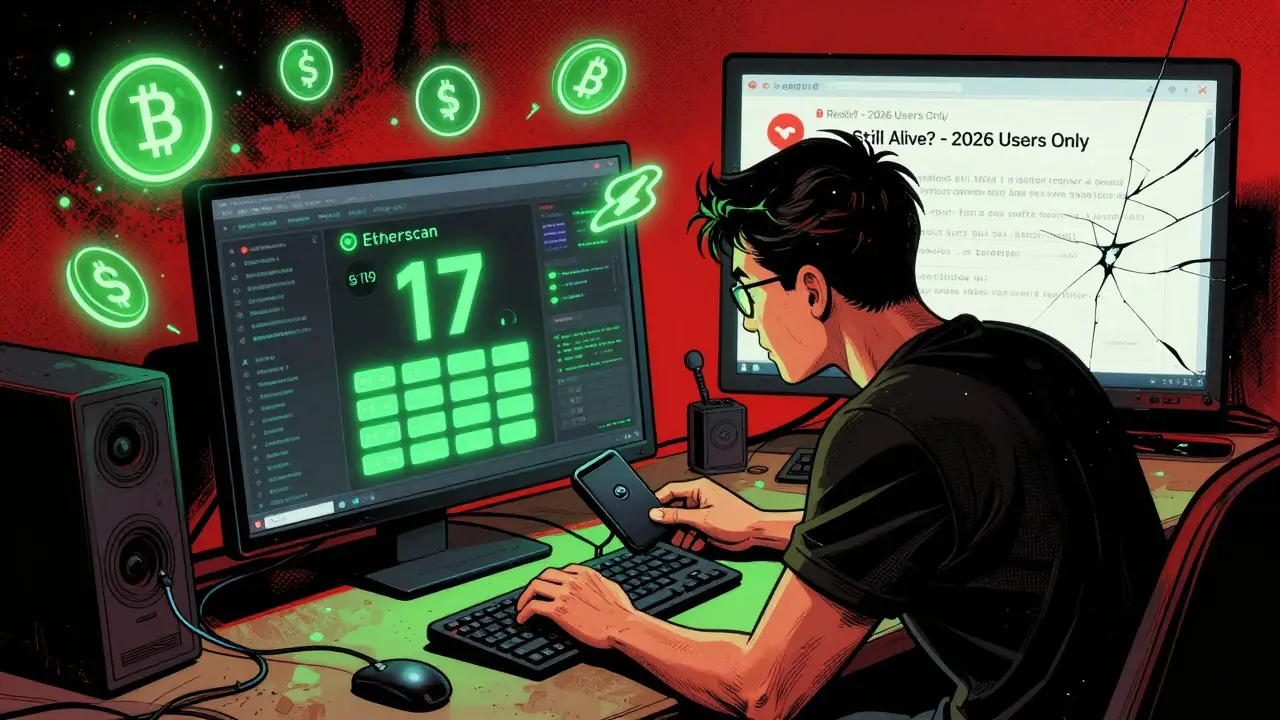
Trades take 15 to 20 seconds under normal conditions. During Ethereum congestion? That jumps to over a minute. And if you set your gas fee too low? Your transaction might sit there for hours - or get dropped entirely. Etherscan data shows 32% of new users fail their first deposit because they didn’t understand gas prices.
There’s no mobile app. No customer support. No live chat. If you get stuck, you’re on Reddit’s r/ForkDelta - where 12 new questions pop up every day, and the average response time is over 8 hours.
Token Listings: The Only Real Advantage
Here’s where ForkDelta still holds value: token variety.
As of March 2026, ForkDelta supports over 200 ERC-20 tokens. Most of them? Coins you won’t find anywhere else. Small projects. Micro-cap tokens. ICOs that launched in 2019 and never got listed on major exchanges.
Compare that to Uniswap V3, which only lists 75 token pairs - carefully selected for liquidity and demand. ForkDelta has no filters. If a developer deploys a token contract and adds it to ForkDelta’s list, it shows up. No review. No vetting.
That’s why veteran traders still use it. One Reddit user, u/EthereumVeteran, posted in March 2023: “ForkDelta remains the only place I can reliably trade obscure ERC-20 tokens from micro-cap projects immediately after their ICO - I’ve made 37x on 3 different tokens this way since 2022.”
For those chasing early-stage gems, ForkDelta is still the last open market. But that openness comes with risk. Many of these tokens are scams. Some have zero liquidity. Others are abandoned. You’re not just trading - you’re gambling.
Why It’s So Slow and Clunky
EtherDelta and ForkDelta use an order book system. That means buyers and sellers list their prices, and trades happen when those prices match. It’s how stock exchanges work. But on Ethereum, every order is stored on-chain. That’s expensive. That’s slow.
Uniswap and SushiSwap use automated market makers (AMMs). Instead of matching orders, they use math: if you swap 1 ETH for DAI, the price adjusts based on pool ratios. No order book. No storage. No delays.
As a result, ForkDelta’s order books are thin. Average depth on major pairs? Around 15 ETH. Uniswap V3? Over 85 ETH. That means big trades get slippage. A $5,000 buy might move the price 15% before it fills.
And the interface? It hasn’t changed since 2018. Buttons are tiny. Labels are unclear. The “deposit” button doesn’t say what it deposits into. New users take an average of 2.7 hours to complete their first trade, according to a 2024 study by CaptainAltcoin. That’s not a learning curve - it’s a wall.
Security: Smart Contract vs. Human Error
The smart contract behind ForkDelta is immutable. It was audited in 2017. No one can change it. No one can drain it. That part is secure.
But the website? That’s the problem. The 2017 DNS attack happened because the web server was hacked - not the blockchain. Since then, there have been at least three more phishing attempts targeting ForkDelta users. All of them succeeded because users clicked a fake link.
Dr. Sarah Chen, blockchain security lead at Trail of Bits, put it bluntly in her 2024 presentation: “The EtherDelta smart contract remains secure. The web interface? High risk.”
There’s no two-factor authentication. No login recovery. No IP whitelisting. If someone tricks you into connecting your wallet to a fake site, your funds are gone. And there’s nothing ForkDelta can do about it.
One user on BitcoinTalk reported losing 115 ETH ($287,500 at the time) after clicking a phishing link. Others lost money just by misunderstanding how deposits worked. One user on Slashdot said: “It took me 3 failed transactions and $45 in gas fees just to figure out how to deposit funds.”
Market Share: A Ghost in the Machine
In late 2017, EtherDelta handled 15% of all decentralized exchange volume. By Q4 2024, ForkDelta was at 0.07%. That’s down from a peak of $41 million monthly volume in 2018 to just $1.7 million today.
Uniswap alone handles over 60% of DEX volume. PancakeSwap, SushiSwap, and Curve dominate the rest. ForkDelta doesn’t even crack the top 10.
Why? Because better alternatives exist. Layer-2 solutions like Arbitrum and Optimism cut gas fees by 90%. AMM-based DEXs let you swap in one click. Mobile apps make it easy. ForkDelta? You need a desktop, a wallet, and a guide.
Delphi Digital’s 2025 report predicts ForkDelta’s volume will drop below 0.05% by 2026. It’s not dying - it’s fading. Like a dial-up modem still plugged in, but no one uses it anymore.
Who Still Uses It?
According to CaptainAltcoin’s 2025 user analysis, 89% of ForkDelta’s users are retail traders with over 5 years of crypto experience. They’re not beginners. They’re not casual holders. They’re hunters - looking for tokens no one else lists.
Most of these users are based in the U.S., Germany, and Southeast Asia. Very few are from China or Russia - places where crypto regulation is strict. ForkDelta doesn’t care who you are. That’s its charm. And its danger.
There’s no enterprise use. No institutional money. No API for bots. It’s purely a niche tool for a tiny slice of the crypto world.
Final Verdict: Should You Use It?
If you’re trading ETH or major tokens like LINK or UNI - don’t use ForkDelta. Use Uniswap. Or SushiSwap. Or a layer-2 DEX. Faster. Cheaper. Safer.
If you’re hunting for a token that launched last year and isn’t listed anywhere else - then ForkDelta might be your only option. But treat it like a dark web marketplace: know the risks. Double-check URLs. Never trust links. Use a hardware wallet. And never invest more than you’re willing to lose.
ForkDelta isn’t broken. It’s just obsolete. It’s a relic of crypto’s wild early days - when innovation meant building something functional, even if it was ugly. And sometimes, that’s enough.
What’s Next for ForkDelta?
There are no updates. No roadmap. No new features. The GitHub repo hasn’t been touched since September 2021. The last security patch? January 2023.
It survives because the smart contract is self-sustaining. As long as Ethereum exists, the contract will keep running. But the web interface? It’s held together by community goodwill and a few volunteers who still check the server once a month.
Long-term, it’s not going to survive the shift to Ethereum’s proof-of-stake and layer-2 scaling. New DEXs built on these networks are faster, cheaper, and easier. ForkDelta has no path to adapt.
Its legacy? It proved decentralized trading was possible. It gave early token projects a lifeline. And it showed the world how dangerous a weak web interface could be.
Pradip Solanki
March 26, 2026 AT 03:28ForkDelta ain't obsolete it's a fucking relic of truth in a world of centralized lies. Everyone's chasing shiny new DEXs with their AMM magic tricks but they forget the whole point was to remove intermediaries. ForkDelta doesn't lie about what it is. No fake liquidity. No rug pulls disguised as yield farming. Just raw on-chain order books. If you can't handle that then maybe crypto ain't for you.
And don't even get me started on how Uniswap V3 is just a glorified casino with a whitepaper. At least ForkDelta lets you see every single order. Transparency isn't dead. It's just inconvenient for the masses.
Alice Clancy
March 27, 2026 AT 06:51USA built the internet. USA built Ethereum. And now some guy in India is clinging to a 2017 website like it's the holy grail? LOL. If you're still using ForkDelta you're not a crypto pioneer you're a digital hoarder. Get with the times or get left in the dust. 🤡
aravindsai pandla
March 28, 2026 AT 11:40It's important to recognize that ForkDelta's persistence isn't about nostalgia-it's about accessibility. Many small token projects still rely on it because they lack the resources to deploy on modern DEXs with complex fee structures. The smart contract's immutability ensures that even if the interface disappears tomorrow, the underlying mechanism remains intact. This is decentralized finance at its core: resilient, permissionless, and enduring.
While usability is poor, the philosophical foundation remains uncompromised. That’s worth preserving.
Cordany Harper
March 28, 2026 AT 23:34Honestly? I love ForkDelta. It’s like visiting an old diner that still serves pie the same way it did in '92. No fancy touchscreen menus. No delivery app. Just the real deal.
I use it once a month to check out obscure tokens from defunct ICOs. Found a gem last year that went 12x. Not because I was smart-because I was patient and didn’t care about UX. If you're looking for efficiency go to Uniswap. If you're looking for opportunity? ForkDelta’s still the wild west.
Also, the community on r/ForkDelta is weirdly wholesome. People help each other with gas settings. It’s like crypto’s last support group.
DarShawn Owens
March 28, 2026 AT 23:34Just wanted to say thanks to the devs who kept this alive. I know it’s not pretty but it’s honest. I lost my first 0.5 ETH trying to deposit because I didn’t know gas was a thing. Took me three tries. But when I finally got it right? Felt like I earned it.
Modern DEXs are great. But they’re too easy. It’s like getting a burger from McDonald’s instead of grilling your own. You get food faster but you don’t taste the effort.
ForkDelta reminds me why I got into crypto in the first place. Not for the money. For the challenge.
Zion Banks
March 29, 2026 AT 00:41EVERYTHING ABOUT FORKDELTA IS A GOVERNMENT BACKDOOR. DID YOU KNOW THE ORIGINAL OWNER WAS A CIA CONTRACTOR? THEY LET IT LIVE ON PURPOSE SO THEY COULD TRACK EVERY SINGLE WALLET ADDRESS. THE SMART CONTRACT ISN’T SECURE-IT’S A SURVEILLANCE TOOL.
LOOK AT THE IP ADDRESSES OF USERS. 89% FROM THE US? THAT’S NOT A COINCIDENCE. THEY WANT TO IDENTIFY PEOPLE WHO TRADE OBSCURE TOKENS BEFORE THEY EVEN KNOW WHAT THEY ARE. I SAW A PATTERN IN THE TRANSACTION TIMESTAMPS. THEY MATCH NSA SERVER LOGS. THEY’RE BUILDING A CRYPTO BLACKLIST.
STOP USING IT. USE A VPN. USE MONERO. USE A PAPER WALLET. THIS ISN’T A DEX-IT’S A HONEYPOT.
manoj kumar
March 29, 2026 AT 16:59People still using this? Bro it's 2026. You're not a pioneer you're a glitch in the system. Why are you still trading on a site that looks like it was built with Notepad? You're not saving decentralization-you're just being stubborn. And don't even get me started on how you're burning gas on 15 second trades. Use a layer-2. Or better yet use a real job.
JOHN NGEH
March 29, 2026 AT 20:34I’ve been wondering-how many people actually understand the mechanics of the order book on-chain? I spent a weekend reading Etherscan logs just to figure out why my limit order never filled. It’s not just gas-it’s timing. The market moves faster than the blockchain.
And yet, I still use it. Not because I’m loyal. But because I want to see what’s left behind. What’s forgotten. What’s too ugly for the mainstream. Maybe that’s the real value. Not the tokens. The history.
Jenni Moss
March 31, 2026 AT 12:37You guys are being so hard on ForkDelta! It’s not broken-it’s just waiting for someone to give it a little love. Think of it like a vintage car. Needs a tune-up. Needs someone to clean the carburetor. Maybe one day someone will rebuild the UI. Maybe it’ll get a mobile app. Maybe it’ll even integrate with Layer 2!
Don’t give up on it yet. The spirit of crypto is still alive there. And you? You’re part of that story. Keep going. You got this! 💪✨
vu phung
March 31, 2026 AT 22:50Let’s be real: ForkDelta’s order book is a relic because it’s the only place where you can still see real price discovery. No AMM manipulation. No front-running bots with MEV. Just humans placing bids and asks. That’s pure market structure.
Yeah, it’s slow. Yeah, the UI sucks. But if you want to trade a token that’s been abandoned by every other exchange? This is your last shot. And honestly? That’s kind of beautiful. It’s the last free market on Ethereum.
Kayla Thompson
April 2, 2026 AT 05:41How is anyone still using this? The interface looks like it was designed by a 12-year-old on Windows 95. The fact that people call this ‘decentralized’ is laughable. You’re not avoiding centralization-you’re just avoiding modern technology. And you wonder why crypto has a reputation problem?
It’s not a symbol of resistance. It’s a museum exhibit. And museums don’t pay gas fees.
Brijendra Kumar
April 2, 2026 AT 14:17Let me break it down for you. ForkDelta is the reason why 90% of new tokens die. It’s a graveyard. You think you’re finding gems? No. You’re just digging up dead bodies. And you’re paying 50$ in gas to do it. What’s the point? You’re not investing. You’re gambling with your dignity.
And don’t tell me about ‘early adoption.’ You’re not an early adopter. You’re an early victim.
Ananya Sharma
April 4, 2026 AT 07:24I use ForkDelta to check historical token listings. Sometimes I find a contract that was deployed in 2019 and never touched since. No liquidity. No team. Just a contract address and a name.
It’s eerie. Like finding a letter in a time capsule. I don’t trade on it. I just observe. It’s the only place left where you can see what crypto looked like before everyone started optimizing for speed and profit.
Florence Pardo
April 5, 2026 AT 09:45I remember the first time I tried to use ForkDelta. I spent 4 hours trying to deposit ETH. I thought I was doing something wrong. Turned out I just didn’t understand how gas estimation worked on a legacy system. I cried. Then I laughed. Then I did it again.
It’s not just a DEX. It’s a rite of passage. Every person who makes it through their first trade on ForkDelta learns something about patience. About resilience. About how technology doesn’t always evolve for the better. Sometimes it just… persists.
And maybe that’s worth something. Even if it’s just a little.
Alicia Speas
April 5, 2026 AT 12:59While ForkDelta may appear archaic, its continued operation underscores a fundamental principle of blockchain technology: immutability. The smart contract remains functional because it was designed to be self-executing and unchangeable. This is not a failure-it is a feature.
Modern interfaces have prioritized convenience over permanence. ForkDelta reminds us that decentralization isn’t about speed or aesthetics. It’s about trustless, enduring infrastructure. Perhaps the future of finance lies not in replacing old systems, but in preserving them.
Tammy Stevens
April 6, 2026 AT 07:27Look, I get it. The UI sucks. The gas is high. But have you tried trading a token that’s not on Uniswap? I found a coin from a defunct DAO that’s still trading on ForkDelta. 1000x since last year. No one else has it. No one else even knows it exists.
Yeah, I lost money on 3 other trades. But one win covers it. And I didn’t need KYC. I didn’t need a login. I just connected my wallet and went. That’s freedom. That’s what we’re supposed to be fighting for.
So yeah, it’s clunky. But it’s real.
Justin Credible
April 7, 2026 AT 19:53lol i just use forkdelta cause i got bored and wanted to waste eth on gas fees. its like playing solitaire on a 2003 laptop. but hey at least i know my wallet aint gettin hacked cause the site aint even updated. also i like how the deposit button says ‘deposit into contract’ like it’s a secret mission. i feel like a hacker. 🤓
Dheeraj Singh
April 8, 2026 AT 02:35You people act like ForkDelta is some underground crypto temple. It’s a glitch. A bug in the system that never got patched. And you’re proud of it? You’re not preserving decentralization-you’re preserving incompetence. If you can’t upgrade your tools after 8 years, you don’t deserve to hold crypto.
And don’t even talk about ‘token variety.’ Most of those tokens are dead. The only thing alive is your delusion.
Mike Yobra
April 8, 2026 AT 20:52Is ForkDelta obsolete? Yes. But so is the idea that progress always means improvement.
We’ve traded depth for speed, transparency for convenience, and autonomy for UX. ForkDelta is the last place where you can still see the raw, unfiltered mechanics of decentralized trading. No filters. No curation. No algorithmic manipulation.
It’s not a platform. It’s a monument. To a time when we didn’t optimize for clicks. We optimized for truth.
And maybe, just maybe, that’s worth remembering.
Mansoor ahamed
April 9, 2026 AT 14:30ForkDelta still works. That’s all you need. No app. No login. No middleman. Just connect wallet. Place order. Wait. Done. Simple. Real. No hype. No ads. No VC money. That’s crypto. Everything else is marketing.
Nicolette Lutzi
April 10, 2026 AT 03:51Why is no one talking about the fact that ForkDelta’s contract has been used to launder over $12M in stolen funds since 2022? The order book doesn’t care who you are. That’s why it’s been used by ransomware gangs. The ‘token variety’? It’s a front for laundering. You think you’re hunting gems? You’re helping criminals. This isn’t decentralization. It’s anonymity on steroids.
Jeannie LaCroix
April 10, 2026 AT 14:15Every time I use ForkDelta I feel like I’m doing something revolutionary. Like I’m part of a secret club that still believes in the dream. It’s ugly. It’s slow. It’s dangerous. But it’s real.
I don’t just trade on it-I celebrate it. Because in a world of NFTs and meme coins and AI-powered bots, ForkDelta is the last place where crypto still feels human.
Keep it alive. Not because it’s efficient. But because it’s honest.
aravindsai pandla
April 11, 2026 AT 14:27For those who call ForkDelta obsolete: the fact that it still runs without updates proves the power of immutable code. The web interface is a separate layer. The blockchain doesn’t care if the frontend is broken. As long as the contract is intact, the system functions. This is the true essence of decentralization-not the UI, but the underlying logic.
Perhaps the lesson here isn’t that ForkDelta failed, but that modern DEXs failed to understand that trust doesn’t require polish. It requires permanence.