
When you trade crypto on a decentralized exchange, you want speed, low fees, and real returns-not just hype. PancakeSwap V3 on Base isn't another rebranded DEX. It’s a serious upgrade that changes how you provide liquidity and execute trades. If you’ve used PancakeSwap before, you might think you know it. But V3 on Base? That’s a different beast.
What Makes PancakeSwap V3 on Base Different?
PancakeSwap V3 on Base launched in 2023 as part of the Base blockchain, built by Coinbase. This isn’t just a copy of the original BSC version. It’s optimized for lower fees and faster transactions. Unlike older DEXs that spread your liquidity across every possible price, V3 lets you lock your funds into specific price ranges. This is called concentrated liquidity. It means you can earn more trading fees with less capital. A liquidity provider on V3 might earn 5x more than on V2 using the same amount of funds.Base blockchain itself is fast and cheap. Transactions cost pennies, not dollars. That’s why traders are shifting here from Ethereum. PancakeSwap V3 on Base currently supports 59 tokens and 113 trading pairs. The biggest pair? WETH/USDC. In a single day, it moved over $112 million in volume. Total 24-hour volume on the platform hits $235 million. That’s 93rd percentile among all DEXs-meaning only 7% of decentralized exchanges trade more.
Fees That Actually Matter
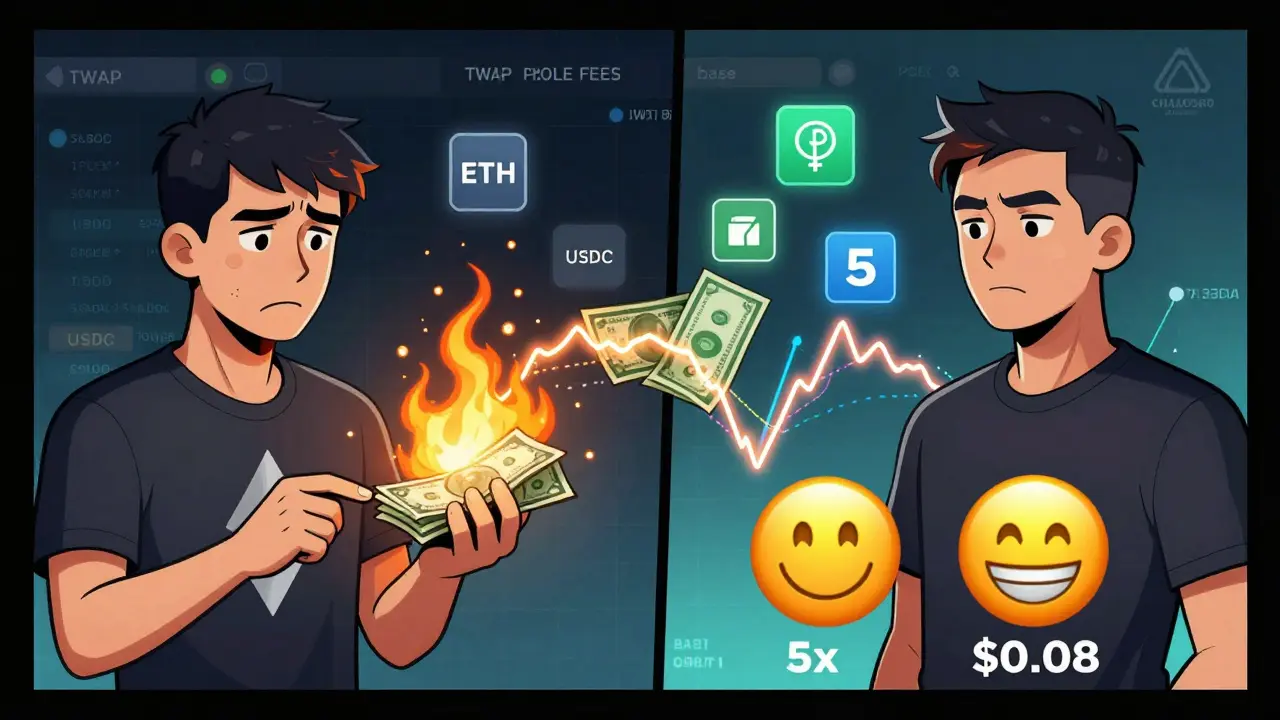
Most centralized exchanges charge 0.1% to 0.5% per trade. PancakeSwap V3 on Base? 0.00% for both maker and taker fees. No hidden costs. No surprise deductions. You pay only the network gas fee-usually under $0.10 on Base.But here’s the twist: the platform uses a tiered fee structure. For stablecoin pairs like USDC/USDT, the fee is 0.01%. For volatile pairs like BTC/ETH, it’s 0.3%. This isn’t a penalty-it’s smart design. Stablecoins move slowly, so lower fees keep traders coming. Riskier assets? Higher fees compensate LPs for the volatility risk. It’s not random. It’s calibrated.
Advanced Orders That Actually Work
Forget simple swaps. V3 on Base has real trading tools:- Limit Orders: Set a price, walk away. Your trade executes automatically when hit. Works for 90% of tokens-except those with transfer taxes (like some meme coins).
- Time-Weighted Average Price (TWAP): Need to swap $50,000 in ETH without crashing the price? TWAP splits it into 100 smaller trades over 30 minutes. Reduces slippage by 70% compared to one big order.
- Smart Order Routing: The system scans every liquidity pool on Base, BSC, and Ethereum. It finds the best rate and executes it in one click.
These aren’t gimmicks. They’re features that institutional traders use. And now, anyone with a wallet can access them.
How Liquidity Providers Win
If you’re just swapping tokens, you’re missing half the story. The real money is in providing liquidity. On V2, you’d deposit equal amounts of two tokens and earn fees across the whole price range. But if the price moved outside your range? You earned nothing.V3 changes everything. You pick a price range-say, $3,000 to $3,500 for ETH. If ETH stays within that range, you earn fees from every trade. If it moves out? Your funds get converted to the other token. You’re not passive. You’re strategic.
Real-world example: A user deposited $10,000 in ETH/USDC on V2. After 30 days, they earned $180 in fees. The same user moved to V3 on Base, set a tighter range around the current price, and earned $920 in the same period. That’s a 411% increase. And they used 80% less capital.
What Users Say (And What They Hate)
The website gets over 1.2 million visits a month. 99% of that traffic is organic. People aren’t being pushed here by ads. They’re finding it because it works.Reddit threads are full of praise:
- “Switched from Uniswap to PancakeSwap V3 on Base. Gas fees dropped from $15 to $0.20. Game changer.”
- “My LP position on V3 is earning 6x more than my old V2 one. I didn’t even have to add more funds.”
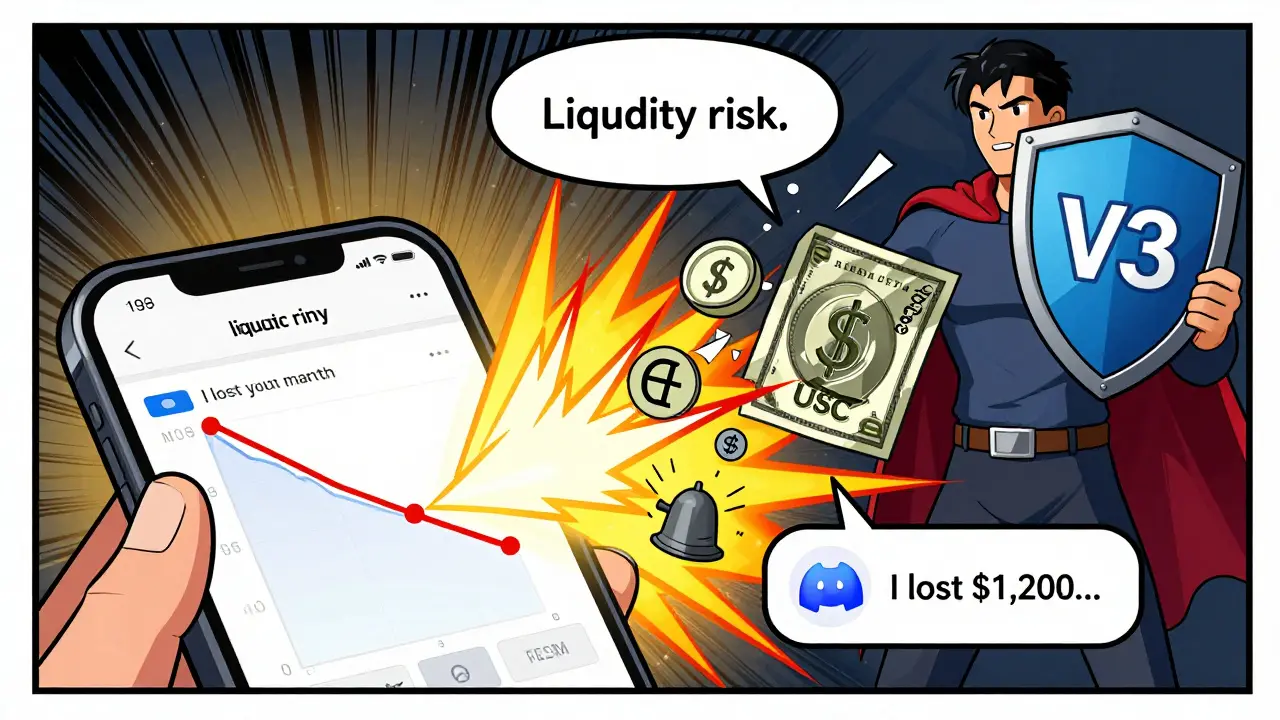
But there’s friction. New users struggle with the interface. Concentrated liquidity sounds simple, but setting the right price range? That takes practice. One user on Discord said: “I set my range too wide. Ended up with 80% of my funds in ETH when the price crashed. Lost $1,200 in opportunity.”
Advanced features like TWAP and limit orders are powerful, but they’re not intuitive. The platform has tutorials, but most users rely on YouTube guides or community Discord channels to learn. The official support team is slow. Community help? Fast.
How It Compares to the Competition
| Feature | PancakeSwap V3 (Base) | Uniswap V3 (Ethereum) | SushiSwap (Polygon) |
|---|---|---|---|
| Trading Fees (Maker/Taker) | 0.00% | 0.00% (but gas up to $5) | 0.05% / 0.05% |
| Network | Base (Coinbase) | Ethereum | Polygon |
| Avg. Transaction Cost | $0.08 | $3.20 | $0.15 |
| 24h Volume | $235M | $1.2B | $48M |
| Concentrated Liquidity | Yes | Yes | No |
| Limit Orders | Yes | Yes | No |
| Supported Tokens | 59 | 1,200+ | 300 |
Uniswap V3 has more volume and more tokens. But if you’re trading on Ethereum, you’re paying $3+ in gas every time. That eats into profits. PancakeSwap V3 on Base gives you 90% of the features with 1/40th the cost. SushiSwap? It’s a decent alternative, but it lacks advanced order types and has lower liquidity.
Who Is This For?
This isn’t for everyone. If you’re just buying Bitcoin and holding it? Use a centralized exchange. Simple.PancakeSwap V3 on Base is for:
- Traders who do more than 3 swaps a week
- Liquidity providers who want higher yields with less capital
- Users tired of $5 gas fees on Ethereum
- Those who use limit orders, TWAP, or want to avoid slippage
If you’re new to DeFi? Start small. Try swapping USDC for DAI. Get comfortable. Then try a limit order. Then, if you’re ready, provide liquidity with a narrow range. Don’t jump in with $10,000.
The Risks You Can’t Ignore
No regulation. No insurance. No customer support if you mess up your wallet. This is crypto. You’re the bank.Smart contracts are secure, but bugs happen. A vulnerability in 2023 caused $2 million in losses on another DEX. PancakeSwap’s code has been audited multiple times, but audits don’t guarantee safety.
Also, Base is new. It’s backed by Coinbase, but it’s still growing. If network congestion spikes, transactions could slow. That’s rare so far, but it’s possible.
And remember: if you set a liquidity range too wide, you’ll earn less. Too narrow? You get converted to the wrong token during a crash. You need to monitor it. This isn’t passive.
Final Verdict
PancakeSwap V3 on Base is the most efficient decentralized exchange for active traders and liquidity providers on a low-cost chain. It’s not the biggest, but it’s the smartest. You get institutional-grade tools-limit orders, TWAP, concentrated liquidity-with gas fees that are practically free.It’s not perfect. The interface is complex. You need to learn. You need to monitor. But if you’re serious about DeFi, this is where the action is. The volume isn’t just hype-it’s real. The yields aren’t theoretical-they’re happening right now.
Stop paying $3 in gas to trade on Ethereum. Stop earning pennies as a liquidity provider. Base is here. PancakeSwap V3 is built for it. And if you’re not using it, you’re leaving money on the table.
Is PancakeSwap V3 on Base safe to use?
PancakeSwap V3 on Base is built on audited smart contracts and runs on the Base blockchain, which is backed by Coinbase. The platform has no known major exploits since its launch. However, it’s still a decentralized exchange-there’s no insurance or customer support. If you send funds to the wrong address or misconfigure your liquidity range, you lose them. Always start with small amounts. Use trusted wallets like MetaMask or Trust Wallet. Never share your seed phrase.
How do I start using PancakeSwap V3 on Base?
First, install a wallet like MetaMask. Switch the network to Base. Then go to pancakeswap.finance and connect your wallet. You’ll see the trading interface. To swap tokens, pick a pair (like WETH/USDC), enter the amount, and click swap. To provide liquidity, click "Pool," select a pair, then choose a price range. The platform will show you the expected fees. Start with a wide range to learn, then tighten it as you get comfortable.
Why is trading volume lower than Uniswap?
Uniswap V3 on Ethereum has more total volume because Ethereum has more users and more tokens. But volume on Base is growing fast. PancakeSwap V3 on Base focuses on efficiency, not just size. It’s cheaper, faster, and better for active traders. Many users who used to trade on Uniswap are now switching to Base because of the low fees. Volume will keep rising as Base attracts more developers and users.
Can I lose money with concentrated liquidity?
Yes. If you set your liquidity range too narrow and the price moves outside it, your funds convert to the other token. For example, if you provide ETH/USDC liquidity between $3,000 and $3,200, and ETH crashes to $2,800, your entire ETH position converts to USDC. You lose exposure to ETH until the price comes back. That’s the trade-off: higher fees for less price protection. Always monitor your positions or use tools that alert you when price moves near your range.
Does PancakeSwap V3 on Base support all tokens?
No. It supports 59 tokens as of March 2026. Most are major coins like ETH, USDC, WBTC, and popular Base-native tokens. It doesn’t support tokens with transfer taxes (like some meme coins) because they break limit orders and TWAP functionality. Always check if a token is listed before trading. You can’t add custom tokens without a contract audit.
Is PancakeSwap V3 on Base better than the BSC version?
For most users, yes. The BSC version has higher gas fees (around $0.50-$1.50 per trade) and slower transaction finality. Base is faster, cheaper, and growing fast. The V3 features are identical, but Base’s infrastructure gives it a real edge. If you’re trading daily, Base is the smarter choice. BSC still has more liquidity overall, but the gap is closing fast.



Aman Kulshreshtha
March 22, 2026 AT 08:05Leona Fowler
March 24, 2026 AT 01:37Tammy Stevens
March 24, 2026 AT 08:51Brad Zenner
March 26, 2026 AT 05:08Anna Lee
March 26, 2026 AT 17:32Dominic Taylor
March 27, 2026 AT 10:30Justin Credible
March 28, 2026 AT 03:38Abhishek Thakur
March 29, 2026 AT 00:40Alice Clancy
March 30, 2026 AT 06:48Shelley Dunbrook
March 30, 2026 AT 15:28Tony Phillips
April 1, 2026 AT 04:11Sam Harajly
April 1, 2026 AT 23:45Shana Brown
April 3, 2026 AT 01:27Alicia Speas
April 3, 2026 AT 21:02John Alde
April 5, 2026 AT 03:13Marie Mapilar
April 5, 2026 AT 09:53JOHN NGEH
April 7, 2026 AT 07:41DarShawn Owens
April 9, 2026 AT 00:10Andy Green
April 10, 2026 AT 07:50Zion Banks
April 12, 2026 AT 04:07Abhishek Thakur
April 12, 2026 AT 09:22