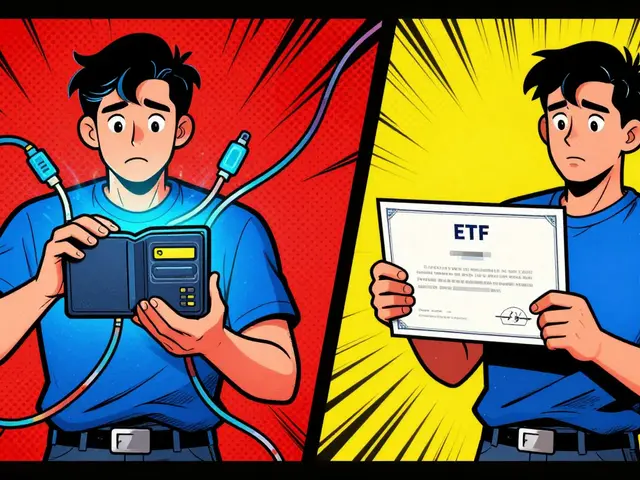
You’ve probably seen headlines flashing about the "ETH Trust Fund" or "Ethereum ETF" and wondered if you need to download a new wallet or buy a specific coin. Here is the first thing you need to know: Ethereum ETF is not a cryptocurrency. It is not a digital token you can send to a friend for coffee. It is a traditional financial product that lets you invest in Ethereum’s price without ever touching the blockchain yourself.
This distinction matters because it changes how you buy, hold, and think about your money. If you are looking for a way to participate in the crypto market using the same brokerage account where you keep your stocks, this guide breaks down exactly what these funds are, how they work, and why they matter right now in 2026.
The Core Misconception: ETF vs. Crypto Coin
Let’s clear up the confusion immediately. When people ask about the "ETH Trust Fund," they are often mixing up two very different things. On one side, you have Ethereum (ETH), which is the native cryptocurrency of the Ethereum network, used for transactions and powering decentralized applications. You own this directly in a digital wallet. On the other side, you have the Ethereum Exchange-Traded Fund (ETF), which is a regulated financial security traded on stock exchanges that tracks the price of Ethereum.
An ETF is a basket of assets managed by a professional fund company. In this case, the asset is Ethereum. When you buy shares of an Ethereum ETF, you do not get private keys. You do not get access to the Ethereum blockchain to vote on proposals or run smart contracts. Instead, you get a share of a corporation that holds Ethereum on its balance sheet. Your value goes up if Ethereum’s price goes up, and down if it drops. It is pure price exposure, stripped of the technical hassle.
How Spot Ethereum ETFs Actually Work
To understand why these funds are popular, you have to look at the mechanics. Before July 2024, most crypto-related ETFs were "futures-based." This means they bet on where the price of Ethereum would be in three months, not what it was today. That created a disconnect between the ETF price and the actual coin price, often leading to tracking errors and higher fees.
The game changed with the approval of Spot Ethereum ETFs, which directly hold physical Ethereum tokens rather than betting on future prices through derivatives. These funds buy real ETH and store it securely. The fund manager creates shares based on the amount of ETH held. If demand for the ETF shares rises, the fund buys more ETH. If demand falls, they sell some ETH. This mechanism keeps the ETF’s price tightly aligned with the actual market price of Ethereum.
Think of it like this: A futures ETF is like buying a ticket to a concert that hasn’t happened yet, hoping the band will still be good. A spot ETF is like buying a piece of the concert hall itself while the show is playing. You own the underlying asset, just indirectly.
| Feature | Direct Ethereum (Crypto Wallet) | Ethereum ETF (Stock Brokerage) |
|---|---|---|
| Custody | You hold private keys (self-custody) or use an exchange | Fund provider holds the assets (institutional custody) |
| Staking Rewards | Yes, you can earn yield by staking ETH | No, currently restricted by U.S. regulations |
| Utility | Use in DeFi, NFTs, and dApps | Pure price appreciation only; no utility |
| Tax Reporting | Complex; requires manual tracking of every transaction | Simplified; standard Form 1099 from broker |
| Security Risk | Hacks, lost passwords, phishing scams | Market risk only; protected by regulatory oversight |

Why the SEC Approval Changed Everything
The landscape shifted dramatically on July 23, 2024, when the U.S. Securities and Exchange Commission (SEC) approved multiple spot Ethereum ETFs. This was a massive milestone. For years, regulators had been skeptical, fearing fraud and manipulation in the crypto markets. By approving these funds, the SEC signaled that Ethereum was mature enough for mainstream institutional investment.
The impact was immediate. Just as Bitcoin ETFs saw billions in inflows after their launch, Ethereum ETFs attracted over $1 billion in their first week. This wasn’t just retail investors jumping in; pension funds, endowments, and wealth managers who previously couldn’t touch crypto due to compliance rules suddenly had a compliant vehicle. This influx of capital has helped stabilize Ethereum’s liquidity and reduced extreme volatility.
Major players like BlackRock, a global investment management corporation offering the iShares Ethereum Trust ETF, entered the space with products like the iShares Ethereum Trust ETF (ticker: ETHA). Their involvement adds a layer of trust and operational rigor that smaller crypto exchanges often lack.
The Trade-Off: What You Lose by Using an ETF
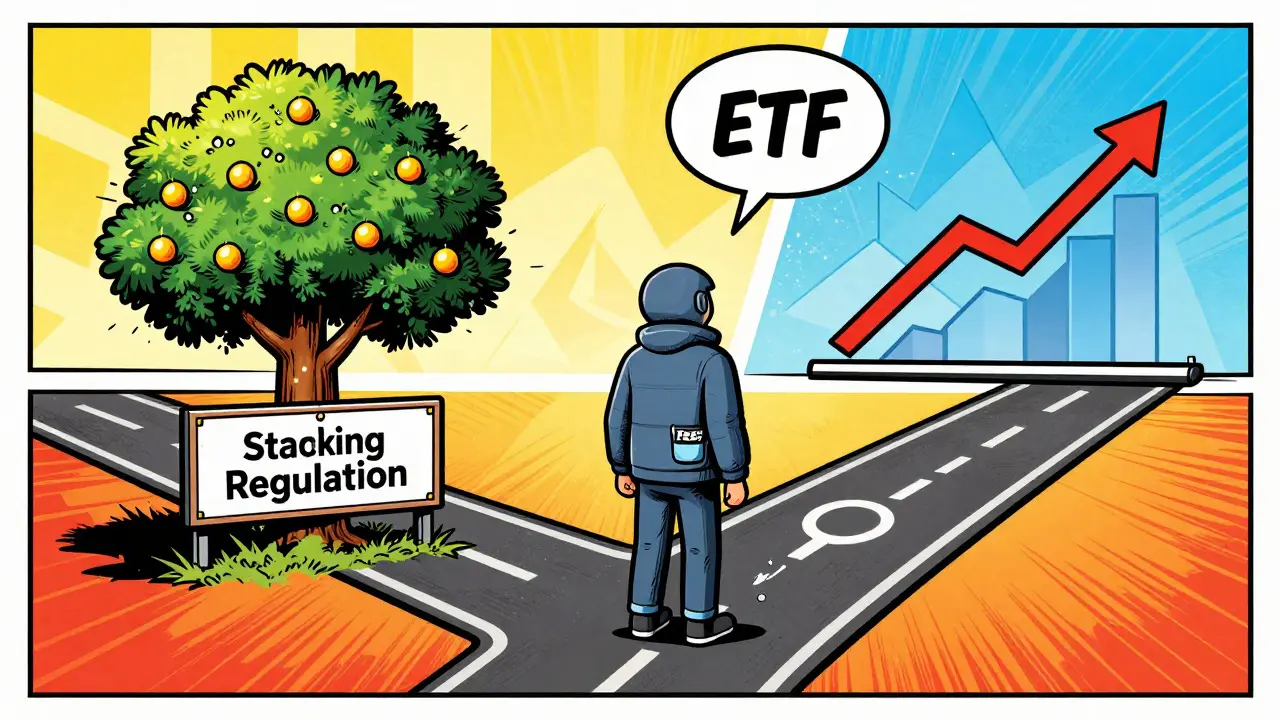
If ETFs are so convenient, why would anyone buy direct Ethereum? The answer lies in functionality. When you buy an ETF, you are buying a simplified version of Ethereum. You get the price movement, but you lose the "spirit" of the technology.
The biggest missing feature is staking. Ethereum uses a proof-of-stake consensus mechanism, meaning holders can lock up their ETH to help secure the network and earn rewards, typically around 3-5% annually. However, current U.S. regulations make it difficult for ETF providers to offer these staking rewards to shareholders due to complex tax and legal issues. So, while your ETF shares might go up in value if ETH rises, you aren’t earning that extra passive income stream that direct holders enjoy.
You also lose utility. With direct ETH, you can swap tokens on Uniswap, lend money on Aave, or mint an NFT. With an ETF, you can only buy and sell shares during market hours. You cannot interact with the decentralized finance (DeFi) ecosystem. If your goal is purely financial speculation-betting that the price will go up-the ETF is efficient. If your goal is to use the technology, the ETF is useless.
Who Should Invest in an Ethereum ETF?
Your choice depends entirely on your investor profile. Let’s break down who benefits most from this structure.
- The Traditional Investor: If you already have accounts with Fidelity, Vanguard, or Charles Schwab, an ETF allows you to add crypto exposure without learning how to seed phrases or hardware wallets. It fits neatly into your existing portfolio rebalancing strategy.
- Institutional Funds: Pension funds and university endowments often have strict mandates prohibiting direct crypto holdings. An ETF provides a regulated, audited alternative that satisfies compliance officers.
- Risk-Averse Participants: If the idea of losing your entire portfolio because you clicked a phishing link keeps you up at night, an ETF removes the self-custody risk. The fund handles security; you handle market timing.
Conversely, long-term believers in decentralization, developers, and those wanting to maximize returns through staking should stick to direct ownership. The ETF fee (expense ratio), usually between 0.25% and 0.50%, eats into profits slightly compared to holding zero-fee coins in a wallet, though it saves you gas fees for transfers.
Navigating the Risks
Even with regulatory approval, risks remain. First, there is market risk. Ethereum is still a volatile asset. Its price can swing 10-20% in a week based on macroeconomic news, regulatory updates, or tech upgrades. An ETF does not protect you from price drops; it just makes it easier to sell when panic sets in.
Second, consider the structural risk. Since these ETFs are cash-settled (not in-kind), the creation and redemption process relies on the issuer managing liquidity efficiently. While rare, operational failures or cybersecurity breaches at the custodian level could theoretically impact the fund. However, these funds are required to disclose holdings daily and undergo regular audits, providing transparency that opaque crypto exchanges rarely match.
Finally, watch out for expense ratios. While lower than many mutual funds, they are not free. Over a decade of holding, a 0.50% annual fee compounds. Compare this against the potential staking yield you’re missing out on to see if the convenience is worth the cost for your specific timeline.
Is the ETH Trust Fund the same as buying Ethereum?
No. Buying Ethereum means you hold the actual digital currency in a wallet, giving you full control and utility. The ETH Trust Fund (ETF) is a stock-like security that tracks Ethereum's price. You own shares in a fund that holds Ethereum, but you do not own the coins themselves.
Can I stake my Ethereum if I buy an ETF?
Currently, no. Due to U.S. regulatory complexities, most spot Ethereum ETFs do not pass staking rewards to investors. You benefit from price appreciation only, missing out on the ~3-5% annual yield available to direct ETH holders.
Where can I buy an Ethereum ETF?
You can buy Ethereum ETFs through any traditional brokerage account that supports stock trading, such as Fidelity, Robinhood, E*TRADE, or Charles Schwab. You simply search for the ticker symbol (e.g., ETHA) just like you would for Apple or Tesla stock.
Are Ethereum ETFs safer than crypto exchanges?
In terms of personal security, yes. ETFs eliminate the risk of losing funds due to forgotten passwords, phishing scams, or exchange hacks. However, they introduce counterparty risk (relying on the fund manager) and do not protect against market volatility.
What happens to the Ethereum held by the ETF?
The fund manager purchases actual Ethereum tokens and stores them in cold storage with institutional-grade custodians. These tokens are held on behalf of all shareholders. The number of ETF shares outstanding adjusts based on demand, but the underlying ETH remains secured by the fund.