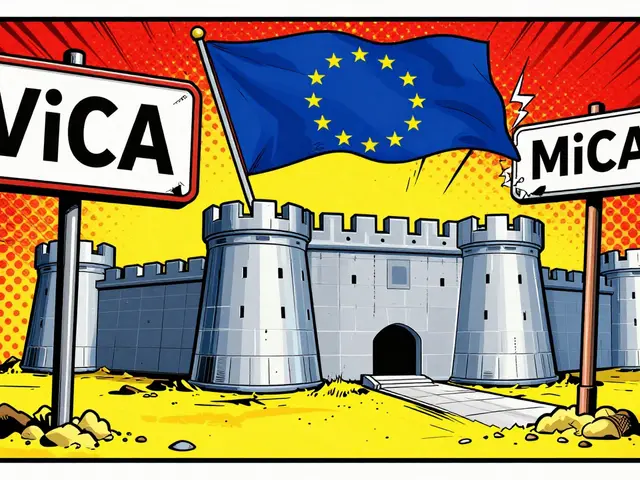
For years, Malta was known as the "Blockchain Island," a place where crypto startups flocked for its early and friendly regulatory stance. But if you are looking at Malta Financial Services Authority crypto rules today, the landscape has shifted dramatically. The old days of loose oversight are gone. Since November 2024, Malta has fully implemented the European Union's Markets in Crypto-Assets Regulation (MiCA) through its own national law, the Markets in Crypto-Assets Act.
This isn't just a minor update; it is a complete overhaul of how digital assets are supervised. If you are a business trying to operate in Malta or a user wondering about the safety of your funds, understanding these new restrictions and requirements is critical. The MFSA is no longer just watching from the sidelines; they are actively licensing, supervising, and enforcing strict compliance standards across the board.
The Shift from VFA to MiCA
To understand where we are now, you have to look at where we came from. Until late 2024, Malta operated under the Virtual Financial Assets (VFA) Act, passed back in 2018. It was pioneering for its time, but it was also an island solution in a sea of changing global regulations. With the arrival of MiCA, that local framework was replaced by Act No. XXXVI of 2024. This new act aligns Malta directly with EU-wide standards, ensuring that a license in Malta carries weight across the entire European Economic Area.
The transition means that the old VFA licenses are effectively obsolete for new entrants. Existing entities had to adapt their operations to meet the new MiCA Rulebook, published in March 2025. This rulebook adds layers of technical specificity to the primary legislation, covering everything from how whitepapers are notified to the ongoing operational requirements for licensed firms. For anyone entering the market now, the starting point is not the VFA Act, but this comprehensive MiCA framework.
Who Needs a License? Understanding Entity Types
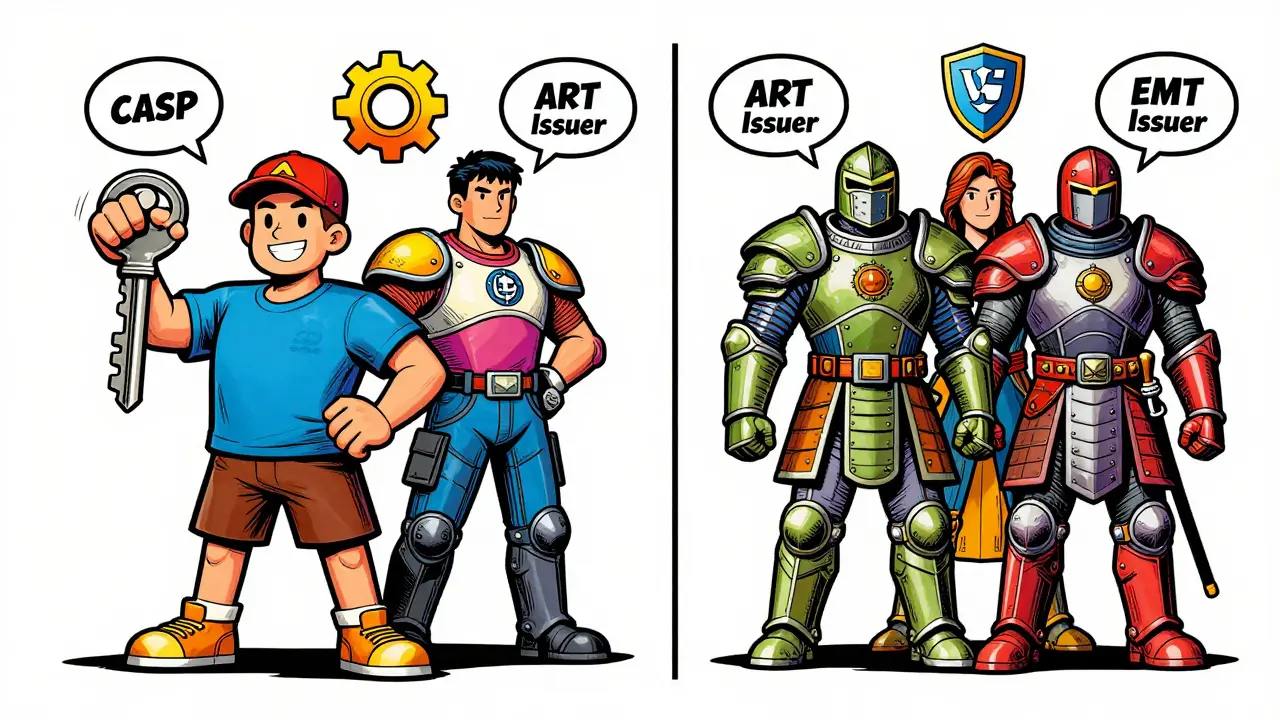
The MFSA doesn't treat all crypto businesses the same. They categorize entities based on what they actually do and what they issue. Getting the wrong license can lead to immediate shutdowns or heavy fines. Here is who falls under which bucket:
- Crypto-Asset Service Providers (CASPs): These are the custodians, exchanges, and wallet providers. If you help users buy, sell, store, or trade crypto-assets, you need a CASP license. This is the most common category for traditional crypto businesses.
- Issuers of Asset-Referenced Tokens (ARTs): These are tokens pegged to multiple fiat currencies or other assets. Because they resemble stablecoins with broader backing, they face stricter scrutiny due to their potential systemic importance.
- Issuers of Electronic Money Tokens (EMTs): These are tokens pegged 1:1 to a single fiat currency (like the Euro). Issuing EMTs requires not just MFSA approval but also compliance with the Financial Institutions Act, adding another layer of banking-style regulation.
- Other Crypto-Assets: Utility tokens or non-fungible tokens (NFTs) that don't fit into ART or EMT categories still require notification and adherence to specific conduct rules, though the authorization process differs.
Knowing your classification is step one. Misclassifying an EMT as a simple utility token, for example, is a fast track to regulatory trouble. The MFSA expects precise alignment between your business model and your legal status.
| Entity Type | Primary Regulator | Key Requirement | Complexity Level |
|---|---|---|---|
| CASP | MFSA | Authorization & Ongoing Supervision | High |
| ART Issuer | MFSA + ECB | Strict Reserves & Governance | Very High |
| EMT Issuer | MFSA + Central Bank | Banking Standards & 1:1 Peg | High |
| Utility Token | MFSA | Whitepaper Notification | Medium |
The Authorization Process: What to Expect
Getting licensed in Malta is not a quick checkbox exercise. The MFSA has built a robust authorization process designed to filter out weak operators. For CASPs, this begins with a detailed application demonstrating your ability to manage risks, protect customer funds, and maintain operational integrity.
One of the first hurdles is the whitepaper notification. Before you launch a token offering, you must submit a whitepaper to the MFSA. This document must clearly explain the technology, the rights attached to the token, and the risks involved. The authority reviews this to ensure transparency for investors. For ARTs and EMTs, the scrutiny is even deeper, involving stress tests and reserve audits.
The timeline varies. Simple utility tokens might move faster, but CASPs and issuers of regulated tokens should expect months of dialogue with regulators. The MFSA often requests clarifications or additional documentation during this phase. It is not uncommon for applications to take six to twelve months to finalize, depending on the complexity of the business model and the responsiveness of the applicant.
Supervisory Expectations: More Than Just Paperwork
Once you have your license, the work really begins. The MFSA emphasizes "market conduct" and "compliance expectations." This means they are watching how you treat customers, how you handle conflicts of interest, and how you respond to market changes.
In June 2025, the MFSA held a major workshop titled "Building a Compliant Crypto Future." Senior officials like Sarah Pulis, Head of Conduct Supervision, highlighted conflict of interest management as a top priority. They want to see clear policies that prevent employees or executives from profiting at the expense of clients. This isn't just theoretical; the MFSA conducts regular checks and expects documented proof of these controls.
Another key area is anti-money laundering (AML). While the MFSA handles the licensing, the Financial Intelligence Analysis Unit (FIAU) enforces AML rules. You cannot ignore this. All crypto businesses in Malta must implement rigorous KYC (Know Your Customer) procedures, transaction monitoring, and reporting mechanisms. Failure here leads to swift penalties, regardless of your MFSA standing.

Why Malta Still Matters
With so many countries adopting MiCA, why choose Malta? The answer lies in experience. Malta has been regulating crypto since 2018. That gives the MFSA a depth of knowledge that newer jurisdictions simply don't have yet. They have seen the pitfalls, handled the crises, and refined their approach.
This experience translates into better guidance. The MFSA proactively publishes insights, like their August 2025 report "Changing Dynamics of Crypto Regulation 2025," which helps companies stay ahead of curve. They also engage directly with industry players through workshops and direct communication channels. For a company navigating complex EU rules, having a regulator that speaks your language and understands your tech is a huge advantage.
Furthermore, Malta's fee structure, set out in L.N. 295 of 2024, is transparent and proportional. You pay for what you get, and there are no hidden surprises. This clarity helps businesses budget accurately for compliance costs.
Challenges for New Entrants
It is not all smooth sailing. The multi-layered nature of the regulation-EU MiCA rules plus Maltese national laws-creates a steep learning curve. Many companies find they need specialized legal counsel just to understand the interplay between the two. Compliance resources become a significant part of your operational budget.
Additionally, the pace of change is rapid. The MFSA continues to refine its supervisory approach based on real-world experience. Updates to guidelines or interpretations of rules can happen quickly. Staying compliant requires constant vigilance and adaptation. You cannot set up your compliance department once and forget about it.
What happened to the old VFA Act in Malta?
The Virtual Financial Assets (VFA) Act was replaced by the Markets in Crypto-Assets Act in November 2024. This new act implements the EU's MiCA regulation. Existing VFA license holders had to transition to the new framework, and new applicants must apply under MiCA rules.
How long does it take to get a CASP license in Malta?
The timeline varies based on complexity, but typically ranges from 6 to 12 months. The process involves submitting a detailed application, whitepaper notifications, and undergoing thorough due diligence by the MFSA. Delays often occur if additional information is requested during the review.
Do I need a separate license for AML compliance?
No, you do not get a separate "AML license," but you must comply with AML regulations enforced by the Financial Intelligence Analysis Unit (FIAU). Your MFSA license application will heavily scrutinize your AML/KYC frameworks. Non-compliance with FIAU rules can result in severe penalties alongside MFSA sanctions.
What is the difference between an ART and an EMT?
An Asset-Referenced Token (ART) is pegged to a basket of assets or multiple currencies, making it more complex and systemically important. An Electronic Money Token (EMT) is pegged 1:1 to a single fiat currency, like the Euro. EMTs face stricter banking-style regulations under the Financial Institutions Act, while ARTs have specific reserve and governance requirements under MiCA.
Is Malta still a good place for crypto startups?
Yes, but only for serious, well-capitalized businesses. The era of easy licenses is over. However, Malta offers regulatory certainty, experienced supervision, and access to the entire EU market via passporting rights. For companies ready to invest in proper compliance, Malta remains a top-tier jurisdiction.