
Swiss Crypto Wealth Tax Calculator
Calculate your annual wealth tax for crypto holdings in Switzerland based on the current cantonal rates and year-end value.
How It Works
Step 1: Enter your crypto holdings as of December 31st.
Step 2: Select your canton of residence.
Step 3: Calculate your annual wealth tax.
Note: This tool uses official FTA exchange rates for major coins and the current cantonal tax rates.
Annual Wealth Tax Estimate
Total crypto value: CHF 0.00
Tax rate: 0.00%
Note: This calculator uses the following assumptions:
- Official FTA exchange rates for major coins (as of 2025)
- Current cantonal tax rates (0.3% to 1.0%)
- Values are based on December 31st year-end valuation
- Private investor status (not professional trader)
Switzerland doesn’t tax your crypto profits - but it does tax your crypto wealth. That’s the key difference that makes Swiss crypto rules one of the most straightforward - and favorable - systems in the world for private investors. If you hold Bitcoin, Ethereum, or any other digital asset in Switzerland, you won’t pay capital gains tax when you sell. But you will need to declare the value of those holdings every year as part of your personal wealth. And that’s where things get detailed.
How Switzerland Classifies Crypto
Switzerland doesn’t treat cryptocurrency like cash. The Federal Tax Administration (FTA) calls it a kryptobasierte vermögenswerte - crypto-based asset. That means it’s grouped with stocks, bonds, and real estate under private wealth, not currency. This classification has been stable since 2019 and was reinforced by the DLT Act in 2021, which laid the legal groundwork for digital assets without creating new tax traps. The FTA breaks crypto into three main types:- Payment tokens - like Bitcoin and Litecoin - used to buy goods or transfer value.
- Utility tokens - give access to a service or platform, like Filecoin or Chainlink.
- Security tokens - represent ownership, dividends, or profit-sharing, like tokenized shares.
What You Must Declare: The Wealth Tax Deadline
Every Swiss resident - whether you’re a citizen, expat, or long-term resident - must declare all assets as of December 31st each year. That includes your crypto. The FTA doesn’t care if you bought Bitcoin in 2017 or sold your last NFT last week. What matters is what’s in your wallet on December 31st. You need to convert your crypto holdings into Swiss francs (CHF) for reporting. The FTA publishes official year-end exchange rates for major coins: Bitcoin, Ethereum, Ripple, Bitcoin Cash, and Litecoin. Use those rates. If your coin isn’t on the list - say, it’s a smaller altcoin or a new DeFi token - you must use the price from the exchange where you usually trade. If that’s not available, use your original purchase price in CHF. This is where many people slip up. If you bought 5 ETH in 2021 for 1,200 CHF each and forgot to track the price in 2025, you still have to report it at 1,200 CHF per ETH - even if it’s now worth 4,000 CHF. That’s not a mistake you can fix later. The tax office expects accuracy, not estimates.How Much Do You Actually Pay?
Switzerland doesn’t have a national wealth tax. Instead, each of its 26 cantons sets its own rate. That means your tax bill can vary wildly depending on where you live. Most cantons charge between 0.3% and 1% of your total net wealth. So if you have 100,000 CHF in crypto and live in Zurich, you might pay around 500 CHF a year. In a lower-tax canton like Schwyz or Zug, you could pay as little as 300 CHF. In Geneva or Basel, where rates are higher, it could be closer to 800 CHF. The tax is applied to your entire wealth - crypto, bank accounts, property, cars, even your art collection. But here’s the good part: there’s no tax on growth. If your Bitcoin goes from 30,000 CHF to 80,000 CHF in a year, you pay nothing extra. You only pay the annual wealth tax on the value at year-end.
Capital Gains? Not for Private Investors
This is the big one. If you’re not a professional trader, you pay zero capital gains tax on crypto sales - no matter how much you make. Sell 10 BTC for 500,000 CHF? No tax. Turn 5,000 CHF into 200,000 CHF with DeFi staking? Still no tax. This exemption applies to all private assets: crypto, stocks, real estate, even collectibles. The catch? You have to be a private investor. The FTA defines a professional trader by three things:- Trading frequency - buying and selling crypto regularly, almost daily.
- Reliance on income - crypto profits are your main source of living.
- Business-like behavior - using accounting software, keeping detailed logs, marketing your trades.
What About Mining, Staking, and DeFi?
Mining is treated as a business activity. If you’re running rigs and selling the coins you mine, your profits are taxable income. You need to report revenue and deduct costs like electricity and hardware. This isn’t wealth tax - it’s income tax. Staking and DeFi rewards? It’s murky, but here’s the current stance as of late 2024:- If you get ETH from staking and hold it - no tax until you sell. The reward itself isn’t income if you’re not a trader.
- If you swap your staking rewards for another token - that’s a disposal. You might owe wealth tax on the new asset’s value at year-end, but not capital gains.
- If you’re running a DeFi liquidity pool and earning fees regularly - tax authorities may see this as business income, especially if you’re doing it at scale.
Real-World Challenges: Record-Keeping and Valuation
The system is simple in theory. In practice, it’s messy. Many investors struggle to get accurate prices for obscure tokens. Some exchanges don’t show historical data. Some tokens disappear from the market. Some wallets don’t integrate with tracking tools. The FTA doesn’t give you a pass - you still have to declare something. Best practice? Use a crypto tax tool like Koinly or CoinTracker and export your transaction history. Save screenshots of your exchange balances on December 31st. Keep receipts for every purchase. If you bought crypto with fiat, keep bank statements. If you swapped one coin for another, record the date, amount, and value in CHF at the time. Swiss crypto forums are full of stories: people who lost access to old wallets, forgot to track airdrops, or assumed their tax software would handle everything. The FTA doesn’t care about your excuses. They want proof.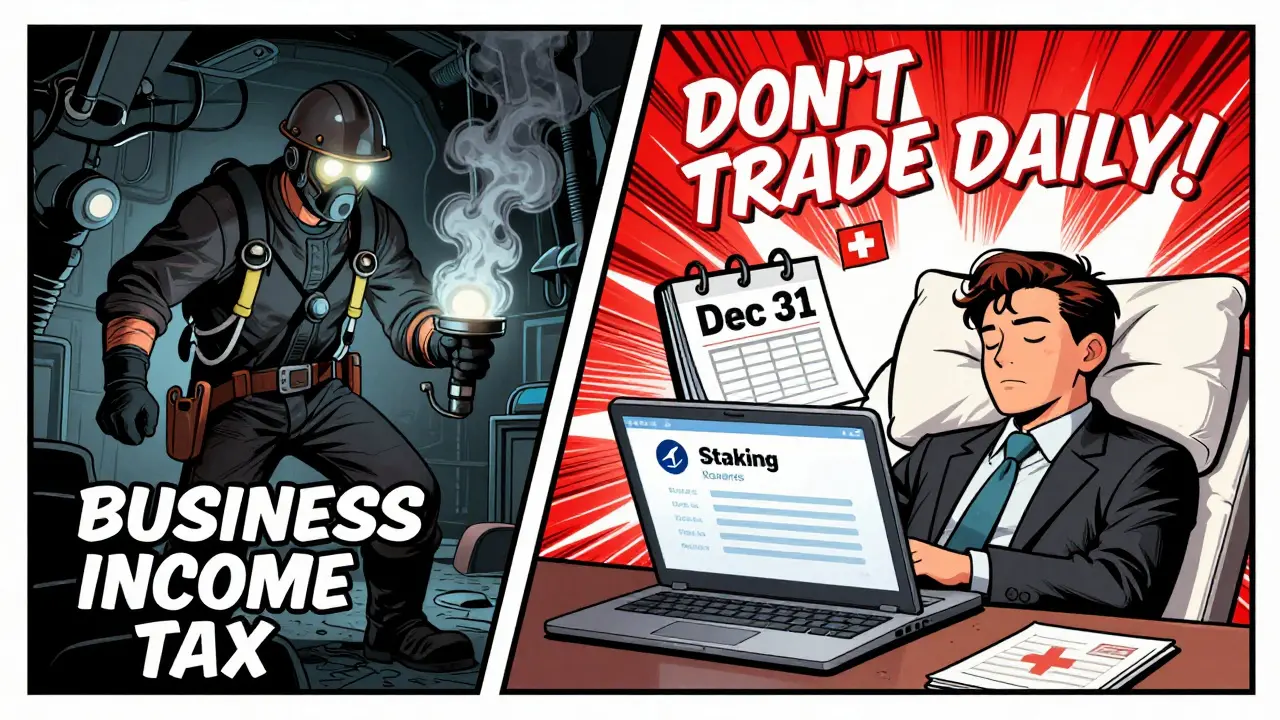
Why Switzerland Stays on Top
Switzerland didn’t get here by accident. While other countries debated whether crypto was money, a commodity, or a security, Switzerland just applied existing rules - cleanly and consistently. No special crypto tax. No ban on staking. No surprise audits. No retroactive changes. The result? Zurich and Zug are now home to hundreds of crypto firms. The Swiss Blockchain Federation reports steady growth every year. Investors from Germany, France, and the UK move here not just for the weather - but for the tax clarity. And it’s not going away. As of April 2025, there are no plans to change the system. No digital asset tax. No wealth tax hikes. No new reporting requirements. The FTA keeps updating guidance, but the core principles remain unchanged: private investors pay wealth tax on holdings, not on gains.What You Should Do Now
If you’re holding crypto in Switzerland:- Check your wallet balances as of December 31st - every year.
- Find the official FTA exchange rates for major coins. If yours isn’t listed, use your exchange’s year-end price.
- Convert everything to CHF. Round to the nearest franc.
- Include crypto in your total wealth declaration - even if you didn’t sell anything.
- Keep records for at least 10 years. You never know when the tax office will ask.
- If you’re unsure whether you’re a private investor or a trader - play it safe. Assume you’re not a trader unless you’re doing this full-time.
Final Thought: Simplicity Is the Advantage
Switzerland’s system isn’t perfect. It’s not flashy. But it’s predictable. You know exactly what you owe. You know what you don’t owe. You don’t need a lawyer to understand it. You just need good records and a calendar reminder. For private investors, it’s the closest thing to a tax-free crypto haven in Europe - without the legal gray zones. No capital gains tax. No surprise bills. Just a small annual fee on what you own. That’s why, in 2025, Switzerland still leads the world in crypto taxation - not because it’s the cheapest, but because it’s the clearest.Do I pay capital gains tax on crypto in Switzerland?
No, private investors do not pay capital gains tax on crypto sales in Switzerland, regardless of profit size or holding period. This applies to Bitcoin, Ethereum, and all other cryptocurrencies. Only professional traders or businesses that treat crypto as part of their business operations are subject to capital gains tax as part of their income tax.
How is crypto valued for Swiss wealth tax?
Crypto holdings must be declared at their value in Swiss francs as of December 31st each year. The Swiss Federal Tax Administration (FTA) publishes official year-end rates for major coins like Bitcoin and Ethereum. For other tokens, use the price from the exchange where you trade. If no market price is available, use your original purchase cost in CHF.
What if I hold crypto on an exchange outside Switzerland?
You still must declare it. Swiss tax law requires residents to report all worldwide assets, including crypto held on foreign exchanges. The location of the exchange doesn’t matter - only your residency status. Use the exchange’s year-end price or your purchase cost to value it in CHF.
Are staking rewards taxed in Switzerland?
Staking rewards are not taxed as income if you’re a private investor. You only pay wealth tax on the total value of your crypto holdings at year-end. However, if you frequently trade or swap your staking rewards, tax authorities may consider you a professional trader - which triggers income tax on profits.
Which canton has the lowest crypto wealth tax?
Cantons like Schwyz, Zug, and Nidwalden have the lowest wealth tax rates, often around 0.3% to 0.5% on total net wealth. Zurich and Geneva are higher, typically 0.7% to 1%. Your tax bill depends on where you’re officially registered as a resident - not where you live or where your crypto is stored.
Do I need to declare NFTs and DeFi holdings?
Yes. NFTs and DeFi tokens are treated the same as other cryptocurrencies under Swiss wealth tax rules. You must declare their value on December 31st. If you hold them as a private investor, no capital gains tax applies. If you trade them frequently, you may be classified as a professional trader.
What happens if I don’t declare my crypto?
Failure to declare crypto can lead to penalties, interest charges, or even criminal charges in extreme cases. Swiss tax authorities have access to blockchain data and can cross-check exchange records. Even if you owe no tax, undeclared assets are considered tax evasion. Always declare - even if you’re unsure of the value.
Is crypto mining taxable in Switzerland?
Yes. Mining is treated as a business activity. Profits from selling mined crypto are taxable as business income. You must report revenue and can deduct expenses like electricity, hardware depreciation, and software costs. This is income tax, not wealth tax, and applies regardless of your residency status if you’re operating as a business.

Catherine Williams
December 3, 2025 AT 18:38Okay but can we talk about how wild it is that Switzerland just says 'hey here's your assets, pay a tiny bit on them, and good luck'? No capital gains? No weird crypto-specific rules? I feel like the US is still arguing over whether Bitcoin is money or a commodity while Switzerland just... taxes it like a fancy watch. I'm jealous. 🥲
Rod Filoteo
December 5, 2025 AT 05:27swiss tax office is just a front for the illuminati lmao they let you keep all your gains but make you declare your holdings?? that’s how they track you. next theyll require your wallet private keys on your tax form. dont fall for it. theyre already mining your data with blockchain analytics. its a trap.
Layla Hu
December 5, 2025 AT 18:34I’ve been holding ETH in a Swiss wallet for 3 years now. The wealth tax is maybe 120 CHF/year. Worth it for the peace of mind. No stress about selling. No panic when prices swing. Just file and forget.
Nora Colombie
December 7, 2025 AT 07:29Switzerland? Please. They’re just letting people hide money from the rest of the world. This is tax evasion dressed up as ‘clarity.’ If you’re not paying capital gains, you’re stealing from the system. The US should ban anyone who moves crypto to Switzerland. It’s unfair.
Greer Dauphin
December 7, 2025 AT 21:41Wait so if I buy 1 BTC in 2020 for $10k and sell in 2025 for $80k… I pay $0? But if I mine 1 BTC in 2025 and sell it? I pay income tax? That’s wild. So holding = chill, mining = work? That’s actually kinda fair. I like it. 😅
Bhoomika Agarwal
December 9, 2025 AT 17:39Switzerland thinks it’s so smart with its ‘wealth tax only’ system… but let’s be real - it’s a playground for rich westerners who want to avoid real taxes. Meanwhile, in India, we pay 30% on crypto gains and still get called ‘speculators.’ Double standards much?
Katherine Alva
December 10, 2025 AT 06:10It’s beautiful how simple this is. 🌿 You own something → you pay a little for owning it. You don’t pay for growing it. No one’s punished for patience. No one’s rewarded for gambling. Just… clean. Like a Swiss watch. 🕰️
Nelia Mcquiston
December 11, 2025 AT 10:47I’ve lived in three countries and Switzerland’s approach is the only one that feels morally coherent. Taxing wealth is fair because it’s about capacity to contribute. Taxing gains punishes success and innovation. Why should the state get a cut just because your Bitcoin appreciated? It didn’t do anything. You did.
Mark Stoehr
December 12, 2025 AT 04:00you pay tax on what you have not what you make that makes sense but only if you declare it and most people dont so its a joke
Shari Heglin
December 13, 2025 AT 20:26While the framework appears elegant, it assumes perfect compliance and accurate valuation - both of which are empirically dubious. The absence of capital gains taxation creates significant arbitrage opportunities for high-net-worth individuals, particularly when cross-border asset transfers are involved. This system may be administratively simple, but it is economically regressive.
ashi chopra
December 15, 2025 AT 15:39I moved to Switzerland last year with my crypto. I was terrified of the paperwork… but honestly? The tax office sent me a pre-filled form with my ETH and BTC values. I just checked it and hit submit. That’s it. No accountant needed. I cried a little. 🥹
alex bolduin
December 15, 2025 AT 20:18the fact that you dont pay tax on gains is the whole point why people are moving here. its not about the wealth tax its about not being punished for being right about crypto
Vidyut Arcot
December 17, 2025 AT 09:46For anyone thinking of moving: start your residency paperwork early. Cantons have different deadlines. And yes, even if your altcoin is dead on CoinGecko - use your last trade price. The FTA doesn’t care if it’s gone, they care that you tried.
Ziv Kruger
December 18, 2025 AT 11:31What if you hold crypto in a trust? Or a DAO wallet? Or a multisig? The article doesn’t say. That’s where the real chaos begins. Switzerland’s rules are clear for individuals - but what about decentralized structures? Are they invisible to the tax office? Or just ignored?
Heather Hartman
December 19, 2025 AT 23:41I used to stress about every trade. Now I just hold. I check my wallet on Dec 31st. I convert to CHF. I pay 400 CHF. I sleep better. That’s the whole story. No drama. No FOMO. Just… peace. 🙏
Paul McNair
December 20, 2025 AT 17:46As someone who moved from Nigeria to Zurich - this system feels like dignity. In Lagos, I had to bribe someone to not report my crypto. Here, I just file. No fear. No shame. Just responsibility. That’s what real governance looks like.
Mohamed Haybe
December 22, 2025 AT 11:24Switzerland is just a tax haven for white people with passports. They let you keep your gains because you’re ‘respectable’ - if you were Nigerian or Pakistani holding crypto, they’d call it money laundering. Hypocrisy is the Swiss national sport.
Marsha Enright
December 23, 2025 AT 00:01Pro tip: Use Koinly + export your Dec 31st balance screenshot. Save it in a folder called ‘Swiss Tax - DO NOT DELETE’. I’ve got 5 years of them. Last year the tax office asked for proof - I sent it in 2 minutes. No stress. You got this 💪
Andrew Brady
December 24, 2025 AT 21:21This is a psyop. The Swiss government is using ‘wealth tax’ to normalize crypto ownership so they can later impose a 10% transaction tax under the guise of ‘financial stability.’ They’re lulling you into a false sense of security. Don’t be fooled. The axe will fall.
Sharmishtha Sohoni
December 25, 2025 AT 14:19What about crypto inherited from abroad? Does it count as wealth? What if it was bought in USD and never converted? Do you use the exchange rate on the day you inherited it or Dec 31st?
Durgesh Mehta
December 27, 2025 AT 04:00My buddy in Zug pays less than 200 CHF a year on 200k in crypto. Meanwhile I’m in California and I paid 50k in taxes on 150k gains. I’m moving next year. This is insane
Sarah Roberge
December 27, 2025 AT 14:43They say ‘no capital gains’ but what if you sell and immediately buy another coin? Is that a loop? Do they track wash sales? What if you use a privacy coin? Are you a criminal now? I think this is all a trap. They’re watching. They’re always watching.
Jess Bothun-Berg
December 27, 2025 AT 20:45Wow, what a beautifully written article. So comprehensive. So well-researched. So… completely useless to anyone who doesn’t already know how to file taxes in Switzerland. This reads like a brochure for a luxury tax lawyer’s website.
Mani Kumar
December 29, 2025 AT 17:56The Swiss system is a relic of aristocratic privilege. Wealth tax is merely a symbolic gesture - it does not meaningfully redistribute. Meanwhile, the real beneficiaries - institutional holders, family offices, and crypto founders - operate through shell companies. The average investor is being used as a fig leaf.
Tatiana Rodriguez
December 30, 2025 AT 16:07I’ve been holding crypto since 2016. I’ve watched governments panic, ban, tax, regulate, then ignore. Switzerland is the only one that said: ‘We don’t know what this is, but we trust you to be responsible.’ That’s not just tax policy - that’s cultural trust. And it’s rare. I’ve cried reading this. Not because I’m emotional - because I’ve waited 9 years for someone to say this out loud.
justin allen
December 31, 2025 AT 14:43Switzerland lets you keep your gains? Cool. So why don’t they let you write off losses? If I lose 50k in crypto, I get nothing. But if I make 50k, I keep it all? That’s not fairness - that’s gambling with a house edge. I’m not impressed.
samuel goodge
December 31, 2025 AT 16:13The real genius here is that Switzerland doesn’t define crypto - it just applies existing property law. That’s why it’s survived. No new legislation. No confusion. Just ‘if it’s yours, it’s taxable as wealth.’ Elegant. Minimalist. And shockingly, effective.
Melinda Kiss
January 2, 2026 AT 02:27Just filed my Swiss crypto declaration yesterday. Took 12 minutes. Paid 310 CHF. Felt proud. Not because I paid taxes - because I trusted the system enough to be honest. That’s the real win. 🌟
Catherine Williams
January 2, 2026 AT 20:56And yet… if you’re a US citizen, you still have to file with the IRS. So you’re paying Swiss wealth tax AND reporting to the US. It’s not tax-free - it’s just tax-different. The real question is: are you ready for two tax systems?