The landscape of investing in digital assets has changed completely. Just a few years ago, buying Bitcoin or Ethereum through a standard brokerage account was impossible for most Americans. Today, you can buy shares of Bitcoin ETF is an exchange-traded fund that tracks the price of Bitcoin without requiring direct ownership of the cryptocurrency. The same goes for Ethereum. These products have bridged the gap between traditional finance and the crypto world, allowing millions of investors to gain exposure to these assets using familiar tools like 401(k)s and IRAs.
If you are looking to understand how these funds work, why they matter, and what recent regulatory changes mean for your wallet, this guide covers everything you need to know. We will look at the history of approvals, the difference between cash and in-kind processing, fee structures, and what experts predict for the future.
How It All Started: The Road to Approval
For over a decade, the U.S. Securities and Exchange Commission (SEC) rejected every attempt to launch a spot Bitcoin ETF. The regulator argued that markets were too small and prone to manipulation. This stance shifted dramatically in August 2023, when the U.S. Court of Appeals for the D.C. Circuit ruled in Grayscale Investments LLC v. SEC. The court found that the SEC had applied inconsistent standards by rejecting Bitcoin ETF applications while approving similar trusts for other commodities.
This legal pressure forced a change. On January 10, 2024, the SEC approved the first wave of spot Bitcoin ETFs. Trading began the next day, and the response was immediate. BlackRock’s iShares Bitcoin Trust (IBIT) attracted $4.6 billion in assets within its first week alone. By September 2025, the total assets under management (AUM) for spot Bitcoin ETFs reached $54.3 billion.
Ethereum followed six months later. On July 23, 2024, the SEC approved the first spot Ethereum ETFs. Eleven products launched, including offerings from giants like Fidelity, VanEck, and Grayscale. As of late 2025, Ethereum ETFs hold approximately $18.7 billion in AUM. This approval validated Ethereum as a distinct "blue chip" asset class, separate from Bitcoin, due to its smart contract capabilities and proof-of-stake consensus mechanism.
Cash vs. In-Kind: A Major Structural Shift
When these ETFs first launched, they operated on a "cash-only" model. This means that when authorized participants (APs) wanted to create new ETF shares, they had to give the fund provider cash, which the provider then used to buy Bitcoin or Ethereum on the open market. To redeem shares, the process reversed. This created inefficiencies. Buying and selling the underlying crypto triggered taxable events and added operational costs.
Everything changed on July 29, 2025. The SEC approved "in-kind" creation and redemption mechanisms for crypto asset ETPs. This aligns crypto ETFs with traditional commodity ETFs like gold (GLD), which have used in-kind processing since 2004.
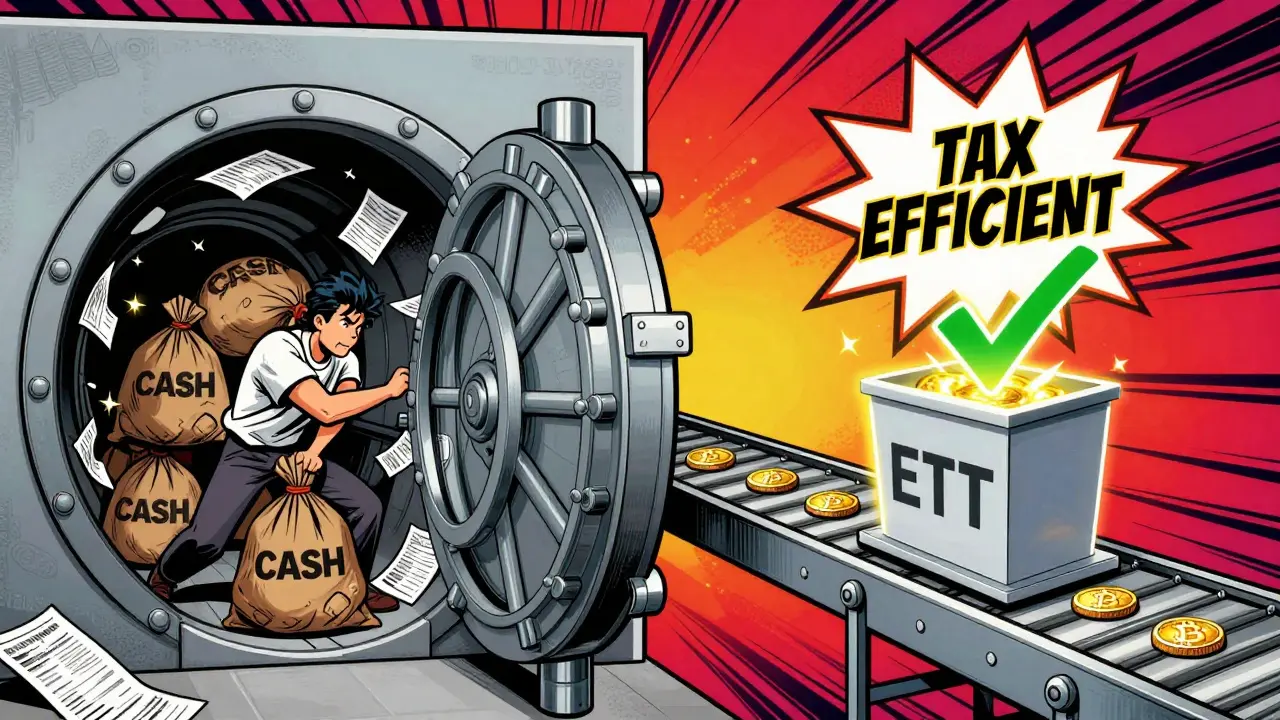
Under the new in-kind framework, APs can deliver actual Bitcoin or Ethereum directly to the ETF provider in exchange for shares. They do not need to sell their holdings for cash first. This shift offers two major benefits:
- Tax Efficiency: Investors can convert existing crypto holdings into ETF shares without triggering a capital gains tax event immediately. Bloomberg reported that large holders converted over $3 billion worth of Bitcoin into ETF shares using this method by October 2025.
- Lower Costs: Eliminating cash conversions reduces operational friction. Jamie Selway, Director of the Division of Trading and Markets at the SEC, estimated that in-kind processing could reduce annual operational costs by 0.15% to 0.25%. For the $100 billion crypto ETF market, this translates to savings of $150-$250 million per year.
This change has been particularly popular among institutional investors. A survey of 142 institutions found that 78% prefer holding Bitcoin through ETFs for easier collateralization in prime brokerage arrangements. Estate planning has also become simpler, as families can transfer ETF shares more easily than private crypto keys.
Bitcoin vs. Ethereum ETFs: Key Differences
While both Bitcoin and Ethereum ETFs serve similar purposes, their underlying technologies create different investment dynamics. Understanding these differences is crucial for making informed decisions.
| Feature | Bitcoin ETFs | Ethereum ETFs |
|---|---|---|
| Consensus Mechanism | Proof-of-Work | Proof-of-Stake |
| Staking Rewards | Not applicable | Some providers distribute quarterly rewards |
| Average Management Fee | 0.25% | 0.35% |
| Market Share Leader | BlackRock (IBIT) | Grayscale (ETHE) |
| Total AUM (Sep 2025) | $54.3 Billion | $18.7 Billion |
The biggest technical difference is staking. Ethereum uses a proof-of-stake network, where validators lock up ETH to secure the network and earn rewards. Bitcoin does not have this feature. Some Ethereum ETF providers, like Grayscale with its ETHE product, choose to stake a portion of their holdings. As of September 2025, Grayscale allocated 4.2% of its 3.1 million ETH to staking, generating $127 million in quarterly rewards distributed to shareholders. However, only 5 of the 11 approved Ethereum ETFs participate in staking. Most providers avoid it to simplify compliance and tax reporting.
Fees also differ. Bitcoin ETFs generally charge lower fees, averaging 0.25%, with Fidelity’s FBTC charging 0.00% initially to gain market share. Ethereum ETFs average 0.35%, ranging from VanEck’s competitive 0.15% (EETH) to Grayscale’s higher 1.50% (ETHE). Grayscale’s premium reflects its conversion from an older trust structure, which historically carried higher costs.
Market Performance and Investor Sentiment
Since their launch, Bitcoin and Ethereum ETFs have shown divergent trends. In Q3 2025, spot Bitcoin ETFs experienced $1.2 billion in net outflows amid rising interest rates. Conversely, Ethereum ETFs saw $478 million in net inflows during the same period. This suggests that investors may view Ethereum as having more growth potential in certain market conditions, possibly due to its utility in decentralized finance (DeFi).
User sentiment remains largely positive but nuanced. Analysis of Reddit discussions in r/CryptoMarkets showed 63% positive sentiment toward Ethereum ETFs. Users praised the regulatory clarity but criticized high fees from legacy providers like Grayscale. On the other hand, Trustpilot reviews of Coinbase’s ETF integration highlighted a 4.2/5 rating, with 72% of users praising the seamless transition from self-custody to ETF exposure. However, 28% complained about complex tax documentation required for in-kind conversions.
Liquidity is strong across the board. Fidelity’s FETH ETF processed $842 million in trading volume in a single day in October 2025, representing 17.3% of total Ethereum ETF volume. Bitcoin ETFs trade at an average premium of 0.08% to Net Asset Value (NAV), while Ethereum ETFs trade at 0.23%, indicating slightly stronger demand relative to supply for Ether-based products.

Regulatory Outlook and Future Developments
The regulatory environment continues to evolve. Under Chairman Paul S. Atkins, the SEC has signaled a more supportive stance toward crypto innovation. Atkins stated that developing a "fit-for-purpose regulatory framework" is a key priority. This philosophical shift led to the rapid expansion of in-kind processing rules in October 2025.
However, caution remains. John Coates, former SEC Acting Chairman and Harvard Law professor, warned that approving Ethereum ETFs without clear rules on staking could create systemic risks. He noted that 68% of Ethereum’s network security comes from staked ETH, meaning any instability in ETF staking practices could impact the broader network.
Looking ahead, several developments are expected:
- Expansion to Other Coins: The SEC’s October 2025 orders permit in-kind creations for a "host of crypto asset ETPs," hinting at future approvals for coins like Solana or XRP. Hong Kong already approved its first spot Solana ETF in October 2025, signaling global momentum.
- Growth in AUM: Analysts project that combined Bitcoin and Ethereum ETF AUM will reach $150 billion by December 2026.
- Cost Reductions: With in-kind processing fully adopted, operational costs across the ecosystem could drop by $500 million annually.
It is important to note that not all cryptocurrencies will qualify for ETF treatment. Chairman Atkins emphasized that each asset will be evaluated case-by-case. Assets deemed securities under current laws may still face rejection.
Who Should Invest in Crypto ETFs?
Crypto ETFs are ideal for investors who want exposure to Bitcoin or Ethereum without managing private keys, dealing with exchanges, or worrying about hacking risks. They are particularly suitable for:
- Retirement Savers: You can now hold crypto in IRAs and 401(k)s, providing long-term growth potential within tax-advantaged accounts.
- Institutional Investors: Banks and pension funds often cannot hold raw crypto due to compliance rules. ETFs provide a regulated wrapper that meets internal governance standards.
- Beginners: If you already use a brokerage like Fidelity or Schwab, adding Bitcoin or Ethereum is as easy as buying a stock. No need to learn about wallets or seed phrases.
However, ETFs are not for everyone. If you believe in the ethos of decentralization and want full control over your assets, self-custody remains the preferred option. Additionally, ETFs charge management fees, which eat into returns over time compared to holding the asset directly.
Can I stake my Ethereum if I buy an Ethereum ETF?
Generally, no. Most Ethereum ETFs do not allow individual investors to stake their shares. While some providers like Grayscale stake the underlying ETH on behalf of the fund and distribute rewards, you do not have direct control over the staking process. If you want to stake yourself, you should hold Ethereum directly in a non-custodial wallet.
What is the difference between cash and in-kind creation?
In cash creation, authorized participants give the ETF provider money, which the provider uses to buy crypto. This triggers taxable sales. In in-kind creation, participants give actual crypto to the provider in exchange for ETF shares. This avoids immediate tax liabilities and reduces operational costs for the fund.
Which Bitcoin ETF has the lowest fees?
As of late 2025, Fidelity’s Wise Origin Bitcoin Fund (FBTC) charges 0.00% management fee, making it one of the cheapest options. Other low-cost alternatives include Bitwise Bitcoin ETF (BITB) at 0.20% and Ark 21Shares Bitcoin Strategy ETF (ARKB) at 0.21%. Grayscale’s GBTC charges a higher 0.90% fee.
Are crypto ETFs safe from hacks?
ETFs are significantly safer than holding crypto on personal exchanges or hot wallets because the assets are held by institutional custodians like BNY Mellon or Coinbase Custody. These firms use cold storage and insurance policies. However, no system is 100% immune to risk, and you still face market volatility.
Will there be ETFs for other cryptocurrencies like Solana or XRP?
It is likely, but not guaranteed. The SEC has opened the door for more crypto ETPs with its in-kind rulings. Hong Kong has already approved a Solana ETF. In the US, the SEC evaluates each application based on market surveillance and manipulation resistance. XRP and Solana have active applications, but approval depends on ongoing regulatory dialogue.