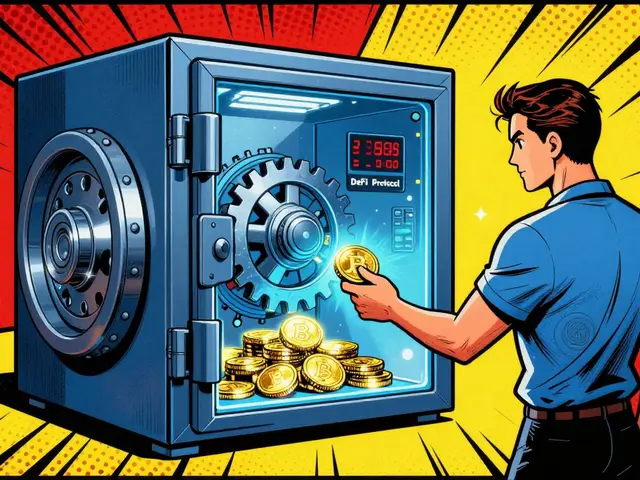
Imagine depositing your savings into a high-yield account, only to find out the bank doesn’t actually hold your money in a vault. Instead, it’s locked inside a complex digital machine that trades your assets automatically, exposes them to market swings, and leaves you vulnerable if the code breaks. This isn’t a hypothetical scenario; it’s the daily reality for anyone providing liquidity in Decentralized Finance (DeFi), a financial system built on blockchain technology where users replace traditional banks with automated protocols. Liquidity pools are the engine rooms of this new economy. They allow traders to swap tokens instantly without needing a buyer or seller to match their order. But while they offer attractive rewards, they come with risks that can wipe out your principal if you aren’t careful. You need to understand exactly what happens to your assets once you click "deposit."
The Core Mechanism: How Liquidity Pools Work
To understand the risks, you first need to grasp how the system operates. Traditional exchanges use an order book, where buyers list prices they’re willing to pay and sellers list prices they’re willing to accept. A human or algorithm matches these orders. In contrast, Automated Market Makers (AMMs) use a mathematical formula to set prices based on the ratio of tokens in a pool. When you become a Liquidity Provider (LP), you deposit two tokens of equal value-for example, $500 worth of Ethereum (ETH) and $500 worth of USD Coin (USDC)-into a smart contract. This contract is a self-executing program on the blockchain. As traders swap ETH for USDC or vice versa, the pool’s balance shifts. The AMM adjusts the price to maintain equilibrium. In return for keeping the pool stocked, you earn a share of the trading fees generated by every transaction.
This sounds efficient, but it creates a specific type of exposure. Unlike holding tokens in a personal wallet, your assets are constantly being rebalanced by the protocol. This automatic rebalancing is the source of the most significant risk you will face: impermanent loss.
Impermanent Loss: The Price of Volatility
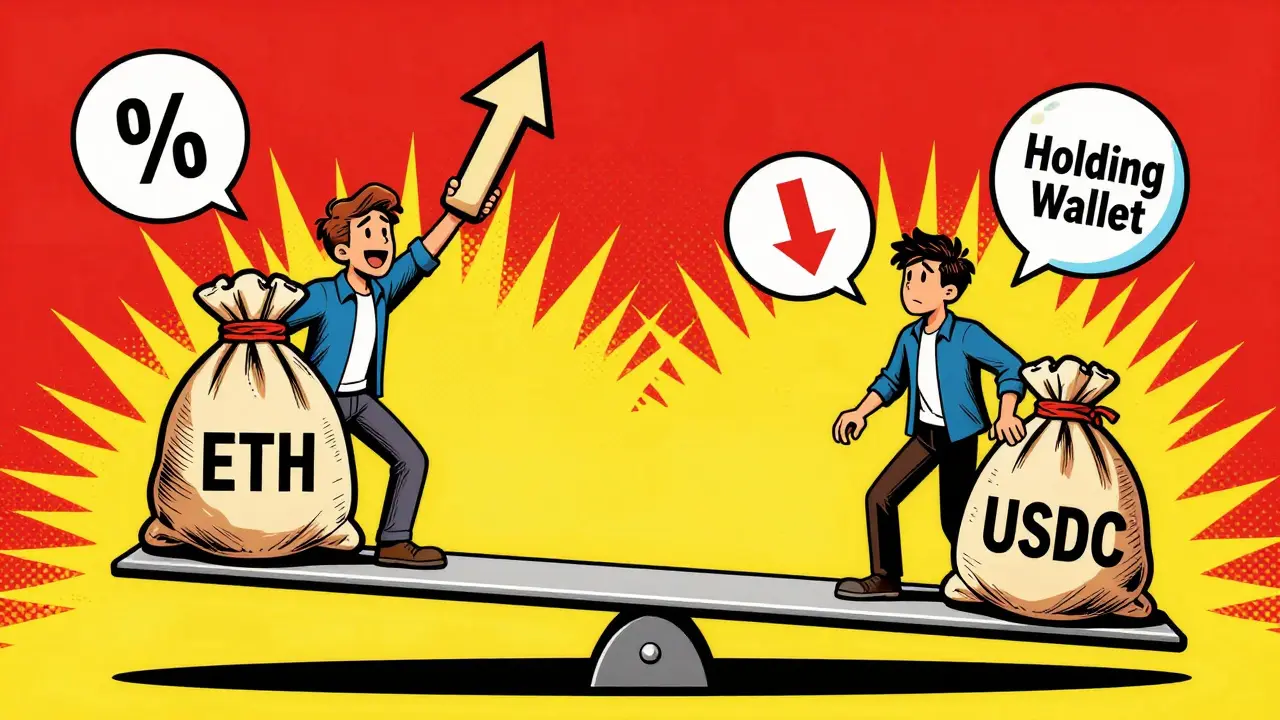
Impermanent loss occurs when the price of the tokens in your pool diverges significantly from their external market prices. It is called "impermanent" because the loss is unrealized until you withdraw your funds. If the prices converge again before you exit, the loss disappears. However, if you withdraw during a divergence, the loss becomes permanent.
Here is why this happens. AMMs maintain a constant product of the two token reserves (typically represented as x * y = k). When one token’s price rises sharply, traders sell that expensive token into the pool to buy the cheaper one. This increases the supply of the expensive token in the pool and decreases the supply of the cheaper one. As a result, your pool now holds more of the depreciating asset and less of the appreciating asset compared to if you had simply held both tokens in separate wallets.
Consider this scenario: You deposit 1 ETH and 1000 USDC when ETH is priced at $1,000. If ETH’s price doubles to $2,000, arbitrageurs will buy ETH from your pool using USDC. To maintain the balance, the pool sells ETH and buys USDC. Eventually, your pool might hold 0.7 ETH and 1414 USDC. While you still have roughly $2,828 in total value, if you had just held the original 1 ETH and 1000 USDC, you would have $3,000 ($2,000 from ETH + $1,000 from USDC). That $172 difference is your impermanent loss.
The greater the price volatility between the two assets, the larger the impermanent loss. Stablecoin pairs (like USDC/DAI) have minimal impermanent loss because their prices remain pegged to each other. Volatile pairs (like ETH/SOL) carry much higher risk.
| Pool Type | Impermanent Loss Risk | Fee Yield Potential | Best For |
|---|---|---|---|
| Stablecoin/Stablecoin (e.g., USDC/DAI) | Very Low | Low | Capital preservation, low-risk yield |
| Stablecoin/Volatile Asset (e.g., USDC/ETH) | Moderate to High | Medium | Balanced risk/reward, hedging strategies |
| Volatile Asset/Volatile Asset (e.g., ETH/SOL) | High | High | Active traders, high-risk tolerance |
| Concentrated Liquidity (Uniswap V3) | Variable (Range-dependent) | Very High | Expert LPs who actively manage positions |
Smart Contract Vulnerabilities: Code Is Law, But Code Can Break
While impermanent loss is a mathematical certainty of volatility, smart contract risks represent existential threats to your capital. Once you deposit funds into a liquidity pool, you lose direct control over them. The smart contract becomes the custodian. If there is a bug in the code, hackers can exploit it, and your funds may be stolen or frozen indefinitely.
Unlike traditional banks, which have insurance and legal recourse, DeFi protocols operate on the principle of "code is law." There is no customer support team to reverse a transaction. Many high-profile hacks in the DeFi space have resulted from reentrancy attacks, flash loan exploits, or logic errors in the AMM formulas. Even audited contracts are not immune; audits check for known vulnerability patterns but cannot guarantee absolute security against novel attack vectors.
To mitigate this risk, you should prioritize established protocols with a long track record, such as Uniswap, Curve Finance, or Aave. These platforms have undergone extensive real-world testing and multiple independent audits. Avoid new, unaudited protocols offering unsustainable yields, as they are often honeypots designed to drain liquidity.
Governance Risks and Rug Pulls
Another critical danger lies in project governance. In many DeFi projects, developers retain control over the smart contracts through multi-signature wallets or admin keys. This centralized control creates a single point of failure. If the developers act maliciously, they can alter the contract parameters, pause withdrawals, or even drain the pool entirely.
A rug pull is a specific type of scam where creators launch a new token, provide initial liquidity, and hype the project to attract investors. Once enough liquidity has accumulated, the developers dump their entire token stash into the pool, crashing the price, and then withdraw all the paired valuable assets (like ETH or USDT), leaving liquidity providers with worthless tokens.
You can identify potential rug pulls by checking if the liquidity is locked. Reputable projects use locking services like Uniswap Lock or Team.Finance to lock their liquidity for a predetermined period. If the liquidity is unlocked, the developers can remove it at any time. Always verify the contract ownership status; renounced ownership means the developers can no longer modify the contract, adding a layer of security.
Concentrated Liquidity and Out-of-Range Risks
Newer iterations of AMMs, such as Uniswap V3, introduced concentrated liquidity. This allows providers to allocate their capital within specific price ranges rather than across the entire price spectrum from zero to infinity. While this increases capital efficiency and fee earnings, it introduces out-of-range risk.
If the market price moves outside your specified range, your position stops earning fees. Worse, your entire position converts into the single asset that has decreased in value relative to the other. For example, if you set a range for ETH/USDC between $1,500 and $2,000, and ETH drops to $1,000, your position will consist entirely of ETH. You are now fully exposed to further downside without earning any fees to offset the loss.
This requires active management. You must monitor the market and adjust your ranges frequently. Each adjustment involves paying gas fees, which can eat into your profits, especially during periods of network congestion. Passive investors should stick to full-range liquidity provision on older versions like Uniswap V2 or Curve, where positions do not go out of range.
Mitigation Strategies for Liquidity Providers
Managing liquidity pool risks requires a proactive approach. Here are practical steps to protect your capital:
- Diversify Across Protocols: Do not put all your funds into a single platform. Spread your liquidity across different chains and protocols to reduce exposure to a single smart contract failure.
- Prioritize Stable Pairs: If you are risk-averse, stick to stablecoin pairs (USDC/USDT) or blue-chip asset pairs (ETH/WBTC) where price correlation is high, minimizing impermanent loss.
- Calculate Net Yield: Always compare the potential fee income and incentive rewards against the historical impermanent loss of the pair. Use tools like Impermanent.com or DefiLlama to simulate losses under different price scenarios.
- Verify Audits and Ownership: Only provide liquidity to protocols with public audit reports from reputable firms like CertiK or OpenZeppelin. Check if contract ownership has been renounced.
- Monitor Gas Costs: On networks like Ethereum, high gas fees can make frequent rebalancing unprofitable. Consider using Layer 2 solutions like Arbitrum or Optimism, or alternative chains like Solana, where transaction costs are lower.
Treating liquidity provision as an active job rather than a passive investment is crucial. The market conditions change rapidly, and what was a safe pool last week may become risky today due to shifting incentives or emerging vulnerabilities.
What is impermanent loss, and is it permanent?
Impermanent loss is the difference in value between holding tokens in a liquidity pool versus holding them in a personal wallet. It occurs when the price ratio of the two tokens changes. It is only "impermanent" because if the prices revert to their original ratio before you withdraw, the loss disappears. However, if you withdraw during a divergence, the loss becomes permanent.
Can I lose all my money in a liquidity pool?
Yes. While impermanent loss rarely results in a total loss, smart contract exploits, rug pulls, or severe depegging events (where a stablecoin loses its peg) can lead to the total loss of deposited funds. Always assess the security of the protocol and the stability of the assets involved.
How do I avoid impermanent loss?
You can minimize impermanent loss by providing liquidity to pairs with highly correlated assets, such as two stablecoins (USDC/DAI) or wrapped versions of the same asset (WBTC/renBTC). Additionally, earning high trading fees or staking rewards can sometimes offset the losses incurred from price divergence.
What is a rug pull in DeFi?
A rug pull is a scam where developers create a fake project, attract liquidity, and then abruptly remove all funds from the pool, leaving investors with worthless tokens. To avoid this, check if the liquidity is locked and if the smart contract ownership has been renounced.
Is providing liquidity safer than holding crypto in a wallet?
Generally, no. Holding crypto in a non-custodial wallet eliminates smart contract risk and impermanent loss. Providing liquidity introduces additional layers of complexity and risk, including code vulnerabilities and market volatility. You should only provide liquidity if you understand these risks and believe the fee income outweighs them.