
Imagine a place where you can pay your city taxes with Bitcoin. Where the local government doesn't just tolerate cryptocurrency but actively builds its infrastructure around it. That place is Zug, a canton in Switzerland widely known as the global 'Crypto Valley' due to its progressive regulatory framework and high concentration of blockchain companies. For years, entrepreneurs and investors have flocked here because the rules are clear, the taxes are favorable, and the technology is embraced.
But let’s get one thing straight right away: "crypto-friendly" does not mean "lawless." If you are looking for a jurisdiction with zero restrictions or no oversight, Zug is not it. The Swiss approach is built on the principle of "same risks, same rules." This means that if your digital asset looks like a security, acts like a security, and sounds like a security, it will be regulated exactly like a traditional stock. The goal isn't to stifle innovation; it's to protect investors and prevent money laundering while giving businesses a predictable legal environment.
The Core Regulatory Framework: FINMA and the DLT Act
To understand how things work in Zug, you first need to understand who is pulling the strings. The primary regulator is FINMA, the Swiss Financial Market Supervisory Authority responsible for regulating banks, insurance companies, securities dealers, and payment institutions in Switzerland. FINMA doesn't create new laws for crypto out of thin air. Instead, they apply existing financial market laws to digital assets based on their economic function. This is crucial. It means there is no separate "crypto law" that exists in a vacuum. Your token is classified based on what it does.
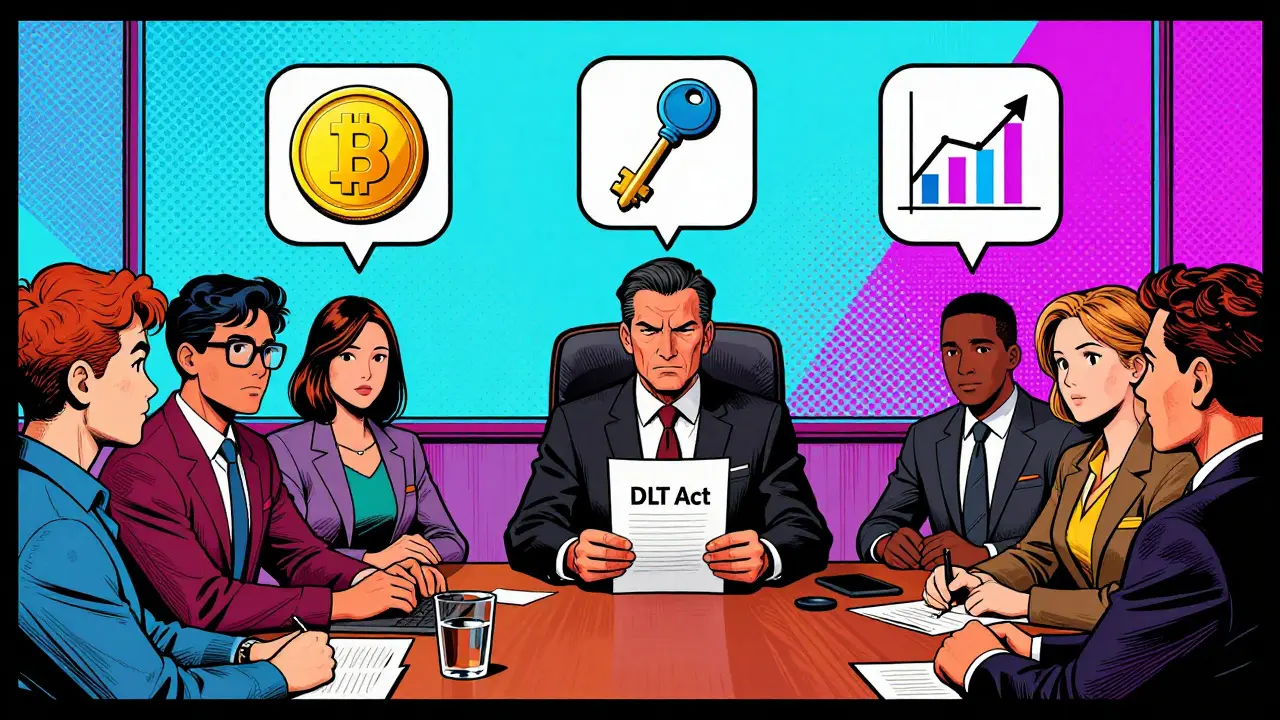
In August 2021, Switzerland introduced the DLT Act, legislation that provides a specific legal framework for distributed ledger technology-based trading venues and tokenized securities in Switzerland. This was a game-changer. Before this, operating a crypto exchange or issuing tokenized assets was legally gray. Now, it’s codified. On March 25, 2025, BX Digital, a Swiss fintech company that received the first-ever DLT trading venue license from FINMA, allowing it to operate a multilateral trading platform for digital securities received the first official license under this act. This signaled to the world that Switzerland is ready for institutional-grade digital asset trading.
So, what does this mean for you? If you are launching a project in Zug, you don’t guess your classification. You ask FINMA. They categorize tokens into three main buckets:
- Payment Tokens: These are used primarily for payments (like Bitcoin). They are not considered securities. However, platforms handling them must comply with Anti-Money Laundering (AML) laws.
- Utility Tokens: These grant access to a service or product. Generally, they are not securities unless they promise future profits.
- Asset Tokens: These represent rights to an underlying asset, such as equity or debt. These are treated as securities and require strict compliance, including prospectus requirements.
Taxation in Zug: What You Keep vs. What You Pay
One of the biggest draws for individuals and businesses moving to Zug is the tax treatment. But there are nuances here that many people miss. Let’s break down the reality of paying taxes on crypto in Switzerland.
For individual investors, the good news is straightforward: capital gains tax is generally zero. If you buy Bitcoin today and sell it next year for a profit, you do not pay income tax on that gain. This applies to most cryptocurrencies held as private wealth. However, this privilege comes with a condition. You must declare your holdings. Switzerland has a wealth tax, and your crypto counts toward your total net worth. Every year, you report the value of your crypto assets, and you pay a small percentage based on your cantonal rates. In Zug, these rates are among the lowest in the country, which is why so many wealthy individuals relocate there.
Where it gets tricky is with active income. If you are mining, staking, or providing liquidity for rewards, those earnings are treated as income, not capital gains. This means they are subject to regular income tax. Similarly, if you trade crypto professionally-meaning it’s your main source of livelihood and you trade with high frequency-the tax authorities may view your entire portfolio as business assets, making all gains taxable. The line between "investor" and "trader" is drawn by behavior, not just intent.
| Activity | Tax Type | Rate/Rule | Reporting Requirement |
|---|---|---|---|
| Selling Crypto (Private Investor) | Capital Gains | 0% | Declare value for Wealth Tax |
| Mining/Staking Rewards | Income Tax | Progressive (up to ~40%) | Include in annual return |
| Holding Crypto Assets | Wealth Tax | Low single digits (%) | Annual declaration required |
| Professional Trading | Income Tax | Progressive | Full business accounting |
Real-World Adoption: Beyond the Hype
Regulations are only as good as their implementation. Zug doesn’t just write rules; it lives them. Since 2016, the municipality has accepted Bitcoin and Ether for tax payments up to CHF 100,000 annually. This wasn’t a marketing stunt. It was a practical test of integration. Other cities followed suit. Lugano went further, planning to accept stablecoins like Tether (USDT) and even its own municipal token for transactions.
This real-world usage matters because it creates demand for liquidity and stability. When the government accepts crypto, it signals to banks and businesses that the asset class is legitimate. Major Swiss banks like PostFinance now offer custody for multiple cryptocurrencies. Even traditional institutions like Credit Suisse and Pictet have tested blockchain-based settlement systems for tokenized securities. This bridges the gap between the old financial world and the new decentralized one.
Restrictions and Compliance: The "Same Risks" Reality
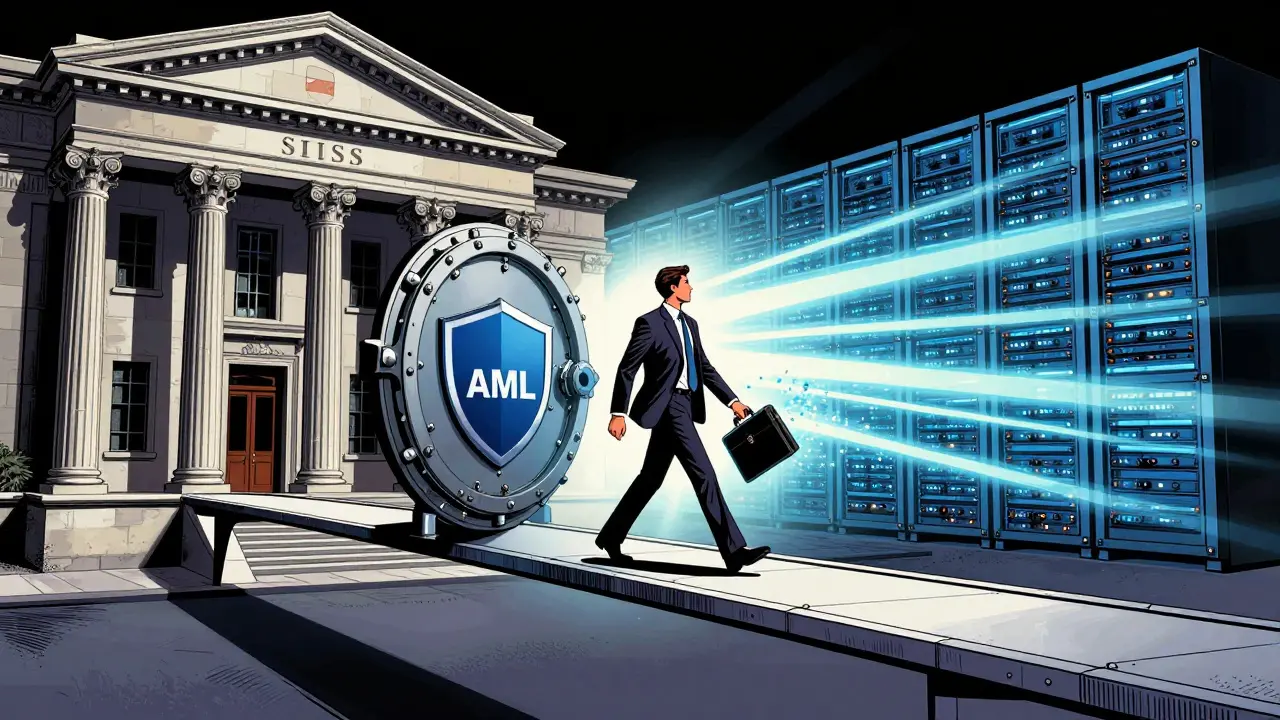
Let’s address the elephant in the room: restrictions. While Zug is friendly, it is not a wild west. The primary restriction is compliance with Anti-Money Laundering (AML) laws. Any entity providing crypto services-exchanges, wallets, custodians-must register with FINMA and undergo rigorous AML checks. This includes Know Your Customer (KYC) procedures. If you try to run an anonymous exchange in Zug, you will be shut down quickly.
Another major development impacting privacy is the Automatic Exchange of Information (AEOI). In June 2025, the Swiss Federal Council approved sharing crypto asset data with 74 partner countries. Starting in January 2026, with actual data exchanges beginning in 2027, your crypto holdings in Zug will be visible to foreign tax authorities if you are a resident elsewhere. This ends the era of using Swiss crypto accounts for offshore tax evasion. The system is designed for transparency, not secrecy.
Stablecoins also face scrutiny. FINMA uses a substance-over-form approach. If your stablecoin promises to maintain a peg to the Swiss Franc or USD, it may fall under banking regulations or collective investment schemes laws. There is no special "stablecoin exemption." You must prove you have the reserves and operational structure to back your claims.
Why Zug Remains the Global Benchmark
Despite stricter global trends, Zug continues to attract top talent. Why? Because certainty is valuable. In many countries, regulators change rules overnight. In Zug, the DLT Act provides a five-to-ten-year horizon of legal stability. Companies know exactly what they need to do to comply. The combined valuation of blockchain companies in Switzerland and Liechtenstein reached $584 billion in 2023, a 56% jump from the previous year. This growth isn’t accidental. It’s the result of a regulatory environment that treats innovation as a partner, not a threat.
If you are considering moving your business or investments to Zug, the path is clear. Engage with FINMA early. Classify your tokens correctly. Prepare for wealth tax declarations. And remember, while the gates are open, the guards are watching. Compliance is the price of admission to the world’s most advanced crypto ecosystem.
Can I pay my taxes in Bitcoin in Zug?
Yes. Since 2016, the municipality of Zug has accepted Bitcoin and Ether for tax payments up to a limit of CHF 100,000 per year. This makes it one of the few places globally where you can settle civic obligations directly with cryptocurrency.
Do I pay capital gains tax on crypto in Switzerland?
Generally, no. Private investors do not pay capital gains tax on profits from selling cryptocurrencies. However, you must declare your holdings for annual wealth tax purposes. Active traders or miners may be subject to income tax on their earnings.
What is the DLT Act and why does it matter?
The Distributed Ledger Technology (DLT) Act, effective since August 2021, provides a legal basis for tokenized securities and DLT-based trading venues. It allows companies like BX Digital to operate regulated crypto exchanges, bringing institutional credibility to digital asset trading in Switzerland.
Is crypto anonymous in Zug?
No. All crypto service providers must comply with strict Anti-Money Laundering (AML) and Know Your Customer (KYC) regulations. Additionally, starting in 2026, Switzerland will automatically exchange crypto asset information with 74 other countries, ending any possibility of using Swiss accounts for tax evasion.
How does FINMA classify different types of tokens?
FINMA classifies tokens based on their economic function. Payment tokens (like Bitcoin) are not securities. Utility tokens grant access to services. Asset tokens represent underlying rights (like shares) and are regulated as securities. This "same risks, same rules" approach ensures appropriate oversight without banning innovation.

John Gonzalez Bentham
May 23, 2026 AT 19:34nah its all just hype man like everyone thinks zug is some utopia but really its just rich people hiding money from their home countries using fancy words like dlt act to make it sound legit i mean sure finma is nice and all but do you really think they care about the little guy trading shitcoins on his phone probably not its all about the big banks wanting to tokenize their boring stocks and call it innovation meanwhile regular folks get hit with kyc and aml checks every time they try to move five bucks
Ellie Riddell
May 24, 2026 AT 17:27oh look another person pretending they understand the nuance of financial regulation while simultaneously dismissing the entire ecosystem as a scam for the elite how refreshing really because nothing says freedom like ignoring the fact that without those regulations the whole thing collapses under its own weight of fraud and theft but sure lets keep playing pretend that decentralization means no rules ever existed
Gavin Wonnacott
May 25, 2026 AT 00:15you are completely missing the point here because the real issue is that switzerland is becoming a haven for tax evaders from across europe and while you sit there praising their efficiency you fail to see the moral decay inherent in such a system where wealth is protected at the expense of social responsibility and transparency is merely a facade designed to appease the masses while the elite continue to exploit loopholes that were never meant to exist in the first place
Sudarshan Anbazhagan
May 25, 2026 AT 13:41i must say that your assertion regarding the moral decay of swiss banking practices is somewhat reductive and fails to account for the historical context in which these institutions evolved to serve global commerce and investment needs which predates modern notions of nationalistic fiscal policy by several centuries and thus to judge them solely through the lens of contemporary political ideology is to ignore the complex interplay between international finance and domestic regulation that has shaped our current economic landscape
moreover the implementation of aei demonstrates that switzerland is actively participating in global efforts to combat tax evasion rather than facilitating it which suggests that the narrative of secrecy is outdated and no longer reflects the reality of compliant operations within the jurisdiction
Mike S
May 26, 2026 AT 14:16lol wow you guys are seriously arguing about whether switzerland is evil or good while ignoring the fact that the entire premise of crypto was supposed to be decentralized resistance against exactly this kind of institutional control and now we have fintech bros wearing suits talking about tokenizing stocks like its some great achievement instead of realizing that we sold out the revolution for a slightly better tax rate on gains
Tricia Alach
May 27, 2026 AT 23:38honestly i think both sides have valid points but maybe we are overthinking it like yeah its regulated but thats kinda necessary if you want mainstream adoption right? i mean imagine trying to convince your grandma to put her retirement savings into something that could vanish overnight because some hacker stole the keys so having finma around gives people peace of mind even if it feels less punk rock now
Destiny Kilby
May 28, 2026 AT 12:23i understand the concern about losing the original ethos of cryptocurrency but one must consider that mass adoption requires trust and trust is built through reliability and security which are provided by regulatory frameworks that protect consumers from fraud and market manipulation therefore the shift towards institutional acceptance is not necessarily a betrayal of ideals but rather an evolution towards sustainability and longevity in the financial sector
Jerry CUNNINGHAM SR
May 30, 2026 AT 07:21it is important to recognize that the transition from a niche technological experiment to a mainstream financial asset class inevitably involves increased scrutiny and regulation which serves to legitimize the industry in the eyes of traditional investors and policymakers alike and while purists may lament the loss of anonymity the benefits of legal clarity and investor protection far outweigh the drawbacks for the vast majority of participants who seek stability and predictability in their investments
Ruben Michel
May 30, 2026 AT 22:56the notion that regulation stifles innovation is a fallacy perpetuated by those who lack the sophistication to navigate complex legal environments and prefer the simplicity of lawlessness whereas true innovators thrive within structured frameworks that provide clear guidelines for development and deployment of new technologies thereby ensuring that only viable projects survive the rigorous testing process imposed by competent authorities
Bronwen Butler
June 1, 2026 AT 10:49actually most innovations happen in the wild west not in boardrooms so you are wrong
Ruben Michel
June 1, 2026 AT 23:43your statement lacks empirical evidence and relies on anecdotal examples that do not reflect the broader trend of successful technological advancements which consistently demonstrate that long-term viability requires adherence to established standards and protocols that ensure interoperability security and scalability factors that are often neglected in unregulated environments leading to fragmented ecosystems that fail to achieve critical mass
Shelby Cantu
June 2, 2026 AT 22:13lets focus on what matters which is the practical application of these tools for everyday users who want secure transactions and transparent records without needing a degree in computer science to understand how it works
Albert Lee
June 3, 2026 AT 16:53absolutely agree shelby because the technology should serve people not confuse them and seeing zug accept taxes in bitcoin shows that governments can adapt to meet user needs rather than forcing users to conform to outdated systems which is a huge step forward for accessibility and inclusion in the digital economy
Bijan Das
June 5, 2026 AT 01:23yeah sure whatever helps you sleep at night while the rest of us watch our savings evaporate due to inflation caused by central banks printing money out of thin air so go ahead and pay your taxes in bitcoin while i deal with the consequences of your elite policies
Michelle Bonahoom
June 5, 2026 AT 14:44typical whining from someone who doesnt take responsibility for their own financial decisions instead of blaming external forces you should learn to manage your resources properly and stop looking for scapegoats
Matt Davis
June 6, 2026 AT 21:46how dare you speak to him in such a tone when he is expressing legitimate frustration with the economic system that has failed him repeatedly and yet you choose to attack his character rather than address the underlying issues of monetary policy and wealth distribution that plague our society today
Ashley Rodriguez
June 8, 2026 AT 21:20i feel like we are getting off track here because everyone seems angry about something but nobody is proposing solutions so maybe we should talk about how small businesses can use stablecoins for payroll to avoid fees and delays which is a real benefit that helps workers get paid faster and reduces administrative burdens for employers