
When you hear people talk about cryptocurrency splits, they are usually referring to a blockchain fork. These aren't just minor software updates. They are moments when the digital money itself fundamentally changes direction. Some forks create entirely new currencies out of thin air, while others quietly patch security holes in the background. Understanding these events is crucial because they shaped the entire crypto landscape we see today.
Blockchain Fork is a term describing the divergence of a blockchain network into two separate paths. This occurs when developers modify the underlying protocol rules. It is similar to taking two roads at a junction; sometimes they merge back together, and other times they never cross again. According to data from Forkology, the Bitcoin blockchain alone has experienced 107 forks as of 2023. Of those, 78 remain active chains. This sheer volume proves that splitting code is a primary mechanism for evolution in this industry.
What Exactly Happens During a Fork?
To understand the significance of history's biggest splits, you first need to know the mechanics. There are two main types: soft forks and hard forks. A soft fork is like upgrading a car's engine while keeping the same chassis. It is backward-compatible, meaning old nodes can still communicate with the new network. You saw this with Segregated Witness SegWit, implemented in August 2017. It separated signature data from transaction data to reduce bloat without changing the block size limit.
A hard fork is much more aggressive. It creates an incompatibility. If a node doesn't upgrade its software, it becomes part of the old chain, effectively leaving the new network behind. This is how new cryptocurrencies are born. The most famous example is Bitcoin Cash, which spun off from Bitcoin in 2017. Suddenly, anyone holding Bitcoin also held Bitcoin Cash. This distinction matters immensely for your wallet security and asset management.
The Bitcoin Wars: SegWit and Bitcoin Cash
Bitcoin's history is littered with scaling debates. In late 2014, Mike Hearn and Gavin Andresen proposed increasing the block size limit from 1MB to 8MB via Bitcoin XT. It failed to gain traction, eventually dropping to zero active nodes by 2017. The tension remained until August 2017. Developers introduced SegWit as a compromise to increase capacity without making blocks physically larger. Pieter Wuille's proposal, known as BIP 141, aimed to fix malleability issues and squeeze roughly 1.7x more capacity into existing blocks.
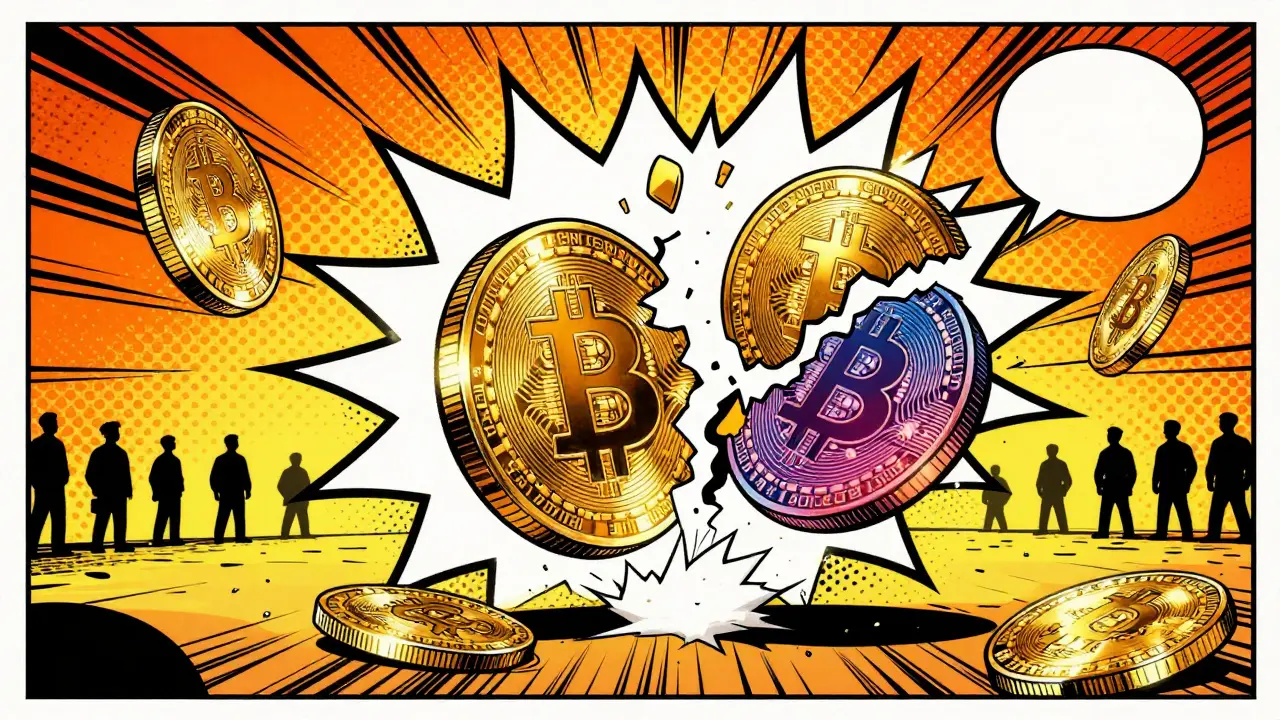
However, a faction of developers wanted bigger blocks immediately. On August 1, 2017, at block number 478,558, the chain split. This created Bitcoin Cash, championed by figures like Roger Ver and Jihan Wu. They raised the block size limit to 8MB immediately. The goal was simple: lower fees and higher transaction throughput. At its peak, Bitcoin Cash could process around 117 transactions per second compared to Bitcoin's ~3.3 TPS. For a short time, Bitcoin Cash became the fourth-largest cryptocurrency by market cap.
The drama didn't stop there. In November 2018, Bitcoin Cash itself forked again. Craig Wright and Calvin Ayre pushed for even larger blocks and a different vision for the ledger. This created Bitcoin SV. Just to complicate things further, Bitcoin SV split again in 2020 to form eCash (XEC) with a massive 1:1,000,000 conversion ratio. As Dr. Garrick Hileman noted in his Cambridge Centre report, while hard forks create viable alternatives, market forces ultimately decide survival. Bitcoin Cash captured 28% of Bitcoin's hash rate initially but fell to nearly 0.1% by 2023.
Ethereum's Philosophical Split: The DAO Hack
If Bitcoin forks were technical arguments, Ethereum's biggest fork was moral. In June 2016, a decentralized fund called The DAO was exploited. Hackers drained approximately 3.6 million ETH, worth about $50 million at the time. The community faced a choice: leave the stolen funds alone and maintain "immutable" code, or rewrite history to return the assets.
Vitalik Buterin, co-founder of Ethereum, argued that protecting user funds was necessary. On July 20, 2016, at block 1,920,000, the network executed EIP-779. This reversed the hack. About 90% of hash power moved to the new Ethereum (ETH) chain. The remaining 10% refused to accept the reversal, sticking to the original transaction history. That minority became Ethereum Classic.
While Ethereum Classic maintains a stable market cap of around $1.2 billion as of late 2023, the split established a dangerous precedent regarding immutability. Vitalik himself later admitted this fork was risky. Yet, it paved the way for future upgrades. Subsequent forks like Tangerine Whistle (October 2016) and Spurious Dragon (November 2016) fixed gas costs and contract limits. These weren't contentious splits but coordinated upgrades showing the network maturing.
| Coin Name | Fork Date | Type | Primary Motivation | Current Status |
|---|---|---|---|---|
| Bitcoin Cash (BCH) | August 1, 2017 | Hard Fork | Larger Block Size | Active |
| Ethereum Classic (ETC) | July 20, 2016 | Hard Fork | Reversing The DAO Hack | Active |
| Segregated Witness (SegWit) | August 24, 2017 | Soft Fork | Block Capacity & Fees | Integrated |
| Bitcoin Gold (BTG) | October 24, 2017 | Hard Fork | GPU Mining Capability | Low Volume |
| Ethereum Merge | September 15, 2022 | Hard Fork | Proof-of-Stake Transition | Integrated |
The Merge: Proof-of-Stake Revolution
In recent years, forks have shifted from ideological battles to necessary upgrades. The most monumental event was The Merge in September 2022. This wasn't a split that created two chains. Instead, it combined Ethereum's execution layer with a new consensus layer. Before this event, Ethereum relied on miners solving math puzzles (Proof-of-Work). Post-Merge, validators stake ETH to secure the network (Proof-of-Stake).
This upgrade reduced energy consumption by 99.95% according to the Ethereum Foundation. It required simultaneous updates to execution clients like Geth and Nethermind, alongside consensus clients like Prysm and Lighthouse. Despite fears of network instability, the success rate was 99.98%. This proves that modern blockchain coordination has become incredibly sophisticated compared to the wild days of 2017.
User Impact: Risk and Reward
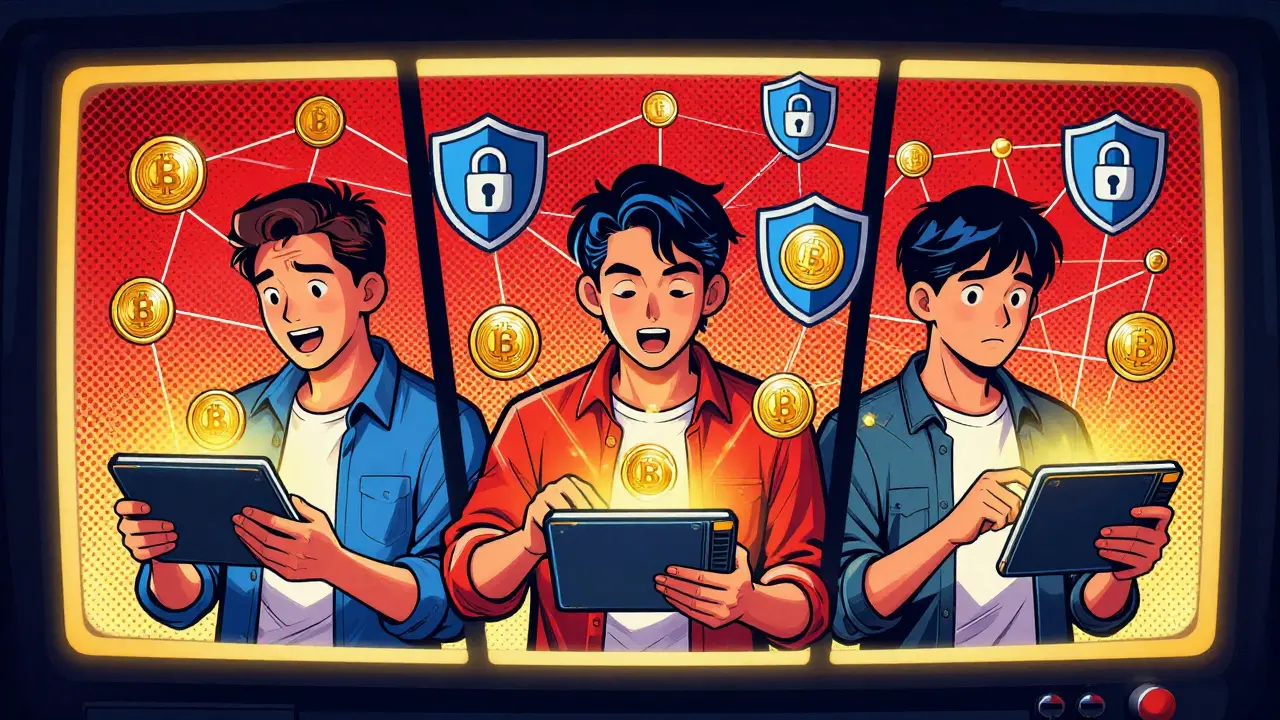
For a regular investor, forks present both opportunities and dangers. In March 2021, a Reddit user documented netting $15,000 from a $3,000 Bitcoin investment by claiming forked coins like BCH, BTG, and BSV. These "airdrops" happen automatically to holders at a specific block height. However, the technical side poses real threats. During the Bitcoin Cash fork in 2017, many users suffered replay attacks. This means a transaction sent on Bitcoin could accidentally execute on the Bitcoin Cash chain too, causing financial loss. One user reported losing $2,300 this way.
Security requires vigilance. When a fork happens, wallet providers must update software. Coinbase took months to support SegWit fully. Users who didn't update lost access to their funds temporarily. Furthermore, MyEtherWallet saw a 400% spike in "lost funds" inquiries after the DAO fork. Separating ETH and ETC holdings required manual intervention for many. Always check your wallet provider's status before moving funds around during a scheduled upgrade.
Survival Rates and Market Reality
Not every fork survives. A University of California study found that 68% of Bitcoin hard forks disappear within 18 months. Litecoin, which forked back in October 2011, remains an exception, holding a top 20 position. It proves that early forks with genuine technical differentiation survive better than those based solely on governance disputes. Bitcoin SV (BSV) and Bitcoin Gold (BTG) managed to stay in the top 100 for several years but struggle to regain early momentum.
Looking ahead, analysts suggest future forks will focus less on ideological splits and more on interoperability. Cross-chain communication is becoming the new frontier. While 2017 was defined by the battle between big blocks and small blocks, 2026 looks toward bridges connecting different chains. However, risks persist. Even planned forks carry execution danger. The Ethereum Shanghai upgrade in April 2023 required a 24-hour delay due to client incompatibilities. This reminds us that software engineering risks never truly vanish.
Will I automatically get new coins if my coin forks?
If you hold the original coin in your own wallet, yes. Most forks grant a 1:1 distribution at a specific block height. However, if you hold coins on an exchange, the exchange must announce support for the new asset. They may list it as a tradable token later, so check their announcements.
Is a hard fork always a bad thing?
Not necessarily. Sometimes hard forks are required for safety fixes or essential upgrades like The Merge. The problem arises when the community disagrees on the path forward, leading to a permanent split and brand dilution.
What is the difference between BTC and BCH?
Bitcoin Cash (BCH) is a result of a hard fork from Bitcoin. The main difference is block size. BCH started with an 8MB limit to allow more transactions, whereas BTC maintained 1MB with SegWit efficiency improvements to prioritize low fees and decentralization.
Why did Ethereum split into ETH and ETC?
The split occurred after The DAO hack. The majority chose to reverse the theft, creating the ETH chain. The minority believed code should be immutable regardless of financial loss, continuing the original chain as ETC.
Can a soft fork create a new currency?
No. Soft forks are backward compatible. Everyone stays on the same chain with updated rules. Only a hard fork, which changes rules so drastically old nodes can't follow, creates a separate chain.
Leah Lara
March 30, 2026 AT 13:37The history lesson here is pretty dense.
Justin Smith
March 30, 2026 AT 18:45Technically speaking the distinction between soft and hard forks regarding backward compatibility is often misunderstood by casual observers who conflate software updates with protocol changes. A soft fork enforces stricter rules that old nodes do not recognize as invalid but hard forks introduce rules that old nodes reject entirely creating the separation. This nuance matters immensely for node synchronization processes.
Wade Berlin
April 1, 2026 AT 15:17Oh wow another philosophical debate on blockchain immutability because why just use one currency when you can have three slightly different versions. It always amuses me how serious people get over a digital ledger split.
Colin Finch
April 3, 2026 AT 03:07The philosophical implication of reversing transactions during the DAO incident changed the fundamental definition of trust within distributed systems. We traded absolute code execution for a moral obligation to protect capital which shifts the burden of truth from the machine to the developer community consensus. Immutability becomes subjective when the majority votes to rewrite the past.
Alex Kuzmenko
April 3, 2026 AT 15:29i agree with everything said here its good info for new peeps. the replay attacks part scares me tho
Elizabeth Akers
April 5, 2026 AT 10:07security requires vigilance when stuff happens just stay updated on wallet news and dont panic move funds too much
Alex Lo
April 6, 2026 AT 03:34I remeber back in 2017 when everyone was panicing about the split. My wallet was full of bitcoin cash then too. People said we would make millions easily. The fees were getting so high on the original chain. Segwit helped fix some bloat issues i think. But the hard fork created a lot of noise in the forums. Everyone wanted free money without understanding the tech. Security was really scary during those replay attacks. You could send your btc and lose it on the other chain too. Wallet providers took months to support the new tokens. Coinbase delayed listing the coins for a long period. Some people got confused and lost access to their funds entirely. MyEtherWallet had spikes in lost fund inquiries reports. The merge later showed upgrades can work better than splits. Proof of stake reduced energy usage significantly. It feels like the industry learned lessons from the early chaos. Most small forks disappear fast eventually. Only strong ones survive the market forces. Litecoin proved longevity is possible for older chains. We still see governance disputes pop up every year. Future forks might focus on bridges instead. Interoperability looks promising for next decade. Risks never vanish completely in software engineering. I hope we stop fighting over block sizes soon. It is exhausting keeping track of all the new coins. But innovation continues regardless of the community drama.
Jay Starr
April 7, 2026 AT 01:17The emotional toll of managing assets through a contentious fork period is rarely discussed adequately in technical literature. Users felt betrayed when funds became inaccessible during the upgrade windows.
Cara Boyer
April 7, 2026 AT 04:04The centralization inherent in these forks provves the underlying weakness of decenralized systems, yet the eltes continue to manipulate hash rates for profit while the common investor suffers through volatility caused by arificial scarcity engineered by shadowy development committes who claim to act in the best intrest of the netowrk while serving thier own finacial incenetives exclusively 🛑🇺🇸
Chris R
April 8, 2026 AT 07:58While concerns about manipulation are understandable, open source development allows scrutiny that traditional finance lacks. Community governance remains messy but transparent compared to hidden bank ledgers.
Lisa Walton
April 10, 2026 AT 03:41So we burn the planet with proof of work just so we can argue about block size and call it decentralization genius moves right there.
Shubham Maurya
April 10, 2026 AT 22:47Bro u clearly dont know what imt tells urself u saved the world wth the merge 💯🚀🔥
Ashley Stump
April 11, 2026 AT 04:29Forks are just centralized control masquerading as freedom until the SEC wakes up.
Disha Patil
April 11, 2026 AT 06:34I worry if my coins are safe when they update. Its scary thinking about losing everything.
Matt Bridger
April 12, 2026 AT 14:26the merge required precise coordination of four major execution clients simultaneously. Nethermind Geth Erigon Besu
Lisa Miller
April 13, 2026 AT 05:05This technical maturity shows real progress for the ecosystem despite the initial growing pains we experienced together.
Joy Crawford
April 14, 2026 AT 06:18all this tech talk makes me feel so small and confused about where to even start with wallets. :( 😢