
If you're running a crypto exchange in Australia, you must register with AUSTRAC. There's no way around it. Starting March 31, 2026, the rules are getting even stricter - and if you're not ready, you could be facing criminal charges, fines, or worse. This isn't a suggestion. It's the law.
Who Needs to Register?
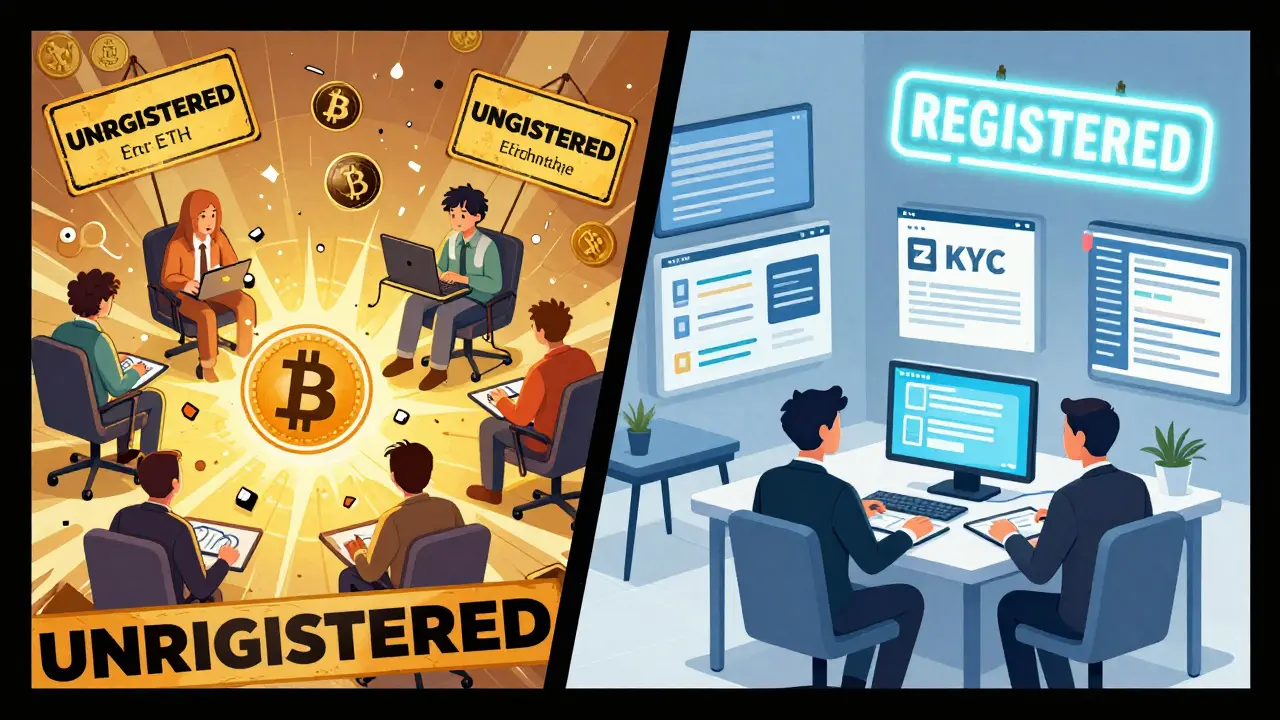
AUSTRAC (Australian Transaction Reports and Analysis Centre) doesn't care if you're a startup in Melbourne or a crypto ATM operator in Sydney. If your business exchanges Australian dollars for Bitcoin, Ethereum, or any other digital currency - or the other way around - you need to register. That includes online platforms, physical kiosks, and even peer-to-peer services that act like exchanges.As of October 2025, the rule was simple: fiat-to-crypto or crypto-to-fiat = register. But starting March 31, 2026, that changes. Now, you’ll also need registration if you:
- Exchange one cryptocurrency for another (like BTC for ETH)
- Hold or manage crypto assets for clients (custody services)
- Transfer crypto on behalf of someone else
- Help with token sales, ICOs, or other digital asset offerings
This expansion mirrors global standards from the Financial Action Task Force (FATF). Australia is catching up - and it’s not optional. If you’re doing any of these things after March 31, 2026, and you’re not registered, you’re breaking the law.
What You Need Before You Apply
You can’t just fill out a form and hit submit. AUSTRAC requires two core documents before you even start the registration process:- AML/CTF Program - This is your playbook for stopping money laundering and terrorism financing. It must include procedures for identifying suspicious activity, training staff, monitoring transactions, and reporting to AUSTRAC. You can’t copy-paste a template from the internet. It has to fit your business model.
- ML/TF Risk Assessment - You need to prove you’ve analyzed your own risks. Who are your customers? Where do funds come from? Are you dealing with high-risk jurisdictions? Are you using KYC tools? This isn’t a one-time thing - you have to review and update it every year.
If you don’t have these ready when AUSTRAC asks for them (and they will), your application gets rejected. No second chances. No extensions. No "I’ll send it next week."
The Registration Process
The application is online through AUSTRAC’s portal. But don’t be fooled - it’s not a simple form. You’ll need to provide:- Your business details (ABN, legal structure, directors)
- Proof of your AML/CTF Program and Risk Assessment
- Details of your compliance officer
- Information about your technology systems (how you verify IDs, store records, monitor transactions)
- Any previous regulatory breaches or investigations
AUSTRAC has the power to refuse, suspend, or cancel your registration if they think you’re a risk. They’ve done it before. They’ve also published names of non-compliant operators - and that reputation damage can kill a business before it even starts.
What Happens After You Register?
Registration isn’t the finish line. It’s the starting line. Once approved, you’re locked into ongoing obligations:- Know Your Customer (KYC) - You must verify every customer’s identity. That means government-issued ID, proof of address, and sometimes even source-of-funds checks. No anonymous wallets. No exceptions.
- Transaction Monitoring - All transactions over $10,000 must be reported. Suspicious activity? Report it within 24 hours. AUSTRAC uses AI to detect patterns - if your system flags something, you have to act.
- Record Keeping - You must keep records of all transactions, customer data, and compliance actions for at least seven years. Digital or paper, it doesn’t matter. They can audit you anytime.
- Annual Compliance Report - Every year, you submit a detailed report showing you’ve followed your own AML/CTF Program. Miss this, and your registration can be revoked.
There’s no automation here. No "set it and forget it." This is ongoing work. You need staff trained in compliance. You need systems that log everything. You need someone accountable.
AUSTRAC vs ASIC: What’s the Difference?
This is where people get confused. Just because you’re registered with AUSTRAC doesn’t mean you’re done. If you’re dealing with crypto assets that qualify as financial products - like tokenized shares, derivatives, or security tokens - you also need an Australian Financial Services License (AFSL) from ASIC.Here’s the split:
| Requirement | AUSTRAC | ASIC (AFSL) |
|---|---|---|
| Focus | Anti-money laundering and terrorism financing | Regulated financial products and consumer protection |
| Applies to | All crypto exchanges trading fiat and crypto | Only if you offer tokenized securities, derivatives, or investment products |
| Key obligation | Report suspicious activity, verify customers | Disclose risks, meet capital requirements, act in clients’ best interests |
| Enforcement | Penalties, criminal charges | Fines, license suspension, civil lawsuits |
Many exchanges think they’re covered by AUSTRAC alone. But if you’re selling a token that acts like a share, you’re in ASIC territory. And if you’re not licensed? You’re exposing yourself to lawsuits from investors.
What’s Changing in March 2026?
The big shift isn’t just about adding new activities. It’s about mindset. Australia is moving from "let’s watch crypto" to "crypto is finance."After March 31, 2026:
- Crypto-to-crypto trading will be treated like currency exchange - fully regulated.
- Custody services (holding crypto for clients) will require the same level of oversight as a bank.
- Platforms offering staking, lending, or yield products may need to prove they’re not running unlicensed investment schemes.
Companies that waited until the last minute are already scrambling. Those who started preparing in 2024 are now compliant. The gap between those who planned and those who didn’t is widening fast.
Common Mistakes (And How to Avoid Them)
Most businesses fail not because the rules are unfair - but because they misunderstand them.- Mistake: Using third-party KYC tools without checking if they meet AUSTRAC standards. Solution: Audit your vendor. Ask for their compliance certificates.
- Mistake: Thinking "we’re small, so we don’t need it." Solution: Size doesn’t matter. AUSTRAC has shut down tiny operators with just 50 users.
- Mistake: Assuming "we’re not in Australia, so we’re exempt." Solution: If you serve Australian customers - even one - you’re in scope.
- Mistake: Ignoring consumer law. Solution: Even if your token isn’t a financial product, you can’t lie about returns. False claims = breach of Australian Consumer Law.
What Happens If You Don’t Register?
The penalties aren’t just financial - they’re personal.- Fines up to $21 million for corporations
- Up to 10 years in prison for individuals
- Public naming on AUSTRAC’s enforcement list
- Bank accounts frozen
- Reputational damage that kills future fundraising or partnerships
There’s no warning. No grace period. AUSTRAC doesn’t send a reminder. If you’re operating without registration after March 31, 2026, you’re already in violation.
Where to Get Help
This isn’t something you figure out on your own. Most successful operators hire compliance consultants. Firms like Zitadelle AG and Xenia Compliance specialize in AUSTRAC registration packages. They don’t just help you fill forms - they help you build systems that last.You can use AUSTRAC’s online assessment tool to check if you need to register. But don’t rely on it alone. The tool gives you a yes/no. It doesn’t tell you how to build a compliant program.
Start now. Even if you think you’re not affected, re-evaluate in January 2026. The rules are changing. If you wait, you’re gambling with your business.
What’s Next?
Australia is trying to become a global hub for digital assets. But it won’t happen with loose rules. The government is already drafting laws that could require exchanges to hold financial services licenses - not just AUSTRAC registration. That means capital requirements, audit trails, and investor disclosures could be next.The message is clear: If you want to operate in Australia, you need to operate like a financial institution. Not because it’s hard - but because it’s the only way to stay legal.
Do I need AUSTRAC registration if I only trade crypto for crypto?
Yes, starting March 31, 2026. Exchanging one digital currency for another (like Bitcoin for Ethereum) will require AUSTRAC registration. Before that date, it wasn’t required - but after, it is. If you’re doing this now, prepare for compliance.
Can I operate without registration if I’m based overseas?
No. If your service is available to Australian customers - even if you’re headquartered in the U.S. or Singapore - you still need AUSTRAC registration. Location doesn’t matter. Customer location does.
How long does AUSTRAC registration take?
It can take 3 to 6 months if you’re fully prepared. If your AML/CTF Program or Risk Assessment is incomplete, AUSTRAC will pause your application until you fix it. Many applicants take over a year because they start too late.
Do I need an AFSL if I have AUSTRAC registration?
Only if you’re offering financial products. If you’re just exchanging Bitcoin for AUD, AUSTRAC is enough. But if you’re selling tokens that act like shares, bonds, or investment funds, you need an AFSL from ASIC too. Many businesses need both.
What happens if I don’t report a suspicious transaction?
You could face criminal charges. AUSTRAC requires reporting within 24 hours of detecting suspicious activity. Failing to report - even once - can lead to fines, license suspension, or prosecution. There’s no "I didn’t know" defense.
Can I use a third-party compliance service to handle everything?
Yes - and many operators do. But you remain legally responsible. If your third-party provider fails, you’re still liable. Choose a reputable firm with proven AUSTRAC experience. Don’t pick the cheapest option.