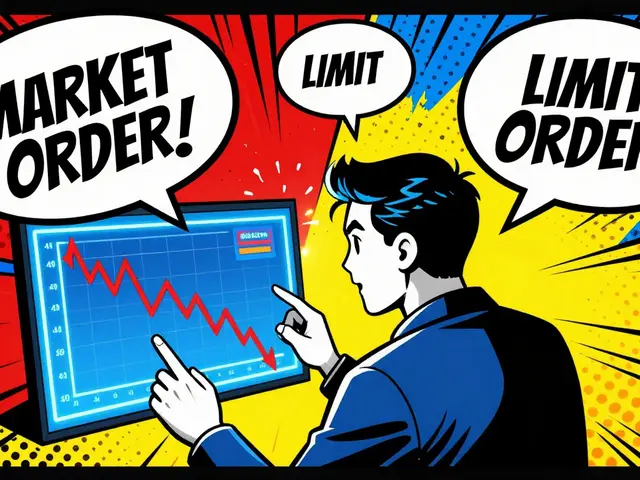
Imagine you’re staring at your screen, watching the price of Bitcoin dip. You want to buy before it bounces back. Do you click 'Buy Now' and hope for the best? Or do you set a specific price and wait, risking that the price shoots up without you? This is the fundamental choice every trader faces: market orders versus limit orders. It’s not just about clicking buttons; it’s about understanding how the engine under the hood-the order book-actually works.
In blockchain and traditional finance, these two order types are the DNA of trading. One guarantees you get in (or out) immediately. The other guarantees you get the price you want, but maybe not at all. Getting this wrong can cost you money through hidden fees or missed opportunities. Let’s break down exactly how they work inside the order book, so you can stop guessing and start executing with precision.
The Engine Room: Understanding the Order Book
Before we dive into the orders themselves, you need to see where they live. Think of the order book as a digital ledger that lists every pending buy and sell request for an asset. It’s divided into two sides: the bids (people wanting to buy) and the asks (people wanting to sell).
Every entry in this book has three pieces of data: the price, the quantity, and the time the order was placed. The highest bid and the lowest ask are always sitting right next to each other. The gap between them is called the bid-ask spread. This spread is crucial because it represents the immediate cost of trading. When you place an order, you aren’t talking to a broker who finds a buyer manually. You are interacting directly with this list of numbers. Your order either matches with someone already there, or it joins the queue waiting for someone else to match with you.
Market Orders: Speed Over Price
A market order is simple: "I want to buy (or sell) right now, no matter what." When you submit a market order, you are telling the exchange to execute your trade at the best currently available price. There is no negotiation. There is no waiting.
Here is what happens in the order book when you hit buy with a market order:
- Your order sweeps through the existing sell orders (the ask side) from the lowest price upward.
- If there isn’t enough liquidity at the best price to fill your entire order, the system automatically moves to the next highest price, then the next, until your full amount is purchased.
- You become a taker, consuming the liquidity that other traders provided.
This speed comes with a risk called slippage. Slippage is the difference between the price you expected and the price you actually got. In highly liquid markets like Ethereum or major forex pairs, slippage might be fractions of a cent. But in smaller altcoins or during high volatility, a market order can result in buying significantly higher than the last displayed price because you ate up all the cheap sell orders and had to pay more for the rest.
Use market orders when execution certainty matters more than price precision. For example, if you’re panic-selling to stop losses or rushing to buy a trending asset before it gaps up, a market order ensures you don’t miss the boat.
Limit Orders: Control Over Timing
A limit order flips the script. Here, you say, "I will only buy at $X or lower" or "I will only sell at $Y or higher." If the market doesn’t reach your price, nothing happens. Your order sits in the order book, waiting.
When you place a limit order to buy below the current market price, you are adding liquidity to the book. You become a maker. Many exchanges reward makers with lower fees-or even rebates-because you are helping the market function by providing depth.
Consider this scenario: Bitcoin is trading at $60,000. You think it’s too expensive, so you place a limit buy order at $58,000. Your order goes into the bid side of the order book. It stays there until a seller decides to sell at $58,000 or less. If Bitcoin crashes to $57,900, your order fills at $58,000 (the best available price within your limit). If Bitcoin rallies to $65,000, your order remains unfilled, and you watch from the sidelines.
The trade-off here is obvious: you save money on price and potentially fees, but you risk missing the trade entirely. This is known as execution risk. In fast-moving markets, prices can zip past your limit level without stopping long enough to fill your order.
Takers vs Makers: The Hidden Cost Structure
To truly understand which order to use, you have to look at the fee structure. Most crypto exchanges and stock brokers operate on a maker-taker fee model.
| Feature | Market Order | Limit Order |
|---|---|---|
| Execution Speed | Immediate | Conditional (when price hits) |
| Price Control | None (accepts best available) | Full (you set the max/min) |
| Role in Order Book | Taker (consumes liquidity) | Maker (provides liquidity) |
| Fee Impact | Higher (usually) | Lower or zero (often) |
| Risk | Slippage | Non-execution |
| Best For | Urgent entries/exits, high liquidity assets | Patient trading, low liquidity assets, sniping dips |
Because market orders take liquidity, they often incur higher transaction fees. Limit orders, by adding liquidity, are cheaper. Over hundreds of trades, this fee difference can eat into your profits significantly. If you are day trading, using limit orders whenever possible is a basic strategy to preserve capital.
When to Use Which: Practical Scenarios
There is no single "best" order type. The right choice depends on your goal, the asset’s liquidity, and market conditions.
Use a Market Order when:
- Liquidity is high: You are trading major pairs like BTC/USD or ETH/USD where the spread is tiny. Slippage will be minimal.
- Speed is critical: News breaks, and the chart is spiking vertically. Waiting for a limit order to fill might mean missing the move entirely.
- You are closing a position urgently: If you need to free up cash or cut losses immediately, paying a slight premium via slippage is worth the peace of mind.
Use a Limit Order when:
- You are accumulating slowly: You want to build a position over time at specific support levels.
- The asset is illiquid: In small-cap altcoins, the spread can be wide. A market order could jump the price by 1% or more instantly. A limit order protects you from this.
- You are profit-taking: Set a limit sell order above the current price to lock in gains automatically if the market reaches your target.
- You want to save on fees: If you aren’t in a rush, placing limit orders saves you the taker fee.
Common Pitfalls to Avoid
Even experienced traders make mistakes with these basics. Here are the most common traps:
1. The Partial Fill Surprise
With limit orders, you might expect your entire order to fill at once. In reality, if you try to buy $10,000 worth of a coin with thin liquidity, you might only get $2,000 filled at your limit price. The rest sits there unfilled. Always check the depth chart before placing large limit orders.
2. Ignoring the Spread in Market Orders
New traders often look at the last traded price and assume that’s what they’ll get. They place a market order and end up paying the ask price, which is higher. In volatile markets, this gap widens. Always look at the top of the order book, not just the historical price chart.
3. Setting Limits Too Tight
If you set a buy limit too close to the current market price, it might fill immediately as a marketable limit order, negating any benefit. If you set it too far away, you risk missing the bounce. Use technical analysis to find realistic support and resistance zones.
Advanced Variations: Stop-Limit Orders
Once you master market and limit orders, you’ll encounter hybrid types. The most common is the stop-limit order. This combines both concepts. You set a "stop" price that triggers the order, and a "limit" price that defines the maximum you’ll pay.
For example, if you own a token at $100 and want to protect against a crash, you might set a stop-limit sell order with a stop at $95 and a limit at $94. If the price drops to $95, your limit sell order at $94 is activated. This prevents you from selling into a massive plunge (which a market order might do), but it also carries the risk that the price skips past $94, leaving your order unfilled while the asset continues to drop.
Final Thoughts on Execution Strategy
Understanding the difference between market and limit orders isn’t just academic-it’s financial self-defense. Every time you trade, you are making a bet on whether speed or price control is more valuable in that specific moment. By reading the order book and respecting the maker-taker dynamic, you take control of your costs and risks. Don’t let the exchange’s default settings dictate your strategy. Choose your order type intentionally, based on liquidity, volatility, and your personal goals.
What is the main difference between a market order and a limit order?
A market order executes immediately at the best available current price, prioritizing speed. A limit order only executes at a specific price you set (or better), prioritizing price control but risking non-execution if the market never reaches that price.
Why do limit orders often have lower fees?
Exchanges use a maker-taker fee model. Limit orders add liquidity to the order book (making you a "maker"), which helps the market function. Market orders remove liquidity (making you a "taker"). Exchanges charge higher fees to takers to compensate for the risk they take and to incentivize makers.
What is slippage in trading?
Slippage is the difference between the expected price of a trade and the actual executed price. It commonly occurs with market orders in low-liquidity or high-volatility markets, where there aren't enough orders at the desired price to fill the entire trade, forcing the system to accept worse prices.
Can a limit order fail to execute?
Yes. If the market price never reaches your specified limit price, the order will remain open until you cancel it or it expires (depending on the order duration settings). This is known as execution risk.
When should I use a market order in crypto trading?
Use market orders when you need immediate execution, such as entering a rapidly moving trend or exiting a position quickly to manage risk. They are also safer in highly liquid markets like Bitcoin or Ethereum where slippage is typically minimal.