Imagine running a company without a CEO, a board of directors, or even an office building. Sounds impossible, right? Yet, this is exactly how Decentralized Autonomous Organizations (DAOs) operate. Instead of top-down orders, decisions are made by the community through transparent, code-enforced rules. If you’ve heard about DAOs but aren’t sure how they actually function on a day-to-day basis, you’re not alone. The concept is revolutionary, but the mechanics can feel abstract.
In this guide, we’ll break down the core components of DAO governance systems that allow communities to manage funds, update protocols, and make collective decisions without centralized authority. We’ll look at how proposals move from idea to execution, the different ways voting works, and the real-world challenges these organizations face. Whether you’re a crypto enthusiast or just curious about the future of work, understanding these mechanics is essential for navigating the Web3 landscape in 2026.
The Four Pillars of DAO Governance
At its heart, a DAO is a set of rules written in code that dictates how an organization operates. These rules aren’t enforced by lawyers or managers; they are enforced by the blockchain itself. To understand how this works, you need to know the four key components that drive every decision:
- Proposals: These are suggestions submitted by members for the community to consider. A proposal could be anything from funding a new marketing campaign to changing the technical parameters of a protocol.
- Voting Mechanisms: This is the process by which members cast their votes. Unlike traditional companies where one person might have veto power, DAOs use various models to ensure fair representation, often weighted by token holdings.
- Governance Tokens: These digital assets represent ownership and voting power. Holding more tokens typically gives you more influence, creating a democratic structure based on stake rather than hierarchy.
- Smart Contracts: These are self-executing programs on the blockchain. Once a proposal passes, the smart contract automatically executes the decision-such as releasing funds-without any human intervention.
This combination creates a system that is both transparent and immutable. Anyone can audit the code to see how the DAO operates, ensuring trust isn’t placed in people but in mathematics.
From Idea to Execution: The Proposal Lifecycle
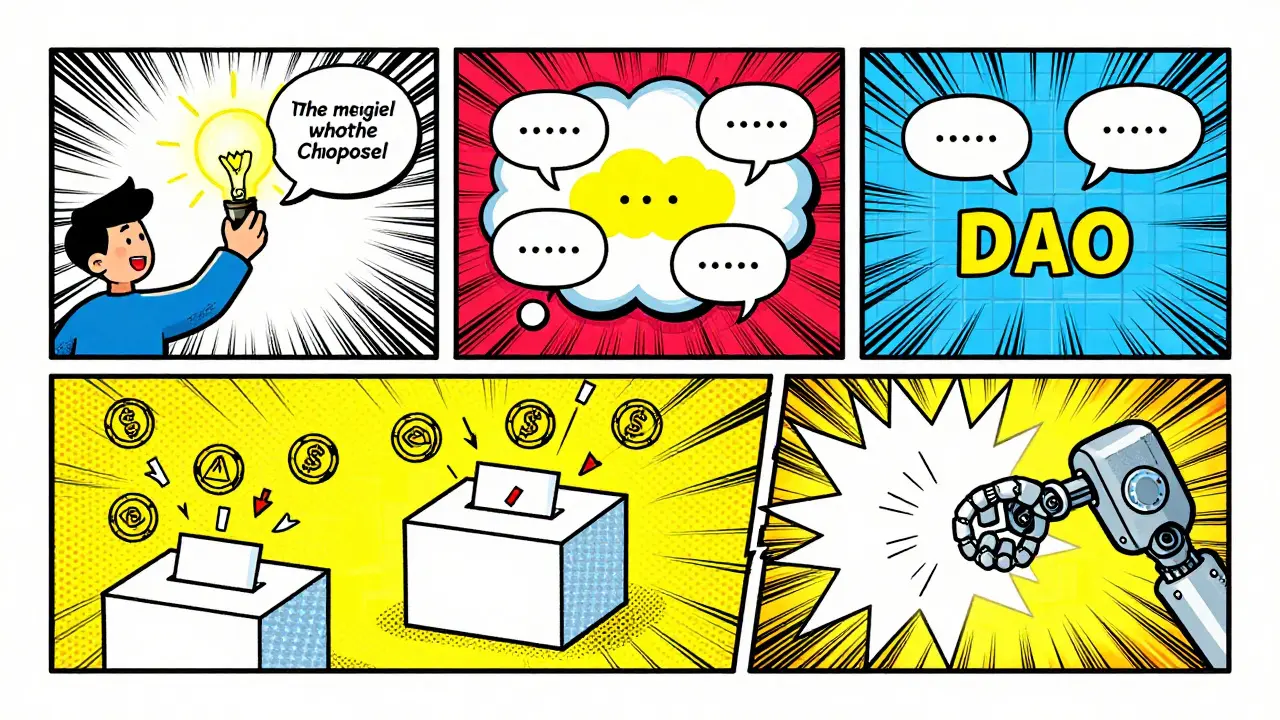
So, how does a random idea become an official action taken by the organization? It follows a strict, four-step lifecycle designed to prevent errors and malicious activity.
- Submission: A member drafts a proposal. This usually includes a detailed explanation of what they want to change and why. In many DAOs, you need a minimum amount of governance tokens to submit a proposal, preventing spam.
- Discussion: Before voting begins, the community discusses the proposal in forums like Discord, Telegram, or dedicated governance platforms. This stage is crucial for refining ideas and identifying potential risks. Stakeholders debate the implications and suggest modifications.
- Voting: Token holders cast their votes during a set period. Voting power is usually proportional to the number of tokens held. Some systems use quadratic voting to reduce the influence of large holders, while others use simple majority rules.
- Execution: If the proposal meets the required threshold, the smart contract automatically executes it. For example, if the vote was to send $10,000 to a developer, the blockchain transaction happens instantly and irrevocably. No manager needs to sign a check.
This automated execution eliminates the need for trusted intermediaries. You don’t have to trust that the treasury manager will actually send the money; the code guarantees it.
Voting Models: One Size Does Not Fit All
Not all DAOs vote the same way. The choice of voting mechanism significantly impacts security, efficiency, and fairness. Here are two common models and their trade-offs:
| Mechanism | How It Works | Pros | Cons |
|---|---|---|---|
| Permissioned Relative Majority | Votes are counted based on who voted yes vs. no. No minimum turnout required. | Fast, cheap, and easy to participate in. | Risk of low participation; a single active member could sway decisions. |
| Rage Quitting (Sponsored) | Proposals require sponsorship. After approval, there’s a grace period where dissenters can withdraw their stake. | Protects minority interests; prevents bad actors from hijacking the DAO. | Slow process; complex to implement; may discourage quick decisions. |
The permissioned relative majority model is popular because it’s straightforward. However, it has a major flaw: if only one person votes, they control the outcome. This is risky for large treasuries. To mitigate this, some DAOs require sponsorship, where other members must endorse a proposal before it goes to a vote. This adds a layer of social consensus.
On the other hand, the rage quitting mechanism, pioneered by Moloch DAO, offers higher security. If a proposal passes but you disagree with it, you can “rage quit” by withdrawing your tokens from the DAO before the changes take effect. This ensures that those who remain are truly aligned with the decision. The downside? It takes time. In fast-moving markets, waiting days for a grace period can be impractical.
Real-World Examples of DAO Governance
Theory is helpful, but seeing how actual DAOs operate provides better context. Different projects have tailored their governance to fit their specific goals:
- Ethereum Name Service (ENS) DAO: ENS manages the .eth domain names. Their governance focuses on protocol upgrades and fee structures. They use a quadratic voting system to ensure that small holders have a voice alongside large ones, promoting broader community alignment.
- ConstitutionDAO: This DAO famously formed to bid on a copy of the US Constitution. It operated under a strict constitutional framework, emphasizing legal compliance and clear dissolution plans if they lost the bid. It showed how temporary, goal-oriented DAOs can work.
- Friends With Benefits (FWB): As a social DAO, FWB focuses on community building rather than financial returns. Their governance is lighter, prioritizing cultural initiatives and member engagement over rigid financial controls.
- Juicebox: This platform enables creators to launch their own DAOs. Juicebox implements flexible treasury management tools, allowing projects to automate recurring payments and grant distributions based on community votes.
These examples show that there is no single “correct” way to govern a DAO. The structure depends on whether the group is focused on finance, social connection, or infrastructure development.
The Challenges of Decentralized Decision-Making
While DAOs offer transparency and autonomy, they are not without significant hurdles. Two major issues plague most governance systems today:
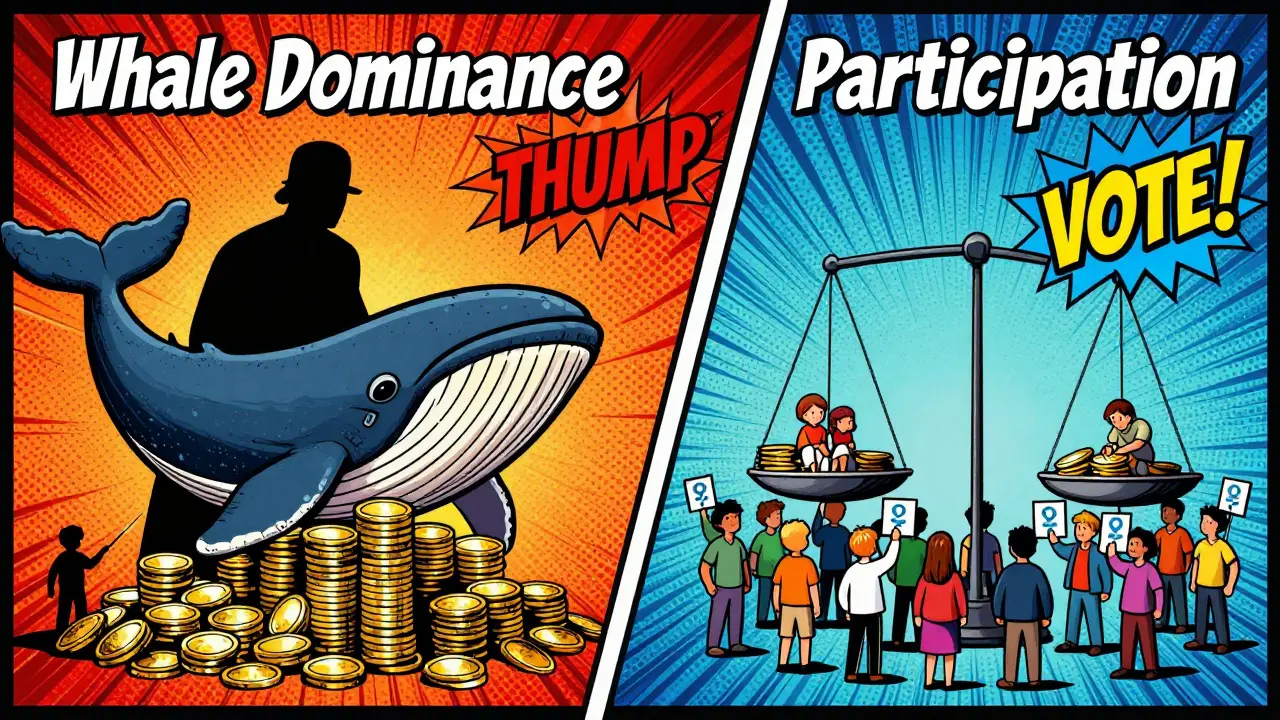
Whale Dominance: Since voting power is often tied to token ownership, wealthy individuals (“whales”) can exert disproportionate influence. This undermines the democratic ideal of “one person, one vote.” Even with quadratic voting, whales can still coordinate to push agendas that benefit them personally. Balancing fairness with incentive compatibility remains a tough problem.
Low Participation Rates: Many token holders simply don’t vote. They might be unaware of proposals, find the process too complex, or feel their individual vote doesn’t matter. When participation is low, decisions are made by a tiny minority, which can lead to poor outcomes or even exploitation. Engaging the community consistently requires effort beyond just writing code.
To address these, many DAOs are experimenting with reputation-based systems, where influence is earned through contribution rather than just buying tokens. Others are using off-chain signaling tools to gauge interest before committing to formal on-chain votes.
Why Smart Contract Security Is Non-Negotiable
Because DAO actions are executed automatically by code, bugs in that code can be catastrophic. If a smart contract has a vulnerability, attackers can drain the treasury before anyone can vote to stop them. This makes security audits critical.
Modern DAOs use secure programming languages and undergo multiple independent audits before deployment. Additionally, many include emergency pause functions, though this contradicts the principle of full decentralization. The trend in 2026 is toward modular security, where core governance logic is separated from experimental features, reducing the attack surface.
Trust in a DAO isn’t about trusting people; it’s about trusting the math and the code. That’s why transparency is paramount. Every transaction, every vote, and every line of code is visible on the blockchain for anyone to inspect.
The Future of DAO Governance
As DAOs grow larger and more complex, governance models are evolving. Researchers are looking into polycentric governance theories, where multiple overlapping systems handle different aspects of decision-making. This could help scale coordination without sacrificing decentralization.
We’re also seeing more integration with real-world identities and legal frameworks. While pseudonymity is a core feature of crypto, some DAOs are exploring ways to align with regulatory requirements without compromising privacy. This balance will be key for mainstream adoption.
Ultimately, DAO governance represents a shift from hierarchical control to distributed coordination. It’s messy, slow, and sometimes inefficient compared to a traditional startup. But it offers something unique: true community ownership. As technology improves and best practices emerge, we’ll likely see more robust, user-friendly governance tools that make participating easier for everyone.
What is a DAO in simple terms?
A DAO, or Decentralized Autonomous Organization, is an internet-native business owned and managed by its members. Instead of having bosses or employees, decisions are made collectively through voting, and the rules are enforced by computer code (smart contracts) on a blockchain.
How do I get voting power in a DAO?
In most DAOs, voting power comes from holding governance tokens. You can earn these by contributing to the project, buying them on a market, or receiving them as rewards. The more tokens you hold, the more influence you generally have, though some DAOs use alternative methods like quadratic voting to limit whale dominance.
Can a DAO be hacked?
Yes, if the smart contracts governing the DAO have vulnerabilities. Since code is law, a bug can allow attackers to steal funds or manipulate votes. This is why reputable DAOs undergo rigorous security audits and often use multi-signature wallets for critical actions to add an extra layer of protection.
Is DAO governance faster than traditional companies?
Usually, no. Traditional companies can make decisions quickly because a few executives can agree. DAOs require discussion, voting periods, and sometimes grace periods, which can take days or weeks. However, once a decision is made, execution is instant via smart contracts.
What is rage quitting in a DAO?
Rage quitting is a safety mechanism where, after a proposal passes, members who disagree have a window to withdraw their tokens from the DAO. If enough people leave, the proposal is canceled. This protects minority interests but slows down the decision-making process.