Imagine locking up your money to buy a vote in a club that might not even meet next month. That’s essentially what governance token staking is about, but with real financial stakes. You’re not just holding a coin; you’re actively participating in the decision-making process of a decentralized protocol while earning interest on your holdings. It sounds like a win-win, right? But here’s the catch: many people jump in without understanding the lock-up periods, slashing risks, or the difference between true governance power and mere economic influence.
If you’ve ever looked at your DeFi portfolio and wondered how to squeeze more value out of idle tokens, this guide breaks down exactly how governance token staking works. We’ll look at the mechanics, compare major platforms like Algorand and Aave, and help you decide if the yields are worth the complexity. No jargon-heavy fluff-just the facts you need to make an informed choice.
What Is Governance Token Staking?
At its core, governance token staking is a mechanism where users lock their cryptocurrency tokens into smart contracts to earn rewards and gain voting rights within a Decentralized Autonomous Organization (DAO). Unlike traditional Proof-of-Stake (PoS) systems, which primarily secure the blockchain network itself, governance staking focuses on protocol management. You aren’t validating transactions for the whole chain; you’re helping steer the ship of a specific application, like a lending platform or an exchange.
This concept gained massive traction after MakerDAO introduced MKR tokens in 2017, but it exploded during the "DeFi Summer" of 2020 when Compound launched COMP. Suddenly, users realized they could earn free governance tokens just by using a protocol. Today, about 78% of the top 50 DeFi protocols use some form of this model. The goal is simple: align user incentives with protocol health. If you have skin in the game, you’re more likely to vote responsibly and stick around long-term.
The Dual Value Proposition: Why Stake?
Why would you lock up assets instead of trading them? Two main reasons drive participation:
- Financial Yield: You earn annual percentage yields (APY) ranging from 3% to over 12%, depending on the platform and market conditions.
- Governance Power: Your staked tokens often translate directly into voting weight. More stake equals more say in protocol upgrades, fee structures, and treasury allocations.
However, it’s crucial to distinguish between passive income and active governance. Some protocols, like Curve Finance, offer boosted rewards for long-term lockers (veCRV model), creating a hierarchy where long-term believers get better returns. Others, like Uniswap, offer modest yields (around 3.2% APY as of mid-2024) primarily for the privilege of voting. Ask yourself: Are you here for the cash flow, or do you genuinely want to shape the future of the project? If it’s just the cash, there are often simpler ways to earn yield without tying up your capital in complex governance mechanisms.
How Do Rewards Actually Work?
Reward calculations aren’t magic; they follow specific formulas defined in smart contracts. Generally, three factors determine your payout:
- Amount Staked: Most protocols use linear curves. Double your stake, double your reward share.
- Duration: Time-weighted models reward patience. For example, Aave uses square-root weighting, meaning doubling your stake doesn’t quite double your voting power, encouraging broader distribution.
- Funding Source: This is critical. Are rewards paid from actual protocol revenue (like transaction fees) or from new token emissions (inflation)?
Be wary of high APYs funded solely by inflation. A 2023 report noted that 32% of governance staking rewards were unsustainable because they relied on printing new tokens rather than real earnings. If a protocol pays you 20% APY but the token price drops 30% due to dilution, you’re losing money in dollar terms. Always check if the yield comes from real usage or just empty printing presses.
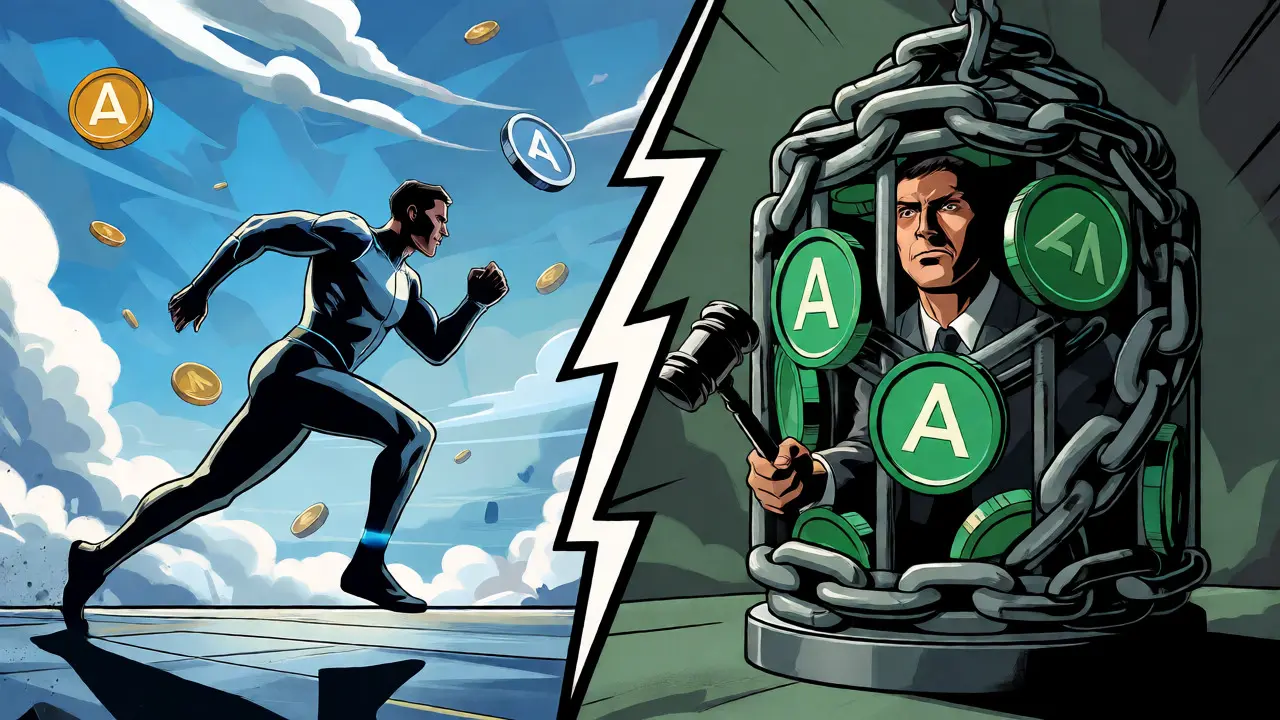
Platform Comparison: Algorand vs. Ethereum Ecosystems
Not all staking experiences are created equal. Technical requirements and liquidity options vary wildly. Let’s look at two contrasting approaches.
| Feature | Algorand (ALGO) | Aave (AAVE) | Curve Finance (CRV) |
|---|---|---|---|
| Lock-up Period | None (Flexible) | Minimum 10 days | Up to 4 years (for max boost) |
| Slashing Risk | None | Low (mostly governance related) | None (but opportunity cost) |
| Min. Requirement | 30,000 ALGO for node operators | Variable (no hard min for staking) | Any amount (boost scales with time) |
| Typical APY | ~4-6% (variable) | ~5% (plus safety module rewards) | ~12.7% (with max lock) |
| Technical Difficulty | Moderate (Node operation) | Easy (Wallet interface) | Moderate (Complex UI) |
Algorand stands out for its user-friendly approach. In 2024, they eliminated the previous three-month commitment period, allowing instant liquidity while still offering rewards. There are no slashing penalties, so you won’t lose tokens for minor technical hiccups. This makes it ideal for users who want flexibility.
In contrast, Ethereum-based protocols like Aave often require fixed lock-ups. You’re committing capital for a set time, which can be risky if the market crashes. However, these platforms usually have deeper liquidity and more mature governance communities, meaning your vote actually carries significant weight in a larger ecosystem.
The Risks: Plutocracy and Impermanence
It’s not all sunshine and yields. The biggest criticism of governance staking is plutocracy-the rule of the rich. If one entity holds 28% of the voting power, as happened in a notable MakerDAO incident, does democracy really exist? Large holders can sway votes to benefit themselves, potentially at the expense of smaller participants.
Additionally, consider the tax implications. In many jurisdictions, including the US, staking rewards are taxed as ordinary income upon receipt. If you’re earning 5% APY on a volatile asset, you might owe taxes on gains that disappear when you sell later. Also, beware of "impermanent loss" if you’re using liquid staking derivatives that pair your governance token with another asset.

Getting Started: A Step-by-Step Checklist
Ready to try it? Don’t dive in headfirst. Follow this path to minimize risk:
- Research the Protocol: Check their revenue sources. Do they have real users paying fees?
- Start Small: Use a small portion of your portfolio to test the waters.
- Understand Liquidity: Can you unstake instantly, or is there a waiting period? Algorand allows instant exit; others may take weeks.
- Track Taxes: Keep records of every reward received. Tools like CoinTracker can help automate this.
- Engage: Read the proposals. If you don’t vote, you’re just a passive investor with extra steps.
For beginners, liquid staking solutions like Lido or Rocket Pool are good entry points. They let you maintain liquidity while earning yield, though the governance rights might be delegated rather than held directly. Once comfortable, you can move to direct governance staking on platforms like Aave or Uniswap.
The Future: Where Is This Heading?
The sector is evolving rapidly. Analysts predict a shift toward reputation-based voting to combat plutocracy. Projects like 1Hive are experimenting with systems where consistent, positive contributions earn more voting power than just buying tokens. We’re also seeing cross-chain governance, allowing unified voting across multiple ecosystems, similar to Polkadot’s XCMv3 upgrade.
However, consolidation is coming. Gartner warns we’re at the "peak of inflated expectations." Expect weaker projects with unsustainable reward models to fail, leaving only those with real utility and revenue. By 2026, the staked value could hit $210 billion, but only for protocols that prove their governance is more than just a marketing gimmick.
Is governance token staking safe?
Safety depends on the platform's code audit history and decentralization level. Smart contract bugs are the primary risk. Platforms like Algorand have no slashing, reducing operational risk, while Ethereum protocols may have higher complexity but longer track records. Always check if the contract has been audited by reputable firms.
Can I lose my staked tokens?
In most governance staking models, you cannot lose your principal amount unless there is a catastrophic protocol failure or hack. Unlike PoS validator staking, where slashing occurs for downtime or double-signing, governance staking rarely penalizes you for being offline. However, the value of the token itself can drop significantly.
Do I need to run a node to stake?
No, not for most DeFi governance staking. You typically interact via a web wallet interface. Running a full node is required for certain Layer-1 networks like Algorand to earn maximum rewards, but many protocols allow simple delegation through smart contracts without hardware maintenance.
Are staking rewards taxable?
Yes, in many countries including the UK and US, staking rewards are considered taxable income at the moment they are received. The fair market value at the time of receipt is used to calculate the tax liability. Consult a tax professional for your specific jurisdiction.
What happens if I unstake early?
Policies vary. Some platforms charge a penalty fee or forfeit accrued rewards. Others, like Algorand’s flexible model, allow instant withdrawal with no penalty. Always read the specific terms of the smart contract before locking your funds.