
Imagine you own a grocery store. To keep the shelves stocked and customers happy, you need inventory. In the world of Decentralized Finance, or DeFi, that inventory is cryptocurrency, and the shelves are called liquidity pools. If you want to trade tokens on platforms like Uniswap or SushiSwap, there must be someone willing to hold those assets so trades can happen instantly without a middleman.
This is where Liquidity Mining comes in. It’s a mechanism that pays you to provide that inventory. You deposit your crypto into these pools, and in return, you earn rewards-usually a cut of the trading fees or new tokens issued by the platform. It sounds like free money, but it’s not quite that simple. There are risks, technical steps, and specific strategies involved. Let’s break down exactly how it works, what you stand to gain, and where things can go wrong.
How Liquidity Mining Actually Works
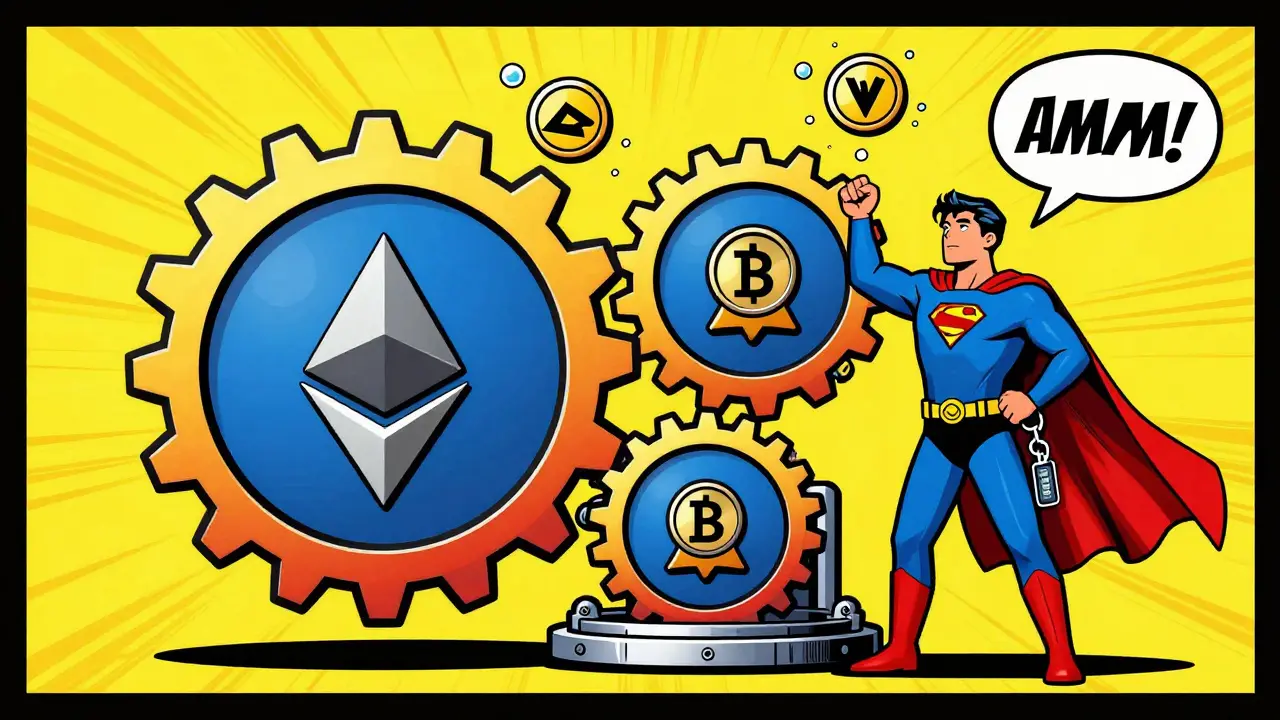
At its core, liquidity mining is about providing fuel for decentralized exchanges (DEXs). These exchanges don’t have order books like traditional stock markets. Instead, they use automated market makers (AMMs). An AMM is a smart contract that holds pairs of tokens-for example, Ethereum (ETH) and USD Coin (USDC)-and allows users to swap between them based on a mathematical formula.
To participate, you need to deposit equal values of both tokens in a pair. If ETH is trading at $3,000 and you want to deposit $600 worth of liquidity, you would put in 0.2 ETH ($600) and 600 USDC. The smart contract then issues you LP Tokens (Liquidity Provider Tokens). Think of these LP tokens as a receipt. They prove your share of the pool. As long as you hold them, you’re entitled to your portion of the trading fees generated by the pool.
Here is the step-by-step process most users follow:
- Set up a Web3 wallet: You’ll need a non-custodial wallet like MetaMask or Phantom to interact with DeFi protocols.
- Acquire tokens: Buy the specific token pairs required for the pool you want to join (e.g., ETH and USDC).
- Connect to a DEX: Go to a platform like Uniswap, Curve, or Balancer and connect your wallet.
- Add Liquidity: Select the pool, enter the amount of one token, and let the interface calculate the matching amount of the second token.
- Receive LP Tokens: Once the transaction confirms, you receive LP tokens representing your stake.
- Earn Rewards: Over time, the pool generates fees from traders swapping tokens. Some protocols also distribute additional governance tokens as incentives.
The beauty of this system is automation. Smart contracts handle everything. You don’t need to trust a bank or an exchange operator. However, this autonomy means you are responsible for managing your assets and understanding the risks.
Liquidity Mining vs. Staking and Yield Farming
It’s easy to get confused because DeFi has a lot of buzzwords. People often use “liquidity mining,” “staking,” and “yield farming” interchangeably, but they are distinct concepts. Understanding the difference helps you choose the right strategy for your goals.
| Strategy | Primary Action | Risk Level | Reward Source |
|---|---|---|---|
| Liquidity Mining | Deposit two tokens into a trading pool | Medium to High | Trading fees + Protocol tokens |
| Staking | Lock single asset to secure network | Low to Medium | Network consensus rewards |
| Yield Farming | Move assets across multiple protocols | High | Incentive tokens + Complex yields |
Staking involves locking up a single cryptocurrency to help secure a blockchain network (like Proof-of-Stake chains). It’s generally safer because you aren’t exposed to price volatility between two different assets. Liquidity Mining, on the other hand, requires you to hold a pair of assets, which introduces the risk of impermanent loss.
Yield Farming is the broader umbrella term. Liquidity mining is actually a subset of yield farming. While liquidity mining focuses on providing capital to DEXs, yield farming might involve lending your tokens on Aave, borrowing against them, and then depositing the borrowed funds into another pool. It’s more complex, potentially higher yielding, but carries significantly higher risk due to smart contract interactions and leverage.
The Hidden Cost: Impermanent Loss Explained
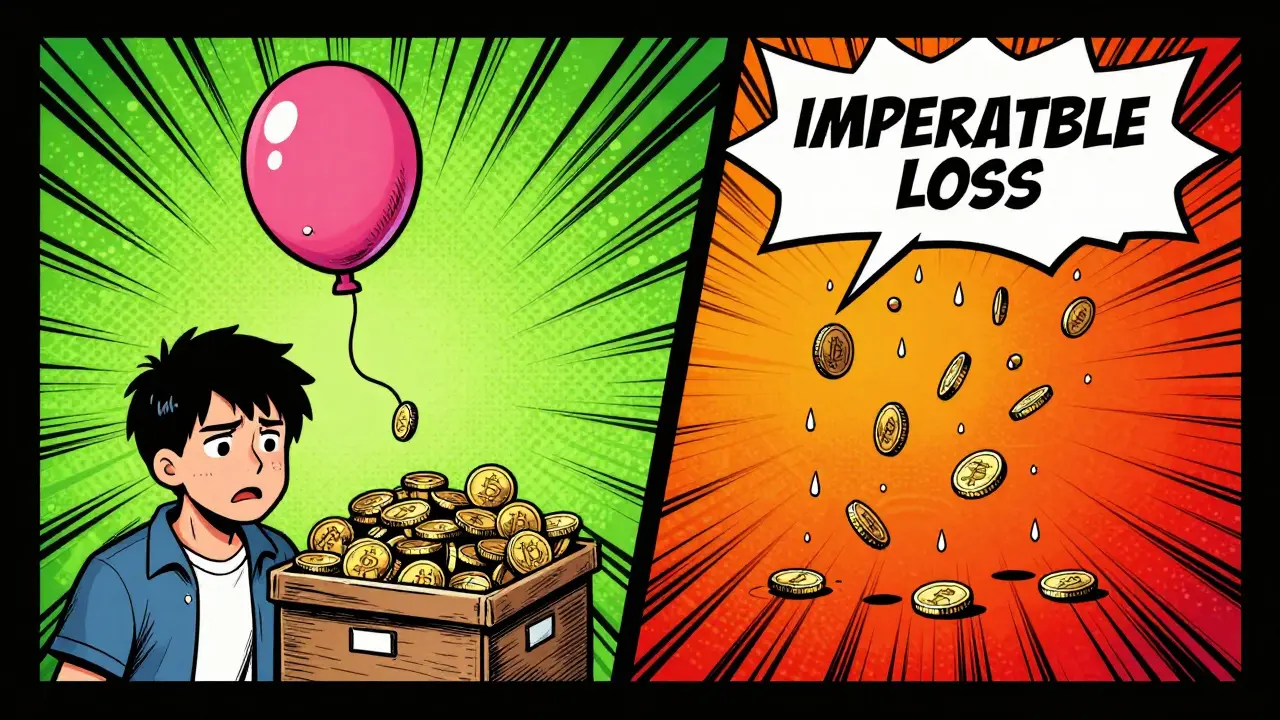
If there is one thing you must understand before starting liquidity mining, it is Impermanent Loss. This is the primary reason many beginners lose money despite earning high annual percentage yields (APY).
Impermanent loss occurs when the price ratio of the two tokens in your pool changes significantly after you deposited them. Because AMMs rebalance automatically to maintain the product of reserves constant, your portfolio composition shifts compared to if you had just held the tokens in your wallet.
Let’s look at a concrete example. Suppose you deposit $1,000 worth of ETH and $1,000 worth of USDC into a pool. Total value: $2,000. Now, imagine ETH doubles in price to $6,000. Meanwhile, USDC stays at $1.
Due to arbitrage traders taking advantage of the price difference, the pool will now contain less ETH and more USDC than when you started. When you withdraw, you might find you have fewer ETH tokens than you would have if you’d just held them. Even though you earned trading fees, the drop in the value of your principal investment relative to holding might outweigh those gains. This loss is “impermanent” only until you withdraw. If prices revert to their original ratio, the loss disappears. If they don’t, it becomes permanent.
To minimize this risk, many experienced providers stick to stablecoin pairs (like USDC/USDT) or correlated assets (like ETH/wstETH), where price divergence is minimal. Volatile pairs offer higher fee potential but come with much greater impermanent loss exposure.
Top Platforms for Liquidity Mining in 2026
Not all DEXs are created equal. Some offer better security, lower fees, or more efficient capital usage. Here are some of the leading platforms where liquidity mining thrives:
- Uniswap: The largest DEX by volume. Uniswap V3 introduced concentrated liquidity, allowing providers to allocate capital within specific price ranges. This boosts capital efficiency but requires active management.
- Curve Finance: Specializes in stablecoins and pegged assets. It’s known for low slippage and minimal impermanent loss, making it a favorite for conservative yield seekers.
- Balancer: Allows custom pool weights. You can create a pool with 80% ETH and 20% USDC, for instance, giving you flexibility in risk exposure.
- PancakeSwap: Built on Binance Smart Chain (now BNB Chain), it offers lower gas fees, making it accessible for smaller investors who might find Ethereum mainnet costs prohibitive.
When choosing a platform, consider the total value locked (TVL), the age of the protocol, and whether its smart contracts have been audited by reputable firms. Newer platforms may offer juicy APYs to attract users, but they carry higher smart contract risk.
Step-by-Step: How to Start Liquidity Mining Safely
Ready to dive in? Follow this checklist to ensure you start safely and avoid common pitfalls.
- Start Small: Don’t invest money you can’t afford to lose. Begin with a small amount to learn the interface and mechanics.
- Choose the Right Pair: For beginners, stablecoin pairs are the safest entry point. They generate lower yields but protect you from severe impermanent loss.
- Check Gas Fees: On networks like Ethereum, transaction fees can eat into your profits. Consider using Layer 2 solutions like Arbitrum or Optimism, where fees are fractions of a cent.
- Use Reputable Tools: Use aggregators like Zapper.fi or DeBank to track your positions. They help visualize your exposure and calculate real-time returns.
- Monitor Regularly: Unlike staking, liquidity mining often requires attention. If you’re using concentrated liquidity, you may need to adjust your price range as the market moves.
- Tax Implications: In many jurisdictions, receiving reward tokens is considered taxable income. Keep records of all deposits, withdrawals, and rewards received.
Risks Beyond Impermanent Loss
While impermanent loss gets all the attention, other risks exist. Smart Contract Risk is paramount. If the code governing the pool has a bug, hackers could drain the entire pool. Always check if a protocol has undergone audits by firms like CertiK or OpenZeppelin.
Regulatory Risk is also growing. Governments worldwide are scrutinizing DeFi. While liquidity mining itself isn’t illegal, the tokens you earn might be classified as securities in some regions, creating tax complications or legal gray areas.
Finally, there’s Platform Risk. Some projects rug pull-they abandon the project and run off with the liquidity. Stick to established, community-governed protocols with transparent teams.
Is liquidity mining safe?
Liquidity mining carries moderate to high risk. While the technology is robust, you face impermanent loss, smart contract vulnerabilities, and market volatility. It is not "safe" in the traditional banking sense. Only invest what you can afford to lose.
How much can I earn from liquidity mining?
Returns vary wildly. Stablecoin pairs might offer 2-5% APY, while volatile pairs can promise 20-100%+ APY. However, high APYs usually come with high impermanent loss. Realistic net returns after losses often fall between 5-15% for experienced users.
What is the minimum amount to start?
There is no official minimum, but practical limits exist. On Ethereum, high gas fees make deposits under $500 inefficient. On Layer 2 networks or BNB Chain, you can start with as little as $50-$100.
Can I lose all my money in liquidity mining?
Yes, though it’s rare. You could lose everything if the smart contract is hacked or if one of the tokens in your pair goes to zero. Diversification and sticking to blue-chip assets mitigate this risk.
Do I need to pay taxes on liquidity mining rewards?
In most countries, yes. Rewards are typically treated as ordinary income at the time of receipt. Additionally, selling those tokens later may trigger capital gains tax. Consult a local tax professional for advice specific to your jurisdiction.