
Crypto Swap Cost Calculator
Compare swap costs for your transaction across different platforms. The calculator shows total fees for Uniswap v4 on Avalanche versus Ethereum, centralized exchanges, and other DEXs.
Total Cost Breakdown
Cost Comparison
Why this matters
Uniswap v4 on Avalanche provides the lowest costs for swaps under $10,000. The gas fee is only about $0.01-$0.05 compared to $3-$15 on Ethereum. For a $5,000 swap, you save $20-$25 compared to Ethereum and $15 compared to centralized exchanges.
When you want to swap crypto without a middleman, Uniswap v4 on Avalanche isn’t just another option-it’s the most efficient one right now. If you’ve ever paid $50 in gas fees to trade $200 worth of ETH on Ethereum, you know why this combo matters. Uniswap v4 launched in early 2025 with a radical upgrade: hooks. These let developers build custom trading logic directly into the protocol. On Avalanche, that means faster trades, lower fees, and deeper liquidity-all without sacrificing the open, permissionless nature of DeFi.
What Makes Uniswap v4 Different?
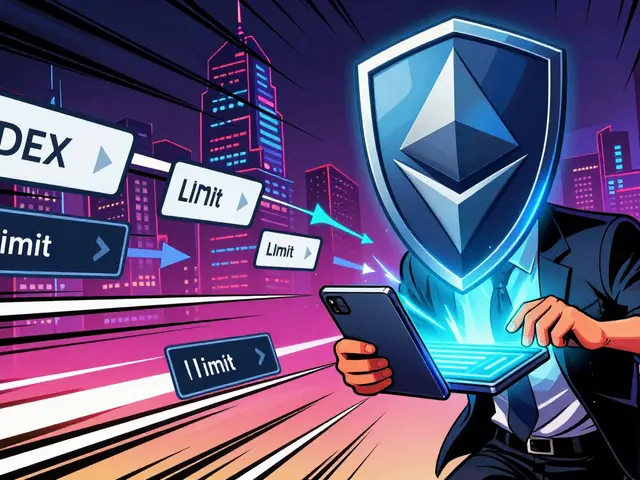
Uniswap v4 isn’t just an update. It’s a complete redesign. Before v4, every liquidity pool had to be created the same way. You picked a pair, set a fee (0.01%, 0.05%, 0.3%, or 1%), and that was it. No exceptions. v4 changed that with hooks. Think of them like plug-ins for your trading pool. Want to automatically rebalance your liquidity when prices shift? Add a hook. Want to charge different fees based on time of day or trading volume? Add a hook. Want to enable on-chain limit orders without relying on off-chain oracles? Also a hook.This flexibility means developers can now build advanced strategies right on-chain. For traders, that translates to better prices, less slippage, and more control. And because Uniswap v4 reduces pool creation costs by 99.99% compared to v3, new token pairs pop up faster. You’ll find newer, smaller tokens listed here before they even hit centralized exchanges.
Why Avalanche Makes Uniswap v4 Even Better
Uniswap runs on 34 blockchains, but Avalanche stands out. Why? Three things: speed, cost, and reliability.Avalanche finalizes transactions in under a second. Ethereum? Sometimes 15-30 seconds during peaks. On Avalanche, your swap confirms before you finish reading this sentence. Gas fees? Around $0.01-$0.05 per transaction. On Ethereum mainnet, the same trade can cost $3-$15. That’s not a difference-it’s a revolution for small traders and frequent users.
The Alpenglow upgrade in late 2024 made Avalanche even more scalable. Block production is faster, validator rewards are optimized, and network congestion is rare. That’s why major DeFi projects like Aave and Trader Joe moved key operations here. Uniswap v4 on Avalanche isn’t just a copy-it’s a performance upgrade.
How Fees Compare: Uniswap v4 vs. Centralized Exchanges
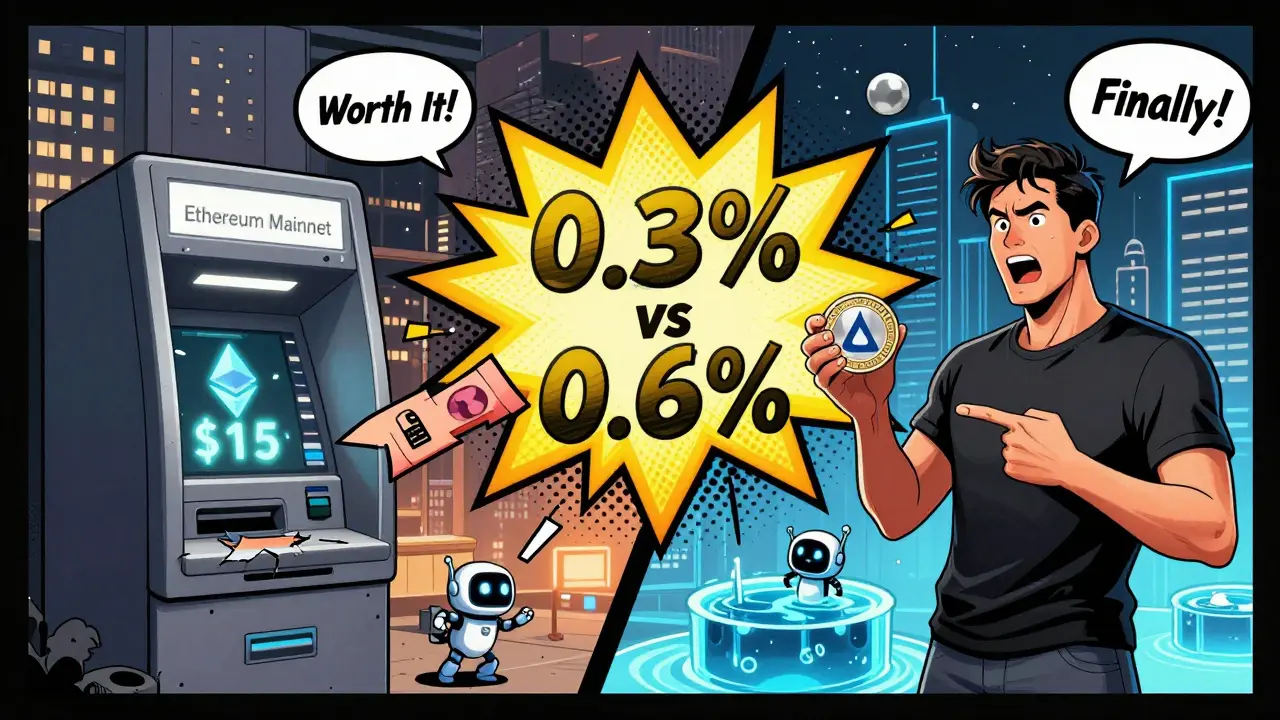
Let’s say you want to swap $5,000 of ETH for USDC. On Coinbase Advanced, you’d pay 0.6%-that’s $30. On Uniswap v4, the standard fee is 0.3%-$15. And that’s just the protocol fee. On Avalanche, your network fee is less than 10 cents. Total cost? Around $15.10.On Ethereum mainnet? You’re looking at $15 + $5-$10 in gas. Total: $20-$25. That’s 30-60% more. Even if you use a Layer 2 like Arbitrum, fees are still 2-3x higher than Avalanche. And you don’t get sub-second finality.
Some DEXs like Curve or SushiSwap offer lower fees on specific pairs, but they lack Uniswap’s liquidity depth. Uniswap v4 on Avalanche has the most liquidity for the widest range of tokens-over 12,000 on Avalanche alone. That means your $5,000 swap won’t move the price by 2%.
Concentrated Liquidity: Why It Matters
Uniswap v3 introduced concentrated liquidity. v4 made it smarter. Instead of spreading your ETH and USDC across the whole price range (like 1,500-4,000), you can focus it where the action is-say, 2,800-3,200. That means your capital works harder. You earn more fees per dollar invested.On Avalanche, this works even better. Faster block times mean price updates happen more often. Your liquidity gets adjusted in real time. If the price moves outside your range, your position becomes inactive-but you’re not stuck. You can manually adjust it, or use a hook to automate the move. Some third-party tools now let you set up auto-rebalancing bots that trigger on-chain when prices hit certain levels. All without leaving the wallet.
Who Should Use Uniswap v4 on Avalanche?
If you’re a beginner, you can start in under 10 minutes. Connect your wallet (MetaMask, Phantom, or Trust Wallet), pick a token pair, click swap, and confirm. The interface is clean, familiar, and doesn’t overwhelm you with options. You don’t need to understand hooks or liquidity ranges to trade.If you’re an advanced user-liquidity provider, yield farmer, or DeFi power user-this is your playground. You can deploy custom hooks to create dynamic fee structures, auto-compound rewards, or even build your own mini-DEX inside Uniswap. Developers are already releasing open-source hooks for limit orders, flash loans, and fee harvesting. All of it runs on-chain, transparently.
And if you’re tired of paying high fees on Ethereum or waiting forever for confirmations? Avalanche + Uniswap v4 is your escape hatch. It’s not just cheaper-it’s faster, more reliable, and just as secure.

Downsides? Yes. But They’re Manageable
No system is perfect. The biggest risk is impermanent loss. If you provide liquidity and the price of one asset swings hard, you might lose value compared to just holding. That’s true on any DEX. But on Avalanche, you can exit faster and cheaper. Less time stuck = less exposure.Another issue: you need to understand wallets and private keys. If you lose your seed phrase, your funds are gone. There’s no customer service to call. But that’s true for all DeFi. Uniswap doesn’t change that.
Some tokens listed here are risky. New projects can be scams. Always check token contracts on Etherscan or Snowtrace (Avalanche’s block explorer). Look for verified contracts, audits, and liquidity locks. Don’t just trust the interface.
What’s Next for Uniswap v4 on Avalanche?
The roadmap is clear: more hooks, more chains, more automation. The Uniswap team is working on hooks for cross-chain swaps, so you could trade ETH on Avalanche for SOL on Solana-all within one transaction. That’s not science fiction. It’s in testing.Avalanche’s team is also rolling out new subnets for institutional use. That means hedge funds and trading firms will soon be able to run private Uniswap pools with custom rules-still on-chain, still transparent, but with privacy controls. That’s a big deal.
Long-term, Uniswap v4 on Avalanche is positioned to dominate retail DeFi trading in North America and Europe. It’s faster than Ethereum, cheaper than Solana, and more flexible than any centralized exchange.
How to Get Started
1. Install a wallet that supports Avalanche: MetaMask, Phantom, or Trust Wallet. 2. Add the Avalanche network to your wallet (RPC: https://api.avax.network/ext/bc/C/rpc). 3. Buy AVAX (for gas) from a centralized exchange like Coinbase or Kraken, and send it to your wallet. 4. Go to app.uniswap.org and connect your wallet. 5. Switch the network to Avalanche (top-right corner). 6. Swap tokens, add liquidity, or explore new pools-all with fees under $0.10.You don’t need to be a developer to use this. But if you are? The hooks system is the most powerful DeFi tool released since smart contracts.
Is Uniswap v4 on Avalanche safe?
Yes, but only if you follow basic DeFi safety rules. Uniswap v4’s code is open-source and has been audited by multiple firms, including Trail of Bits and CertiK. The Avalanche network has operated without major exploits since its 2020 launch. However, you’re responsible for your own wallet security. Never share your seed phrase. Double-check token addresses before swapping. Use trusted interfaces like app.uniswap.org-never random links from Twitter or Discord.
Do I need AVAX to use Uniswap v4 on Avalanche?
Yes. AVAX is the native token of the Avalanche network and is required to pay for gas fees. You can’t swap tokens without paying a small fee in AVAX. Most users buy a small amount (like $5-$10 worth) upfront. Once you start trading, you’ll use AVAX for every transaction-swaps, adding liquidity, or withdrawing.
Can I use Uniswap v4 on Avalanche without a wallet?
No. Uniswap is a decentralized exchange. That means there’s no central server storing your funds. You need a wallet like MetaMask or Phantom to sign transactions and control your crypto. If you don’t have a wallet, you can’t interact with Uniswap v4 or any other DeFi protocol. Wallets are free and easy to set up-just download one and follow the setup steps.
How does Uniswap v4 compare to SushiSwap or Curve on Avalanche?
SushiSwap and Curve are solid, but they’re more limited. SushiSwap has fewer hooks and less liquidity overall. Curve is optimized for stablecoin swaps and doesn’t support many new tokens. Uniswap v4 has the largest liquidity pool on Avalanche, supports over 12,000 tokens, and lets developers build custom logic. If you want the broadest selection, deepest liquidity, and most flexibility, Uniswap v4 is the clear winner.
Is Uniswap v4 better than centralized exchanges like Coinbase or Binance?
It depends on your goal. If you want to buy Bitcoin with a credit card, centralized exchanges are easier. But if you want to trade new tokens, avoid KYC, or earn fees by providing liquidity, Uniswap v4 wins. It’s cheaper (0.3% vs. 0.6%), faster on Avalanche, and gives you full control. You’re not trusting a company-you’re trusting code. That’s the whole point of DeFi.
What’s the minimum amount I can swap on Uniswap v4?
There’s no minimum. You can swap as little as $0.10 worth of crypto. The only limit is the gas fee-you need enough AVAX to cover it (around $0.01-$0.05). So even small traders can use it. That’s why Uniswap v4 on Avalanche is popular with users who trade regularly but don’t have large balances.
Are there any taxes or fees I should know about?
Uniswap doesn’t charge taxes. But your country might. In the U.S., Canada, UK, Australia, and most EU countries, swapping one crypto for another is a taxable event. You need to track your cost basis and report capital gains. Use tools like Koinly or TokenTax to auto-calculate this. The protocol doesn’t help with taxes-you’re responsible for compliance.
Can I use Uniswap v4 on my phone?
Yes. Use the MetaMask, Phantom, or Trust Wallet mobile apps. Open the app, connect to the Avalanche network, then go to app.uniswap.org in your phone’s browser. The interface works the same as on desktop. Many users prefer mobile because it’s easier to confirm swaps on the go.

Sharmishtha Sohoni
December 5, 2025 AT 06:15Uniswap v4 on Avalanche is insane for small trades. I swapped $15 of SHIB last week and paid 3 cents in gas. On Ethereum? I’d have lost half my money to fees.
Durgesh Mehta
December 5, 2025 AT 12:17Been using this setup for months and it just keeps getting better. No more waiting 10 minutes for a swap to confirm. Also the hooks are wild, I made a simple auto-rebalance for my ETH-USDC pool and it just works
Nora Colombie
December 5, 2025 AT 23:15Of course it’s better on Avalanche - America built the internet and Ethereum is just a slow European relic. Why are we even talking about this? If you’re not on Avalanche you’re literally falling behind in the crypto race. Also who even uses Ethereum anymore? It’s 2025.
Bhoomika Agarwal
December 7, 2025 AT 18:31Uniswap v4 on Avalanche? More like Uniswap v4 on ‘Finally Something That Doesn’t Suck’ 🤡
Used to pay $20 to swap $200 on Ethereum. Now I swap $2000 and still have change for a coffee. Thanks, Avalanche. You’re the unsung hero of DeFi.
Katherine Alva
December 9, 2025 AT 04:47This is the future. 🌱
Not just cheaper - it’s *elegant*. The way hooks let you build logic without layers of middleware… it’s like DeFi finally grew up. No more kludgy oracles or off-chain bots. Just clean, on-chain intelligence. I’m emotional.
Nelia Mcquiston
December 9, 2025 AT 17:45I used to think DeFi was just for degens until I tried this. It’s not about making a quick buck - it’s about having sovereignty over your money. No middlemen. No gatekeepers. Just code that works. That’s powerful. And yes, I know I sound like a TED Talk but it’s true.
alex bolduin
December 10, 2025 AT 15:02hook system is wild honestly
been playing with a custom one that auto swaps to stable when ETH dips below 3k
no more babysitting my portfolio
just set it and forget it
Marsha Enright
December 11, 2025 AT 13:43For anyone new to this - start small. Get $5 in AVAX, try swapping 10 bucks of something random. Don’t overthink it. The UI is clean, the fees are tiny, and you’ll learn by doing. You got this 💪
Andrew Brady
December 13, 2025 AT 13:15Who’s really behind Avalanche? I’ve read rumors the U.S. military funded it to bypass Ethereum’s ‘foreign influence’. And why is Uniswap v4 suddenly so fast? Coincidence? I don’t think so. This isn’t innovation - it’s a controlled rollout. Watch your wallet.
Murray Dejarnette
December 13, 2025 AT 18:13Bro I just lost $400 because I didn’t know how to adjust my liquidity range and now my position is inactive and I can’t figure out how to fix it. Why is this so hard?? I just wanted to swap some LINK. 😭
Maggie Harrison
December 13, 2025 AT 20:40YOU CAN DO THIS. 🌟
It feels overwhelming at first but trust me - you don’t need to understand every hook to start swapping. Just connect your wallet. Click swap. Done. You’re already winning. The rest? That’s bonus knowledge. Go get your crypto freedom!
Akash Kumar Yadav
December 15, 2025 AT 18:33Avalanche? More like Avalance of scams. Half the tokens listed here are rug pulls. I saw a token called $BANANA that had 200M market cap and zero dev. Zero. And people are swapping it like it’s gold. We’re not building a financial revolution - we’re building a casino with a blockchain label.
Jay Weldy
December 17, 2025 AT 12:54I used to hate DeFi because it felt like a maze. This? This feels like a highway. Clean, fast, no toll booths. The hooks are like customizable exits - you don’t have to take them, but they’re there if you need them. That’s intelligence, not just tech.
Melinda Kiss
December 17, 2025 AT 13:27Important note: Always verify token contracts on Snowtrace before swapping. I’ve seen too many people send funds to fake contracts because they trusted the interface. Double-check the address. It takes 10 seconds. Your funds will thank you.
Catherine Williams
December 18, 2025 AT 14:29Imagine if your bank let you build your own ATM rules. Want to only allow withdrawals after 8 PM? Done. Want to charge extra fees on weekends? Easy. That’s what Uniswap v4 feels like. It’s not a DEX - it’s a financial LEGO set.
Jess Bothun-Berg
December 19, 2025 AT 17:02This is all marketing fluff. Uniswap v4? It’s just v3 with a new name. Hooks? We’ve had similar logic in Solidity for years. And Avalanche? It’s still centralized validators. You’re not ‘decentralized’ if 5 nodes control 70% of stake. Stop hyping this.
Joe B.
December 19, 2025 AT 21:44Let’s break this down statistically. Uniswap v4’s liquidity depth on Avalanche is 12,000+ tokens, yes. But only 12% of those have >$100k in liquidity. The rest? Ghost pairs. Slippage on micro-cap tokens is often 5-15%. So while the interface looks clean, your actual execution quality? Often terrible. And the hooks? Most are poorly coded by amateur devs. You think you’re getting innovation? You’re getting beta software with a fancy UI. Also, gas is $0.01? Only if you’re not during peak hours. I paid $0.23 yesterday. And don’t get me started on the tax implications - the IRS doesn’t care if you used a ‘decentralized’ protocol. You’re still liable. So yes, it’s cheaper. But it’s not magic. It’s math. And math doesn’t care how you feel.
Rod Filoteo
December 20, 2025 AT 10:29They’re tracking your trades through your wallet. That’s why it’s so fast - they’re pre-loading your swaps with data from your social media. And AVAX? It’s not a blockchain, it’s a spy tool. The government wants to know who’s swapping what. You think you’re free? You’re just a data point in a bigger game. Don’t fall for it.
Greer Dauphin
December 21, 2025 AT 22:25so i tried the auto-rebalance hook and it worked once then my position got liquidated bc i forgot to lock liquidity
oops
lesson learned: read the docs before you click ‘deploy’
also why is the UI so pretty but the docs so bad??
Mark Stoehr
December 21, 2025 AT 22:26hook system is the future but i still dont trust it
why would i let code control my money
what if there's a bug
what if someone exploits it
what if the devs disappear
what if
what if
what if