
Five years ago, institutional investors avoided Bitcoin like it was radioactive. Banks wouldn’t touch it. Pension funds had strict rules against it. Hedge funds whispered about it in backrooms. Today, Bitcoin ETFs are the fastest-growing asset class in modern finance. By November 2025, over $58 billion in assets flowed into spot Bitcoin ETFs since their launch in early 2024. That’s not retail speculation. That’s Wall Street, pension funds, and sovereign wealth managers putting real capital to work - legally, transparently, and at scale.
Why Institutional Investors Are Now Buying Bitcoin
The shift didn’t happen overnight. It was built on three pillars: regulation, infrastructure, and proof of concept. Before 2024, institutions faced a wall of uncertainty. Who regulates crypto? Where do you custody it? Is it even legal under fiduciary rules? The approval of spot Bitcoin ETFs by the SEC in January 2024 answered those questions with a clear yes. Suddenly, you could buy Bitcoin through your Fidelity or Charles Schwab account - no wallet, no private keys, no technical headaches. That change unlocked the floodgates. JPMorgan’s analysis shows institutions now hold about 25% of all Bitcoin ETPs. And it’s not just Bitcoin. Ethereum ETFs launched later in 2024 and quickly gathered $12 billion in AUM. Why? Because institutions don’t just want to bet on price. They want exposure to the entire ecosystem - DeFi, tokenized assets, smart contracts. The Total Value Locked in DeFi hit $112 billion by mid-2025. Tokenized real-world assets like bonds, real estate, and commodities crossed $19.5 billion. These aren’t fringe experiments anymore. They’re institutional-grade use cases.The Regulatory Turning Point: The GENIUS Act and the Strategic Bitcoin Reserve
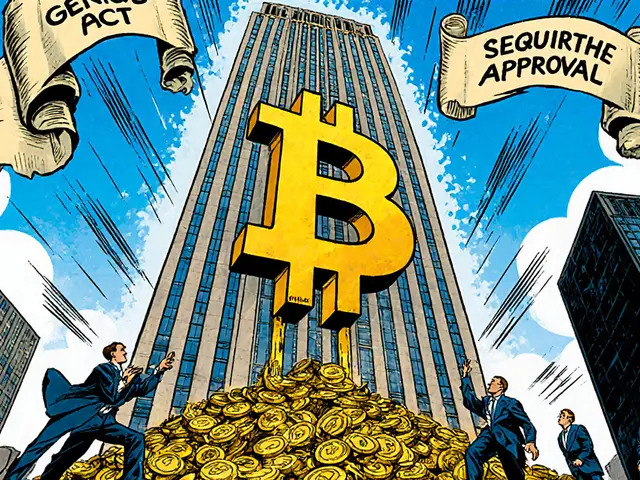
Regulation didn’t just clear the path - it built a highway. The GENIUS Act, passed by the U.S. Senate in March 2025, was the game-changer. It defined digital asset categories, set clear compliance standards, and gave regulators authority without overreach. For the first time, institutions had a rulebook they could trust. No more guesswork. No more fear of sudden enforcement actions. Even more symbolic was the creation of the U.S. Strategic Bitcoin Reserve. Not a stockpile of coins. A policy signal. The federal government officially recognized Bitcoin as a legitimate treasury asset - one that could be held for long-term value preservation. This wasn’t just about crypto. It was about monetary sovereignty. With inflation lingering and the dollar’s global role under pressure, institutions saw Bitcoin as a hedge, not a gamble. Companies like MicroStrategy, which now holds over 630,000 BTC, aren’t just tech enthusiasts. They’re corporate treasurers acting like central banks.Corporate Treasuries Are Now Crypto Wallets
Over 170 public companies now hold Bitcoin on their balance sheets. Collectively, they own 1.07 million BTC. That’s more than 5% of all Bitcoin ever mined. MicroStrategy owns nearly 60% of that total. But it’s not just about Bitcoin. Companies are now using tokenized assets to manage cash. BlackRock’s BUIDL product - a tokenized version of U.S. Treasury bills - hit a $2 billion market cap in 2025. Why? Because it offers the same yield as a T-bill, but with settlement in minutes instead of days. Institutions don’t care if it’s blockchain or not. They care about efficiency, cost, and risk. This isn’t speculative investing. It’s treasury management. Companies are using Bitcoin to protect against currency devaluation. With the Federal Reserve signaling potential rate cuts in late 2025, institutions are reallocating capital. Bitcoin isn’t seen as a currency anymore. It’s seen as digital gold - a non-sovereign, scarce asset that doesn’t print more when politicians need to spend.
It’s Not Just Bitcoin Anymore
The early wave was Bitcoin. The second wave is everything else. Nearly half of institutional asset managers are now researching Ethereum investments. Why? Because Ethereum isn’t just a coin. It’s a platform. It powers DeFi, NFTs, tokenized RWAs, and now institutional-grade staking products. Solana, with its low fees and high throughput, is gaining traction in cross-border payments. The CoinDesk 20 Index - which tracks the top 20 digital assets - rose 22.1% in Q2 2025, outperforming Bitcoin itself. That tells you something: institutions aren’t putting all their money into one basket. They’re building diversified crypto portfolios. Stablecoins are the hidden engine behind this. Supply hit $277.8 billion by September 2025. These aren’t just for traders. They’re used by hedge funds to move capital between exchanges without converting to fiat. They’re used by corporations to pay overseas contractors instantly. They’re the bridge between the old financial system and the new one.Global Adoption Is Diverging - And Asia Is Leading
The U.S. may have led the ETF charge, but Asia is moving fastest. According to Chainalysis’ 2025 Global Crypto Adoption Index, the Asia-Pacific region saw a 69% year-over-year jump in on-chain activity. Hong Kong SAR ranks fifth globally - higher than the UK or Germany. Why? Because Hong Kong’s regulators didn’t wait for federal legislation. They built their own framework. They licensed exchanges. They allowed institutional custody. They opened the door wide. Meanwhile, countries like Ukraine, Moldova, and Georgia lead in retail adoption, but that’s feeding institutional interest too. When millions of people use crypto for payments and remittances, institutions notice. They see liquidity. They see demand. They see infrastructure being built from the ground up.
The Infrastructure Is Now Institutional-Grade
You can’t have institutional adoption without institutional tools. That’s why custody has evolved. Fidelity, Coinbase Institutional, and BitGo now offer insured, multi-signature, cold-storage solutions that meet pension fund standards. Prime brokers like Goldman Sachs and Morgan Stanley offer crypto lending, margin trading, and derivatives. The Chicago Mercantile Exchange reported record open interest in crypto futures - not from retail traders, but from hedge funds using Bitcoin as a hedge against equity volatility. Even trading platforms have changed. Order execution is now sub-millisecond. Liquidity pools are deep enough to handle $100 million trades without slippage. The tech isn’t perfect, but it’s good enough. And for institutions, “good enough” is all they need.Equity Markets Are Now Crypto Proxy Markets
If you don’t want to hold Bitcoin directly, you can now buy it through stocks. Bullish (BLSH), the parent company of CoinDesk, went public in August 2025. Its shares jumped 45% in the first three months. Why? Because investors see it as a pure-play on institutional crypto adoption. If Bullish gets its BitLicense later in 2025 - as expected - its stock could become a mainstream ETF component. That’s the next phase: crypto exposure through regulated public equities.What This Means for the Future
The old narrative - crypto is volatile, unregulated, risky - is dead. The new narrative is simple: crypto is an asset class, and institutions are allocating to it like they would to real estate, private equity, or commodities. The data doesn’t lie. $58 billion in Bitcoin ETFs. 170+ companies holding BTC. $277 billion in stablecoins. $112 billion in DeFi. 85% of institutions already in or planning to enter. The question isn’t whether institutions will adopt crypto. It’s how fast they’ll scale it. And with regulatory clarity now in place, infrastructure mature, and macro conditions favorable, adoption isn’t coming. It’s already here.What are Bitcoin ETFs and why do institutions care?
Bitcoin ETFs are regulated investment funds that track the price of Bitcoin and trade on traditional stock exchanges. Institutions care because they can buy them through their existing brokerage accounts without needing to manage wallets, private keys, or crypto exchanges. This removes complexity and legal risk, making Bitcoin accessible under traditional fiduciary rules.
How much Bitcoin do institutions actually own?
By late 2025, institutions hold approximately 25% of all Bitcoin ETPs, according to JPMorgan. Public companies collectively own over 1.07 million BTC, with MicroStrategy alone holding 630,000 BTC. ETFs account for another $58 billion in assets under management, representing tens of billions in institutional Bitcoin exposure.
Why did the GENIUS Act matter so much?
The GENIUS Act, passed in March 2025, created the first clear federal regulatory framework for digital assets in the U.S. It defined which agencies regulate which assets, set compliance standards, and provided legal certainty. Before this, institutions feared sudden enforcement actions. Afterward, they could confidently allocate capital without legal ambiguity.
Is Ethereum more important than Bitcoin for institutions now?
Bitcoin is still the entry point, but Ethereum is where the real innovation is. Institutions are increasingly interested in Ethereum for its role in DeFi, tokenized assets, and smart contracts. Nearly half of institutional asset managers are now researching Ethereum investments. The Ethereum ETF launched in 2024 and has already attracted $12 billion in AUM, showing strong institutional demand beyond Bitcoin.
Are stablecoins just for traders?
No. Stablecoins are now critical infrastructure for institutions. With $277.8 billion in supply by September 2025, they’re used by hedge funds to move capital between exchanges, by corporations to pay global contractors, and by asset managers to hedge against crypto volatility. They’re the functional bridge between fiat and crypto systems.
Can I invest in institutional crypto adoption without buying Bitcoin?
Yes. You can invest in companies that benefit from institutional adoption. Bullish (BLSH), the parent of CoinDesk, went public in 2025 and has become a proxy for crypto infrastructure. You can also invest in firms offering crypto custody, trading, or tokenization services. These are regulated public companies, so you avoid direct crypto exposure while still gaining access to the trend.
Why are companies like MicroStrategy buying Bitcoin?
They’re treating Bitcoin like a treasury reserve asset - similar to gold or foreign currency. With inflation and currency devaluation risks rising, companies are using Bitcoin to preserve value. MicroStrategy holds over 630,000 BTC because it believes Bitcoin is a better store of value than holding cash in a bank, especially with low interest rates and uncertain monetary policy.
Is crypto adoption only happening in the U.S.?
No. While the U.S. led with ETF approvals, Asia is growing fastest. The Asia-Pacific region saw a 69% year-over-year increase in on-chain activity through mid-2025. Hong Kong SAR is a top-five global hub for institutional crypto services. Countries like Ukraine and Georgia show high retail adoption, which fuels institutional interest too. Crypto adoption is global, not just American.

Tony spart
November 26, 2025 AT 09:08Ben Costlee
November 26, 2025 AT 22:17Mark Adelmann
November 28, 2025 AT 15:38ola frank
November 29, 2025 AT 01:19imoleayo adebiyi
November 29, 2025 AT 22:26Vaibhav Jaiswal
December 1, 2025 AT 01:27Abby cant tell ya
December 2, 2025 AT 02:09Janice Jose
December 2, 2025 AT 14:55Savan Prajapati
December 4, 2025 AT 03:22Michael Labelle
December 5, 2025 AT 16:08Joel Christian
December 5, 2025 AT 19:50jeff aza
December 7, 2025 AT 14:31Ian Esche
December 9, 2025 AT 07:39Felicia Sue Lynn
December 11, 2025 AT 00:58Wilma Inmenzo
December 12, 2025 AT 04:45priyanka subbaraj
December 13, 2025 AT 03:00George Kakosouris
December 13, 2025 AT 07:07Angel RYAN
December 13, 2025 AT 11:14stephen bullard
December 14, 2025 AT 12:39SHASHI SHEKHAR
December 15, 2025 AT 12:55Brian Bernfeld
December 17, 2025 AT 01:11Tom MacDermott
December 17, 2025 AT 14:00Susan Dugan
December 17, 2025 AT 22:03Shelley Fischer
December 19, 2025 AT 09:31Puspendu Roy Karmakar
December 21, 2025 AT 06:59Komal Choudhary
December 21, 2025 AT 18:58Sam Daily
December 23, 2025 AT 12:42Tony spart
December 23, 2025 AT 17:27Ben Costlee
December 25, 2025 AT 10:09Abby cant tell ya
December 27, 2025 AT 07:28