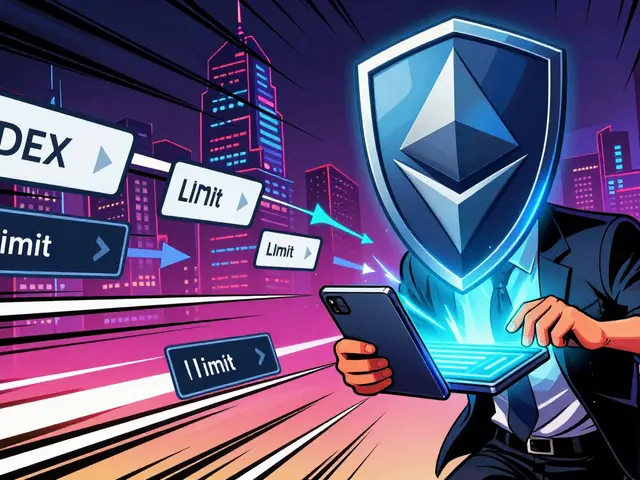
Imagine a world where you could trade any cryptocurrency without a middleman, a sign-up form, or a company deciding which assets are "allowed" on their platform. Before late 2018, that was mostly a dream. Then Uniswap v1 is the first iteration of the Uniswap protocol, a decentralized exchange (DEX) that replaced traditional order books with an automated mathematical formula. It didn't just launch a product; it launched an entire era of finance. While it looks primitive by today's standards, understanding v1 is like looking at the first blueprints of the internet-it's where the fundamental rules of modern DeFi were written.
| Attribute | Value / Detail |
|---|---|
| Launch Date | November 2018 |
| Core Mechanism | Constant Product AMM (x * y = k) |
| Network Support | Ethereum (ERC-20 tokens only) |
| Trading Fee | 0.3% (goes to liquidity providers) |
| Verification | No KYC / No Registration |
How the Automated Market Maker Changed the Game
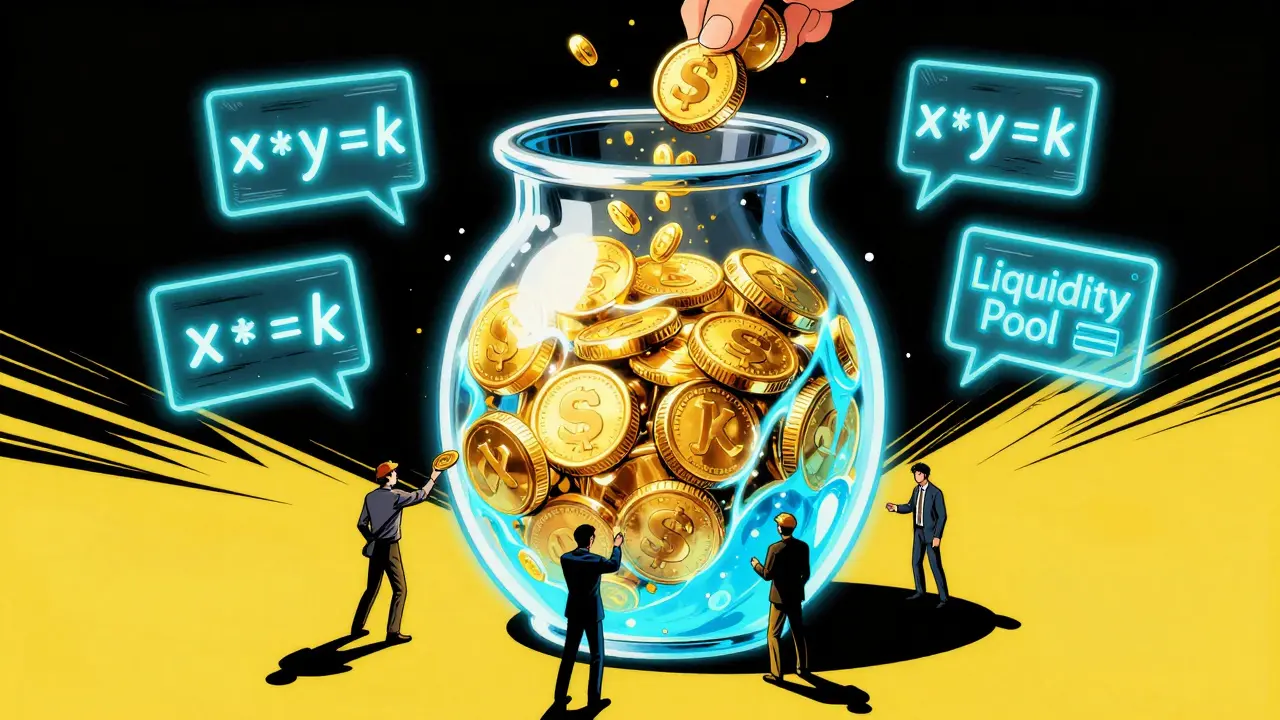
In a traditional exchange, you have an order book. You put in a "limit order" to buy at a certain price and hope someone else puts in a "sell order" at that same price. If there's no one on the other side, your trade doesn't happen. Uniswap v1 threw that model out the window and introduced the Automated Market Maker (or AMM). Instead of matching buyers and sellers, the AMM uses a liquidity pool-a big pot of two different tokens-and a mathematical formula to determine the price automatically.
This meant that as long as there were tokens in the pool, you could trade instantly. You weren't waiting for a specific person to take the other side of your trade; you were trading against a smart contract. This shift ensured that liquidity was always available, making it possible for smaller, niche tokens to have a functional market without needing a massive amount of active traders constantly hovering over an order book.
The Experience: Trading and Onboarding
If you used Uniswap v1, the first thing you'd notice was the lack of a "Create Account" button. There is no email, no password, and definitely no uploading your passport for a KYC check. To get started, you simply connected an Ethereum web wallet (like MetaMask). Once connected, the interface was incredibly stripped down: a search bar to find your token and a swap box. That was it.
For the average user, this was a breath of fresh air. You could go from "curious observer" to "active trader" in about three minutes. However, this simplicity came with a steep learning curve regarding costs. While the 0.3% trading fee was predictable, the Ethereum gas fees were not. Because every trade is a smart contract interaction on the blockchain, you had to pay the network to process the transaction. In times of high congestion, these fees could sometimes be higher than the value of the tokens you were actually trading.
Making Money: The Role of Liquidity Providers
A DEX can't function without assets in its pools. To solve this, v1 allowed anyone to become a Liquidity Provider (LP). You would deposit an equal value of two tokens (for example, ETH and a stablecoin) into a pool. In exchange for providing this "fuel" for the exchange, you earned a slice of that 0.3% trading fee every time someone made a swap.
This created a self-sustaining loop: traders wanted liquidity to avoid price slippage, and LPs provided that liquidity to earn passive income. Later on, the introduction of the UNI governance token gave the community a way to actually vote on how the protocol should evolve. It turned the users into stakeholders, which is a core tenet of the decentralized movement. But it wasn't all free money; LPs had to deal with "impermanent loss," where the price of the deposited assets diverges, potentially leaving the LP with less value than if they had just held the tokens in their wallet.
The Technical Flaws: Lessons Learned the Hard Way
As groundbreaking as it was, v1 was a proof-of-concept and had some serious holes. The most glaring issue was the Price Oracle. In v1, the price was calculated based on the ratio of tokens in the pool. This was easy to manipulate. A "whale" could execute a massive trade to artificially spike the price, and other contracts relying on that price feed would be tricked. This created a dangerous environment for any application trying to use Uniswap as a reliable price source.
Then there was the "ETH-centric" routing. In v1, if you wanted to trade Token A for Token B, you almost always had to go through Ethereum. The path was Token A → ETH → Token B. This meant you were paying gas fees for two separate swaps instead of one, which was inefficient and expensive. Furthermore, the protocol was susceptible to reentrancy attacks-a technical glitch where a malicious contract could call back into the Uniswap contract before the first transaction finished, potentially draining funds.
How v1 Paved the Way for v2 and v3
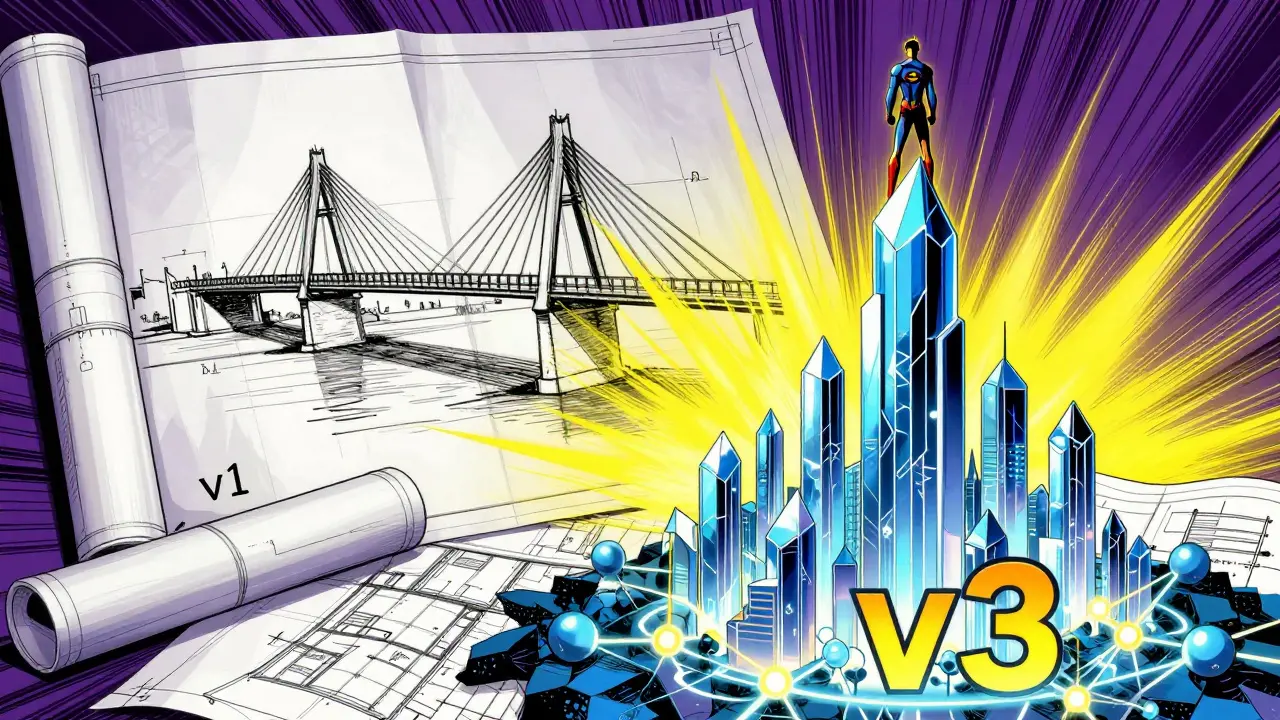
The mistakes of v1 are exactly what made v2 and v3 so successful. When Uniswap v2 arrived, it solved the routing problem by allowing any token pair to have its own pool, removing the mandatory ETH middleman. It also fixed the gas efficiency on failed transactions and improved the oracle system to make price data more secure.
By the time we reached Uniswap v3, the protocol introduced "concentrated liquidity." While v1 LPs had to spread their capital across the entire price range from zero to infinity, v3 allowed providers to pick a specific price range. This meant they could earn more fees with less capital, vastly increasing the efficiency of the entire system. v1 was the rough draft; v3 is the polished, professional financial instrument.
Final Verdict: Was it a Success?
If you judge Uniswap v1 by today's standards-no charts, slow support, and high gas-it looks like a failure. But if you judge it by its impact, it's one of the most successful pieces of software in crypto history. It proved that you don't need a CEO or a company to run a global exchange. It democratized access to trading and forced centralized exchanges to rethink their business models.
It was the catalyst for the "DeFi Summer" and every other AMM we see today. Whether you are a pro trader or just someone curious about blockchain, v1 represents the moment the industry realized that code could replace the middleman entirely.
Did Uniswap v1 require KYC?
No. Uniswap v1 was completely decentralized and did not require any identity verification, email registration, or KYC processes. You only needed a compatible Ethereum wallet to trade.
What were the main risks of providing liquidity in v1?
The biggest risk was impermanent loss, which happens when the price of your deposited tokens changes relative to each other. Additionally, there were technical risks related to smart contract vulnerabilities, such as reentrancy attacks.
Could I trade non-Ethereum tokens on v1?
No. Uniswap v1 was limited exclusively to ERC-20 tokens on the Ethereum blockchain. If you wanted to trade tokens from other chains, you would have to bridge them to Ethereum first.
How did the fee structure work in Uniswap v1?
Every trade incurred a 0.3% fee. This fee was not kept by a company but was instead distributed to the liquidity providers who supplied the tokens for that specific trading pool.
Why was the v1 price oracle considered insecure?
The oracle relied on the current spot price within the pool. Because a single large trade could significantly shift the ratio of tokens, a "whale" could easily manipulate the price momentarily, leading to incorrect data for other connected apps.