
Imagine making a profit of ₹1,00,000 on one Bitcoin trade but losing ₹80,000 on another. In a normal world, you'd pay tax on your actual profit of ₹20,000. But in India, the government doesn't see it that way. Because of the no loss offset rule is a tax regulation that prevents investors from using losses in one cryptocurrency trade to reduce the taxable gains from another, you are taxed on the full ₹1,00,000. You end up paying ₹30,000 in tax, even though your actual take-home gain was only ₹20,000. You've effectively paid more in tax than you actually earned.
What Exactly is the No Loss Offset Rule?
Under Section 115BBH(2)(b) is the specific part of the Indian Income Tax Act that prohibits the setting off of losses from Virtual Digital Assets against any other income of the Income Tax Act, the rules for Virtual Digital Assets is a broad category including cryptocurrencies, NFTs, and other digital tokens (VDAs) are incredibly strict. Unlike traditional stocks or real estate, where a loss in one asset can often cancel out a gain in another, crypto is treated as an isolated bucket.
This means if you trade Bitcoin, Ethereum, or even a random meme coin, any loss you incur is simply "gone" from a tax perspective. You can't use it to lower your tax bill for other crypto gains, and you certainly can't use it to reduce the tax you owe on your salary or business income. It's a one-way street: the government takes a cut of every winning trade, but they don't give you a break for the losing ones.
The Heavy Burden: More Than Just One Rule
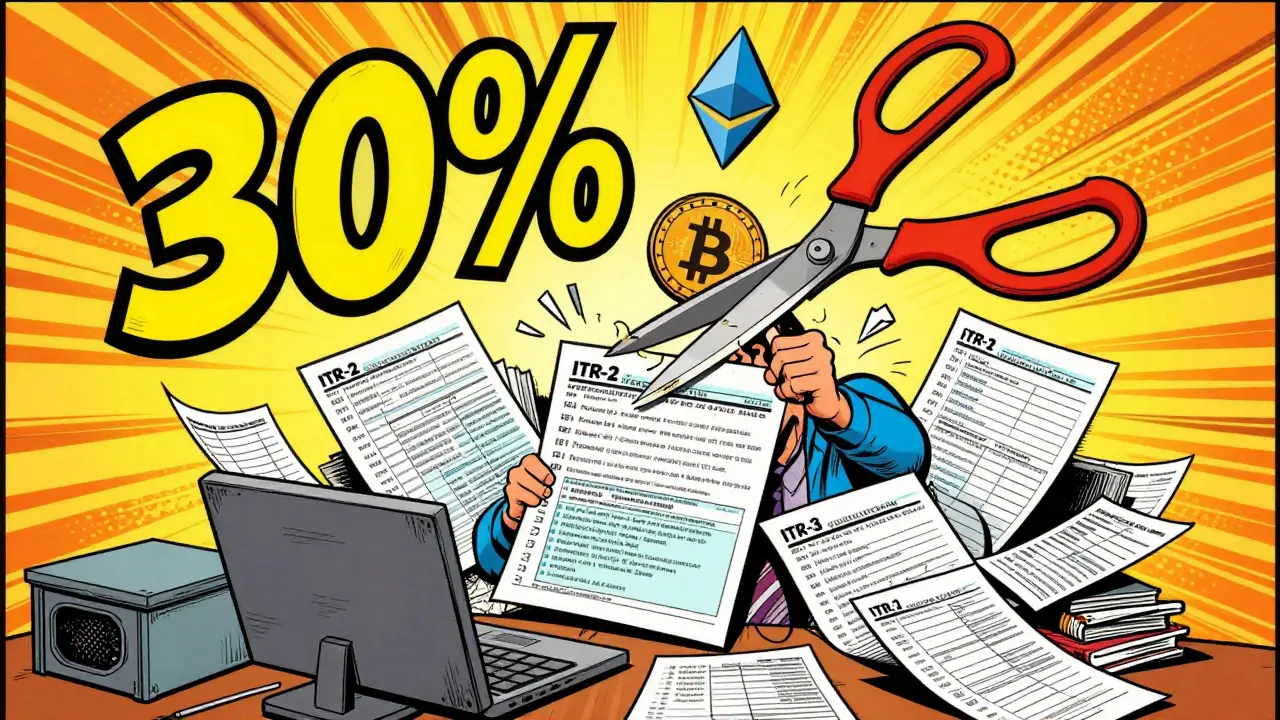
The no loss offset rule doesn't act alone. It's part of a larger, aggressive tax framework that makes trading in India a uphill battle. First, there is a flat 30% tax on all gains. It doesn't matter if you're a student earning minimum wage or a millionaire; the rate is the same. On top of that, you have to deal with the Tax Deducted at Source is a 1% tax collected at the moment of every crypto transfer exceeding certain thresholds (TDS). This 1% is sliced off the total transaction value, not just the profit, which creates a constant drain on your trading capital.
What makes this even more frustrating is the lack of expense deductions. In most businesses, you can deduct costs like electricity, internet, or platform fees. In the Indian crypto world, you can only deduct the cost of acquiring the asset. That means gas fees, exchange transaction charges, and software subscriptions are all out of your own pocket. You're paying tax on gross gains, not net profits.
| Feature | Equity (Stocks) | Crypto (VDAs) |
|---|---|---|
| Loss Offsetting | Allowed within category | Strictly Prohibited |
| Carry-forward Losses | Up to 8 years | Not Allowed |
| Tax Rate | Slab based / LTCG 12.5% | Flat 30% |
| Expense Deductions | Some allowed | Acquisition cost only |
How This Changes Trader Behavior
When the math doesn't add up, people change how they play the game. Many Indian traders are moving away from "spot trading" (buying and selling actual coins) and shifting toward Crypto Futures is derivative contracts that speculate on the future price of a cryptocurrency without owning the asset itself. Since futures are derivatives and not technically VDAs, they often bypass the 1% TDS and the brutal no loss offset rule, though they come with significantly higher financial risk due to leverage.
Others are tempted by offshore exchanges. However, this is a dangerous game. The government tracks money leaving the country via the Liberalised Remittance Scheme is a framework allowing Indian residents to remit up to USD 250,000 per year for permitted current or capital account transactions (LRS). If you send more than ₹7 lakh abroad, you might trigger a 20% Tax Collected at Source (TCS), adding another layer of cost to your "escape" strategy.
Compliance Nightmares and Penalties
Filling out your tax return as a crypto trader is no longer a simple task. You can't use the basic ITR-1 form. Instead, you have to navigate the complex ITR-2 or ITR-3 forms, specifically using Schedule VDA. You need a meticulous record of every single trade: the date you bought it, the price, the date you sold it, and the value at the time of transfer.
The risks of getting this wrong have skyrocketed. Budget 2025 didn't bring relief; it brought hammers. There's now a retrospective 60% tax rate under Section 158B for undisclosed crypto holdings dating back to February 1, 2025. If you forgot to report a wallet or an old airdrop, the authorities can tax it at this steep rate, and you could face prosecution for willful evasion.
What About Staking and Airdrops?
If you're not just trading but also earning passive income, the rules get even messier. Staking is the process of locking up crypto assets to support a network and earn rewards rewards are generally taxed as income the moment you receive them. This means you pay tax on the value of the tokens at the time of receipt. Later, if you sell those tokens for a profit, you pay the 30% tax on the gain again. It's a double-hit that eats into your long-term compounding.
Airdrops and hard forks follow a similar path. They are treated as income upon crediting. Because of the no loss offset rule, if the token you received via an airdrop crashes to zero, you can't use that loss to offset the taxes you paid when you first received the token. You're essentially paying tax on a "gift" that became worthless.

The Global Perspective: Is India an Outlier?
Compared to the rest of the world, India's approach is among the most restrictive. In the United States, crypto losses can typically be used to offset gains in the same asset class. In Germany, if you hold your crypto for more than a year, the gains can be entirely tax-free. India's model, by contrast, ignores the reality of market volatility. By taxing gains while ignoring losses, the system assumes every single winning trade is a pure profit, regardless of the losses required to achieve it.
Can I carry forward crypto losses to next year?
No. Unlike equity shares where you can carry forward losses for up to eight years, cryptocurrency losses in India cannot be carried forward to any future financial year. Once the year ends, the loss is useless for tax purposes.
Does the 30% tax apply if I trade BTC for ETH?
Yes. Any exchange of one Virtual Digital Asset (VDA) for another is considered a transfer. You must calculate the gain or loss in INR at the time of the swap and pay the 30% tax on any profit made during that specific trade.
Can I deduct gas fees from my taxable gains?
No. The Indian tax authorities only allow the deduction of the initial acquisition cost. Operational expenses, including gas fees, exchange trading fees, and brokerage charges, cannot be deducted from your gains.
What happens if my crypto is stolen or hacked?
Unfortunately, Indian law provides no specific tax relief for losses due to theft or hacking. You cannot offset such a loss against your other gains, meaning you may still owe tax on your winning trades even if your overall portfolio was wiped out by a hack.
Is the 1% TDS refundable?
The TDS is not a separate tax but a prepayment. You can claim it as a credit against your final tax liability when you file your income tax return. However, if your total tax liability is lower than the TDS deducted, you can apply for a refund from the Income Tax Department.
What to Do Now: Next Steps for Traders
If you're trading in India, the only way to survive this regime is through extreme organization. Stop relying on exchange history exports alone; create your own spreadsheet that tracks the exact INR value of every entry and exit. If you are a high-volume trader, consider consulting a tax professional who specializes in VDAs to avoid the 60% penalty for misreporting.
For those feeling the squeeze, diversifying into non-VDA assets or exploring regulated derivatives may be the only way to manage risk. Just remember that any attempt to hide assets offshore is increasingly risky as the government tightens its grip on the LRS and international data sharing.

vijendra pal
April 8, 2026 AT 01:55Bro this is basically legal robbery!! 😱 No wonder everyone is moving to futures or using P2P. The govment wants all the profit but takes zero responsibility for the losses. Totally unfair system man!! 📉💸
Deepak Prusty
April 10, 2026 AT 01:26The logic is simple: the government views VDAs as speculative assets rather than legitimate investments, which is why the tax laws are designed to discourage trading and push people toward more stable, traditional assets.
Trish Swanson
April 11, 2026 AT 09:39Absolute madness...!! Who actually thought this was a good idea...??
Manisha Sharma
April 13, 2026 AT 07:35Yall keep complaining but this is how we build a strong economy. India needs to regulat these wild tokens to avoid scams. If u r actually making profit, paying tax is a sign of patriotism. Stop acting like victims when u chose to gambel with meme coins lol.
Alexandra Lance
April 13, 2026 AT 15:47Oh please, it's clearly just a front to track every single transaction and build a database of who's "disloyal" to the central bank 🙄 They don't care about tax, they care about total control 👁️💰
Bruce Micciulla Agency
April 14, 2026 AT 02:25the fundamental flaw here is the lack of understanding of market volatility from the policy makers who probably still think a ledger is just a book of accounts and they fail to realize that a 30 percent flat tax combined with no offset basically creates a mathematical impossibility for most retail traders to remain profitable over a long horizon especially when you factor in the slippage and the tds drain on capital which is just predatory in nature
Hugo Lopez
April 15, 2026 AT 15:33That sounds really stressful for the traders there! 😅 I hope they find a fair way to resolve this soon! ✨
Patty Levino
April 17, 2026 AT 07:23I've seen a few people struggle with these types of laws in other regions too. It's always a bit of a nightmare when the tech moves faster than the legislation. Just be careful with your records.
Diana Martín Prieto
April 18, 2026 AT 08:46If anyone is struggling with the ITR-2 or ITR-3 forms, just remember to keep your CSV exports from every exchange you used. It makes the reconciliation much easier. I'd also suggest using a dedicated tax software for VDA if the volume is high because manual entry is a recipe for disaster!
Siddharth Bhandari
April 18, 2026 AT 14:37The move towards futures is an interesting adaptation. However, the risk of liquidation is far higher than spot trading, and many newcomers don't realize that leverage can wipe them out faster than the tax man ever could.
sekhar reddy
April 18, 2026 AT 16:41ARE YOU KIDDING ME?? 😱 60% tax for undisclosed holdings is just insane!! This is a total disaster for every small investor in the country! Who is going to save us from this madness!! 😭
Earnest Mudzengi
April 19, 2026 AT 01:22Classic state overreach. This is just a liquidity trap designed to force assets into government-approved channels. The LRS monitoring is basically a digital fence. We're seeing the death of financial privacy in real-time via these VDA reporting requirements.
Suzanne Robitaille
April 20, 2026 AT 18:21It is truly heartbreaking to see such a lack of empathy for the individual's struggle. The financial spirit is being crushed by the weight of these draconian rules! 🌟
Joshua Aldrich
April 22, 2026 AT 07:52i think the real issue is how the airdrops are handled. you get something for free, it's taxed, then it goes to zero, and you still owe. it's like the govt is taxing ghost money lol. really makes you rethink holding anything on-chain in india.
david head
April 23, 2026 AT 01:28wow that's wild 😵 hope things get better for you guys! 🤞
Susan Wright
April 24, 2026 AT 18:41Honestly, the best move right now is just to stop trading on domestic exchanges if you can't handle the TDS. Just keep in mind that the tax liability still exists even if the exchange doesn't deduct it.
alex rodea
April 26, 2026 AT 03:26Just keep track of everything. Use a simple sheet. You can do this!
Brooke Herold
April 27, 2026 AT 15:38The difference between the US and India models here is stark. It's fascinating how differently governments perceive the same technology.
gladys christine
April 28, 2026 AT 14:52this is so cruel!! imagine losing everything in a hack and still owing money to the state just because you had one lucky trade years ago!! absolutely devastating 💔
Susan Payne
April 29, 2026 AT 11:31One would assume that individuals engaging in such high-risk ventures would possess the foresight to anticipate regulatory volatility. To be surprised by these measures is simply an admission of negligence on the part of the trader.
akash temgire
May 1, 2026 AT 00:31The retrospective tax is unacceptable. Purely predatory.