
If you've searched for ROCK crypto coin lately, you've probably noticed something frustrating: there isn't just one "ROCK" token. In the wild west of digital assets, naming collisions are common, and ROCK is a prime example. You'll find a handful of different projects using the same ticker, each with completely different prices, supplies, and goals. This makes it incredibly easy to buy the wrong asset if you aren't looking closely at the contract addresses.
For most people, the "ROCK" they encounter is a low-cap token that has struggled significantly since its peak. However, depending on where you look, you might be seeing a Solana-based project or an old 2018 ICO. Understanding which one is which is the only way to avoid a costly mistake.
The Primary ROCK Token: A Deep Dive
The most commonly tracked ROCK token is a fixed-supply asset with a total of 1 billion tokens. Unlike many modern projects that use complex "burn" mechanisms or inflationary rewards, this version of ROCK keeps it simple: what's created is all there is. No new tokens are minted, and none are removed from the supply.
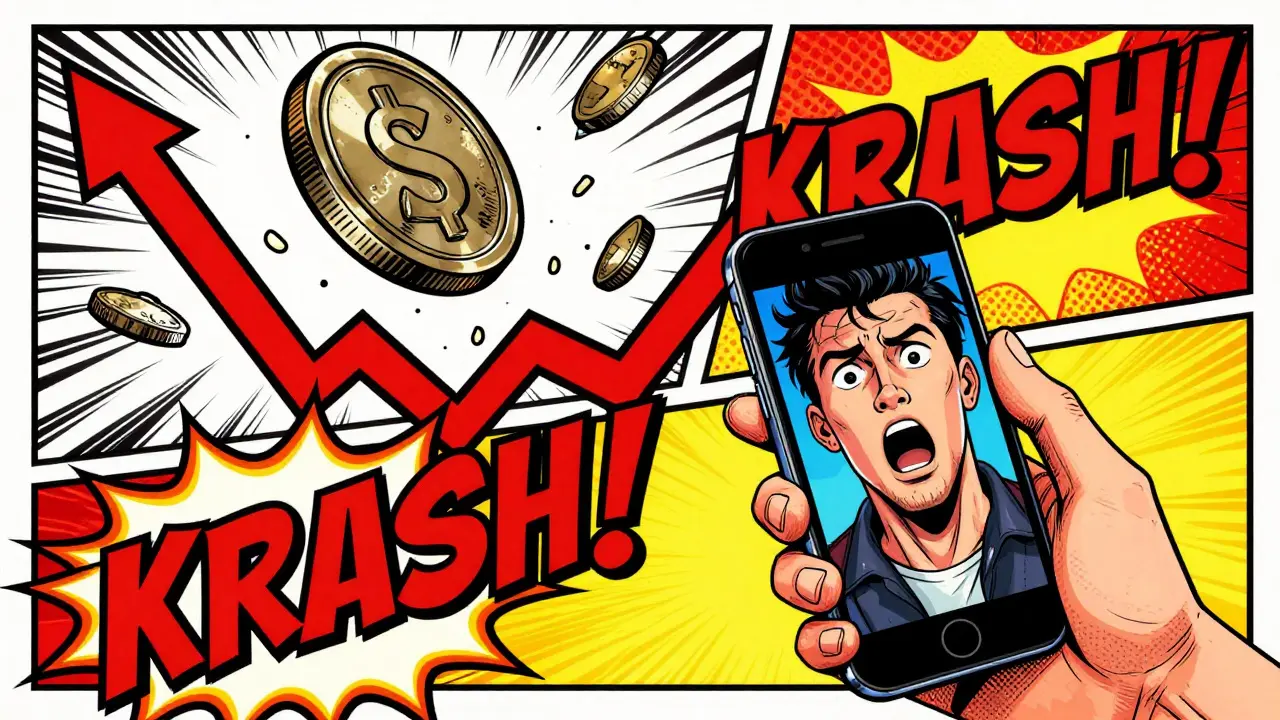
From a financial perspective, the numbers are sobering. While it hit an all-time high of $0.004452 back in September 2024, it has since plummeted. By early 2026, it was trading around $0.00004748, marking a brutal 98% drop from its peak. When a coin loses nearly all its value and lacks a clear roadmap or a known development team, it usually falls into the category of a "ghost project" or a low-effort meme coin.
Liquidity is another major red flag here. With a daily trading volume often hovering around $51,000, this is a "thinly traded" asset. In plain English: if you hold a significant amount of the coin, you might find it very difficult to sell without crashing the price further because there aren't enough buyers on the other side.
The "Three Rocks" Problem: Which One is Which?
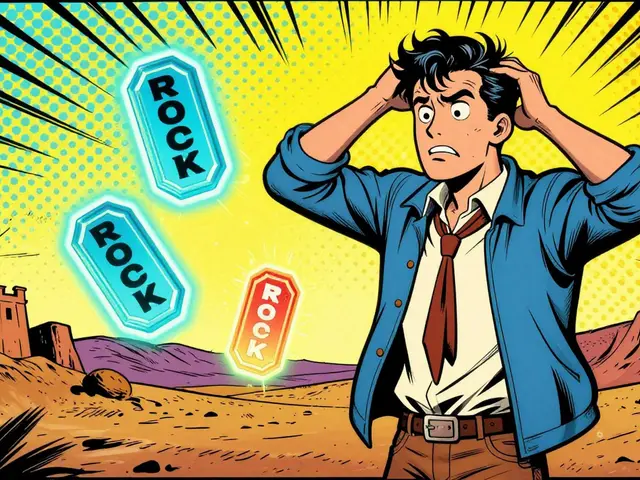
The biggest danger for investors is the overlap in names. To keep your sanity, you need to distinguish between these three distinct entities:
| Token Name/Ticker | Supply Model | Key Characteristic | Market Status |
|---|---|---|---|
| ROCK (Main) | 1 Billion (Fixed) | Low liquidity, high volatility | Speculative/Low-cap |
| Rock (ROCK) Variant | 420 Trillion | Hyper-inflationary supply | Micro-cap meme coin |
| Rock (RKT) | 270 Million | 2018 ICO ($27M raised) | Legacy project |
Notice the massive difference in supply. One token has a billion units, while another has 420 trillion. If you see a price difference of several decimal places, you are likely looking at two different coins entirely. There is also a variant often called BlackRock (ROCK) that operates on the Solana blockchain. This version leverages Solana's high-speed throughput to offer cheaper transactions, but it is functionally unrelated to the 1-billion-supply ROCK token.
Red Flags and Fundamental Analysis
When evaluating any cryptocurrency, professional traders look for a "fundamental value proposition." This is the actual problem the coin solves. For the primary ROCK token, that proposition is virtually non-existent. There is no public whitepaper, no listed founding team, and no documented utility. It doesn't power a decentralized app, it isn't used for governance in a DAO, and it isn't providing liquidity to a protocol.
Usually, a healthy project has a heartbeat: an active Discord server, a buzzing X (formerly Twitter) account, or regular updates on GitHub. ROCK is strangely silent. The lack of community engagement suggests that the project may have been abandoned by its creators. When a coin has no one talking about it and no one building it, any price increase is usually the result of a "pump and dump" scheme rather than organic growth.
Where is ROCK Traded?
You won't find this token on the biggest "Tier 1" exchanges like Coinbase. Instead, it lingers on smaller platforms. Binance has listed it, but interestingly, some data trackers show a $0 market cap there because they aren't reporting the circulating supply correctly. Other platforms like MEXC and LBank provide listings, but the data is often inconsistent.
This inconsistency is a warning sign. When different tracking sites (like CoinGecko vs. LBank) report wildly different market caps for the same ticker, it means the data is unreliable. This usually happens with very small coins that don't have official API integrations with the tracking sites.
How to Handle Low-Cap Tokens Safely
If you are tempted by the "moonshot" potential of a coin like ROCK, you need a strict set of rules to protect your money. First, never rely on the ticker symbol alone. Always verify the Contract Address. The contract address is the unique ID of the token on the blockchain; it's the only way to be 100% sure you are buying the specific version of the coin you intended.
Second, check the liquidity. If a coin has a market cap of $86,000 but a daily volume of only $50,000, you are in a very tight spot. If you try to sell $10,000 worth of the coin, you might cause a massive price slippage, meaning you get far less money than the current market price suggests.
Finally, ask yourself: "What does this coin actually do?" If the only answer is "it might go up," you aren't investing; you're gambling. In a market full of sophisticated AI projects and Layer 2 scaling solutions, a token with no documentation is a high-risk bet with very low odds of long-term success.
Is ROCK coin a safe investment?
Based on available data, it is extremely high-risk. The lack of a whitepaper, missing team information, and a 98% drop from its all-time high suggest a project with very little fundamental value. It behaves more like a speculative meme coin than a stable investment.
Why are there different prices for ROCK tokens?
There are multiple different cryptocurrencies that use the ticker "ROCK." Some have a supply of 1 billion, while others have 420 trillion. Because they are different projects on different blockchains, they have different market values.
Where can I buy the ROCK token?
It is listed on a few smaller exchanges and some larger platforms like Binance and MEXC, though liquidity is very low. Always check the contract address before purchasing to ensure you are buying the correct version.
What blockchain does ROCK use?
It depends on the version. The primary ROCK token has vague technical documentation, while the "BlackRock" variant is built on the Solana blockchain for faster speeds.
Does ROCK have a roadmap or future updates?
Currently, there are no documented roadmaps, partnership announcements, or technical updates from the developers, which often indicates a dormant or abandoned project.
Next Steps and Troubleshooting
If you already hold ROCK tokens and are trying to figure out your next move, start by verifying which version you own. Check your wallet's token contract address and cross-reference it with a blockchain explorer. If you find that your tokens are from a project with zero development activity and no community, you may want to consider the tax implications of a loss.
For those looking for actual utility in the crypto space, it's usually better to look at projects with audited smart contracts and transparent teams. If you're attracted to the high-risk, high-reward nature of small coins, look for "micro-caps" that at least have a working product or a growing community on platforms like GitHub and Discord. Avoiding the "naming trap" is the first step toward becoming a smarter crypto investor.
Michael Repak
April 27, 2026 AT 00:08This is such a great breakdown!!! I really appreciate the warning about the contract addresses!!! It's so easy to get mixed up with these tickers!!! Thanks for sharing this!!!
Livvy Cooper
April 28, 2026 AT 20:45Typical crypto trash. It is all just a scam and people are too lazy to check. Why is anyone still buying this stuff?
Rain Richardsson
April 30, 2026 AT 03:18The contract address tip is key. Very helpful.
Iestyn Lloyd
May 1, 2026 AT 21:46One should always be cautious with low-cap assets. In the UK, we often see similar patterns with micro-cap stocks, where liquidity becomes the primary hurdle rather than the asset's theoretical value.
April D Thompson
May 2, 2026 AT 00:36Oh my god, the absolute tragedy of the 98% drop! It's like a Shakespearean play where the protagonist believes in a dream only to wake up in a nightmare of decimal places! We are all just gambling on digital ghosts in a machine that doesn't love us back!
Kara Spadone
May 2, 2026 AT 12:10Just another lesson in lack of mindfulness 🙄 People chase numbers instead of value. It's so predictable. 🙄
Arun Prabhu
May 4, 2026 AT 07:09The sheer audacity of these projects to exist without a whitepaper is a testament to the intellectual bankruptcy of the modern retail investor. A truly pedestrian tragedy of errors.
Jehan ZA
May 5, 2026 AT 00:05I find the distinction between the three variants to be presented with commendable clarity. It is prudent to maintain such boundaries when navigating these markets.
debra hoskins
May 5, 2026 AT 05:00Who cares about the roadmap when the whole ecosystem is a glittering facade of nonsense. It is just a bunch of digital pebbles.
Pramendra Singh
May 6, 2026 AT 09:38I believe there is always a chance for a project to turn around if a dedicated team takes over.
Amanda Macy
May 6, 2026 AT 15:00It makes one wonder if the value of a token is ever based on anything other than collective belief.
Chloe Fletcher
May 7, 2026 AT 15:11Get those contract addresses checked people! 🚀 Don't let the FOMO blind you! You got this! 💪✨
Mitali Rajvanshi
May 9, 2026 AT 12:59The point about liquidity is very important for beginners.
Ralph Espinosa
May 10, 2026 AT 23:37I've seen this a million times!!! Always check the liquidity pool!!! If the slippage is too high, you're basically trapped!!! Be careful out there!!!
Lex Harley
May 11, 2026 AT 14:53The slipppage on these low-cap pools is insane lol. Basically a honeypot if the LP is locked or too thin. Check the txns on the scan.
Tony Phan
May 12, 2026 AT 08:33Bro this is literally just a rug pull! I've seen a dozen of these shitcoins pump and dump in one week. Total waste of capital! The volatility is a joke!
Bevon Findley
May 12, 2026 AT 15:35Pretty basic stuff but useful. 😊
Kristi Swartz
May 13, 2026 AT 10:25it is common knowledge that tickers are not unique and anyone who forgets this is foolish
Alex Mazonowicz
May 14, 2026 AT 13:42Keep learning and staying safe!!! You can all make it if you do the research!!!
Veronica Bago
May 16, 2026 AT 09:08Just a heads up, be careful with those small exchanges too.
Arti Jain
May 16, 2026 AT 22:53Purely speculative garbage. Pathetic.
Harvey Alford
May 17, 2026 AT 02:01I lost money on a similar coin. Sucks.
VIVEK SINGH
May 17, 2026 AT 20:51Oh, look at that, another 'revolutionary' token with no team and no product. I'm sure it'll go to the moon any second now. Truly a masterpiece of financial engineering.
Lloyd I
May 19, 2026 AT 18:25We can all learn from these mistakes to build a better portfolio together!
Robert Smith
May 21, 2026 AT 11:46Yikes 📉
Felix Eduardo Velasquez
May 21, 2026 AT 12:18The absence of a whitepaper isn't just a red flag; it's a void where the project's soul should be. Without a technical foundation, a token is merely a ledger entry with no purpose.
Emily A
May 22, 2026 AT 06:32It is logically impossible to categorize this as an investment. An investment requires an underlying asset or a service. This is a purely mathematical gamble with skewed odds.
Gabby Puche
May 22, 2026 AT 21:34Stay safe out there everyone! 🌸 Just keep doing your own research! ✨
Lynne Teperman
May 24, 2026 AT 07:58just a wild jungle of numbers and dreams floating in the ether no real anchor to hold onto