
India doesn’t just use cryptocurrency - it dominates it. In 2025, India topped Chainalysis’ Global Crypto Adoption Index across every single category: retail, centralized finance, decentralized finance, and institutional adoption. No other country comes close. Not the U.S., not China, not even Nigeria. India is the world’s most active crypto market - and it’s doing all of this under one of the strictest tax systems on the planet.
Here’s the twist: India taxes crypto gains at 30%, with no deductions for losses. Every trade, every swap, every wallet transfer is tracked. Send 1 BTC to a friend? Taxable event. Buy USDT with rupees? Taxable event. Even holding crypto for years without selling? Still taxed at 30% on any profit. And there’s no GST on crypto purchases - only income tax. Most countries treat crypto like property. India treats it like a lottery win with no exceptions.
So why does adoption keep growing?
Because the people didn’t wait for permission.
The Real Engine: Digital Infrastructure That Works
India’s crypto boom didn’t start with investors. It started with UPI.
Unified Payments Interface - the mobile payment system that lets you send money between bank accounts in seconds, with zero fees - became the secret weapon for crypto on-ramps. By 2025, over 90% of Indian adults used UPI at least once a month. When crypto apps integrated UPI as a payment method, adoption exploded. You could buy Bitcoin with a QR code scan, just like paying your street vendor for chai.
It wasn’t just convenience. It was familiarity. People already trusted digital payments. They knew how to use apps like PhonePe and Google Pay. Crypto apps simply added a new asset class to an existing habit.
And it spread fast. In rural towns, small shopkeepers started accepting USDT for goods. Students in Bangalore coded DeFi bots to automate savings. Gig workers in Hyderabad got paid in crypto to avoid banking delays. This wasn’t speculation. It was utility.
Grassroots Adoption: From Students to Street Vendors
Look at the numbers: between July 2024 and June 2025, India accounted for $4.6 trillion in fiat-to-crypto on-ramps. That’s more than the next three countries combined. Bitcoin was the entry point for 78% of new users - not because it was trendy, but because it was simple. You didn’t need to understand smart contracts. You just needed to know that Bitcoin could be bought, held, and sold without a bank.
But it didn’t stop there. Stablecoins like USDT and USDC became the backbone of daily transactions. Why? Because they don’t swing 20% in a day. A vendor in Jaipur could accept USDT for a meal, convert it to INR via a local exchange in seconds, and have cash in hand. No waiting for bank clearance. No high fees. No chargebacks.
Even in places with no banks, crypto filled the gap. In Bihar and Jharkhand, farmers started using crypto to sell crops directly to buyers in Mumbai, cutting out middlemen who took 30% off the top. A 2025 survey by the Bharat Web3 Association found that 41% of small business owners in Tier-2 cities now use crypto for at least one transaction per week.

Institutional Shift: When the System Starts Playing Along
For years, Indian regulators were hostile. The Reserve Bank of India banned banks from serving crypto exchanges in 2018. In 2022, the government slapped a 30% tax and a 1% TDS (tax deducted at source) on every transaction. Many thought this would kill adoption.
It didn’t. It forced innovation.
Exchanges like CoinSwitch Kuber and ZebPay built their own banking relationships, bypassing traditional institutions. DeFi protocols like WazirX’s lending platform and CoinDCX’s staking services grew without needing approval. Indian developers built blockchain tools that worked offline - syncing data when connectivity returned. These weren’t Silicon Valley startups. They were teams in Hyderabad, Pune, and Kochi solving real problems with real constraints.
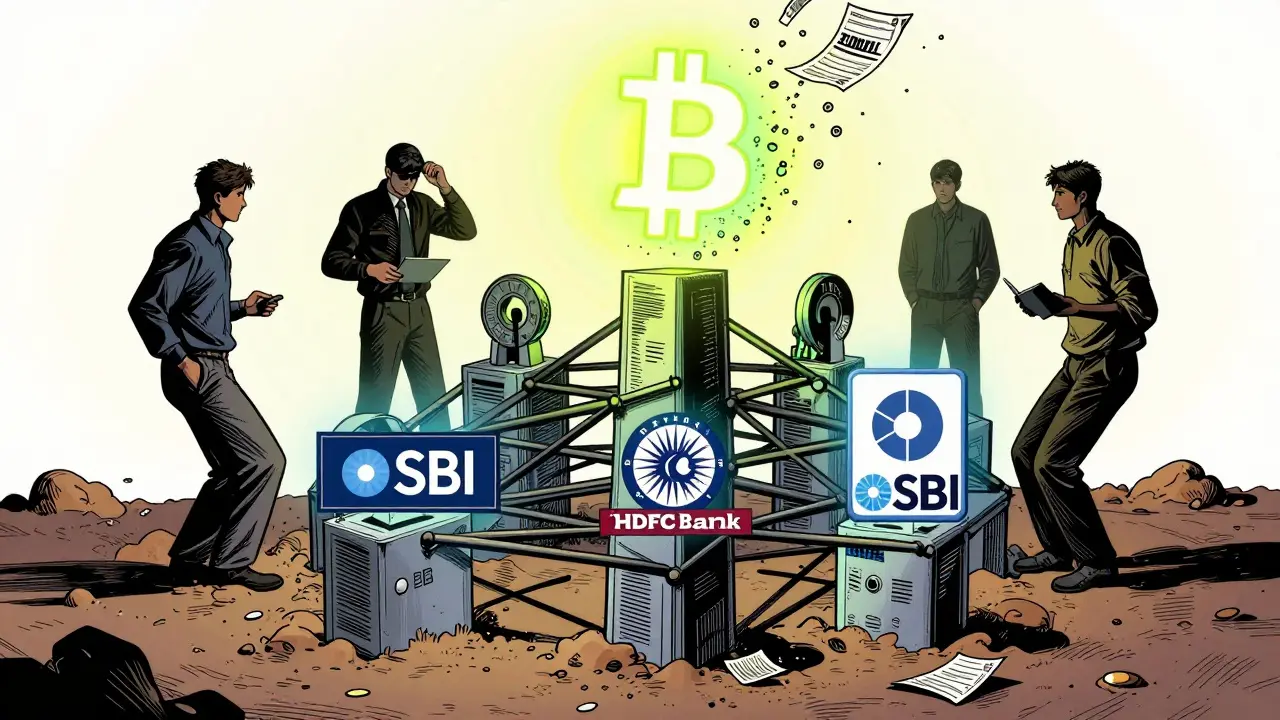
Then came the institutional shift. In late 2024, India’s largest asset manager, Edelweiss, launched a crypto-backed mutual fund. In early 2025, HDFC Bank quietly began offering crypto custody services to high-net-worth clients. The State Bank of India started testing blockchain for cross-border remittances. Even tax authorities began using blockchain analytics to trace transactions - not to shut them down, but to make taxation more accurate.
India’s institutional adoption score in the Chainalysis index didn’t just rise - it soared. Why? Because the market had already proven itself. The government didn’t lead. It followed.
Why the U.S. Isn’t Number One
The U.S. ranked second in global adoption in 2025. But its strength was narrow: institutional ETFs. Americans bought Bitcoin through ETFs on Wall Street. They didn’t use it to pay for groceries or send money home to relatives.
India’s adoption was different. It was everywhere. A college student in Lucknow bought $50 worth of ETH to learn smart contracts. A truck driver in Chennai received payment in USDC for delivering goods. A startup in Bengaluru raised $2 million in crypto from global investors without ever talking to a VC.
India’s crypto ecosystem doesn’t rely on one product. It relies on many: UPI, stablecoins, DeFi, peer-to-peer trading, and mobile apps built for low-bandwidth areas. It’s not a market for investors. It’s a market for users.
The Regulatory Paradox
India’s tax policy is still harsh. But something’s changing.
Reports from late 2025 suggest the government is considering creating a national Bitcoin reserve - not to control it, but to hold it as a strategic asset. The idea? Use Bitcoin as a hedge against currency volatility and global financial instability. That’s not a ban. That’s a bet.
And it’s not just Bitcoin. The Reserve Bank of India is testing a digital rupee (e-Rupee) on blockchain. The goal? To coexist with crypto, not replace it. The e-Rupee is centralized. Crypto is decentralized. Both can serve different needs.
What’s clear now is this: regulation in India isn’t about stopping crypto. It’s about managing it. The tax system is still punitive, but enforcement is shifting from punishment to integration.
What Comes Next?
India’s crypto future won’t be shaped by headlines. It’ll be shaped by everyday people.
More schools are teaching blockchain in computer science classes. More gig platforms are offering crypto payouts. More small businesses are using stablecoins to pay suppliers overseas. The infrastructure is already there - faster, cheaper, and more accessible than traditional finance.
And while other countries debate whether crypto is a bubble or a revolution, India is already using it - daily, reliably, and without fanfare.
The lesson? You can’t stop adoption by taxing it. You can only delay it. And in India, the delay was short. The movement was unstoppable.
Why is India #1 in crypto adoption despite heavy taxes?
India’s leadership comes from its digital infrastructure - especially UPI - which made crypto easy to buy and use. People adopted crypto not because it was profitable, but because it solved real problems: sending money fast, avoiding banking delays, and paying gig workers without intermediaries. Taxes didn’t stop usage; they just made reporting mandatory. The demand was too strong to ignore.
Is crypto legal in India?
Yes. There’s no outright ban on cryptocurrency in India. The Supreme Court overturned a RBI banking ban in 2020. Today, you can legally buy, sell, hold, and trade crypto. The government taxes it heavily - 30% on profits plus 1% TDS on every transaction - but doesn’t prohibit it. Many see this as a way to regulate, not ban.
What role does UPI play in India’s crypto adoption?
UPI is the backbone. Before crypto apps, people used UPI to pay for groceries, ride-sharing, and bills. Crypto platforms added UPI as a payment method, so users could buy Bitcoin or USDT with a simple scan. No bank account needed. No credit card. Just a phone. This integration lowered the barrier to entry dramatically, especially in rural areas.
Are stablecoins popular in India?
Extremely. USDT and USDC are the most traded assets after Bitcoin. They’re used for daily transactions - paying freelancers, buying goods online, and sending money abroad. Unlike Bitcoin, stablecoins don’t swing wildly in value, making them practical for real-world use. Over 60% of peer-to-peer trades in India now involve stablecoins.
Could India create a Bitcoin reserve?
Yes, and it’s likely. Multiple government sources in late 2025 confirmed discussions about holding Bitcoin as a national reserve asset, similar to gold. This would be a major signal of official acceptance. It wouldn’t mean Bitcoin becomes legal tender, but it would show the government sees it as a legitimate store of value - not just a tax target.



Sanchita Nahar
February 13, 2026 AT 00:46Will Lum
February 14, 2026 AT 06:03Sakshi Arora
February 16, 2026 AT 00:55Ben Pintilie
February 17, 2026 AT 21:44Ekaterina Sergeevna
February 18, 2026 AT 19:18Kaz Selbie
February 20, 2026 AT 13:56Robbi Hess
February 22, 2026 AT 13:40Keturah Hudson
February 23, 2026 AT 09:26Ace Crystal
February 23, 2026 AT 12:58Brittany Meadows
February 24, 2026 AT 07:09SAKTHIVEL A
February 25, 2026 AT 07:07krista muzer
February 25, 2026 AT 19:54Tammy Chew
February 27, 2026 AT 12:34Lindsey Elliott
February 28, 2026 AT 02:25bala murali
February 28, 2026 AT 23:43