
Imagine opening a bank account, signing up for a crypto exchange, and applying for a loan. In the traditional world, you submit your passport, proof of address, and utility bills three separate times. You wait days for each institution to manually check your documents. It is frustrating, slow, and repetitive. Now imagine doing it once. Your identity is verified, stored securely, and shared only when you give permission. This is the promise of KYC verification with blockchain.
Know Your Customer (KYC) is a mandatory process for financial institutions to prevent fraud, money laundering, and terrorist financing. Traditionally, this process is centralized, siloed, and incredibly expensive. Each bank or service provider builds its own database, hires compliance officers, and duplicates the work done by others. Blockchain technology changes this dynamic by introducing a decentralized ledger where identity data can be verified once and reused across multiple platforms.
The Problem with Traditional KYC Systems
To understand why blockchain matters here, we need to look at how broken the current system is. Today, if you move from one bank to another, you start from zero. The new bank does not trust the old bank’s verification. They demand new documents, run new background checks, and store the data in their own isolated servers.
This redundancy creates several major issues:
- High Costs: Financial institutions spend billions annually on compliance. A report by the Global Financial Integrity estimated that global banks spend over $10 billion per year just on KYC processes.
- Poor User Experience: Customers face friction during onboarding. Long wait times and repeated document submissions lead to drop-offs. Many potential customers abandon applications because the process is too cumbersome.
- Security Risks: Centralized databases are honey pots for hackers. When a single bank gets breached, millions of records are exposed. Since data is duplicated across many institutions, the same personal information is vulnerable in multiple places.
- Lack of Interoperability: There is no standard format for identity verification. One bank accepts a driver’s license; another requires a biometric scan. This lack of standardization slows down cross-border transactions and partnerships.
The core issue is trust. Banks do not trust each other’s data storage or verification methods. Blockchain solves this by creating a shared, immutable source of truth that no single entity controls entirely.
How Blockchain-Based KYC Works
Blockchain-based KYC does not mean storing your entire passport on the public blockchain. That would be a privacy nightmare. Instead, it uses a hybrid approach combining off-chain storage with on-chain verification.
Here is the step-by-step flow of a typical blockchain KYC transaction:
- Data Collection: A user submits their identity documents (passport, ID card) to a trusted verifier, such as a government agency or a certified third-party provider. This happens off-chain, meaning the sensitive data stays in secure, encrypted servers.
- Hash Generation: The verifier processes the documents and generates a cryptographic hash. Think of a hash as a unique digital fingerprint. If even one pixel in your photo changes, the hash changes completely.
- On-Chain Recording: This hash, along with metadata (like the date of verification and the name of the verifier), is recorded on the blockchain. The actual personal data never touches the ledger.
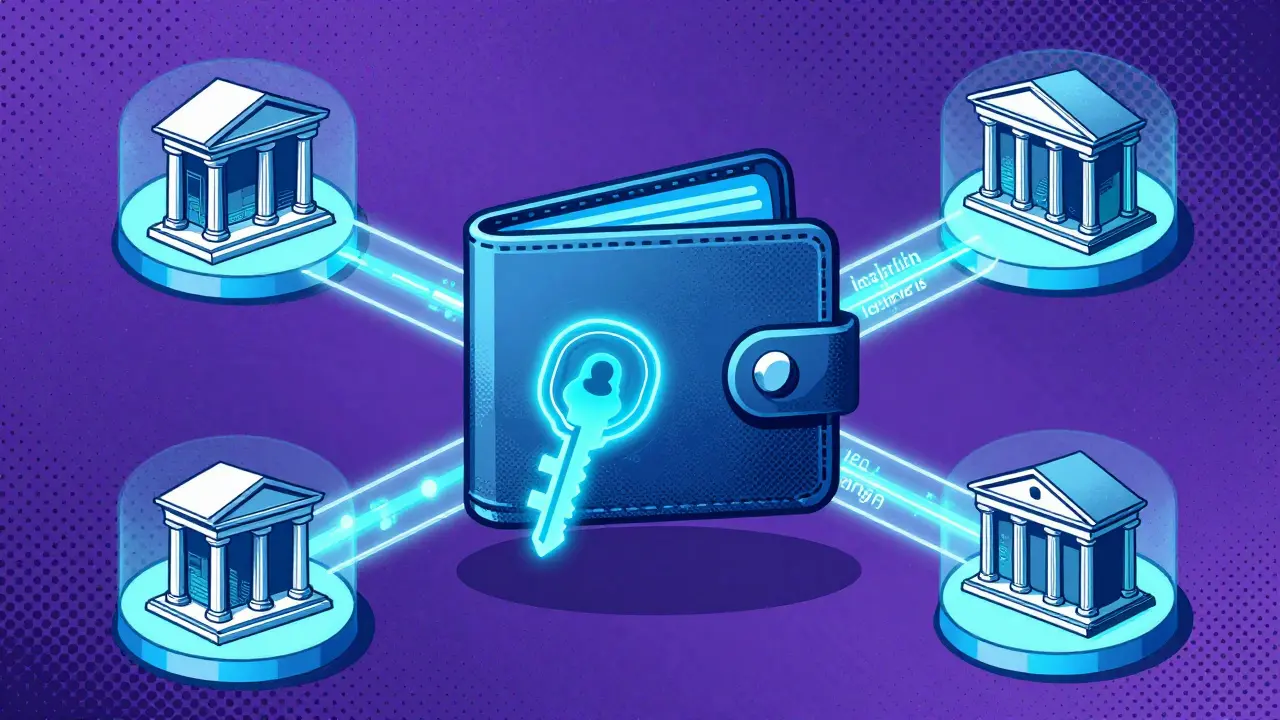
- User Control: The user receives a digital key to their identity wallet. They now own their verified identity status.
- Access Granting: When the user wants to open an account with a new bank, they grant that bank temporary access to view their verification status. The bank checks the hash on the blockchain against the original record.
- Smart Contract Execution: If the hash matches and the verification is valid, a smart contract automatically approves the onboarding process. No manual review is needed.
This system ensures that the data has not been tampered with. Because blockchains are immutable, once a verification is recorded, it cannot be altered or deleted without consensus from the network. This provides a level of auditability that traditional databases simply cannot match.
Key Technologies Powering Blockchain KYC
Several technological components work together to make this possible. Understanding these helps clarify why this solution is robust.
| Technology | Function in KYC | Benefit |
|---|---|---|
| Cryptographic Hashes | Creates a unique digital fingerprint of identity data | Ensures data integrity without exposing raw information |
| Smart Contracts | Automates verification logic and access permissions | Reduces human error and speeds up processing time |
| Permissioned Blockchains | Restricts network access to authorized entities (e.g., banks) | Meets regulatory requirements for privacy and control |
| Zero-Knowledge Proofs | Proves a statement is true without revealing the underlying data | Enhances privacy by minimizing data exposure |
Hyperledger Fabric is a leading enterprise blockchain platform widely used for KYC solutions. Unlike public blockchains like Bitcoin or Ethereum, Hyperledger is permissioned. This means only invited participants (banks, regulators, verifiers) can join the network. This aligns perfectly with financial regulations that require strict access controls. Another notable player is IBM Blockchain, which offers pre-built KYC modules for enterprises. These platforms provide the infrastructure needed to handle high-volume transactions while maintaining security.
Benefits for Users and Institutions
The shift to blockchain KYC offers tangible benefits for both sides of the equation.
For financial institutions, the cost savings are significant. By sharing verified data, banks reduce the need for redundant manual checks. According to industry estimates, blockchain KYC can reduce onboarding costs by up to 30-40%. It also improves risk management. Real-time access to updated verification statuses helps detect fraud faster. If a user is flagged for suspicious activity by one institution, that alert can be securely propagated to the network, preventing bad actors from hopping between banks.
For users, the experience is dramatically smoother. Imagine having a "digital passport" that travels with you. You verify your identity once, perhaps through a government portal or a trusted bank. Then, when you sign up for a new service, you simply click "Connect Wallet" or "Share Verification." The process takes seconds instead of days. You retain control over who sees your data and for how long. This addresses a major concern highlighted in a 2023 Statista survey, where 88% of US adults expressed worry about data privacy. Blockchain gives users sovereignty over their digital identity.
Challenges and Regulatory Hurdles
Despite the advantages, widespread adoption faces real-world obstacles. Technology is rarely the hardest part; regulation and coordination are.
Regulatory Fragmentation: KYC laws vary significantly by country. The European Union’s GDPR emphasizes the "right to be forgotten," which conflicts with the immutable nature of blockchain. If a user requests deletion of their data, how do you remove it from an unchangeable ledger? Solutions exist, such as storing only hashes off-chain and deleting the pointer, but legal clarity is still evolving. In contrast, countries like Singapore and Estonia have embraced digital identity frameworks more aggressively, creating favorable environments for blockchain KYC pilots.
Scalability Issues: While permissioned blockchains are faster than public ones, handling millions of daily transactions globally remains a challenge. Network congestion can slow down verification times. Layer-2 solutions and sharding techniques are being developed to address this, but they add complexity to the architecture.
Interoperability Standards: For blockchain KYC to work globally, different networks must talk to each other. Currently, many projects operate in silos. A verification done on a Hyperledger network may not be easily readable by a Corda network. Industry consortia like the Enterprise Ethereum Alliance are working on standards, but universal adoption is years away.
Initial Setup Costs: Migrating from legacy systems to blockchain infrastructure requires significant investment. Banks must upgrade IT systems, train staff, and integrate with existing compliance tools. Small financial institutions may struggle with these upfront costs, potentially widening the gap between large and small players.

Real-World Implementations and Case Studies
Theory is good, but practice proves the concept. Several organizations are already testing or deploying blockchain KYC solutions.
WeTrust: Based in Europe, WeTrust created a decentralized identity protocol. Their platform allows users to create self-sovereign identities. Partners include various fintech startups and even some government agencies. Users can share credentials like age verification or professional licenses without revealing full birth dates or license numbers.
Bank of China Pilot: In 2021, the Bank of China partnered with IBM to launch a blockchain-based KYC platform. The pilot allowed participating banks to share customer verification data securely. The result was a 50% reduction in onboarding time and significant cost savings. This demonstrated that large traditional banks can successfully integrate blockchain into their compliance workflows.
Estonia’s e-Residency: While not purely blockchain-based in its initial phase, Estonia’s digital identity system leverages blockchain-like principles for security and transparency. Citizens can access government services, open businesses, and file taxes online using digital IDs. This model serves as a blueprint for national-level digital identity systems worldwide.
These examples show that blockchain KYC is moving from concept to reality. However, most implementations are still in pilot stages or limited to specific regions. Full global interoperability is the next frontier.
The Future of Digital Identity
Where is this heading? The trend points toward Self-Sovereign Identity (SSI). In an SSI model, individuals hold their own identities in digital wallets, independent of any central authority. Blockchain acts as the trust layer, verifying that the credentials issued by governments or corporations are authentic.
We will likely see increased integration with AI. Artificial intelligence can analyze behavioral patterns to enhance fraud detection, while blockchain secures the identity foundation. Together, they create a powerful defense against synthetic identity fraud, where criminals combine real and fake data to create new personas.
Regulators will play a crucial role. As data breaches become more common, governments may mandate decentralized identity solutions to protect citizens. The EU’s upcoming Digital Identity Wallet initiative is a step in this direction. Compliance-driven adoption could accelerate the timeline for mainstream blockchain KYC usage.
For developers and businesses, the opportunity lies in building user-friendly interfaces. The backend complexity of cryptography and distributed ledgers should be invisible to the end-user. The goal is seamless, secure, and instant verification. Those who solve the usability puzzle will lead the next generation of financial services.
Is blockchain KYC secure?
Yes, blockchain KYC is highly secure. It uses cryptographic hashing to ensure data integrity and decentralized storage to prevent single-point failures. Unlike centralized databases, there is no single target for hackers. Additionally, smart contracts automate access controls, reducing human error. However, security depends on proper implementation, including strong encryption keys and regular audits of the smart contract code.
Does blockchain KYC violate GDPR?
It can, if not designed carefully. GDPR grants users the right to erasure (being forgotten). Since blockchains are immutable, you cannot delete data once written. To comply, systems typically store only non-personal identifiers (hashes) on-chain and keep personal data off-chain in encrypted databases. When a user requests deletion, the off-chain data is removed, and the on-chain hash becomes useless, effectively satisfying the erasure requirement.
Which blockchain platforms are best for KYC?
Permissioned blockchains are preferred for KYC due to privacy and regulatory needs. Hyperledger Fabric is the most popular choice among enterprises because it allows private channels and fine-grained access control. Other options include R3 Corda, designed specifically for finance, and Quorum, an enterprise-focused version of Ethereum. Public blockchains like Ethereum are generally avoided for sensitive KYC data due to transparency concerns.
How much does implementing blockchain KYC cost?
Implementation costs vary widely based on scale and complexity. Initial setup can range from tens of thousands to millions of dollars, covering software development, infrastructure, and integration with legacy systems. However, long-term operational costs decrease significantly due to reduced manual labor and fewer duplicate verifications. Small institutions might join consortiums to share infrastructure costs rather than building standalone networks.
Can I use my existing digital ID with blockchain KYC?
Currently, most systems are not fully interoperable. You may need to create a new digital identity within a specific blockchain network. However, standards like W3C Verifiable Credentials are emerging to allow different systems to recognize each other’s credentials. In the future, you should be able to port your verified identity from one platform to another seamlessly, similar to how email works today.