Most blockchain apps are essentially blind. They can't "see" what's happening in the real world-like a stock price change or a weather update-without a middleman. This is where SEDA Protocol is a multichain, permissionless protocol designed to bridge real-world data with blockchain networks. Often referred to as SEDA, it acts as a universal data highway, moving information from any source to any blockchain without needing a central authority to give permission.
| Attribute | Value/Detail |
|---|---|
| Network Type | Layer 1 (Multichain Native) |
| Core Function | Permissionless Data Transmission |
| Launch Year | 2021 |
| Current Price Range | $0.013 - $0.031 USD |
| Data Reach | 11+ Million Symbols |
How SEDA Actually Works
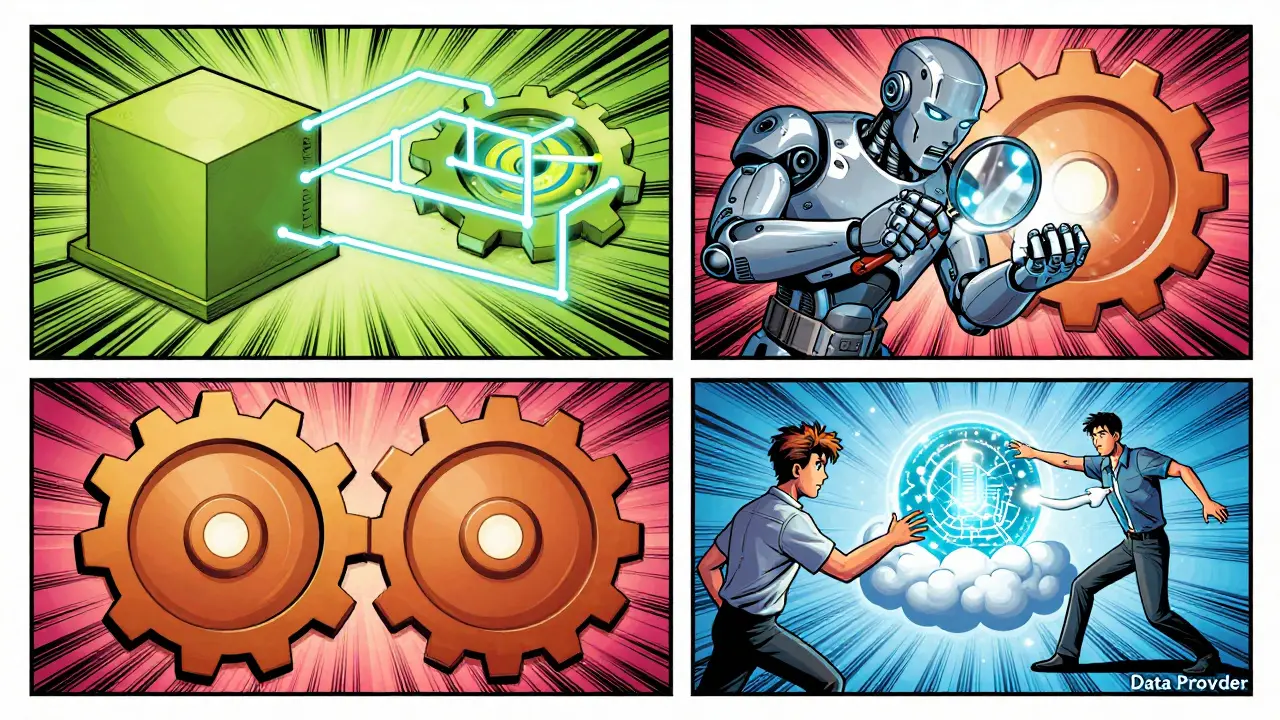
If you've used a standard oracle, you know they often rely on a few trusted nodes. SEDA flips this. It uses a modular architecture that anyone can plug into. To understand how it moves data, you have to look at its four main gears:
- The SEDA Chain: This is the foundation. It's the layer one infrastructure that tracks and secures the data transactions.
- The Overlay Network: Think of this as the routing system. It ensures data gets from the source to the destination efficiently.
- Solvers: These are the workhorses. They process the requests and ensure the data is correct before it hits the blockchain.
- Data Providers: These are the entities that actually fetch the raw info from the outside world.
By separating these roles, SEDA avoids the bottleneck effect. A developer doesn't have to ask a company for a specific data feed; they just deploy it in a permissionless environment. This means if you're building a DeFi app on Ethereum or a game on a Layer 2, you can pull in millions of different data symbols without worrying about whether a specific oracle provider supports your niche asset.
Security and the "Game Theory" Approach
Moving data between a centralized API and a decentralized chain is risky. How do you know the data provider isn't lying? SEDA doesn't rely on "trusting" the provider. Instead, it uses a mix of cryptography and economic incentives.
The protocol employs game theory to make honesty the most profitable strategy. If a solver provides incorrect data, they face economic penalties. Conversely, providing accurate, timely data earns them rewards. By combining this with strong encryption, SEDA removes the need for a "trusted third party," which is the gold standard for true decentralization.
The SEDA Crypto Coin: Market Performance and Reality
When looking at the SEDA crypto coin, you'll notice something strange: the numbers vary wildly depending on where you look. As of April 8, 2026, we're seeing a fragmented market. For instance, CoinGecko might show the price at $0.02226, while Kraken might list it as low as $0.013. This usually happens when a token is traded across multiple smaller exchanges with varying liquidity.
Trading volume is currently hovering between $344,000 and $454,000 in 24-hour windows. While the all-time high is recorded at a staggering $339.46 on some platforms, the current reality is a much more modest trading range. This volatility is common for infrastructure-level projects that are still scaling their user base.
If you're tracking the price, keep an eye on the moving averages. Traders typically look at the 50-day and 200-day lines. If SEDA breaks above these, it's generally a bullish signal. However, recent predictions from analysts at CoinCodex suggest a potential dip toward $0.01654 in the short term, so it's a choppy ride right now.

SEDA vs. Traditional Oracles
You might be wondering why we need SEDA if we already have established oracles. The biggest difference is the "permissionless" aspect. Traditional oracles often act as gatekeepers; they decide which data is available and who gets to provide it. SEDA is a peer-to-peer data feed. It doesn't care who you are-if you can provide the data and secure it, you can participate.
Moreover, SEDA is "multichain native." Instead of building a bridge for every single single chain, it's designed from the ground up to talk to any virtual machine. This makes it a piece of infrastructure-like a power grid-rather than just a specific tool for one app.
Is SEDA Protocol a Layer 1 or Layer 2?
SEDA is a Layer 1 network. It provides the foundational infrastructure needed for data transmission and computation, which then supports other Layer 1 and Layer 2 networks.
How many data sources can SEDA access?
SEDA provides access to over 11 million different symbols across various blockchain networks, making it one of the most comprehensive data tools available.
Why are the SEDA price and supply numbers different on different sites?
This is due to fragmented market data. Different exchanges and tracking sites (like Binance, Coinbase, and CoinStats) report circulating supply and pricing based on their own tracked pools, which can lead to inconsistencies in a developing ecosystem.
What happens if a data provider gives wrong information?
SEDA uses game theory and economic incentives. Providers and solvers are penalized financially for providing inaccurate data, while honest behavior is rewarded, ensuring the network remains reliable.
Can any developer use SEDA?
Yes. SEDA is permissionless, meaning any developer can deploy data feeds or join the network as a solver or data provider without needing approval from a central authority.
What to Do Next
If you're a developer, your next move is to explore the SEDA documentation to see how to deploy a permissionless data feed for your specific project. If you're an investor, the best strategy is to verify the price across at least three different exchanges (like Binance and Kraken) to get a realistic average, as the data is currently fragmented.
For those new to the space, keep an eye on the growth of the Overlay Network. As more solvers and providers join, the speed and reliability of the data transmission will improve, which is the primary indicator of SEDA's long-term health.