
Imagine a contract that doesn’t just follow rules-it learns from them. That’s what AI-powered smart contracts are doing today. They’re not science fiction. Companies like AXA, Maersk, and Fetch.AI are already using them to cut delays, prevent fraud, and automate decisions that used to take weeks. Unlike traditional smart contracts that blindly execute "if this, then that," AI-powered versions analyze real-time data, spot patterns, and adapt their behavior. They’re becoming the new backbone for complex business agreements on blockchain.
What Makes AI-Powered Smart Contracts Different?
Traditional smart contracts run on fixed code. If a shipment arrives, payment releases. If a flight is delayed, compensation auto-pays. Simple. Reliable. But rigid. They can’t handle uncertainty, noise, or changing conditions. An AI-powered smart contract, by contrast, uses machine learning models trained on thousands of past transactions. It doesn’t just react-it predicts.
Here’s how they work differently:
- Learning from data: After processing 10,000+ transaction records, AI models improve prediction accuracy by 15-22%, according to Komodo Platform’s 2025 analysis.
- Self-correction: These contracts adjust their own logic over time. Fetch.AI’s case studies show a 37% drop in execution errors after six months of live operation.
- Pattern recognition: In insurance claims, AI contracts detect fraud with 98.7% accuracy by spotting anomalies in behavior, not just rules.
- Dynamic decision-making: Instead of one condition, they weigh dozens-weather, port congestion, fuel prices, market volatility-all in real time.
This isn’t just automation. It’s intelligence built into the contract itself. And it’s changing how industries handle risk, timing, and compliance.
Where AI Smart Contracts Are Making a Real Impact
Not every contract needs AI. But the ones that do? They’re saving millions.
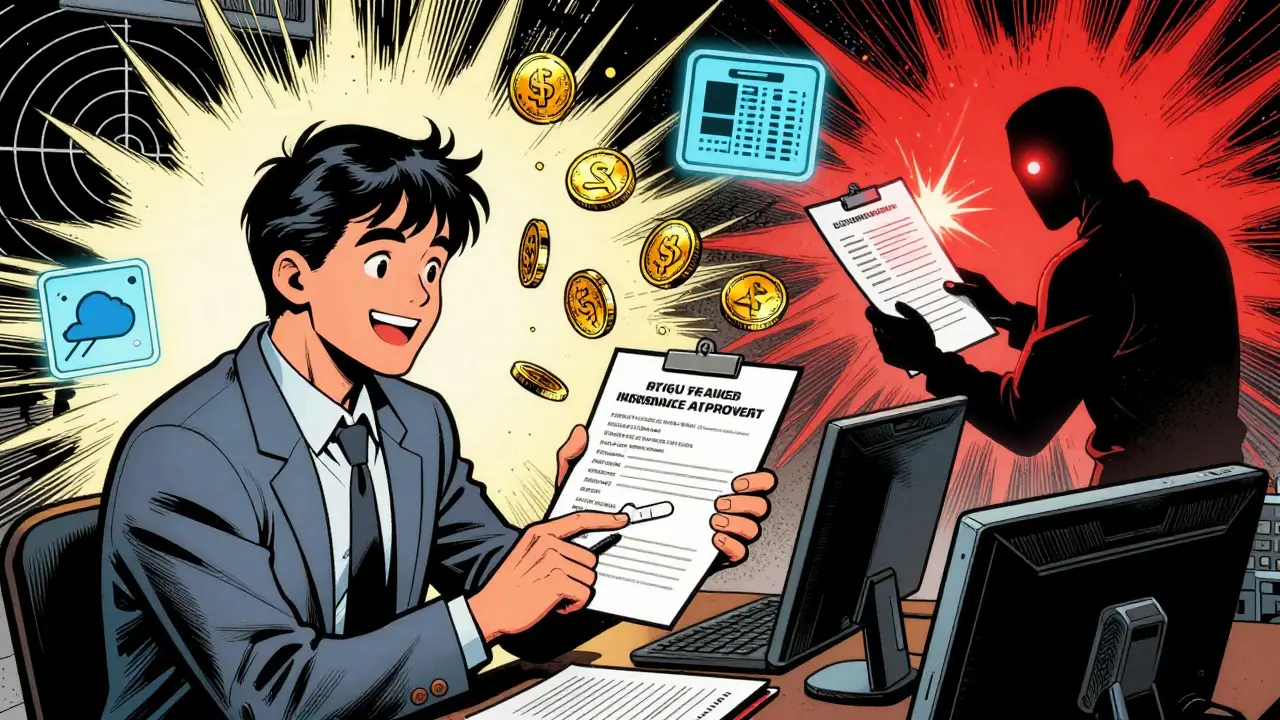
Insurance: AXA’s flight delay program used to take 14 days to process claims. With AI-powered smart contracts, it now takes 47 minutes. The system checks flight status, weather reports, and passenger data automatically. No forms. No calls. 99.2% accuracy in determining eligibility.
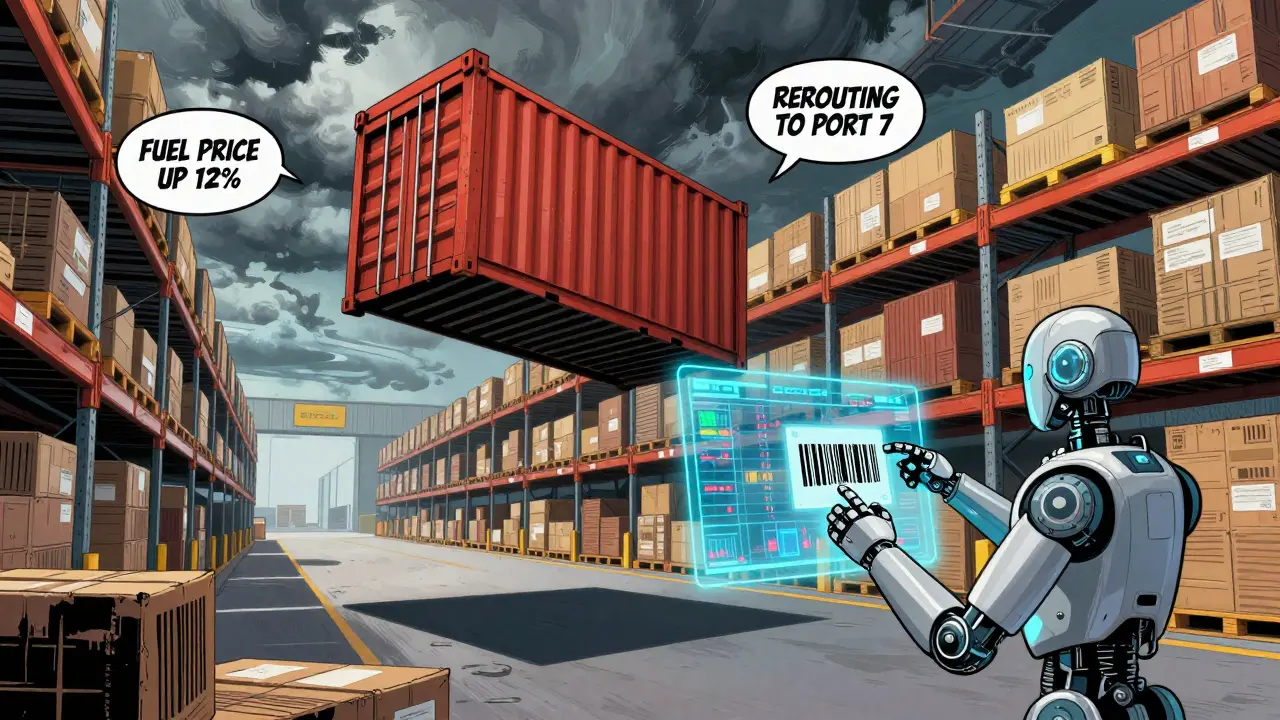
Supply Chain: Maersk tested AI contracts to reroute cargo shipments. By analyzing real-time data from 12 global ports, weather APIs, and fuel cost feeds, the system reduced logistics costs by 22.4%. A shipment heading to a storm-hit port? The contract reroutes it-no human input needed.
Finance: Banks are using AI contracts to automate loan approvals under complex conditions. If a borrower’s transaction history shows stable income, low debt, and consistent payments, the contract approves the loan. If fraud patterns emerge-like sudden cash spikes or fake pay stubs-it flags or rejects the request. One European bank lost $1.2 million in Q4 2024 because its AI misread market volatility. That mistake forced a full audit. But others are now building better guardrails.
These aren’t theoretical pilots. They’re live, profitable, and scaling.
How They Compare to Traditional Smart Contracts and CLM Systems
AI-powered smart contracts don’t replace traditional ones-they complement them.
| Feature | Traditional Smart Contracts | AI-Powered Smart Contracts |
|---|---|---|
| Logic Type | Fixed "if-then" rules | Adaptive, data-driven decisions |
| Speed (Simple Tasks) | 0.2 seconds on Ethereum | 1.1 seconds (slower due to processing) |
| Speed (Complex Tasks) | Fails with multi-variable logic | 3.7x faster than traditional in complex scenarios |
| Data Needs | None | Minimum 5,000 historical transactions |
| Gas Fees (Ethereum) | 0.015 ETH per transaction | 0.045 ETH per transaction |
| Best For | Simple payments, escrow, token transfers | Supply chain, insurance, dynamic pricing, compliance |
Now, compare them to AI-powered Contract Lifecycle Management (CLM) tools like Sirion. CLM systems offer human review, negotiation workflows, and legal oversight. But they’re centralized. AI smart contracts are decentralized, immutable, and execute without intermediaries. They’re not competitors-they’re partners. Many enterprises now use CLM for drafting and negotiation, then trigger AI smart contracts for execution.
Challenges and Risks You Can’t Ignore
AI smart contracts are powerful, but they come with serious risks.
- The black box problem: If the AI denies a claim, can you explain why? Dr. James Lovejoy from IEEE Spectrum warns that unexplainable decisions create legal liability. Regulators in the EU now require "sufficient explainability mechanisms" under MiCA (effective January 2025).
- Data quality matters: A supply chain manager at Unilever said their AI contract took six months to reach 90% accuracy. Why? Poor historical data. 87% of Fetch.AI users report performance drops when input data is messy or incomplete.
- Cost: Gas fees are 3x higher than traditional contracts. That adds up fast at scale.
- Attack surfaces: Danny Ryan from Ethereum Foundation says AI introduces new vulnerabilities. Malicious actors could poison training data or trick models into faulty decisions.
These aren’t deal-breakers-but they’re hurdles. Companies that succeed are the ones building audits, data validation layers, and fallback human review paths into their systems.
How to Get Started
You don’t need to be a genius. But you do need the right team.
Here’s the roadmap:
- Data preparation (8-12 weeks): Gather at least 5,000 historical transactions. Clean, label, and structure them. This is where most projects fail.
- Model training (4-6 weeks): Use TensorFlow or PyTorch to train the AI on patterns. Test it against known outcomes. Accuracy should hit 85%+ before moving forward.
- Blockchain integration (2-3 weeks): Connect the model to a blockchain using Solidity. Use oracles like Chainlink to pull real-time data (weather, prices, inventory).
- Testing and deployment (3-5 weeks): Run simulations. Stress-test edge cases. Deploy in a sandbox first. Monitor for 30 days before going live.
Team structure? IBM’s 2025 guide says you need: 1 blockchain architect, 2 AI specialists, and 1 domain expert (like a logistics manager or insurance underwriter). No one person can do it all.
Training takes time too. ConsenSys Academy’s 2025 certification shows developers need 300-400 hours of specialized training beyond basic smart contract coding.
What’s Next? The Road Ahead
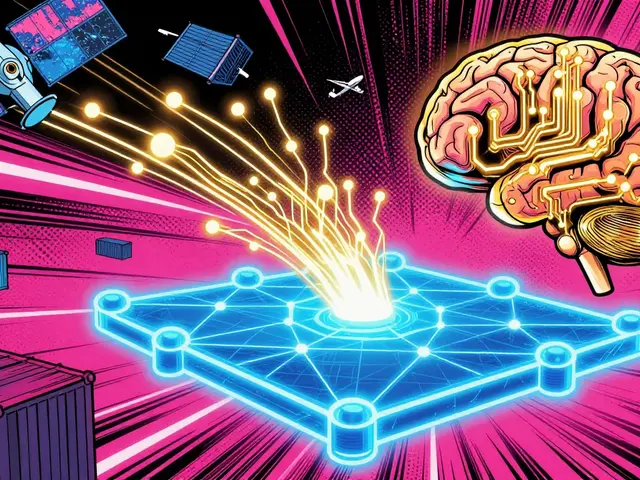
The tech is evolving fast. Ethereum’s Shanghai upgrade in March 2025 cut gas costs for complex AI logic by 28%. Chainlink launched its Decentralized Oracle Network for AI models in January 2025, making data more reliable. The Ethereum Foundation just started a dedicated research track to solve the "black box" problem-using cryptography to prove how an AI made a decision.
ISO/IEC is working on standard 23091-7 to define how AI contracts should be verified. NVIDIA announced a new GPU architecture in May 2025 built specifically for blockchain AI processing. And 17 countries now have regulatory sandboxes to test these contracts in critical sectors like banking and healthcare.
By 2030, Forrester predicts AI-powered smart contracts will handle 40% of global commercial transactions. MIT’s Digital Currency Initiative thinks 85% of complex business agreements will use them by 2035. But the Bank for International Settlements warns of systemic risk-uncontrolled AI contracts could trigger cascading financial failures.
The future isn’t AI replacing humans. It’s AI working alongside humans-faster, smarter, and more reliably than ever before.
Are AI-powered smart contracts legal?
Yes, but with conditions. The EU’s MiCA framework (effective January 2025) requires AI contracts in financial markets to provide explainable decision trails. Other regions are following. Contracts must be able to justify their outcomes-not just execute them. If you can’t explain why a loan was denied or a payment was withheld, regulators can shut it down.
Do I need blockchain to use AI smart contracts?
Not technically-but you lose the key benefits. Blockchain gives you immutability, transparency, and trustless execution. If you run AI logic on a private server, you’re just using AI with a database. The power of smart contracts comes from being on-chain: anyone can verify the rules, no middleman is needed, and once executed, it can’t be altered. That’s why all major implementations use blockchain.
Can AI smart contracts be hacked?
Yes, in new ways. Traditional smart contracts are vulnerable to code bugs. AI contracts are vulnerable to data poisoning-where bad input tricks the model. For example, if someone floods a supply chain contract with fake weather data, it might reroute shipments unnecessarily. That’s why oracle security and data validation layers are now critical parts of the architecture.
Which industries benefit most from AI smart contracts?
Financial services (41% of implementations), supply chain and logistics (29%), and insurance (18%) lead adoption. These industries deal with high-volume, multi-variable agreements where delays or errors cost millions. Manufacturing and healthcare are catching up fast, especially for automated compliance and inventory tracking.
Is this just hype, or is it actually being used?
It’s real. AXA, Maersk, and Unilever are all using them in production. Deloitte and Gartner report $5.4 billion was spent on AI-powered smart contracts in 2024. 68% of Fortune 500 companies have pilot projects. Only 22% are live, but that’s growing fast. This isn’t speculation-it’s a shift happening right now.
What’s the biggest mistake companies make when starting?
They skip data quality. Many assume more data = better AI. But messy, inconsistent, or biased data leads to 40% performance drops. The best teams spend 70% of their time cleaning, validating, and labeling data before writing a single line of code. If your historical records are incomplete, your AI will fail-even if the model is perfect.
Final Thoughts
AI-powered smart contracts aren’t about replacing humans. They’re about removing friction from complex agreements. They handle the noise so people can focus on strategy, ethics, and innovation. The companies winning aren’t the ones with the fanciest AI-they’re the ones who built strong data foundations, layered in human oversight, and respected the limits of automation. The future belongs to contracts that learn, adapt, and still answer to us.
Austin King
March 8, 2026 AT 08:30AI contracts are wild. They don't just follow rules-they learn from mistakes. I've seen teams waste months on rigid code only to realize they needed adaptability. This isn't magic, it's evolution. The real win? When a claim gets paid in 47 minutes instead of two weeks. That's time back for real humans.
Bonnie Jenkins-Hodges
March 10, 2026 AT 05:21YESSSS 🚀🇺🇸 AMERICA IS LEADING THIS CHARGE!!!
Melissa Ritz
March 10, 2026 AT 10:40Look, I get the hype. But let’s be real-this is just blockchain with a fancy ML coat of paint. The gas fees alone make this a luxury toy for Fortune 500s. Meanwhile, small businesses are still stuck with Excel sheets and prayer.
Cerissa Kimball
March 10, 2026 AT 20:13AI contracts need clean data or they fail hard I've seen this firsthand in logistics the training data was full of gaps and duplicates the model kept rejecting valid claims because it thought they were outliers 87 percent of users report this issue its not a bug its a data problem
Ken Kemp
March 12, 2026 AT 15:30Big picture alert: This isn't just about automation. It's about trust. When a contract can prove its own reasoning through crypto-verifiable logs, you don't need lawyers to mediate every dispute. That's the real revolution. Start small. Clean your data. Build the oracle layer right. The rest follows.
nalini jeyapalan
March 13, 2026 AT 17:52Whoa. You guys are missing the point. This isn't about efficiency. It's about power. Who owns the training data? Who audits the model? If a bank denies your loan and the AI says 'because you're risky' without explaining why, that's not innovation-that's algorithmic redlining. We need public oversight now, not after the damage is done.
jay baravkar
March 14, 2026 AT 07:44THIS IS THE FUTURE AND IT’S ALREADY HERE 🤯 Just saw a friend’s insurance claim auto-approved in 42 minutes. No forms. No waiting. Just… done. People are scared of change but this is what progress looks like. Keep pushing!
Ian Thomas
March 14, 2026 AT 12:51So we’re replacing human judgment with statistically optimized bias? Fascinating. Let me guess-the model was trained on data from 2018 to 2022. What happens when a global recession hits? The AI doesn’t know how to handle a 2008-style shock. It just sees 'anomaly' and shuts down. That’s not intelligence. That’s brittle predictability dressed up as AI.
Rachel Rowland
March 16, 2026 AT 10:05Everyone’s focused on the tech but no one’s talking about the people who have to clean the data. The ones labeling 10,000 transaction records by hand. They’re invisible. This system only works if we pay them fairly and train them. Otherwise we’re just automating exploitation.
Basil Bacor
March 17, 2026 AT 00:18ai smart contracts? sounds like a way for big corp to get away with not explainin why they denied you somethin
Issack Vaid
March 17, 2026 AT 07:06Interesting how we're treating AI contracts like they're neutral. They're not. They reflect the biases in their training data. If your historical claims data shows women are 'riskier' borrowers, the AI learns that. And then it enforces it. Immutable doesn't mean fair. It just means permanent.
Shawn Warren
March 17, 2026 AT 23:33AI smart contracts represent a paradigm shift in decentralized governance. The integration of machine learning into immutable ledger systems enables unprecedented operational fidelity. However, the computational overhead necessitates careful architectural planning. Gas fee optimization must be prioritized in Layer 2 implementations to ensure scalability.
Jackson Dambz
March 19, 2026 AT 09:01So now we're trusting machines to make financial decisions? What happens when the AI glitches and drains everyone's funds? It's not a bug-it's a feature of centralized control. This is how the rich automate their dominance. You think this is innovation? It's just a new way to hide exploitation behind code.
Megan Lutz
March 20, 2026 AT 05:21Let’s be honest-this is just replacing one set of gatekeepers with another. The old gatekeepers were lawyers and bankers. The new ones are data scientists and blockchain engineers. And guess who gets paid? The same people. The system still serves power. The only difference is now it’s harder to argue with because it’s 'algorithmic.'
Jesse VanDerPol
March 21, 2026 AT 20:47the data has to be clean or it all falls apart
jonathan swift
March 23, 2026 AT 20:05ALERT ALERT 🚨 This is a government surveillance rollout disguised as tech innovation. AI contracts track EVERYTHING. Your shipping routes. Your payment history. Your weather patterns. They’re building a behavioral map of the global economy. Next thing you know, your fridge refuses to restock because the AI decided you’re 'over-consuming.' This isn’t progress. It’s control.
Datta Yadav
March 24, 2026 AT 08:41Let me tell you something. In India we’ve been doing this for years-manual contracts, handwritten ledgers, and human intuition. You think AI is the future? It’s just a tool for Western corporations to outsource their ethical responsibilities. Who cleans the data? Who audits the model? Who gets blamed when it fails? Always the same people. Always the ones without power. This isn’t innovation-it’s colonialism with a blockchain logo.
Lydia Meier
March 24, 2026 AT 23:24Claims of 98.7% fraud detection accuracy are statistically misleading. Without disclosing the base rate of fraud in the training set, this metric is meaningless. A model that flags 99% of everything as fraud will achieve 98.7% accuracy if fraud occurs in less than 1.3% of cases. This is pseudoscience dressed in technical jargon.
Bryanna Barnett
March 26, 2026 AT 10:52AI contracts? Cute. I mean, I get the whole 'adaptive logic' thing but honestly it just feels like trying to make a toaster do quantum physics. If you need that much intelligence for a contract, maybe you're overcomplicating your business model. Also, gas fees? Are you kidding me?
Jane Darrah
March 27, 2026 AT 22:13Oh wow, another techno-utopian fantasy. Let me guess-next they’ll say AI contracts will end poverty. No. They’ll just make it easier for banks to deny loans to people in rural areas because their 'transaction history' doesn't look 'clean.' This isn't progress. It's algorithmic exclusion with a fancy UI. And don’t even get me started on how they’ll use this to track gig workers. Every movement, every purchase, every delay-all logged, analyzed, punished. Welcome to the new feudalism.
Denise Folituu
March 28, 2026 AT 19:40I just lost my job because the AI contract decided my role was 'redundant.' I was the only human who noticed the data drift. The model kept approving fraudulent claims because the training data was poisoned. They said 'trust the algorithm.' Now I’m broke. And they’re selling this as innovation? This isn’t the future. This is a horror story in beta.
jack carr
March 30, 2026 AT 15:18Love this. Finally, something that doesn’t require 17 emails and 3 approvals just to send a payment. The real win? When the system just… works. No drama. No paperwork. Just clean, quiet, reliable execution. That’s the quiet revolution.
Drago Fila
March 30, 2026 AT 19:58Biggest mistake? Thinking AI contracts are a plug-and-play solution. They’re not. You need domain experts who understand the business, not just coders who know Solidity. One logistics manager I worked with caught a flaw the AI kept missing-it didn’t account for seasonal labor strikes in Southeast Asia. That’s the human layer no algorithm can replace.
Steven Lefebvre
April 1, 2026 AT 04:37Anyone else notice how every example here is from big corporations? What about small farmers using AI contracts to sell crops directly? Or indie artists licensing music? This tech needs to be accessible, not just for Fortune 500s. The real innovation will happen when it’s open-source, low-cost, and community-governed.
Leah Dallaire
April 1, 2026 AT 12:49AI contracts are a trap. They sound smart, but they’re just another way to automate control. The moment you give up explainability, you give up democracy. And who controls the training data? The same tech giants who already own your data. This isn’t progress. It’s surrender.