
Imagine a world where you don't have to worry about which stablecoin might lose its peg. That was the promise of mStable, a decentralized finance (DeFi) protocol designed to create a unified infrastructure for stablecoins. At the heart of this system lies the Meta (MTA) token. But here is the reality check: while the technology behind mStable was once hailed as revolutionary, the market has moved on. Understanding what MTA is today requires looking past the hype and examining its actual utility, governance role, and the significant challenges it faces in 2026.
If you are holding MTA or considering buying it, you need to know that this is not your typical high-growth crypto asset. It is a governance token with specific mechanical functions within a niche protocol. This guide breaks down exactly how MTA works, why it matters, and whether it still holds value in the current DeFi landscape.
The Core Purpose of the Meta (MTA) Token
To understand MTA, you first need to understand the problem mStable tried to solve. Before protocols like mStable gained traction, users had to choose between different stablecoins like USDC, USDT, or DAI. Each carried different counterparty risks. If one issuer failed, your money could vanish.
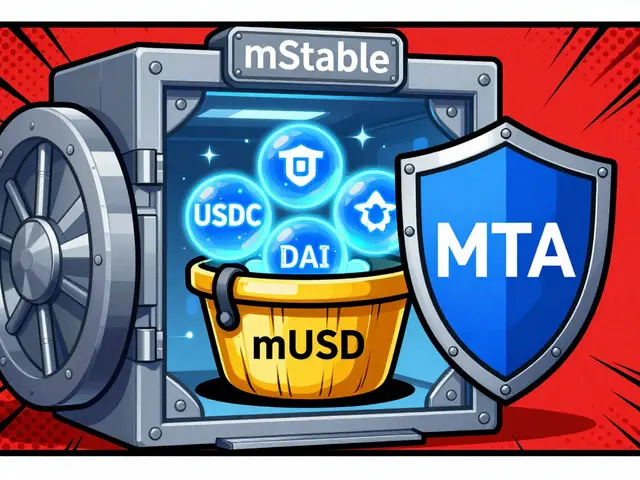
mStable created a solution called "meta-assets." These are baskets of stablecoins bundled together. The primary meta-asset is mUSD, which consists of multiple underlying stablecoins. The idea is simple: if one stablecoin in the basket fails, the others protect your value. This is known as risk-limiting architecture.
So, where does MTA fit in? The Meta (MTA) token serves three main purposes:
- Governance: Holding MTA gives you a voice in how the protocol runs. You vote on adding new assets, changing fees, and selecting price oracles.
- Incentivization: The protocol uses MTA to reward liquidity providers who deposit their stablecoins into the mStable pools.
- Re-collateralization: This is the most critical technical function. If an underlying stablecoin permanently loses its peg (e.g., drops below $1 and never recovers), the protocol can mint new MTA tokens and sell them to raise funds. This helps restore the peg and protects the remaining value in the basket.
Think of MTA as the insurance policy and steering wheel for the mStable ship. Without it, the protocol cannot adjust its course or repair damage from market crashes.
How MTA Governance Actually Works
Just holding MTA in your wallet doesn't automatically give you voting power. To participate in governance, you must stake your tokens in the protocol's smart contract. This process turns you into a "Governor."
Here is what Governors decide:
- Asset Composition: Which stablecoins are allowed in the mUSD basket?
- Maximum Weights: How much of any single stablecoin (like USDT) can make up the basket? This cap prevents over-exposure to one risky asset.
- Fees: What are the costs for minting or redeeming mUSD?
- Oracles: Which data feeds provide the price information for the assets?
However, participation has historically been low. Data from early 2023 showed that only about 42% of the circulating supply was staked for governance. This means decision-making power was concentrated among a small group of large holders, raising concerns about decentralization. If you plan to use MTA for governance, be aware that the barrier to entry is high both in terms of capital required and the complexity of the proposals.
The Re-Collateralization Mechanism: A Safety Net?
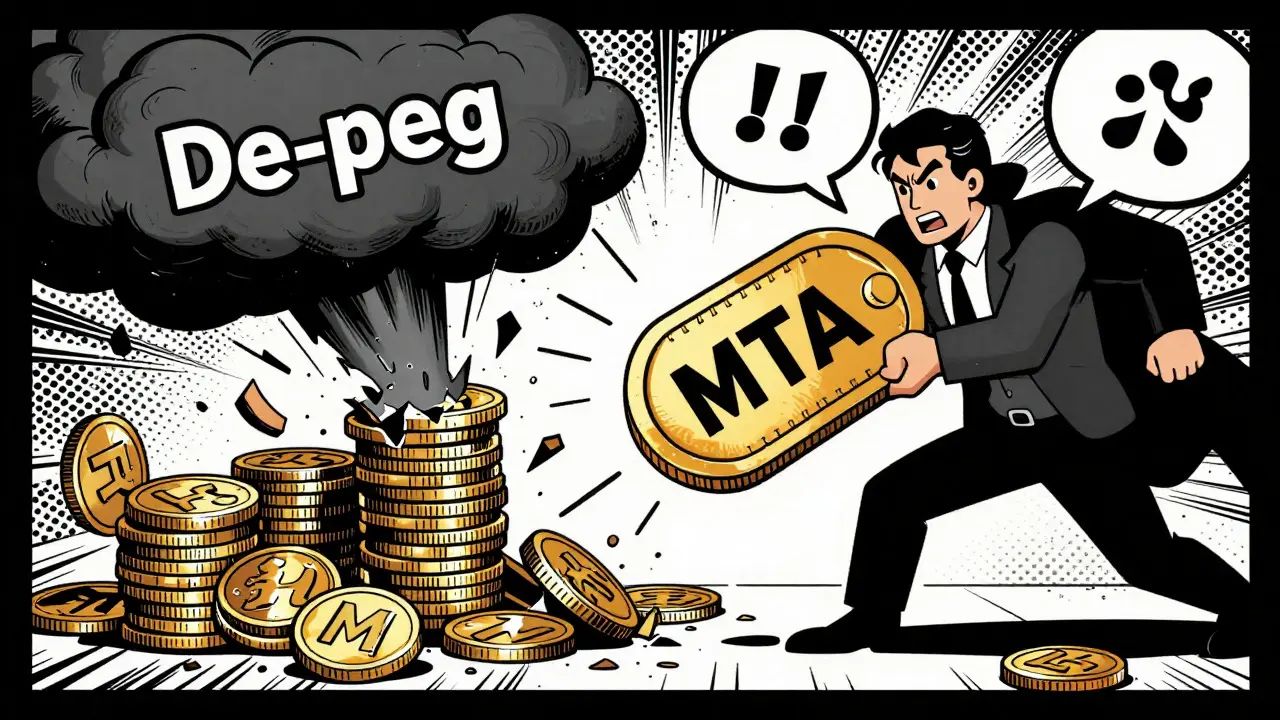
The re-collateralization feature is mStable's unique selling point. Let's say Tether (USDT) suddenly de-pegs to $0.80. In a standard pool, everyone takes a hit. In mStable, the protocol detects this failure.
It then mints new MTA tokens and sells them on open markets. The proceeds are used to buy back the de-peged asset at a discount or compensate liquidity providers. This mechanism aims to keep mUSD close to its $1 target value.
But there is a catch. For this to work, MTA needs to have sufficient market value and liquidity. If MTA's price crashes, the protocol may not raise enough funds to cover the loss. This creates a circular dependency: the safety net relies on the speculative value of the governance token itself.
Market Reality: TVL Decline and Liquidity Issues
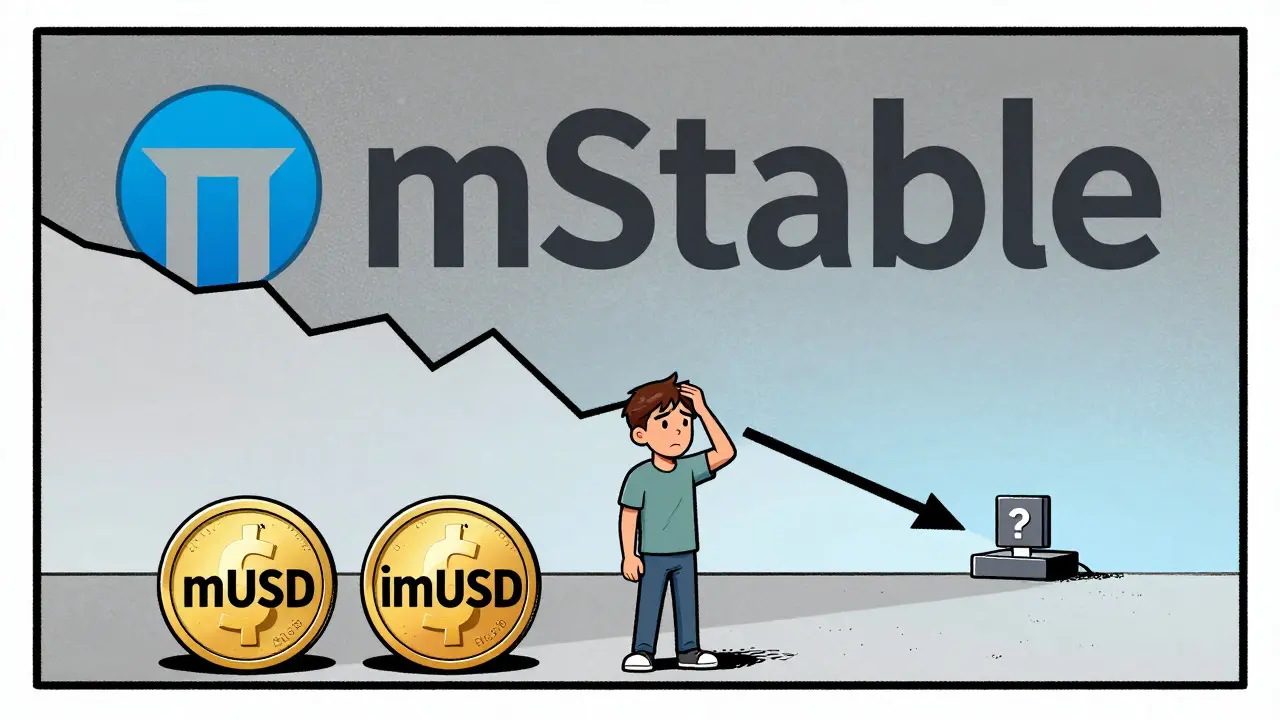
While the technology sounds robust, the market numbers tell a different story. When mStable launched in 2020, led by Stani Kulechov (founder of Aave) and Miles Anthony, it generated massive interest. Total Value Locked (TVL) peaked at around $250 million in early 2021.
By late 2023, TVL had dropped to under $10 million. This represents a less than 5% share of the total stablecoin market, compared to giants like Curve Finance which consistently holds billions in TVL. Why did this happen?
| Feature | mStable (MTA) | Curve Finance (CRV) |
|---|---|---|
| Primary Focus | Risk-limited stablecoin baskets | Efficient stablecoin swapping |
| Peg Failure Protection | Yes (Re-collateralization) | No (Impermanent loss risk) |
| Slippage on Large Swaps | Near zero (Bonding curve) | Low (0.1-0.5%) |
| Complexity | High (Dual-token system) | Medium |
| Market Adoption (2023) | Declining (<$10M TVL) | Dominant ($1-2B TVL) |
Users found mStable's interface confusing. The distinction between mUSD (the stablecoin) and imUSD (the yield-bearing version) caused widespread confusion. Support tickets revealed that over 60% of user issues stemmed from misunderstanding these two tokens. Meanwhile, competitors offered simpler experiences with deeper liquidity.
Tokenomics: Supply and Distribution
The maximum supply of MTA is capped at 100 million tokens. As of late 2023, the circulating supply was approximately 63.7 million tokens. This means nearly two-thirds of all possible MTA tokens were already in circulation.
This limited inflation model is generally positive for scarcity. However, without strong demand drivers, scarcity alone doesn't boost price. The Fully Diluted Valuation (FDV) saw a dramatic drop from its all-time high in May 2021 to a fraction of that value by 2023. Investors should note that the token's value is heavily tied to the protocol's ability to attract new liquidity, which has stalled.
Current Developments: Project Reboot
The mStable team hasn't given up. In mid-2023, they announced "Project Reboot," aiming to migrate to Ethereum Layer 2 solutions to reduce gas fees and improve efficiency. They also planned an upgrade to mStable v2 with expanded asset support.
However, community skepticism remains high. Previous roadmap milestones were missed, eroding trust. Analysts suggest that for mStable to regain relevance, it needs strategic partnerships with larger DeFi protocols and successful integration into emerging ecosystems. Without these, the risk of protocol abandonment increases.
Is MTA Worth Your Attention in 2026?
For most casual investors, MTA is likely too risky and illiquid. Trading volumes frequently dipped below $10,000 daily, making it hard to enter or exit positions without significant slippage. Social media engagement also plummeted, with monthly mentions dropping from over 15,000 at its peak to under 2,000.
However, for DeFi enthusiasts interested in niche governance opportunities or those who believe in the long-term thesis of diversified stablecoin collateral, MTA offers a unique proposition. Its risk-limiting architecture is technically superior to many competitors, even if market adoption lags.
If you decide to engage with MTA, start small. Understand the difference between mUSD and imUSD. Stake your tokens if you want governance rights. And always monitor the protocol's TVL and development updates closely.
What is the main use case for the Meta (MTA) token?
The primary use cases for MTA are governance voting, incentivizing liquidity providers, and re-collateralization. Re-collateralization allows the protocol to mint and sell MTA to recover value if an underlying stablecoin loses its peg, protecting the overall stability of the mUSD basket.
Is mStable safe to use?
mStable has undergone security audits, including by CertiK, which praised its contract architecture but noted potential vulnerabilities in emergency shutdown mechanisms. While the risk-limiting design is robust, smart contract risks and market volatility remain inherent dangers in DeFi. Always do your own research.
Why has mStable's TVL declined so significantly?
The decline is attributed to high complexity for average users, competition from simpler protocols like Curve Finance, and lower liquidity incentives. Users found the dual-token system (mUSD/imUSD) confusing, leading to a migration toward more user-friendly alternatives.
How do I participate in mStable governance?
To participate, you must acquire MTA tokens and stake them in the mStable governance smart contract. Staking grants you voting rights proportional to your stake. You can then vote on proposals regarding asset weights, fees, and protocol upgrades.
What is the difference between mUSD and imUSD?
mUSD is the base stablecoin basket that maintains a $1 peg. imUSD is the yield-bearing version of mUSD. When you deposit mUSD into the protocol, you receive imUSD, which accrues interest from swap fees and other sources. Redeeming imUSD converts it back to mUSD plus accrued yields.
amy miranda
August 7, 2026 AT 00:08The sheer arrogance of these DeFi founders is what truly sickens me. They promise you a utopia where your money is safe, yet they build their castles on sand and call it innovation. It is morally bankrupt to sell governance tokens as if they are insurance policies when the underlying mechanics are so fragile that one bad oracle feed can wipe out everything. People need to stop being so naive and realize that this entire ecosystem is built on greed and hubris rather than actual financial stability.
Pernelia Wahkan
August 7, 2026 AT 01:22It is fascinating how the re-collateralization mechanism acts as both a shield and a sword. On one hand, it offers a theoretical safety net against de-pegging events, which is a clever architectural choice. On the other hand, it creates a circular dependency where the value of the safety net relies entirely on the speculative price of the token itself. This is a classic example of complex systems theory applied to finance, where the solution introduces new vulnerabilities that are often overlooked by retail investors who just want easy yields.
Subhash Kashyap Dm
August 8, 2026 AT 12:12look at the tvl drop from 250m to under 10m its not an accident its designed obsolescence the big players like curve already cornered the market with better liquidity depth mstable was always a vanity project for stani kulechov to flex his coding skills but the math never worked out for long term holders because the inflation rate of mta emissions destroys any real yield you think you are getting smart contracts are just code and code has bugs and humans have biases
Billy Cunningham
August 9, 2026 AT 19:08I feel so drained just reading about all this complexity 😩 Why do we need another stablecoin wrapper when USDC exists? It feels like everyone is trying to reinvent the wheel but making it square instead 📉 I just want my money to sit there and not lose value without having to read a hundred pages of whitepapers or worry about governance votes I am too tired for this drama 😫
Ed Wallace
August 11, 2026 AT 11:02There is a profound philosophical question hidden within the mechanics of mStable. What is the true nature of value when it is derived from a basket of other values that themselves are merely promises? We are essentially layering abstractions upon abstractions, creating a tower of Babel in the digital realm. The MTA token represents not just economic utility but also a collective belief system that must be maintained through constant participation and vigilance. It is a mirror reflecting our own desire for security in an inherently chaotic market.
Joshua Hofford
August 11, 2026 AT 15:19Hey folks! Look on the bright side, even if the TVL is down, the technology is still out there waiting for the right moment to shine again. Innovation often takes a back seat before it comes roaring forward. Maybe this is just a consolidation phase where the weak hands get shaken out and the true believers remain. There is always potential in niche protocols that solve specific problems like risk-limiting architecture. Keep an open mind and stay positive about the future of DeFi! 🌟
Marcia Albert
August 12, 2026 AT 14:28I just sit back and watch the circus unfold. Everyone rushing in during the bull market screaming about revolutionary tech, and then vanishing into thin air once the winds change. It is quite the spectacle really. The contrast between the high-flying promises and the quiet reality of declining usage is almost poetic in its irony. I suppose we will see who is left standing when the next cycle kicks off, but for now it is just a ghost town with fancy decorations.
Emma Smith
August 14, 2026 AT 11:40you guys are missing the point of decentralized autonomous organizations its about the sovereignty of the individual voter but clearly most people dont understand the nuance of staking mechanisms and oracle manipulation risks its a deep dive into the epistemology of trust why would you trust a centralized issuer when you can trust a algorithmic consensus model even if that model has flaws its still better than trusting a bank teller who might steal your cash
Ed Mitchell
August 15, 2026 AT 11:31It is obvious to anyone with eyes to see that this decline is part of a larger narrative controlled by the elite. They allow these projects to flourish briefly to attract attention and capital, only to let them wither away so that the established giants like Curve can maintain their hegemony. The low participation in governance is no coincidence; it is engineered to ensure that decisions favor those who hold the most power. Wake up sheeple, the matrix is protecting its own interests.
Michael Mostyn
August 15, 2026 AT 23:36One must consider the structural integrity of the argument presented regarding the utility of MTA. While the concept of re-collateralization is theoretically sound, its practical application depends heavily on market conditions that are often irrational. The disparity between the intended design and the actual market adoption suggests a fundamental misalignment between developer expectations and user behavior. It is a case study in the limitations of purely algorithmic solutions to human-centric financial problems.
Erica Johnson
August 16, 2026 AT 22:19Let us be honest here, nobody actually cares about the technical details of meta-assets unless they are losing money. The average investor just wants green candles and easy returns. MTA failed to deliver that simple promise, so it gets relegated to the dustbin of history along with hundreds of other dead projects. It is sad but true that complexity does not equal value in the crypto space, simplicity usually wins every single time. :/
Ken G
August 18, 2026 AT 09:58the whole idea of using a governance token as collateral is flawed from the start it smells like a scam wrapped in blockchain jargon to fool people who think they are smarter than the system but really they are just patsies handing over their life savings to venture capitalists who already exited years ago keep your money in gold or cash anything else is just gambling with extra steps
Lorraine Surringer
August 19, 2026 AT 07:06Honestly i feel like everyone is being so harsh on mstable without understanding the effort that went into building it sure the numbers are down but that doesnt mean the vision is dead maybe we just need more education and community support to bring it back to life its okay to make mistakes and learn from them lets not tear each other down but lift each other up instead
Alex Di Mango
August 19, 2026 AT 08:41I think there is room for multiple perspectives here. Some people see the decline as a failure, while others see it as a natural selection process in the DeFi ecosystem. It is important to respect the work that went into creating mStable, even if it did not achieve mainstream success. Every project teaches us something valuable about what works and what does not. Let us celebrate the innovation while acknowledging the challenges.
Amor Jordan
August 20, 2026 AT 23:25I hear your frustrations loud and clear. It is disheartening to see a project with such potential struggle to maintain relevance. However, let us remember that resilience is key in this industry. Many projects have risen from the ashes after facing similar setbacks. Perhaps this is an opportunity for the remaining community to rebuild with a clearer focus and stronger foundations. Your passion for the protocol shows that there is still hope.
Nick Darring
August 21, 2026 AT 23:31You know what, I bet if you dug deep enough you would find that the reason mStable failed is because the developers were secretly shorting their own token while pumping the narrative to unsuspecting retail investors. It is always the same story, isn't it? They create a complex system that nobody fully understands, lure people in with high APYs, and then vanish when the music stops. But sure, let us pretend it was just bad luck and poor market timing instead of outright fraud.
Eden Tadesse
August 23, 2026 AT 02:58i think the main issue is that ppl dont rly get how meta assets work its kinda confusing tbh like why bundle stablecoins when u can just pick one but then again maybe thats the beauty of it diversification right? anyway im just gonna keep watching from the sidelines cuz im scared of impermanent loss lol
Eric Zehr
August 23, 2026 AT 07:26It is crucial to recognize the efforts made by the team behind mStable. They attempted to solve a genuine problem in the stablecoin space, which is counterparty risk. Even though the market has moved on, the lessons learned from their experience are invaluable for future projects. We should encourage continued innovation and not dismiss past attempts simply because they did not reach unicorn status. Progress is often non-linear.
Namrata Mapgaonkar
August 23, 2026 AT 21:09from my perspective in india we see lots of these defi projects come and go very quickly its hard to keep up with all the new terms and technologies but i think the idea of protecting ur stablecoins is good even if mta didnt take off maybe someone else will try again with a simpler approach its ok to fail as long as we learn smth new :)