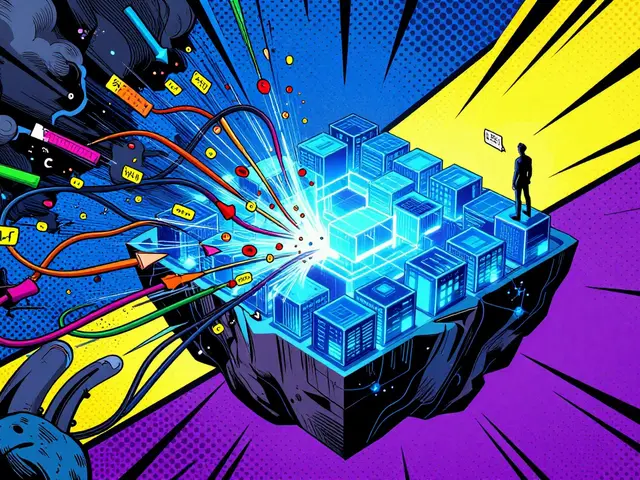
Imagine a smart contract on Ethereum that needs to know the price of Bitcoin to decide whether to liquidate a loan. The blockchain itself is an isolated island; it cannot simply call an API to Coinbase or Binance to get that number. This is the "oracle problem." Price oracles are mechanisms that bridge this gap by providing external asset price data to blockchain networks. Without them, decentralized finance (DeFi) would grind to a halt, as most protocols rely on accurate, tamper-proof price feeds to function.
As of 2023, price oracles secured over $30 billion in DeFi protocols, according to Chainlink documentation. They are no longer just a technical curiosity; they are critical infrastructure. If you are building a DeFi app or investing in one, understanding how these oracles work-and where they might fail-is essential for managing risk.
The Core Problem: Why Blockchains Need Oracles
Blockchains are deterministic and isolated. Every node must agree on the exact same state of the ledger. If one node tried to fetch a live price from a centralized exchange, another node might get a slightly different price due to network latency or market movement. This breaks consensus. Therefore, blockchains need a trusted way to bring outside data in without introducing ambiguity.
Smart contracts are the primary consumers of this data. They use price feeds for:
- Loan Liquidations: Determining if a borrower's collateral value has dropped below a threshold.
- Stablecoin Pegs: Maintaining the value of assets like DAI against the US dollar.
- Automated Market Makers (AMMs): Calculating fair prices for token swaps in pools like Uniswap.
If the oracle provides wrong data, the smart contract executes incorrectly. A small error can lead to massive financial losses, as seen in several high-profile hacks.
How Major Oracle Systems Work
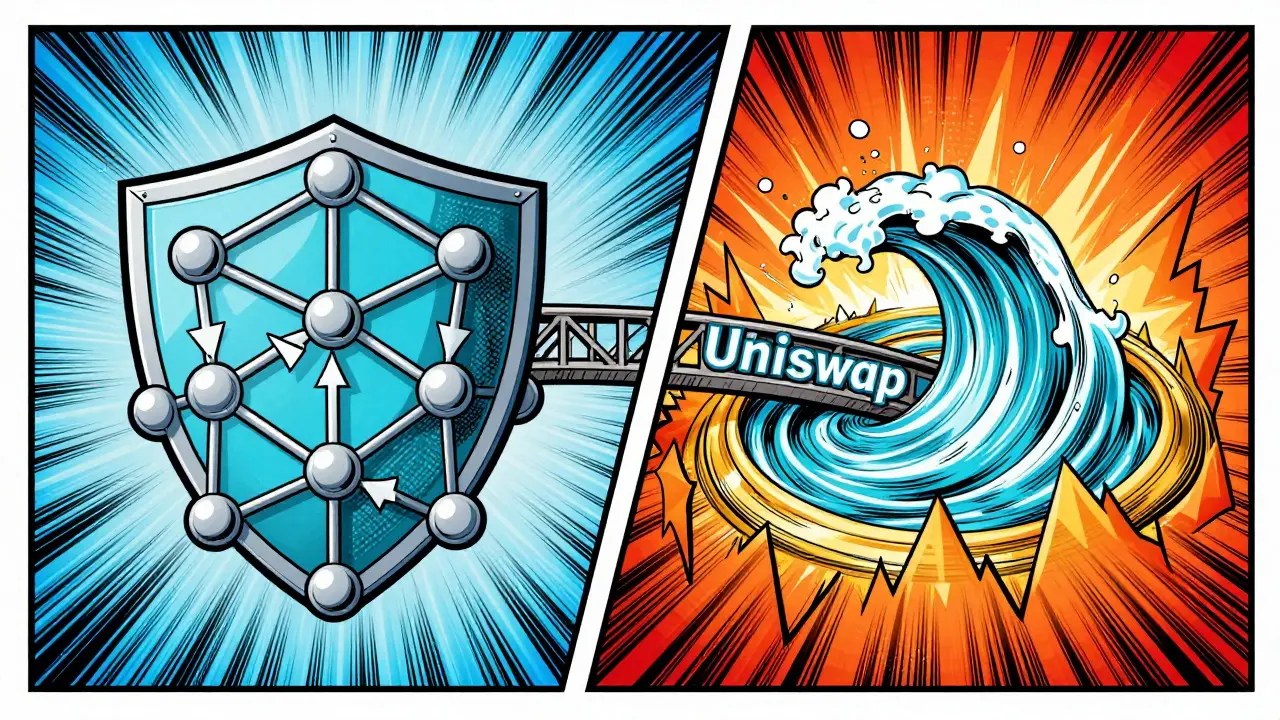
Not all oracles are created equal. The two most prominent approaches are represented by Chainlink and Uniswap.
Chainlink uses a decentralized network of node operators. These nodes fetch data from multiple centralized exchanges, aggregate it, and submit it to the blockchain. To prevent any single point of failure, Chainlink implements three layers of decentralization: at the data source level, the node operator level, and the oracle network level. As of 2023, Chainlink holds approximately 70% market share in the decentralized oracle space, providing feeds for over 1,000 assets across 12 blockchains.
Uniswap's Oracle, introduced with Uniswap V2 in May 2020, works differently. It measures market prices natively within the liquidity pools. It calculates Time-Weighted Average Prices (TWAPs) based on the geometric mean of price observations over time. Crucially, Uniswap updates prices at the end of a block, after the last trade. This design removes the possibility of in-block price manipulations but requires developers to implement their own logic for storing and calculating TWAPs.
| Feature | Chainlink | Uniswap Oracle |
|---|---|---|
| Architecture | Decentralized Node Network | On-chain Liquidity Pools |
| Data Source | Multiple Centralized Exchanges | Native Trading Volume |
| Update Frequency | Sub-1 minute (configurable) | Every Block |
| Manipulation Risk | Low (Aggregated Data) | Moderate (Flash Loan Vulnerability) |
| Integration Complexity | High (External Nodes) | Medium (Requires TWAP Logic) |
Risks and Vulnerabilities: The Dark Side of Oracles
While essential, oracles remain the weakest link in DeFi security. According to Messari's 2023 DeFi Outlook, 37% of all DeFi hacks between 2020 and 2023 involved some form of oracle manipulation. The most famous example is the Harvest Finance hack in October 2020, where attackers manipulated Uniswap's oracle to steal $24 million. They exploited the short observation window in the oracle mechanism to create artificial arbitrage opportunities.
Other risks include:
- Stale Data: During extreme volatility, such as the May 2021 crash, some oracles failed to update quickly enough, leading to undercollateralized liquidations. MakerDAO's system prevented $120 million in potential losses through hourly updates, but other protocols suffered.
- Low Liquidity Assets: Academic research from UC Berkeley (2022) found that TWAPs significantly reduce but don't eliminate manipulation risk, particularly for low-liquidity assets where a single large trade can skew the average.
- Network Congestion: In 2020, during "Black Thursday," ETH gas fees spiked, causing oracle updates to delay, which triggered $4 million in erroneous liquidations.
Security researchers recommend using decentralized oracles over centralized ones and constantly checking performance metrics. Implementing circuit breakers and setting appropriate staleness thresholds are also critical best practices.
Implementation Challenges for Developers
Integrating an oracle is not plug-and-play. For Chainlink, developers typically spend 2-3 weeks on integration, focusing on configuring update thresholds and heartbeat mechanisms to prevent stale data. A Consensys security advisory from June 2022 found that 17% of audited DeFi protocols had incorrect staleness threshold configurations.
For Uniswap, the challenge lies in code complexity. Developers must write custom smart contract logic to store and calculate TWAPs. A developer named Alex Johnson reported a failed integration attempt in March 2023 due to insufficient time-weighted price history for low-volume pairs. This highlights the importance of choosing an oracle that matches the liquidity profile of your assets.
Key skills required for robust oracle implementation include:
- Proficiency in Solidity and smart contract development.
- Understanding of decentralized systems and consensus mechanisms.
- Familiarity with financial market mechanics and volatility patterns.
Market Trends and Future Outlook
The oracle market is growing rapidly alongside DeFi. Total Value Locked (TVL) in protocols using oracles grew from $680 million in January 2020 to $82.3 billion in December 2023. Regulatory frameworks are also catching up. The EU's MiCA legislation, effective December 2024, requires "reliable and verifiable price sources" for stablecoin issuers, directly impacting oracle selection.
Innovation continues. Chainlink launched its Cross-Chain Interoperability Protocol (CCIP) in October 2023, enabling secure cross-chain price data transfers. Delphi Digital predicts that hybrid oracle models, combining on-chain liquidity data with traditional market feeds, will become standard by 2026, potentially reducing manipulation vectors by 70%. While OpenZeppelin warns that oracles remain the "weakest link" until theoretical limitations are addressed, the industry is moving toward standardized, highly secure infrastructure layers.
Frequently Asked Questions
What is the main difference between Chainlink and Uniswap oracles?
Chainlink uses a decentralized network of nodes to aggregate data from multiple external sources, offering higher security against manipulation. Uniswap's oracle derives prices directly from on-chain trading volume within its liquidity pools, offering capital efficiency but requiring more complex developer logic to handle Time-Weighted Average Prices (TWAPs).
Can price oracles be hacked?
Yes. Oracle manipulation is a significant risk in DeFi. Attacks often involve flash loans to temporarily distort price feeds. The Harvest Finance hack in 2020 resulted in $24 million in losses due to oracle manipulation. Using decentralized oracles and implementing staleness checks can mitigate these risks.
Why do blockchains need oracles if they are decentralized?
Blockchains are isolated ecosystems that cannot directly query external data like stock prices or weather data. Oracles act as a bridge, bringing this external information onto the blockchain in a way that maintains consensus and trust among all nodes.
Blockchains are isolated ecosystems that cannot directly query external data like stock prices or weather data. Oracles act as a bridge, bringing this external information onto the blockchain in a way that maintains consensus and trust among all nodes.
Which oracle is best for low-liquidity tokens?
Generally, off-chain oracles like Chainlink are safer for low-liquidity tokens because they aggregate data from multiple exchanges. On-chain oracles like Uniswap's can be easily manipulated by large trades in thin liquidity pools, making them risky for assets with low trading volume.
How often do price oracles update?
It depends on the protocol. Chainlink offers configurable update intervals, often sub-1 minute for major assets. Uniswap's oracle updates every block, but developers usually use Time-Weighted Average Prices (TWAPs) over longer periods (e.g., 1 hour) to smooth out volatility and reduce manipulation risk.