You type "Rune" into a price tracker and get two completely different answers. One shows a mid-cap asset trading around $0.51 with millions in daily volume. The other shows a micro-cap gaming token worth fractions of a cent. This isn't a glitch; it's the biggest confusion trap in crypto right now. When people ask what is Rune crypto, they are almost always asking about THORChain’s RUNE, the backbone of cross-chain swaps. But there is also a Binance Smart Chain gaming token sharing the same ticker. If you buy the wrong one, you’re holding a ticket to a dark fantasy game instead of a piece of decentralized financial infrastructure.
This guide cuts through the noise. We’ll break down exactly what THORChain’s RUNE does, why it matters for swapping Bitcoin and Ethereum without a middleman, and how its unique tokenomics differ from the tiny BSC project. By the end, you’ll know which RUNE fits your portfolio and why the distinction saves you from expensive mistakes.
The Two Faces of RUNE: Infrastructure vs. Gaming
Before diving deep, let’s clear up the identity crisis. In September 2026, the cryptocurrency landscape hosts two distinct assets using the ticker RUNE. Confusing them is like confusing Apple Inc. stock with an apple-shaped candy bar.
| Feature | THORChain RUNE | BSC Rune (Gaming) |
|---|---|---|
| Primary Function | Cross-chain settlement, security collateral, governance | In-game currency for NFT battles and guilds |
| Blockchain Network | Native THORChain Layer-1 + ERC-20/BEP-2 wrappers | Binance Smart Chain (BEP-20) |
| Market Cap Scale | Mid-cap (~$160M+ range) | Micro-cap (negligible volume) |
| Circulating Supply (Sept 2026) | ~328 million tokens | Few thousand tokens tracked |
| Real-World Utility | Facilitates native BTC/ETH swaps without wrapping | Collecting weapons, joining guilds in dark fantasy MMORPG |
When analysts talk about RUNE’s price action or technical levels like the $0.495 support zone, they are exclusively discussing THORChain. The BSC gaming token trades in sub-cent territory with minimal liquidity, meaning you can’t move significant money in or out without crashing the price. For the rest of this article, we focus on THORChain’s RUNE, the asset that actually powers decentralized finance.
How THORChain Uses RUNE to Swap Bitcoin Without Wrapping
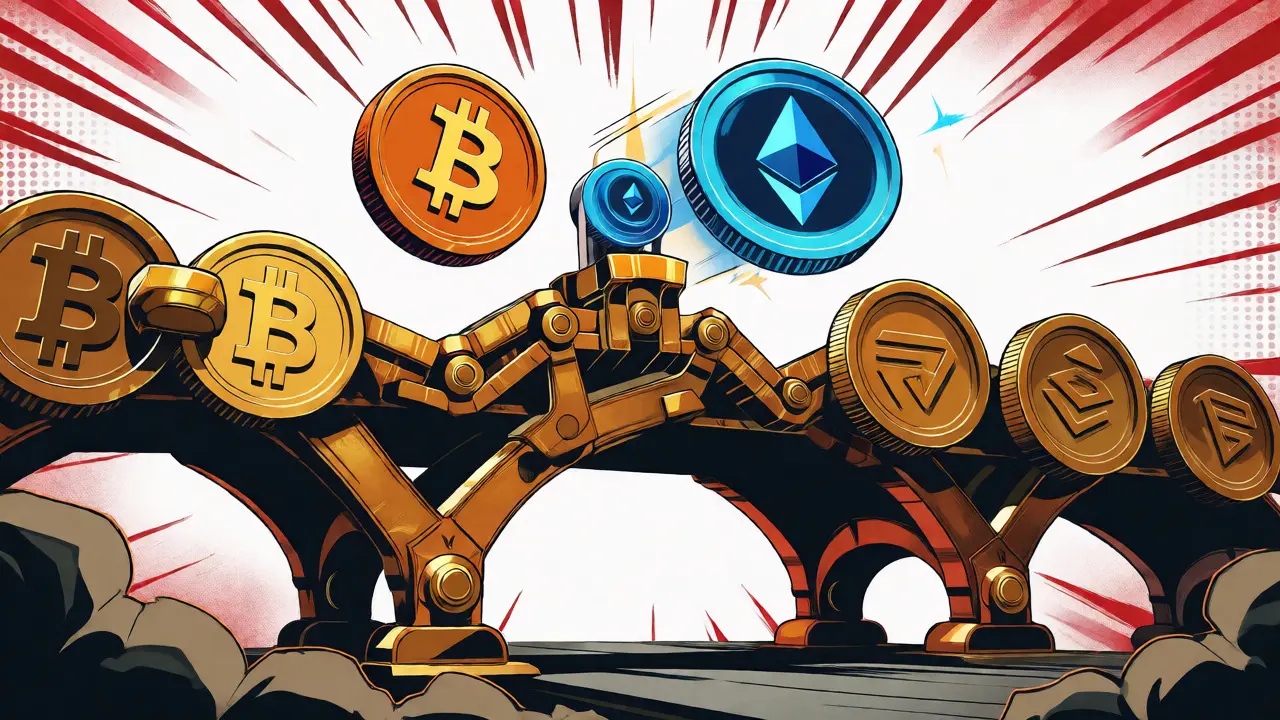
Most decentralized exchanges (DEXs) operate on a single chain. Want to swap Bitcoin for Ethereum? You usually have to "wrap" your Bitcoin-locking it in a vault and receiving a synthetic version on Ethereum. This adds risk, fees, and complexity. THORChain solves this by allowing direct swaps of native assets across different blockchains. How? By using RUNE as the universal bridge.
Imagine you want to swap native Bitcoin (BTC) for native Ethereum (ETH). On THORChain, you don’t send BTC directly to ETH. Instead, you deposit BTC into a BTC-RUNE liquidity pool. The protocol automatically converts half your BTC value into RUNE, then uses that RUNE to pull ETH from an ETH-RUNE pool. You receive native ETH back. RUNE acts as the settlement layer, the common denominator that lets incompatible chains talk to each other.
This design creates constant structural demand for RUNE. Every liquidity pool on THORChain must be paired with RUNE at a 1:1 value ratio. If a provider wants to add $1,000 worth of Bitcoin to the network, they must also provide $1,000 worth of RUNE. This means the more assets flowing through THORChain, the more RUNE gets locked in pools, reducing circulating supply and potentially driving up value if demand holds steady.
The Four Pillars: Why RUNE Has Value Beyond Speculation
Many altcoins fail because their token has no real job. RUNE is different. It serves four critical functions within the THORChain ecosystem, creating a self-reinforcing economic loop.
- Liquidity Backbone: As mentioned, RUNE pairs with every external asset. It ensures unified pricing across pools and facilitates seamless cross-chain routing.
- Security Collateral: Validators (nodes) securing the network must bond substantial amounts of RUNE. If a validator misbehaves, they lose their bonded RUNE. More bonded RUNE makes the network harder to attack, aligning incentives for honest operation.
- Governance Signal: RUNE holders delegate their stake to validators. This delegation signals community trust and influences protocol parameters, such as which new chains get added to the network.
- Incentive Medium: Validators and liquidity providers earn rewards in RUNE. Crucially, these rewards come from actual network fees generated by swaps, not just inflationary emissions. This ties token value directly to real usage.
This utility model explains why THORChain survived the 2022 bear market better than many pure speculation plays. Its value accrues when people actually use the network to swap assets, not just when traders hype the chart.
Tokenomics Deep Dive: Deflationary Pressure and No Vesting
If you’re worried about early investors dumping on retail buyers, RUNE offers some comfort. Under the ADR-023 architecture update, THORChain restructured its tokenomics significantly. The maximum supply is capped at approximately 360 million RUNE, but the circulating supply is dynamic due to a burn mechanism.
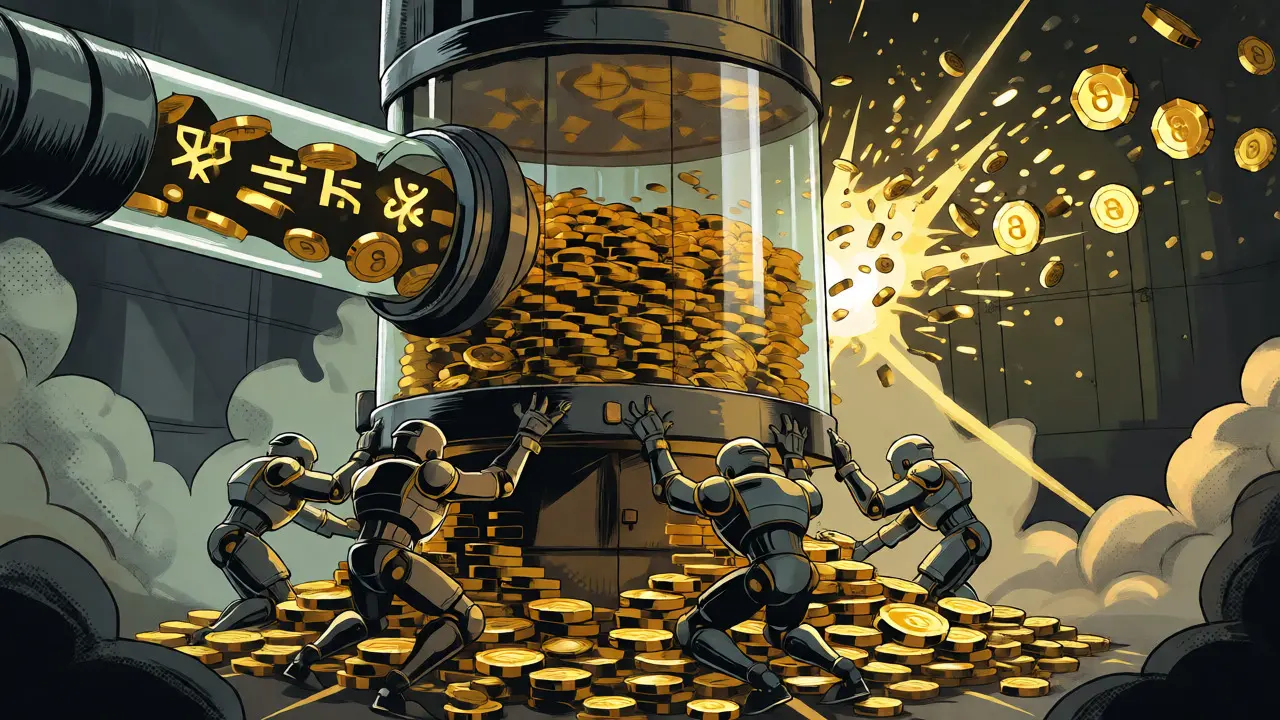
A portion of every swap fee collected by the network is burned-permanently destroyed. This creates deflationary pressure. If network usage remains high, the circulating supply decreases over time, even as new blocks are produced. Unlike many projects where large allocations unlock over years, the final RUNE token unlock occurred in 2023. Today, all RUNE is in circulation except for a small strategic reserve held by the protocol. There are no vesting schedules hanging over the price chart, removing a major source of sell pressure.
As of September 2026, the circulating supply sits around 328.6 million tokens. With a total supply near 353.9 million, the gap represents burned tokens and reserves. This transparency allows investors to track exact supply changes via live dashboards, a feature introduced recently to attract institutional interest.
Buying and Holding RUNE: Practical Steps for Beginners
Ready to acquire RUNE? You have two main paths, depending on your risk tolerance and desire for decentralization.
- Centralized Exchanges (CEX): Platforms like Binance, Kraken, and Gate.io list RUNE. This is the easiest route. You create an account, verify your ID, buy RUNE with fiat or stablecoins, and withdraw to a wallet if desired. Fees are lower, and liquidity is high.
- Decentralized Acquisition via THORChain: You can swap directly into RUNE using supported wallets like XDEFI or Trust Wallet. This skips the middleman, letting you trade native assets for RUNE without leaving your wallet. However, gas fees on the source chain (e.g., Bitcoin miner fees) can be higher during congestion.
Once you hold RUNE, you can simply store it in a non-custodial wallet. But true believers often go further. You can become a liquidity provider by pairing RUNE with another asset (like BTC or ETH) in a THORChain pool. This exposes you to impermanent loss but earns you yield from swap fees. Alternatively, you can delegate your RUNE to a validator to participate in governance and earn staking rewards, though THORChain’s primary reward mechanism favors LPs and validators running full nodes.
Risks and Reality Checks: What Could Go Wrong?
No investment is risk-free, and RUNE has specific vulnerabilities. First, concentration risk. Because every pool relies on RUNE, a sharp drop in RUNE’s price affects all liquidity providers simultaneously. If RUNE crashes, the value of everyone’s collateral drops, potentially triggering liquidations or reduced returns.
Second, competition. Cross-chain bridges and interoperability protocols like Cosmos IBC or Polkadot’s XCMP offer alternative ways to move assets between chains. While THORChain’s non-custodial nature is a strong selling point, faster or cheaper alternatives could erode its market share.
Third, macro sensitivity. Like most altcoins, RUNE correlates strongly with Bitcoin and broader market sentiment. Technical analysis in late 2026 highlights key support at $0.495 and resistance at $0.511. Breaking below support could signal deeper corrections tied to Federal Reserve interest rate decisions or global liquidity shifts.
Finally, don’t forget the name confusion. Always double-check the contract address. THORChain’s native RUNE resides on its own Layer-1 blockchain, while wrapped versions exist on Ethereum (ERC-20) and Binance Chain (BEP-2). The BSC gaming token is a separate BEP-20 contract entirely. Buying the wrong one means missing out on THORChain’s utility entirely.
Frequently Asked Questions
Is THORChain RUNE the same as the Rune gaming token?
No. They are completely different projects. THORChain RUNE is a mid-cap infrastructure token used for cross-chain swaps and security. The Rune gaming token is a micro-cap asset on Binance Smart Chain used in a dark fantasy MMORPG. Always check the blockchain network and contract address before buying.
Why do I need RUNE to swap Bitcoin for Ethereum on THORChain?
THORChain uses RUNE as a universal settlement layer. Direct swaps between incompatible chains like Bitcoin and Ethereum aren't possible natively. RUNE acts as the intermediary currency, allowing the protocol to convert BTC to RUNE, then RUNE to ETH, enabling a seamless cross-chain exchange without wrapping assets.
Is RUNE deflationary?
Yes, partially. THORChain implements a fee-burn mechanism where a portion of transaction fees is permanently destroyed. This reduces the circulating supply over time, provided network usage remains high. The maximum supply is capped at ~360 million, but the effective supply shrinks with burns.
Can I stake RUNE to earn passive income?
You can delegate RUNE to validators for governance participation, but the primary yield generation comes from providing liquidity. Liquidity providers earn a share of swap fees denominated in RUNE. Running a validator node requires technical expertise and larger capital commitments.
What are the key price levels to watch for RUNE in 2026?
As of September 2026, technical analysts identify $0.495 as critical support and $0.511 as immediate resistance. A break below $0.495 could lead to tests of $0.485, while holding above resistance might trigger a rally toward higher psychological levels like $0.55 or $0.60.