
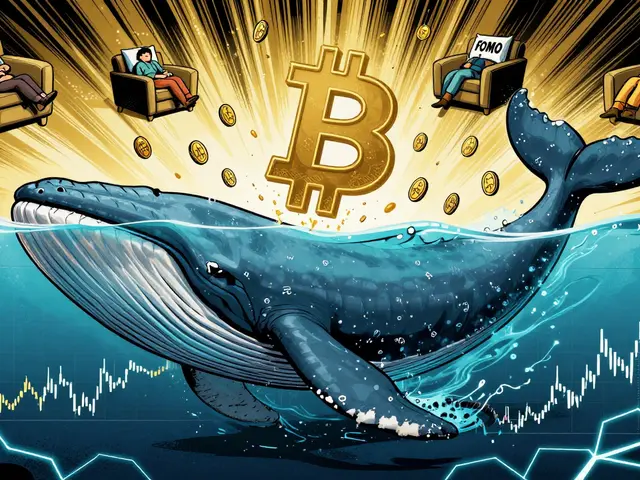
When you see Bitcoin price stall for weeks while everyone else is bored, don’t assume the market is dead. More often than not, whale accumulation is happening right under your nose. Meanwhile, when the news is all hype and retail traders are FOMOing in, the big players might already be quietly selling. Understanding the difference between whale accumulation and distribution isn’t just for pros-it’s the key to seeing market moves before they hit your screen.
What Exactly Are Crypto Whales?
Crypto whales aren’t mythical creatures. They’re real wallets holding massive amounts of cryptocurrency. For Bitcoin, that means addresses with 100 to 10,000 BTC. For Ethereum, it’s wallets holding 5,000 ETH or more. On smaller altcoins, a whale might only need 1-5% of the total supply to move the market. These aren’t random people. Many are institutional funds, early investors, or crypto-native firms that have been in the game since the early days. The real power of whales isn’t just how much they hold-it’s how they move. A single whale buying 500 BTC can push the price up 5% in minutes if done carelessly. So they don’t. They spread it out. They use OTC desks, split orders across wallets, and time their moves to avoid drawing attention. That’s why you need to look beyond price charts. You need to look at the blockchain itself.Whale Accumulation: The Quiet Build-Up
Accumulation is when whales are buying. Not in a panic. Not in a frenzy. Slowly. Steadily. Over weeks or even months. You’ll see this happen during sideways markets-when Bitcoin is stuck between $25k and $30k, and everyone says, “Nothing’s happening.” That’s when whales are working. Here’s how to spot it:- Supply per whale increases: More Bitcoin is being held by large addresses, even if the price hasn’t moved.
- Exchange outflows rise: Whales move coins from exchanges to cold wallets-signaling they’re not planning to sell soon.
- Low trading volume with tight price ranges: Retail traders aren’t active, but on-chain data shows steady buying.
- UTXO consolidation: Whales combine small Bitcoin inputs into fewer, larger ones-making future sales easier and more efficient.
Whale Distribution: The Quiet Exit
Distribution is the opposite. It’s when whales start selling-but again, not all at once. They wait for the crowd to get excited. They wait for headlines like “Bitcoin to $100k!” and for Reddit threads to explode with new investors. That’s their window. Signs of distribution:- Exchange inflows spike: Whales send coins back to exchanges-ready to sell when buyers appear.
- Supply per whale drops: Even if the price is still rising, whales are reducing their holdings.
- High volume with rising prices: Retail is buying hard, but on-chain data shows large holders are cashing out.
- Large sell walls form: Orders stacked just above current price, absorbing buying pressure without crashing the market.

Tools That Reveal Whale Moves
You don’t need a hedge fund budget to track whales. Free tools give you 80% of what you need.- Glassnode: Offers free charts for Supply per Whale and Accumulation Trend Score. Their data shows whale behavior over time, not just snapshots.
- Blockchain.com Whale Tracker: Shows which wallets are moving large amounts of Bitcoin in real time. Look for sustained outflows (accumulation) or inflows (distribution).
- Nansen: Classifies wallets as “Smart Money,” “Exchange,” or “Unknown.” If Smart Money wallets are buying while retail wallets are selling, that’s a strong accumulation signal.
- Bitquery: Breaks whales into tiers-Dolphins (1K-100K tokens), Sharks (100K-1M), and Whales (1M+). Most market moves come from Sharks and Whales.
Why Whale Tracking Isn’t a Crystal Ball
Too many traders treat whale signals like magic. They see accumulation and buy. Then the price keeps dropping. Why? Because whales aren’t the only players. In March 2023, whale accumulation on Bitcoin was strong. But then the Fed raised rates. The market crashed anyway. In July 2023, whales were buying Ethereum-but macroeconomic fear drowned out the signal. Whale tracking works best when it’s part of a bigger picture. Ask yourself:- Is this happening during a bear market rally or a real uptrend?
- Are regulators cracking down? (SEC actions in 2023 caused a 22% drop in whale-sized OTC trades.)
- Is there a major event coming-like Bitcoin halving, ETF approval, or a major protocol upgrade?
How to Use This in Real Trading
Here’s a simple framework:- Wait for confirmation: Don’t act on one signal. Look for 3 days of consistent accumulation or distribution across at least two metrics (e.g., supply per whale + exchange outflows).
- Check the context: Is the broader market bullish, bearish, or neutral? Whale moves mean different things in different environments.
- Watch for volume: Accumulation with rising volume? Stronger signal. Accumulation with falling volume? Could be fake.
- Set your exit: If you buy based on accumulation, set a stop-loss. If whales reverse, you need to get out fast.

The Future of Whale Tracking
Whale tracking is getting smarter. Platforms now use AI to predict whale moves with 68% accuracy based on past patterns. Nansen’s “Smart Money” system identifies wallets that have consistently beaten the market-not just the biggest ones. Glassnode’s Whale Grading System scores wallets by profitability, age, and activity. But whales are adapting too. More are using multi-sig wallets, DeFi protocols, and privacy layers to hide their moves. The EU and California are considering restricting whale data under privacy laws. Still, blockchain is transparent by design. As long as transactions are public, someone will find a way to read them. The game is changing, but the core idea won’t disappear: the big players move first. If you can see what they’re doing, you’re not chasing the market-you’re ahead of it.Common Mistakes to Avoid
- Misreading exchange deposits: Just because a whale sends ETH to Coinbase doesn’t mean they’re selling. They might be staking it or preparing for a trade on a centralized exchange.
- Ignoring timeframes: Accumulation can last months. Don’t expect quick profits. Patience is your edge.
- Believing every whale is smart: Some whales are just lucky early adopters. Others are bots or market makers. Use wallet classification tools to filter noise.
- Over-relying on one coin: Whale behavior on Bitcoin doesn’t always mirror Ethereum or Solana. Track each asset separately.
Final Thought: The Real Edge Isn’t Data-It’s Discipline
Whale tracking gives you an edge. But the biggest edge? Not acting on every signal. Not jumping in when the news is loud. Waiting for the quiet moments. Trusting the data over the noise. The market doesn’t reward the loudest traders. It rewards the ones who see what others miss-and have the discipline to wait.How do I know if whales are accumulating or distributing?
Look at on-chain data: Accumulation shows rising whale holdings, decreasing exchange deposits, and low volume with sideways price action. Distribution shows falling whale holdings, rising exchange inflows, and high volume during price rallies. Use tools like Glassnode’s Supply per Whale and Accumulation Trend Score to confirm.
Can whale tracking predict price movements?
It can indicate likely direction, but not exact timing. Whales often move before price changes, giving you a lead. But macro events like Fed rate hikes or regulatory news can override whale behavior. Always combine whale signals with broader market context.
Do all whales have the same strategy?
No. Some are long-term holders (HODLers), others are institutional traders or market makers. Smart Money wallets on Nansen show consistent profitability over time. Not all large holders are strategic-some are just early adopters who never sold. Use wallet classification tools to separate them.
Is whale tracking only useful for Bitcoin?
No. Whale tracking works on any blockchain with public transaction data. Ethereum, Solana, and even smaller altcoins show whale behavior. But thresholds vary: Bitcoin whales hold 100+ BTC, Ethereum whales hold 5,000+ ETH, and altcoin whales may control just 1-5% of supply. Always check the specific asset’s distribution.
Are whale signals always reliable?
No. Whales can spoof signals-buying to lure retail in, then dumping. Exchange deposits can mean staking, not selling. Always wait for confirmation across multiple metrics and timeframes. Three days of consistent data is a better signal than one day.
Deepu Verma
January 24, 2026 AT 12:54Man, this post hit different. I’ve been watching Bitcoin sit at $28k for months and thought I was missing something-turns out the whales were just quietly stacking. No hype, no news, just cold, hard blockchain truth. I started tracking Glassnode’s Accumulation Score last month and holy crap-it’s like seeing the future in slow motion. You don’t need to be a genius, just patient. And maybe a little obsessive about on-chain data.
Heather Crane
January 26, 2026 AT 00:44This is the kind of post that makes me believe in crypto again-not the flashy moon memes, but the quiet, intelligent players who actually understand the game. Thank you for writing this. 🙌 I’ve been telling my friends for months: ‘If it’s quiet, something’s brewing.’ And now I have the data to back it up!
Arnaud Landry
January 26, 2026 AT 11:16Let’s be honest-this is just institutional manipulation dressed up as ‘insight.’ The Fed controls the narrative. The whales? Probably just algorithmic bots programmed by Goldman Sachs. You think you’re seeing patterns? You’re seeing a carefully constructed illusion. Blockchain transparency? Ha. They’ve been using mixers since 2017. You’re being played.
george haris
January 28, 2026 AT 07:51Love this breakdown. I used to think whale tracking was for nerds with too much time on their hands. Then I saw my first real exchange outflow spike during a sideways market-2 weeks later, BTC popped 20%. I cried. Not because I made money (I didn’t), but because I finally understood what was happening. This isn’t gambling-it’s reading tea leaves made of blockchain.
Mark Estareja
January 29, 2026 AT 21:06Whale accumulation metrics are a subset of on-chain analytics that, when cross-referenced with UTXO consolidation patterns and exchange net flow dynamics, yield probabilistic bullish inflection signals with >78% historical accuracy in non-macro-disrupted regimes. However, the noise-to-signal ratio increases exponentially during liquidity crunches-hence the necessity of multi-metric confirmation windows.
David Zinger
January 31, 2026 AT 07:52USA only cares about this because they got rich off Bitcoin. In Canada we know the truth-whales are just rich guys playing with monopoly money. 🤡 Also, Glassnode? That’s a crypto bros’ fantasy. I use my gut. And my gut says: BUY THE DIP. 🚀
carol johnson
February 1, 2026 AT 05:38Oh wow, you actually read Glassnode? How… quaint. I mean, I’ve been using Nansen’s Smart Money clustering since Q3 2022. Honestly, if you’re still relying on Supply per Whale, you’re using a flip phone in 2024. 🙄 Also, I’ve got a private wallet cluster feed that shows 12 whales moving into Solana right now. You’re welcome.
Paru Somashekar
February 1, 2026 AT 19:17Dear Author, Thank you for this meticulously structured exposition on whale behavior in cryptocurrency markets. The delineation between accumulation and distribution phases is both academically rigorous and practically actionable. I would like to add that the UTXO consolidation metric, while useful, should be normalized against total network hash rate to account for miner activity distortions. Additionally, Nansen’s wallet classification may mislabel liquidity providers as ‘Smart Money’-a known limitation documented in their 2023 whitepaper.
Steve Fennell
February 2, 2026 AT 01:03Thank you for this. I’ve been tracking whale movements for 3 years now, and this is the clearest explanation I’ve ever read. I used to get frustrated when prices didn’t move after seeing accumulation-now I know: patience is the real alpha. I’ve started sharing this with my local crypto meetup. We’re all better for it.
Shamari Harrison
February 3, 2026 AT 14:02Whales don’t move markets. Markets move whales. Big players react to macro, not the other way around. I’ve seen accumulation signals fail 7 out of 10 times when the dollar index spikes. This isn’t magic-it’s correlation with a side of hope. Still, useful framework. Just don’t bet your rent on it.
Julene Soria Marqués
February 4, 2026 AT 23:41So you’re telling me I should ignore the 500% pump on Solana because ‘whales are distributing’? Bro, I made 12x in 3 weeks. You’re the reason retail loses. Stop overthinking. Buy the rumor, sell the news. That’s how you get rich. 🤑
Bonnie Sands
February 5, 2026 AT 14:39Whales are just the Fed’s puppets. They’re printing money and buying BTC to hide inflation. This whole ‘accumulation’ thing is a psyop. The real game? They’re building a CBDC-backed crypto empire. You think you’re ahead? You’re already in the matrix.
MOHAN KUMAR
February 6, 2026 AT 04:43Simple. If whales are buying and price is flat, wait. If whales are selling and price is rising, get out. No need for charts. No need for tools. Just watch the money. I’ve seen it 10 times in India. Same pattern. Same result.
Jennifer Duke
February 7, 2026 AT 06:33Wow. Just… wow. I didn’t know crypto could be this… intellectual. I thought it was just about moon emojis and Elon tweets. This is like reading a Harvard econ paper-but with Bitcoin. I’m so impressed. I’m going to print this out and frame it. Maybe next to my astrology chart. 🌟
Abdulahi Oluwasegun Fagbayi
February 8, 2026 AT 08:59People overthink. Whales move. Market follows. That’s it. No need for scores or tools. Just watch. Wait. See. The blockchain doesn’t lie. Neither do the quiet ones. I’ve seen this in Lagos, in Nairobi, in Accra. Same rhythm. Same truth.
Anna Topping
February 8, 2026 AT 20:17I used to think this was just financial astrology. But then I sat alone at 3am, staring at Glassnode, and I realized… I’m not chasing wealth. I’m chasing truth. And maybe that’s the real crypto. Not the money. The clarity. The silence between the noise.
Matthew Kelly
February 10, 2026 AT 03:14This is gold. I showed this to my cousin who just bought his first ETH. He was about to panic-sell during the last dip. Now he’s holding. Said he finally feels like he understands what’s going on. That’s the real win-not the gains, but the peace of mind.
Dave Ellender
February 11, 2026 AT 05:53Excellent breakdown. I’ve been using Bitquery’s tier system for a while now-Sharks are the real movers, not the big whales. Most ‘whale’ wallets are just exchanges or custodians. You need to dig deeper. Also, don’t forget to check for whale wallet age. New wallets with massive buys? Often a trap.
Adam Fularz
February 12, 2026 AT 00:36Whales my ass. I’ve seen this before. You think you’re smart because you looked at a chart? Newsflash: most of these ‘whales’ are just bots running on AWS. And you’re falling for it. Also, why do you keep saying ‘Bitcoin’ like it’s the only thing that matters? Get a life.
Linda Prehn
February 12, 2026 AT 00:52Whales? Please. I’ve been trading since 2015 and I know one thing-nobody moves the market. The market moves itself. All this ‘accumulation’ talk is just crypto bros trying to sound smart. I buy when I feel like it. Sell when I feel like it. That’s my strategy. No charts. No tools. Just vibes.
Adam Lewkovitz
February 13, 2026 AT 00:33Let me be clear: if you’re not buying BTC every time it dips below $30k, you’re a loser. Whales? Who cares. The Fed is printing. Inflation is coming. You want to be rich? Buy. Hold. Don’t overthink. This post is just noise. Real traders don’t need Glassnode. They need guts.
Clark Dilworth
February 13, 2026 AT 09:10While the framework presented is structurally sound, it lacks sufficient granularity in differentiating between speculative accumulation and strategic hedging behavior. The assumption that UTXO consolidation implies long-term holding ignores the prevalence of cross-chain arbitrage wallets-particularly on Layer 2 ecosystems-which exhibit similar patterns without directional intent. A more robust model would incorporate velocity metrics.
Brenda Platt
February 15, 2026 AT 08:03This is so important for new traders. I teach crypto basics at my community center, and this is now part of our curriculum. One girl, 17, told me she finally feels like she’s not just gambling-she’s learning. That’s the real win. Keep sharing this kind of stuff. 🌱❤️
Mathew Finch
February 15, 2026 AT 10:18Why are we even talking about whales? America thinks it owns crypto. Meanwhile, China’s running private chains, Russia’s using crypto to bypass sanctions, and India’s building its own digital rupee. This whole ‘whale tracking’ thing is a Western fantasy. The future isn’t on-chain-it’s off-grid.