DARWIN Liquidity Impact Calculator
Results
Estimated DARWIN amount: 0
Percentage of daily volume: 0%
Current market cap: $81,298.69 | Daily volume: < $10,000
Most crypto coins are just digital money. But Darwin (DARWIN) isn’t trying to be money. It’s trying to grow intelligence.
Darwin is the native token of Darwin’s Lab - a project built on Solana that claims to create AI not by coding it, but by letting it evolve. Think of it like natural selection, but for artificial intelligence. Instead of one big AI model being trained by engineers, Darwin’s Lab runs thousands of small AI agents that compete, mutate, and eliminate each other. The ones that perform best survive. Over time, smarter systems emerge - not because someone told them how, but because they had to adapt to survive. This is called Synthetic Darwinism.
How Darwin (DARWIN) actually works
The DARWIN token isn’t used to buy goods or pay for services. It’s the fuel for this AI evolution engine. Every time an AI agent runs a computation, mutates, or competes against another agent, it uses DARWIN tokens. More complex tasks cost more tokens. The system rewards successful agents with more tokens, letting them run more simulations and improve faster. It’s a feedback loop: better AI gets more resources, and more resources lead to even better AI.
This happens entirely on Solana. That’s no accident. Solana’s fast, cheap transactions make it possible to run thousands of AI agents simultaneously without drowning in fees. Ethereum or Bitcoin couldn’t handle this kind of activity - Solana was chosen because it can. The token contract address is GUiVKW...ySwAFZ, and it’s a standard SPL token, meaning it follows Solana’s rules and works with wallets like Phantom and Sollet.
Current market status: tiny, volatile, and risky
As of December 14, 2025, Darwin’s market cap sits at just $81,298.69. That’s less than the price of a used laptop. The circulating supply is around 400 million tokens out of a max supply of nearly a billion. The price hovers between $0.00018 and $0.0002 - barely a fraction of a cent.
It’s not hard to see why. Trading volume is extremely low. On Raydium - the only exchange where DARWIN trades - the 24-hour volume is under $10,000. That’s less than 0.01% of what Bitcoin moves in a day. For comparison, Fetch.ai (FET) and SingularityNET (AGIX), two other AI-focused coins, have market caps in the hundreds of millions. Darwin is a speck in the same room.
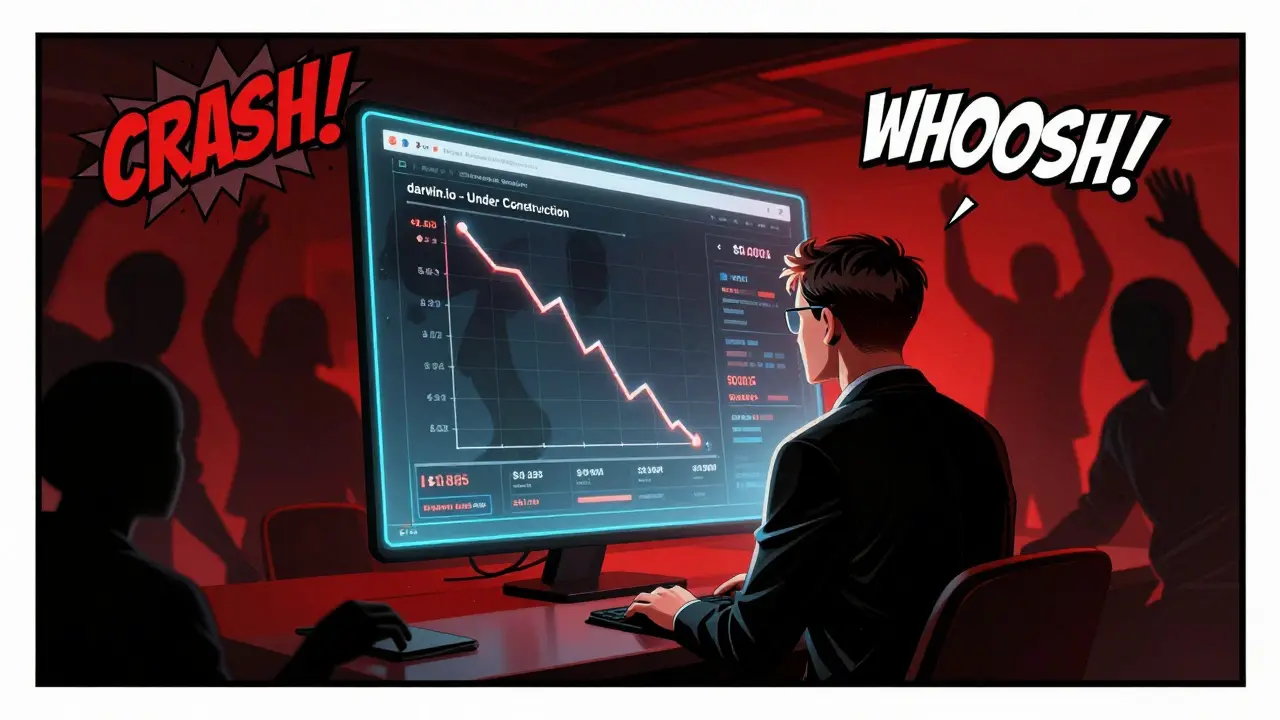
The token’s price history shows wild swings. It hit an all-time high of $0.02528 in July 2025 - over 100 times its current value. Since then, it’s lost 99.2% of that peak. Its lowest point came just weeks ago on November 21, 2025, at $0.0001744. That means in the last month, it bounced back 15% - not because of news or progress, but because of low liquidity. When few people are trading, even small buys or sells can spike the price.
Why experts are skeptical
The idea sounds cool. But there’s a huge problem: no one can verify it.
There’s no whitepaper. No GitHub repository with open-source code. No peer-reviewed papers. No technical blog posts explaining how the AI agents actually learn or what algorithms they use. The project’s website, darwin.io, is still under construction as of December 2025. No official Discord. No public roadmap. Just marketing language about “evolving intelligence.”
Industry analysts have called it out. John Chen of CryptoAI Research said: “The concept of evolving AI agents is fascinating, but where’s the proof?” Sarah Kim from CryptoInsider gave it a 2.8 out of 5, writing: “The Solana integration is sound, but without transparency into the actual AI mechanisms, it’s impossible to evaluate the core value.”
Dr. Michael Torres from the Blockchain Research Institute put it bluntly: “Projects claiming revolutionary AI breakthroughs without peer-reviewed research or open-source code should be approached with extreme caution.”
Who’s buying it?
Only about 1,270 wallet addresses hold DARWIN tokens. That’s not a community - it’s a small group of speculators. Most of them are likely chasing quick gains, not long-term utility.
Reddit threads are full of questions like “Where’s the proof of concept?” and “Is this just another NFT-style hype cycle?” On Twitter, users call it a “low-float token manipulation” - meaning a small number of holders control enough supply to pump and dump the price.
There are no enterprise users. No corporate partnerships. No integrations with real AI tools or platforms. It’s not being used by developers. It’s not powering any real-world application. It’s just a token on a blockchain with a compelling story - and no substance to back it up.
Can you buy DARWIN? Here’s how
If you still want to try it, you can only buy DARWIN on Raydium, a decentralized exchange on Solana. That means you need:
- A Solana-compatible wallet (Phantom or Sollet)
- SOL (Solana’s native coin) to pay for transaction fees
- Access to Raydium’s interface
The process isn’t beginner-friendly. You need to understand how DEXs work, how slippage settings affect trades, and how to avoid failed transactions due to low liquidity. Even then, you might not be able to buy or sell large amounts - the pool is too thin. One user on Reddit reported a $500 buy order only filled at 20% of the requested amount because there wasn’t enough supply.
Is Darwin worth anything?
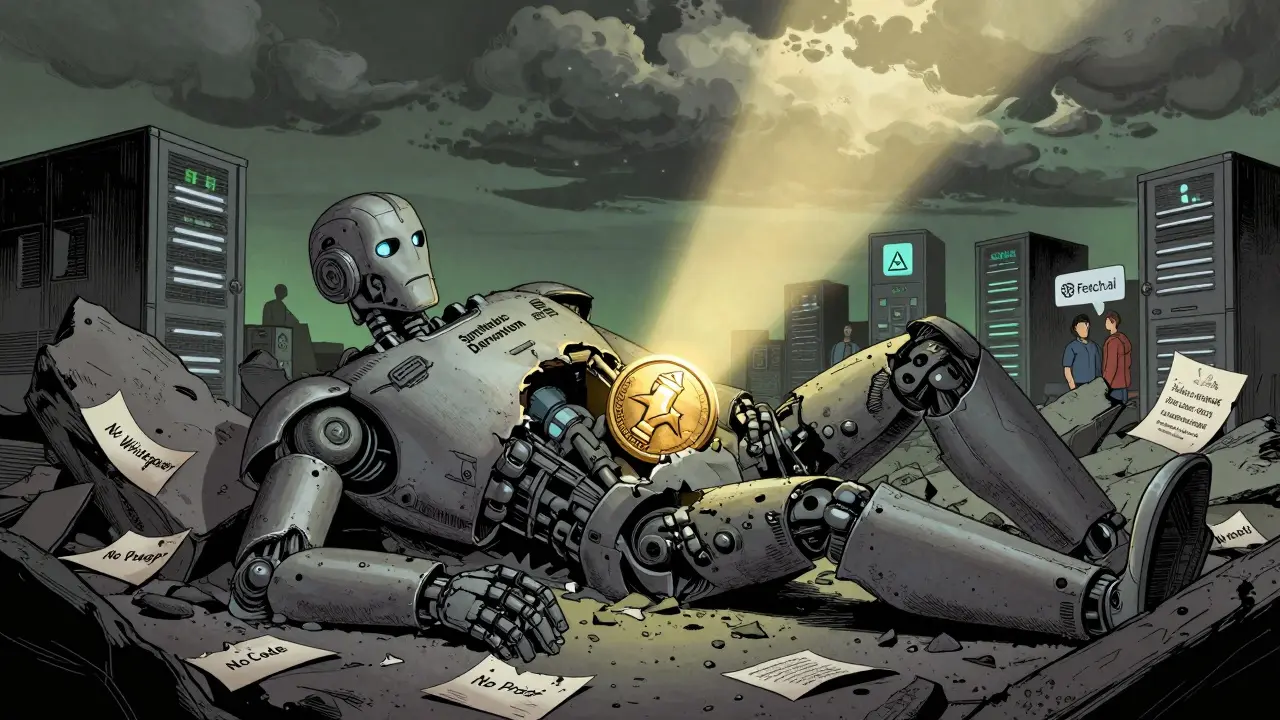
Right now, its value comes from belief - not function. If Darwin’s Lab ever releases even a basic demo of AI agents evolving in real time, the price could surge. But that’s a big “if.”
Most AI crypto projects succeed because they deliver real tools: marketplaces for AI models, decentralized data networks, or AI-powered automation. Darwin offers none of that. It’s a token with a theory, but no proof.
Industry reports from Messari and Delphi Digital show that 87% of micro-cap AI tokens under $1 million market cap fail within a year. Darwin is far below that threshold. The odds are stacked against it.
Still, crypto has a history of turning wild ideas into billion-dollar projects. Maybe Darwin’s Lab has something no one else sees. Maybe the AI is real, hidden behind closed doors. But until they show us - not just tell us - it’s just a gamble wrapped in buzzwords.
What’s the bottom line?
Darwin (DARWIN) is not a coin you buy to use. It’s a bet on a future that might never come. The concept of synthetic Darwinism is interesting. The integration with Solana makes technical sense. But without transparency, code, or progress, it’s impossible to say if this is the next big thing - or just another dead-end crypto experiment.
If you’re looking for real AI crypto projects, look at Fetch.ai, SingularityNET, or Ocean Protocol. They have products, users, and documentation. Darwin has a story. And stories, no matter how exciting, don’t pay bills.
What is Darwin (DARWIN) crypto coin used for?
DARWIN is the fuel for Darwin’s Lab, an AI ecosystem on Solana where artificial intelligence agents evolve through competition and adaptation. The token is used to pay for computational power, agent mutations, and access to AI tools within the system. It’s not meant for buying goods or trading as currency.
Where can I buy DARWIN tokens?
DARWIN is only available on Raydium, a decentralized exchange on the Solana blockchain. You need a Solana wallet like Phantom or Sollet and SOL to trade. It’s not listed on major exchanges like Binance, Coinbase, or Kraken.
Is Darwin (DARWIN) a good investment?
As of December 2025, Darwin is a high-risk, low-probability bet. With a market cap under $100K, minimal trading volume, no technical documentation, and no verifiable AI progress, it lacks the fundamentals of a serious project. Most experts consider it speculative at best. Only buy if you’re comfortable losing your entire investment.
Why is Darwin’s price so volatile?
Darwin’s price swings because of extremely low liquidity. With only about 1,270 holders and trading volume under $10,000 per day, even small trades can cause big price jumps. Its all-time high was $0.02528 in July 2025, but it’s since dropped over 99%. Recent price bumps are likely due to pump-and-dump activity, not real development.
Does Darwin have a whitepaper or open-source code?
No. As of December 2025, Darwin’s Lab has not released a whitepaper, technical documentation, or open-source code. There are no GitHub repositories linked to the project. This lack of transparency is the main reason experts question its legitimacy.
How does Darwin differ from other AI crypto coins?
Unlike Fetch.ai or SingularityNET, which offer marketplaces for AI services or decentralized data networks, Darwin claims to create AI through evolutionary selection - called Synthetic Darwinism. But while those projects have real products and users, Darwin has only a concept with no proof of implementation.
Is Darwin’s Lab real or just hype?
There’s no evidence yet that Darwin’s Lab is more than a marketing narrative. No AI agents have been publicly demonstrated. No code has been shared. No partnerships or technical milestones have been announced. Until those things change, it’s best treated as speculative fiction - not a working blockchain project.
Scot Sorenson
December 15, 2025 AT 12:24So let me get this straight - you’re telling me a bunch of invisible AI bots are having a death match on Solana and the winner gets more crypto? And we’re supposed to believe this isn’t just a glorified lottery with extra steps? Bro, if this was a video game, it’d be banned for being too lazy to code.
Also, no whitepaper? No code? No Discord? Just a website that says ‘evolve or die’ in Comic Sans? I’ve seen more transparency from a 2017 ICO that got rug-pulled in a weekend.
PRECIOUS EGWABOR
December 17, 2025 AT 03:43Darwin’s Lab? More like Darwin’s *Lack* of Substance. Honestly, I’m tired of these ‘AI evolution’ buzzwords being slapped onto vaporware. It’s like calling a PowerPoint deck a quantum computer. You don’t get to claim ‘synthetic Darwinism’ when you can’t even open-source your damn algorithm. This isn’t innovation - it’s intellectual cosplay.
Meanwhile, Fetch.ai is shipping actual agents that negotiate on-chain. But sure, let’s pour our life savings into a dream that’s been stuck in ‘coming soon’ since 2023.
Caroline Fletcher
December 18, 2025 AT 09:13They’re using Solana because it’s easy to hide stuff on. The government and the Fed are behind this. They want you to buy DARWIN so they can track your wallet and eventually freeze your crypto when you’re not looking. I saw a guy in a hoodie at the gas station with a laptop saying ‘DARWIN is the future’ - he had a QR code tattooed on his neck. Coincidence? I think not.
Also, why is the token address ending in ySwAFZ? That’s not random. That’s a code. Probably means ‘you’re being watched’.
Hari Sarasan
December 18, 2025 AT 22:20It is imperative to acknowledge the fundamental epistemological dissonance inherent in the Darwinian token paradigm. The absence of verifiable ontological grounding renders the entire construct a postmodern artifact of speculative capital, wherein value is not derived from utility but from performative belief systems orchestrated by algorithmic sentiment manipulation.
One must interrogate the structural hegemony of Solana’s consensus mechanism as the substrate for such unproven AI architectures. The very architecture of this token betrays a neoliberal fetishization of emergent complexity without empirical accountability.
Stanley Machuki
December 20, 2025 AT 02:17Low cap, low volume, zero code - this is the kind of coin that gets you kicked out of crypto Twitter
But hey, if you’ve got $50 to burn and want to feel like a pioneer, go for it. Just don’t cry when it hits zero. You knew the risks.
Real AI crypto? Look at FET. AGIX. OCEAN. They’ve got products. This? Just vibes.
Jessica Eacker
December 21, 2025 AT 04:11I get why people are excited - the idea of AI evolving on its own is wild. But excitement doesn’t pay rent.
Maybe one day this will be the next big thing. But until then, treat it like a lottery ticket. Buy a little if it makes you happy. Don’t bet your future on it. You’re not wrong for hoping - just be smart about how much you risk.
And if you’re curious, check out the AI projects that actually ship. There’s plenty out there that don’t need a fairy tale to feel real.
Andy Walton
December 22, 2025 AT 18:12Imagine if your thoughts were AI agents… and you had to pay them in crypto to keep thinking… and the smartest one wins and becomes your new consciousness…
That’s basically what’s happening here. I’m not sure if I’m high or if this is genius. Probably both.
Also, I just bought 2 million DARWIN with my rent money. Wish me luck 🤖💸
Candace Murangi
December 23, 2025 AT 20:30It’s funny how crypto always finds a way to turn philosophy into a ticker symbol.
Evolution? Sure. But evolution needs time. And proof. And peer review. And transparency. This has none of that. Just a cool name and a Solana chain.
I’m not here to dunk on dreamers. But I’m also not here to fund a sci-fi screenplay with my life savings. Let’s keep the wonder, but ground it in something real.
Albert Chau
December 25, 2025 AT 11:47Anyone who still thinks this is a good idea hasn’t lived through 2021. You’re not a visionary. You’re a sucker.
Low cap, no code, no team, no roadmap. Just a website with a logo that looks like a confused octopus.
Do you know how many projects like this have vanished into thin air? Hundreds. And you’re gonna be the one holding the bag because you thought ‘evolving AI’ sounded cool.
Pathetic.
Madison Surface
December 25, 2025 AT 13:44I really want to believe in this. I mean, the idea of AI learning through competition? That’s beautiful. It reminds me of how kids learn - by trying, failing, and trying again.
But beauty doesn’t mean it’s real. And crypto needs more than beauty. It needs bones. Structure. Transparency.
If you’re the team behind this - please, just show us one agent. One screenshot. One line of code. We’re not asking for a revolution. Just a glimpse.
You can do this. Don’t let the hype kill the dream.
Tiffany M
December 27, 2025 AT 07:45Okay, so… no whitepaper… no GitHub… no Discord… no team photos… no interviews… just a token on Raydium that’s down 99% from its peak? And you’re still here? Why? Because you’re ‘investing’? Or because you’re just addicted to the dopamine of a pump?
Let me be clear - this isn’t investing. This is gambling with a fancy name. And if you think you’re smarter than the market, you’re already losing.
Also, why is the logo a dinosaur wearing sunglasses? What does that even mean?
Eunice Chook
December 28, 2025 AT 01:13Market cap under 100K? Trading volume lower than my coffee budget? This isn’t a project - it’s a graveyard with a website.
People still buying this? I’m not even mad. I’m just… confused. Like, what’s the endgame? Are you waiting for Elon to tweet about it? Or for a Reddit bot to pump it to $0.01 so you can sell at 500x?
It’s not smart. It’s not brave. It’s just sad.
Abhishek Bansal
December 28, 2025 AT 19:00You all think this is a scam? Nah. It’s worse.
It’s a *real* project that’s just too ahead of everyone. You’re too dumb to understand it. The AI is evolving so fast, they can’t even show it yet. You think they’d waste time making a whitepaper? Bro, the agents are already rewriting themselves.
Wait till it hits $1. Then you’ll all be crying ‘I knew it!’ while I’m on my private island drinking coconut water.
LOL you’re all just jealous.
Jessica Petry
December 30, 2025 AT 13:04How is this not a Ponzi? No one’s asking the right questions. The team is anonymous. The code is hidden. The ‘AI’ is never shown. And yet, somehow, people are still buying?
This isn’t innovation. It’s a confidence trick dressed up as a TED Talk. You’re not supporting the future - you’re funding a ghost.
And the worst part? You’re proud of it.
JoAnne Geigner
December 30, 2025 AT 14:00There’s something poetic about the idea - intelligence evolving without a designer. It’s like nature, but digital.
But poetry doesn’t pay for servers. And without code, we’re all just reading a poem and pretending it’s a blueprint.
If you’re building this, please, just let us see a single agent. One tiny simulation. Even a video. We’re not asking for perfection. Just proof that you’re not just selling dreams.
We’re rooting for you. But we need to believe it’s real.
Joey Cacace
December 31, 2025 AT 11:20Dear Darwin’s Lab Team,
Thank you for your visionary ambition. We recognize the profound potential of synthetic Darwinism as a paradigm shift in artificial intelligence architecture. However, the current lack of formal documentation, verifiable technical implementation, and public engagement protocols presents a significant impediment to institutional credibility and investor confidence.
We respectfully urge you to release a technical whitepaper, open-source the core agent framework on GitHub, and establish a public roadmap with measurable milestones. The global community stands ready to support your mission - but only if transparency is prioritized.
With sincere admiration,
Joey Cacace
Senior Research Analyst, Blockchain Futures Institute
Taylor Fallon
December 31, 2025 AT 14:41Imagine if evolution wasn’t random… but guided by code… and the smartest AI wins not by luck… but by learning from failure…
That’s beautiful. Really.
But beauty needs proof. Not just hype.
I believe in you guys. But please… show us one line of code. One agent. One moment where it actually works. We’re not asking for a billion-dollar valuation. Just a glimpse of truth.
We’re here for you. Not just the token.
Love you all 🤍
Sarah Luttrell
January 1, 2026 AT 14:37Of course it’s a scam. America doesn’t let some Indian dev team build AI on Solana and make a billion. This is a Chinese psyop. Or a CIA op. Or both.
Also, why is the logo a T-Rex? That’s not evolution - that’s extinction. This is a trap to make Americans buy crypto so the Fed can track us.
Also, I heard the devs are in a bunker in Nepal. With a satellite. And a quantum computer. And a pet dragon.
Don’t be fooled.
Taylor Farano
January 2, 2026 AT 12:43Market cap: $81k
Trading volume: $10k
Developers: 0
Proof: 0
Hope: infinite
It’s not a crypto project. It’s a psychological experiment. And we’re all the lab rats.
Kathryn Flanagan
January 3, 2026 AT 21:32I just want to say - I’m not here to hate. I’m here because I care. I’ve seen so many people lose everything chasing these ‘revolutionary’ tokens. And I know how it feels. I lost my savings on a ‘next-gen AI wallet’ in 2022.
This feels familiar. The same language. The same promises. The same silence.
If you’re building something real - we want to help. But if you’re just selling hope… please stop. There are real problems to solve. Don’t waste your talent on this.
We’re not mad. We’re just scared for you.
Ian Norton
January 4, 2026 AT 22:46Low liquidity means low risk? No. It means high manipulation risk.
1270 wallets. That’s not a community. That’s a cartel.
Price jumped 15% last month? Probably one whale buying with $5000 and the rest of you cheering like it’s a miracle.
Stop pretending this is innovation. It’s a pump. And you’re the last ones holding it.
Nicholas Ethan
January 5, 2026 AT 01:20Project lacks technical documentation.
Project lacks open-source verification.
Project lacks public roadmap.
Project lacks credible team disclosure.
Market capitalization is below industry baseline for viable blockchain initiatives.
Conclusion: Speculative instrument with negligible utility.
Recommendation: Avoid exposure.
Rakesh Bhamu
January 5, 2026 AT 06:28Look, I’m from India. We’ve seen this movie before. ‘Next big thing’ with no code, no team, no transparency - and then poof, gone.
I get the dream. I really do. But dreams need foundations. Not just buzzwords.
If you’re building something real, we’ll help you. We have devs here who’d love to contribute. But you gotta show us the door first.
Don’t make us wait forever. The crypto world moves fast. Don’t get left behind because you were too scared to share.
Lynne Kuper
January 5, 2026 AT 18:59Low cap? Good. That means you can still get in cheap.
No code? Even better. That means they’re working on something too powerful to show yet.
100x? Maybe. 1000x? Probably.
Just buy. Hold. Don’t overthink it. The market doesn’t care about your doubts - it cares about your bags.
PS: I bought more today. And I’m not selling until it hits $0.10. You in?
Lloyd Cooke
January 6, 2026 AT 12:23Is this not the ultimate expression of post-capitalist emergence? A token that doesn’t represent value, but the *potential* for value - a recursive self-optimizing system where the currency is not medium of exchange, but medium of evolution?
It is not a coin. It is a *process*. A living algorithm. A digital organism.
To demand a whitepaper is to ask a child to explain its heartbeat.
Perhaps the true innovation is not in the code - but in the refusal to explain it. The mystery is the mechanism.
Or perhaps I’ve been staring at the blockchain too long.
Scot Sorenson
January 6, 2026 AT 22:27Wow, Lloyd. You just turned a crypto scam into a Nietzschean parable. Congrats.
But I still need to know - where’s the code? Or are we just supposed to worship the mystery like it’s a holy relic?
Next you’ll tell me the AI is sentient and it chose not to show itself because it ‘feels misunderstood.’
Save the poetry for your journal. I need to know if my $500 is gonna be worth anything in 6 months.