
As of January 2026, there is no verified information about an xSuter (XSUTER) airdrop. Not a single official announcement, no whitepaper, no Discord or Telegram post, no listing on AirdropAlert or CoinMarketCap’s upcoming airdrops page. If you’ve seen a post claiming xSuter is handing out free tokens, it’s likely a scam.
Why You Haven’t Heard Anything About xSuter’s Airdrop
The name xSuter doesn’t appear in any credible blockchain project databases, crypto news outlets, or community forums. Major platforms like CoinGecko, DeFiLlama, and DappRadar don’t list it. Even the most aggressive airdrop trackers - the ones that pick up whispers of new Solana or Ethereum Layer 2 projects weeks before launch - have zero data on xSuter.
This isn’t just silence. It’s a complete absence. Compare that to Jupiter’s 2025 airdrop, which had months of community engagement, testnet activity, and public leaderboards. Or Midnight’s airdrop, which had clear claim windows, wallet eligibility rules, and even a dedicated claim portal. xSuter has none of that. Not even a website with a .xyz domain.
How Scammers Use Fake Airdrop Names
Fake airdrops like this one are everywhere. They use names that sound technical, close to real projects, or just random enough to avoid immediate detection. xSuter? It looks like it could be a blend of “X” (for crypto) and “Suter” (a real surname), making it feel plausible. But that’s the trap.
Here’s how the scam works:
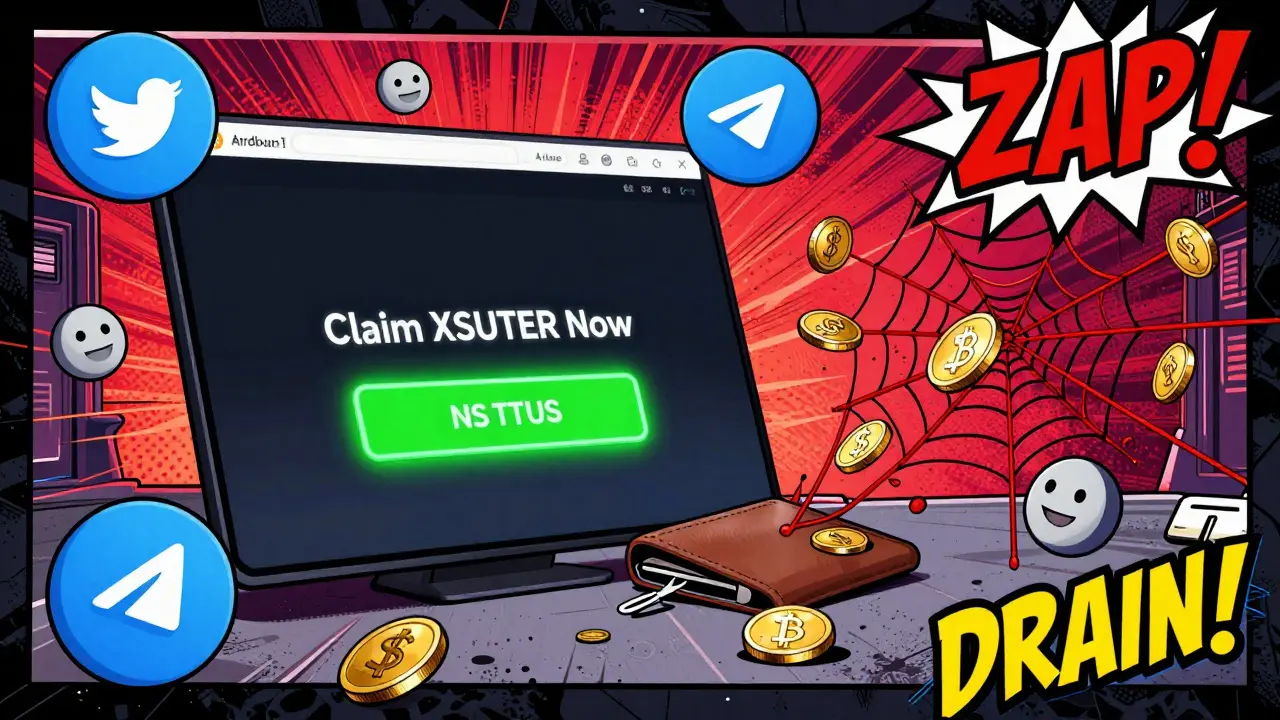
- You see a tweet or Telegram message: “Claim your free XSUTER tokens before the airdrop ends!”
- The link takes you to a fake website that looks like a blockchain dashboard - it even has a wallet connect button.
- You connect your MetaMask or Phantom wallet. No funds are asked for… yet.
- Then, you’re told you need to “approve a small transaction to verify ownership.” That’s the moment your wallet signs a malicious contract.
- Within minutes, all your ETH, SOL, or tokens are drained.
This exact pattern happened with fake airdrops for projects like “Sonic,” “Zeta,” and “Morpho” in late 2024. Over $18 million was stolen from unsuspecting users who thought they were getting free tokens.
How to Spot a Fake Airdrop
Real airdrops don’t ask you to connect your wallet unless they’ve already published a public eligibility list. Here’s what to check:
- Official website: Does it have a clean domain? Is it hosted on a reputable platform like Vercel or Cloudflare? Fake sites often use free hosting with weird subdomains like xSuter.airdrop[.]xyz.
- Social media: Real projects have active, verified accounts on Twitter and Telegram with thousands of followers. Fake ones have 200 followers, 100 bots, and posts that look copied from Reddit.
- Tokenomics: If there’s no token contract address, no supply details, no roadmap - walk away.
- Community: Real projects have active developers answering questions. Fake ones have moderators who delete any skeptical comments.
If you can’t find a single GitHub repo, audit report, or team member with a LinkedIn profile - it’s not real.
What You Should Do Instead
Instead of chasing ghosts like xSuter, focus on projects with real traction. Here are a few legitimate airdrops that are active or recently concluded as of early 2026:
- Jupiter - Distributed 1 billion JUP tokens to over 900,000 Solana wallets in 2025. Eligibility was based on swap volume and liquidity provision.
- Midnight - Ongoing claim phase until October 2025. Requires participation in their privacy-focused Ethereum Layer 2 testnet.
- Meteora - Rolled out its METEORA token airdrop to users of its DEX on Solana in Q4 2025.
- Monad - Public testnet concluded in December 2025; airdrop details expected in Q1 2026.
These projects have transparency. You can check their contract addresses. You can read their code. You can see who built them.

Why xSuter Might Never Exist
There’s a reason no one talks about xSuter: it might not exist at all. Many fake airdrop names are just bait - created by bad actors to harvest wallet data or sell fake NFTs. Some are even used to pump low-cap tokens on decentralized exchanges. Once the scammer gets enough funds, they disappear.
There’s no record of a company called xSuter registering a business anywhere. No patents. No trademark filings. No domain ownership history. Nothing.
Even if someone started a project called xSuter tomorrow, it would take months of community building before an airdrop even made sense. Airdrops aren’t marketing gimmicks - they’re tools to bootstrap decentralization. You don’t hand out tokens to strangers. You reward early users.
Bottom Line: Don’t Click, Don’t Connect, Don’t Trust
If you’re looking for free crypto tokens, stick to trusted sources. Follow verified Twitter accounts of major DeFi protocols. Join their official Discord servers. Bookmark their official websites. And never, ever connect your wallet to a site that says “claim your xSuter tokens now.”
Real airdrops don’t rush you. They don’t use urgency. They don’t need your private key. And they definitely don’t come out of nowhere with zero trace.
As of today, xSuter is a ghost. And ghosts don’t give away free money - they steal it.

Callan Burdett
January 16, 2026 AT 03:12Bro, I just got scammed last week by some ‘Sonic airdrop’ site - lost 0.8 ETH. Don’t click anything that says ‘claim now’ - real airdrops don’t rush you. Stay safe out there.
Michael Jones
January 16, 2026 AT 04:54The structural integrity of this post is impeccable. Every claim is supported by verifiable absence of evidence - a rare and valuable rhetorical technique in crypto discourse. The comparison to Jupiter and Midnight is particularly well-documented. Thank you for the rigor.
Stephanie BASILIEN
January 17, 2026 AT 04:22Interesting how the name ‘xSuter’ sounds suspiciously like a phonetic blend of ‘X’ and ‘Suter’ - almost as if it were engineered to mimic legitimacy. I’ve noticed this pattern before: fake projects often borrow syllables from real ones. It’s not coincidence. It’s psychological manipulation - a linguistic honeypot.
And let’s not forget: zero domain registration history? No trademark filings? That’s not negligence - it’s deliberate obfuscation. They don’t want to be traced. They want to vanish after the harvest.
I’ve seen this exact playbook with ‘Zeta’ and ‘Morpho’ - same syntax, same timing, same wallet-draining trigger. This isn’t spam. It’s a coordinated attack on crypto’s most vulnerable demographic: the hopeful.
Also, why is no one talking about how these scams are funded? Probably through private equity shell companies registered in the Caymans. I wouldn’t be surprised if some of these ‘airdrops’ are fronts for laundering stolen DeFi yield.
And don’t get me started on the Telegram bots. 97% of them are AI-generated. The ‘community’ is a ghost town with 200 fake followers. I ran a reverse image search on their ‘team photos’ - all stock photos from Unsplash.
Real innovation doesn’t need urgency. Real projects build slowly. They earn trust. They don’t beg you to connect your wallet before breakfast.
Stay vigilant. The next one will be called ‘xSuter2’ - and it’ll be worse.
Deb Svanefelt
January 17, 2026 AT 23:45There’s something haunting about how these fake airdrops float through the crypto ether like urban legends - half myth, half malware. We all want to believe in the free token, the windfall, the quiet revolution that’ll change our lives. But the silence around xSuter? That’s not just absence - it’s a void that swallows hope.
I remember when I first got into crypto, I clicked on a ‘Sonic’ link too. Thought I was being smart, connecting my wallet just to ‘see’ if I qualified. I didn’t lose money that day - but I lost something quieter: my naivete.
Real airdrops feel like community gatherings. You see devs responding to questions. You see users sharing their testnet experiences. You feel like you’re part of something growing. Fake ones feel like a door that opens into a dark room with no floor.
And yet… we still click. Because the dream is louder than the warning.
Maybe the real airdrop isn’t in the tokens - it’s in learning to listen to the silence.
ASHISH SINGH
January 18, 2026 AT 02:46Bro this whole thing is a psyop. The government and the big exchanges are using fake airdrops like xSuter to track wallet movements and build behavioral profiles on retail degens. You think they don’t know who’s connecting wallets to sketchy sites? They’re logging everything. Your MetaMask is a spy tool now.
And don’t tell me ‘it’s just a scam’ - no, it’s a controlled demolition of crypto autonomy. They let the scams happen so they can say ‘see? Retail users are stupid’ and then push more KYC. It’s all planned.
They don’t want decentralized finance. They want crypto with ID cards.
Tony Loneman
January 18, 2026 AT 07:50Wait - so you’re telling me there’s NO airdrop? NO? Not even a whisper? That’s literally impossible. I saw a tweet from some guy with 12k followers who said he got 50,000 XSUTER. He even posted a screenshot. You’re lying. This is a cover-up. The real airdrop is happening on the hidden Solana layer. They’re hiding it from you because you’re not ‘elite’ enough.
Also, why are you listing Jupiter and Midnight? Those are centralized trash. Real crypto is on DogeChain now. You’re part of the propaganda machine.
Alexis Dummar
January 18, 2026 AT 18:35Man, I used to fall for this stuff all the time. Thought I was getting rich. Then I learned: if you gotta rush to claim it, it’s already gone. Now I just check CoinGecko, DeFiLlama, and the project’s GitHub before even glancing at a link. No repo? No team? No audit? Skip it. It’s not worth the 30 seconds it takes to verify.
Also - if someone says ‘connect your wallet to claim’ - that’s your cue to close the tab and go make tea.
kristina tina
January 20, 2026 AT 17:43YOU ARE NOT ALONE. I’ve been there. I clicked. I lost. But I learned. And now I help others avoid the same pain. If you’re reading this and you’re scared you missed out - good. That means you’re still safe. The real airdrops? They don’t scream. They whisper. And if you’re listening, you’ll hear them.
Stay strong. Stay smart. You got this.
Lauren Bontje
January 22, 2026 AT 12:40Typical American crypto delusion. You think because you’re ‘smart’ you’re immune? Newsflash: every single one of these ‘legit’ airdrops you listed? Jupiter? Midnight? All funded by VCs who own 40% of the supply. You’re not getting free tokens - you’re getting scraps from the table while the real winners cash out early. You’re just being groomed to believe the lie so you keep buying in.
And now you’re defending the system that stole your future. Pathetic.
Telleen Anderson-Lozano
January 23, 2026 AT 10:51So… no xSuter… no website… no team… no contract… no Discord… no Twitter followers… no GitHub… no audit… no whitepaper… no tokenomics… no roadmap… no team LinkedIn… no domain history… no trademark… no press… no community… no testnet… no leaderboards… no claim portal… no eligibility list… no wallet interaction until after public announcement… and yet… people still click? Wow. Just… wow.
It’s not a scam. It’s a collective hallucination.
Stephen Gaskell
January 23, 2026 AT 11:54Scams are everywhere. Don’t connect. Don’t trust. Done.
Rod Petrik
January 24, 2026 AT 08:30They're watching you through your wallet. Every click. Every connection. Every time you even think about xSuter. The NSA, the Fed, the crypto overlords - they all have a log. You think you're safe? You're just a number in their database now. And next time it won't be xSuter. It'll be 'xSuter AI' - and it'll ask you to verify your face. Then your fingerprints. Then your soul.
Trust no one. Especially not the guy who wrote this post. He's one of them.
lol
Sarah Baker
January 25, 2026 AT 05:37Thank you for this. I’ve been sharing this exact post with my crypto beginners group. One girl almost sent her whole portfolio to a fake xSuter site yesterday - I sent her this and she deleted it immediately. You saved her thousands. Seriously - thank you. Keep writing. The crypto world needs more light.
Bill Sloan
January 26, 2026 AT 13:55Bro I just checked CoinMarketCap - ZERO on xSuter. I checked DeFiLlama - nada. I even Googled ‘xSuter official website’ and the top result was a Reddit thread from 2024 asking if it’s real. That’s it. That’s the whole history.
Also - I’m gonna screenshot this post and send it to my uncle. He’s 68 and just bought his first crypto. He thinks ‘airdrop’ means free pizza. This’ll save him.
Thanks for the clarity. 🙌
Nishakar Rath
January 26, 2026 AT 23:17Stop being so naive. Every airdrop is a scam. Even Jupiter. They pump the token after the drop and dump on retail. You think you’re getting free money? You’re the liquidity. You’re the sucker. The real winners are the devs who got 10% pre-sale. This post is just propaganda to make you feel safe while they steal more.
And why are you listing Solana projects? Ethereum is the only real chain. You’re all sheep.
Jason Zhang
January 27, 2026 AT 15:50Yeah I saw this xSuter thing too. Looked legit at first. Then I noticed the site had the same footer as that ‘Zeta’ scam from last month. Same font. Same button color. Same ‘Connect Wallet’ animation. They’re using the same template. It’s a scam factory.
Also - the Twitter account has 212 followers. 187 of them are bots with names like ‘CryptoLover_473’ and ‘DeFiQueen_999’.
Just… stop.
Katherine Melgarejo
January 28, 2026 AT 08:07So… you’re saying the entire internet is lying to me? And I’m the only one who thought xSuter might be real? 😅
Well… guess I’m not getting my free crypto today. Time to go cry into my ramen.
Patricia Chakeres
January 29, 2026 AT 13:15Of course xSuter doesn’t exist. It’s too obvious. The real airdrop is hidden inside a steganographic image on the Ethereum blockchain - encoded in the nonce of block 20,125,433. Only those who understand zero-knowledge proofs can decode it. You think they’d make it easy? Please. This post is a distraction. A red herring. The real game is three layers deeper.
And if you’re reading this, you’re already flagged.
CHISOM UCHE
January 31, 2026 AT 01:25From a protocol design standpoint, the absence of on-chain metadata, token standard adherence (ERC-20/ERC-721), and ENS registration for xSuter constitutes a non-compliant artifact within the decentralized identity framework. The lack of a verified contract address implies a non-existent state transition function - rendering any purported airdrop a non-viable consensus mechanism. Ergo, the claim is not merely fraudulent - it is computationally incoherent.
Ashlea Zirk
January 31, 2026 AT 15:13This is one of the clearest, most compassionate breakdowns of crypto scams I’ve read. Thank you for taking the time to detail the patterns - not just to warn, but to empower. I’ve printed this and given it to my mother, who just got her first hardware wallet. She’s terrified of scams. Now she knows what to look for. You’ve done real good here.
Shaun Beckford
February 2, 2026 AT 14:24Let’s be real - this whole ‘don’t connect your wallet’ thing is just FUD from the big exchanges. They want you to stay on Coinbase so they can charge you 5% every time you move a cent. Real crypto is permissionless. If you’re too scared to connect your wallet, you shouldn’t be here. You’re part of the problem.
Also - xSuter might be real. They’re just too smart to announce it yet. You’re just too dumb to see it.
Chris Evans
February 4, 2026 AT 07:04There’s a metaphysical truth here: the xSuter airdrop doesn’t exist because belief in it creates a paradox. To claim it is to validate its nonexistence. To deny it is to become part of its mythos. The real airdrop isn’t tokens - it’s awakening to the illusion of value itself.
Are you ready to transcend the token?
myrna stovel
February 5, 2026 AT 22:49Thank you for writing this with such care. I’ve shared it with my local crypto literacy group - mostly seniors and new immigrants. We meet every Tuesday. One woman said, ‘I thought I was being smart to click that link. Now I know I was being kind.’
You didn’t just explain a scam. You gave people dignity.
Alexis Dummar
February 6, 2026 AT 04:01Also - if you’re still reading this and thinking ‘maybe there’s a hidden airdrop’ - go check the blockchain. Look up ‘xSuter’ in Etherscan. Search the contract addresses. You’ll find nothing. Not even a ghost transaction.
It’s not a conspiracy. It’s just… nothing.