
Key Takeaways
- Multi-chain setups move away from single-chain bottlenecks to modular architectures.
- Institutional adoption is skyrocketing, with 89 of the top 100 banks now running pilots.
- Costs for routine transactions have dropped from dollars to cents using Layer 2s.
- Security remains the biggest hurdle, specifically regarding cross-chain bridges.
- The shift is no longer experimental; it is now a requirement for enterprise survival.
Moving Beyond the Single-Chain Bottleneck
For years, the dream was a "world computer"-one single chain that did everything. But as we hit peak usage in late 2025, the cracks showed. If you tried to move a few tokens on Ethereum during a rush, you might have paid over $4 for a single transaction. It just wasn't sustainable for a kid buying a digital collectible or a company tracking a shipment of coffee.
The solution is a Multi-Chain Ecosystem is an architectural framework where multiple interoperable blockchain networks function as a cohesive infrastructure . Instead of one giant road that everyone fights over, we now have a highway system. High-value settlements happen on a secure, slower layer, while the millions of tiny, daily interactions happen on fast, cheap "side roads." This isn't just a technical tweak; it's a complete rethink of how digital trust works.
The Modular Revolution: Breaking the Blockchain
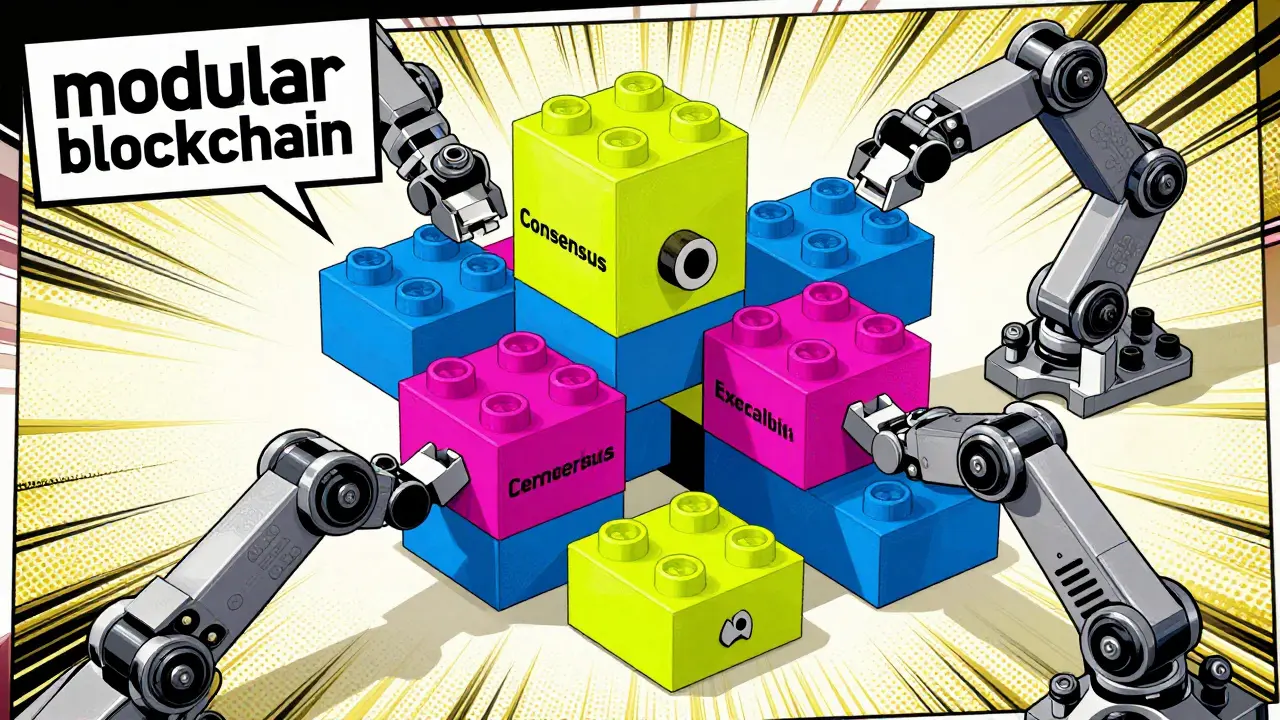
To make multi-chain work, we had to stop treating blockchains as single units. We've moved to a modular approach. Think of it like a Lego set: one piece handles the agreement (consensus), another handles the actual math (execution), and another stores the data (data availability).
Celestia is the first dedicated modular data availability network , which proved that by decoupling data from execution, we could hit finality times of just 10 seconds. This modularity allows developers to pick and choose the best parts of different chains. Why use a slow chain for everything when you can use a specialized AppChain, which is a blockchain tailored specifically for a single application's needs , for your specific business logic?
We're also seeing the rise of shared security. EigenLayer is a re-staking protocol that allows Ethereum validators to secure other modular services . This is a game-changer because it lowers the cost of securing a new chain by about 63%. Essentially, new chains can "rent" the massive security of Ethereum rather than trying to build their own from scratch.
| Metric | Single-Chain (e.g., Ethereum L1) | Multi-Chain (e.g., Base / Optimism) |
|---|---|---|
| Avg. Transaction Cost | ~$4.27 (Peak Q4 2025) | Below $0.03 |
| Throughput (TPS) | 15-30 TPS | 125+ TPS (via Polygon 2.0) |
| Enterprise Deployment | Longer implementation (40% slower) | Faster time-to-market (42% increase) |
| Security Risk | Lower (Internalized) | Higher (Bridge exploits) |
The Institutional Shift: Why Banks are Diving In
If you think this is just for crypto enthusiasts, look at the banks. In 2024, only 37 of the top 100 banks were messing around with multi-chain pilots. By early 2026, that number jumped to 89. Why? Because they realized that a single chain is a liability. If one network goes down or becomes too expensive, their entire operation halts.
Take JPMorgan's Kinexys platform. By using a hybrid on-chain network, they achieved settlement times that were 97% faster than traditional banking systems. They aren't just moving money; they are moving data across different layers to ensure a transaction is both instant and legally binding. For them, the Base Network is an L2 ecosystem integrated with Coinbase's institutional rails , providing a seamless entry point for consumer apps.
But it's not all sunshine. The transition is expensive. WisdomTree, for example, built a tokenized fund platform that slashed transfer costs by 89%. Sounds great, but it cost them $2.3 million and took 14 months of hard development. This is the "entry fee" for the multi-chain era.
The Dark Side: The Bridge Problem
Here is the elephant in the room: bridges. To move assets from one chain to another, you need a bridge. Unfortunately, bridges have become the favorite target for hackers. In 2025, bridge-related exploits cost the industry $287 million. What's wild is that these bridges only handled about 22% of the total value, yet they accounted for 68% of all DeFi losses.
Vitalik Buterin has warned that this complexity creates new "attack surfaces." When you add more chains and more bridges, you add more places for things to break. The industry is now rushing toward Zero-Knowledge Proofs (ZKP), which are cryptographic methods that allow one party to prove something is true without revealing the actual data . The goal is to move assets without needing a risky third-party bridge, using math to verify the transfer instead.

Infrastructure: The Unsung Heroes
One thing developers are complaining about on Reddit and GitHub is RPC (Remote Procedure Call) reliability. If your RPC endpoint is shaky, your multi-chain app is basically a brick. Data shows that public RPCs have 37% higher failure rates than private, enterprise-grade solutions. If you're building a serious app, you can't just rely on the free public nodes; you need dedicated infrastructure.
In the fight for market share, a few names are dominating. Taiko, backed by Consensys, currently holds about 34% of the enterprise market. They're followed by Polygon's AggLayer, which is a coordination layer that unifies liquidity and state across multiple chains . This "aggregation" is the holy grail-it makes the user feel like they are on one chain, while the backend is actually juggling ten different networks.
What to Expect by 2027
We are entering the "Slope of Enlightenment," as Gartner puts it. The experimental phase is over. By 2027, the World Economic Forum predicts that 78% of institutional transactions will happen in multi-chain ecosystems. We are looking at a few major milestones:
- Q2 2026: Universal account abstraction standards will make wallets feel like regular email logins.
- Q3 2026: Privacy-preserving cross-chain transfers using ZK-proofs will go mainstream.
- Q4 2026: Institutional-grade messaging protocols will replace the clunky bridges of today.
The real winners won't be the chains themselves, but the platforms that make the multi-chain complexity invisible to the user. If you have to know which chain you're on, the tech has failed. The future is a world where the blockchain is just the plumbing-reliable, invisible, and incredibly fast.
Is multi-chain better than a single-chain for beginners?
For users, yes, because it typically means lower fees and faster speeds. However, for developers, it is much harder. Learning to build a multi-chain app takes about 8-12 weeks of specialized training, compared to 4-6 weeks for a single chain, due to the complexity of cross-chain security.
Why are cross-chain bridges so risky?
Bridges often act as "honeypots" for hackers because they hold large amounts of locked assets in a single smart contract to facilitate transfers. If that contract has a bug, hackers can drain the entire reserve, which is why the industry is moving toward ZK-proofs for more secure verification.
What is a modular blockchain exactly?
A modular blockchain splits the workload. Instead of one chain doing consensus, execution, and data storage, it delegates those tasks to different layers. For example, Celestia handles the data availability, while another layer handles the actual transaction execution.
Which multi-chain framework is the most popular for businesses?
According to 2026 data, Consensys' Taiko leads with 34% market share, followed by Polygon's AggLayer at 27% and Arbitrum Orbit at 19%. The choice usually depends on whether the business needs deep integration with Ethereum or a more independent AppChain setup.
How does re-staking help multi-chain ecosystems?
Re-staking, via protocols like EigenLayer, allows validators to use their existing stake on Ethereum to secure other networks. This eliminates the need for every new chain to find its own set of validators, reducing security costs by up to 63%.
Next Steps & Troubleshooting
If you're a developer looking to move into this space, start by mastering Zero-Knowledge Proofs. It is the single most important skill for solving the bridge security problem. If you're an enterprise leader, avoid the "single-chain trap." Implementing a multi-chain strategy now may cost more upfront-often between $500k and $2 million-but it prevents the operational paralysis that comes with network congestion.
For those experiencing RPC failures, the first step is to move away from public endpoints. Invest in a private node provider to reduce latency and avoid the 37% failure rate common in public infrastructure. If you're struggling with cross-chain message delays, check the Interchain Foundation's shared knowledge bases for the latest verification standards.

Caiaphas Konkol
April 24, 2026 AT 09:16The obsession with "modular architecture" is just another layer of abstraction designed to hide the fact that we're building a digital panopticon. It is quite obvious to anyone with a shred of intellect that these "invisible machines" are simply tools for institutional capture. The banks aren't "diving in" because it's efficient; they're diving in to ensure they own the pipes before the actual decentralization movement can breathe. It's a classic shell game where the complexity is the distraction.
Gloris Young
April 25, 2026 AT 13:54Super interesting perspective on the modular side of things! It's kind of like how we evolved from one big main street to a whole grid of avenues. Definitely makes the tech feel more approachable for people who aren't devs.
Hannah Rubia
April 26, 2026 AT 20:59I believe the transition toward Zero-Knowledge Proofs is an essential evolution for the industry. While the bridge vulnerabilities are indeed concerning, the mathematical certainty provided by ZKPs offers a robust alternative to the trust-based models we have currently employed. It would be prudent for enterprises to prioritize these cryptographic standards to mitigate systemic risk.
Doc Coyle
April 27, 2026 AT 21:41Actually, the bridge problem is just basic greed. People want the speed without the work, and then they complain when they get hacked. It's just common sense to stay on one chain if you actually care about your money.
Eric Raines
April 29, 2026 AT 12:29Lol imagine thinking staying on one chain is a solution in 2026. That's like saying we should just use horse carriages because cars have accidents. I've seen this movie before and it always ends with the "safe" people getting left behind while the rest of us actually scale. The only real risk here is the slow death of L1s that refuse to play nice with others.
Candace Sherrard
April 30, 2026 AT 13:53There is a profound irony in the way we strive for an "invisible" infrastructure, as the invisibility of the system often mirrors the invisibility of the power structures that govern it. When the blockchain becomes mere "plumbing," we risk forgetting that the pipes are designed by people with specific agendas, and the seamlessness we crave might actually be the very thing that strips away our ability to audit the process in a meaningful way. I wonder if the trade-off between user experience and transparency is a bargain we are too eager to strike, essentially trading the sovereignty of the individual for the convenience of the consumer, which is a transition that has historically led to a gradual erosion of agency in almost every other technological leap we've witnessed over the last century.
Mary Tawfall
May 1, 2026 AT 17:27It's so exciting to see the potential for lower fees! That opens the door for so many more people to get involved without feeling intimidated by the cost.
Tara Aman
May 1, 2026 AT 19:38Totally agree! Lowering the entry barrier is exactly what we need to get the momentum going. Let's keep pushing for these L2 solutions to become the norm!
debashish sahu
May 2, 2026 AT 03:35The mention of institutional adoption in India and globally is quite relevant. While the tech is complex, the actual utility for cross-border payments could be a huge step forward for many developing economies.
Jagdish Sutar
May 3, 2026 AT 09:10Adding to that, if we can mentor the next generation of devs to focus on these multi-chain frameworks, we'll see an explosion of localized apps that actually solve real-world problems instead of just speculative trading.
Alex Hunter
May 4, 2026 AT 12:39I've been helping a few juniors get up to speed with modularity. It's definitely a steep learning curve, but once it clicks, the flexibility is incredible. Just take it one layer at a time.
Mike Krasner
May 6, 2026 AT 09:34imagine paying 2 million for a strategy that might get hacked by a teenager in a basement anyway lol. total waste of money if you ask me
Guy Bianco
May 7, 2026 AT 20:23While the risks are present, the structured approach provided by platforms like Taiko offers a necessary level of stability. ☺️ It is important to maintain a professional standard of infrastructure to ensure long-term viability.
Larry Yang
May 8, 2026 AT 22:43the math is basicly flawed if you think bridges are the only way. its just laggard thinking. honestly the whole 'modular' buzzword is just a way to pump valuations for new tokens. real tech doesn't need a marketing term to explain why it works
Mike Word
May 10, 2026 AT 19:14The point about RPC reliability is something a lot of people overlook. It's like having a Ferrari but the road is made of gravel. You can't actually utilize the speed if the connection keeps dropping.
Clair Geary
May 12, 2026 AT 11:25totally love the lego analogy!! makes it so much easier to wrap my head around the whole mess of layers and stuff
Ellie Drews
May 14, 2026 AT 05:19Just glad to see some movement toward making wallets easier to use. Account abstraction is a huge win for accessibility!
Paige Raulerson
May 15, 2026 AT 21:12The bridge losses are a joke. Imagine losing 287 million and still calling it an "industry." It's an amateur hour of the highest order.
Alex Wan
May 15, 2026 AT 21:47I am absolutely thrilled to see the progress in shared security! It's simply marvelous how EigenLayer is lowering the bar for entry. Its a truly revolutionery step for all of us!!!
Greg Reynolds
May 17, 2026 AT 18:02The claim that 89 of the top 100 banks are running pilots is a meaningless statistic. A pilot is not a deployment. Most of these are just corporate theater to appease shareholders without actually changing a single legacy process.
Sarah Fisher
May 19, 2026 AT 03:56I think we can find a middle ground between the total skepticism of the L1 purists and the hype of the modular crowd. The reality is usually somewhere in between, where we use the best of both worlds.
jill huyo-a
May 20, 2026 AT 09:59I'm really curious about how the transition to ZK-proofs will affect the actual hardware requirements for validators. Will it make it harder for the little guy to run a node?
Benjamin Forg
May 20, 2026 AT 19:44bridges are just honey pots for the alphabet agencies to track every single move u make across chains. dont trust the zkp hype either its just more obfuscation for the same control grid
Matthew Morse
May 22, 2026 AT 07:04too many words for something that basically just says we need better bridges
Kyle Bush
May 24, 2026 AT 00:37USA is gonna lead this tech or we're gonna lose it all!! 🇺🇸 🚀 we need to stop worrying about "bridge risks" and just build the fastest system in the world! LETS GOOOOO!!! 🦅🔥