
When you hear the word airdrop, you might think of free money. A few clicks, a wallet connected, and suddenly your crypto balance jumps. That’s the dream. But for HAI (Hacken Token) holders, the reality was the opposite: a $250,000 hack that wiped out 99% of its value and turned any talk of an airdrop into a trap.
Let’s be clear right away: there is no HAI token airdrop. Not now. Not ever. Not unless Hacken reverses its entire strategy - and even then, it’s unlikely. Anyone promising you one is trying to steal your crypto. This isn’t speculation. It’s fact. Hacken itself has publicly warned users: ignore all airdrop claims.
What Is HAI (Hacken Token)?
HAI is the native token of Hacken is a Web3 cybersecurity company that audits smart contracts and monitors blockchain networks for vulnerabilities. It was never meant to be a speculative coin. It was built to power real security services: staking for rewards, voting in governance through hDAO, and unlocking access to Hacken’s audit tools and threat intelligence feeds.
The token runs on both Ethereum and Binance Smart Chain (BSC). That meant users could move it between networks using Hacken’s own bridge. Sounds smart, right? Except that bridge became the exact point of failure.
The Security Breach That Killed HAI’s Value
In June 2025, Hacken started upgrading its cross-chain bridge. The goal? To make it safer, faster, more reliable. Instead, they accidentally exposed a private key - the digital master key that lets someone create new HAI tokens out of thin air.
That’s not a bug. That’s a disaster.
On a Saturday morning, someone used that leaked key to mint 900 million new HAI tokens. That’s over 90% of the entire supply. Then they dumped them on decentralized exchanges. The price crashed from $0.015 to $0.000056 in minutes. Today, HAI trades around $0.00026 - still down 98% from where it started.
Why did this happen? Because Hacken’s bridge code had a flaw in its access control. The minter account - the one with permission to create tokens - was tied to a key that shouldn’t have been accessible. The team was fixing security, but they broke it worse in the process.
And here’s the worst part: Hacken is a cybersecurity firm. They audit other people’s smart contracts. They warn the world about risks. And yet, their own token contract became the most dangerous exploit in the market.
Why There’s No Airdrop - And Why You Shouldn’t Believe One Is Coming
After the hack, Hacken didn’t vanish. They didn’t disappear. They acted.
- They revoked the compromised minter account - permanently.
- They paused all bridge activity to stop further damage.
- They issued public statements warning users: no airdrops are planned.
But scammers didn’t wait. They saw the panic. They saw the low price. And they saw people desperate for a comeback.
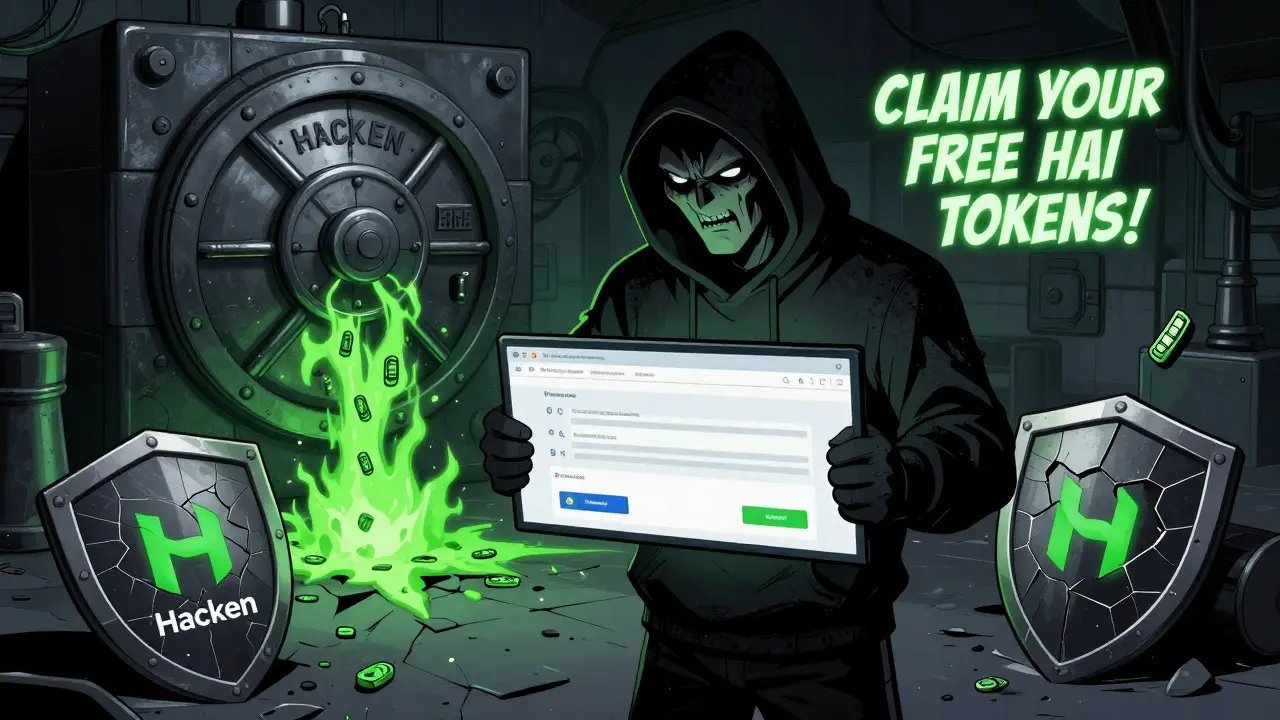
So they started flooding Telegram, Twitter, and Discord with fake airdrop links. "Claim your free HAI tokens!" they say. "New distribution event!" they promise. They even clone Hacken’s website - same logo, same colors - just with a fake wallet address.
Here’s how it works: You click the link. You connect your wallet. The scammer drains your ETH, BNB, or any other token you have in there. They don’t need your HAI - you probably don’t have any left anyway. They just need access.
Hacken’s official Twitter account posted: "We have not and will not conduct any token distribution. Do not trust anyone claiming otherwise. Report scams. Protect your assets."
What Happened to the HAI Token After the Hack?
Even after the bridge was shut down and the minter revoked, the damage was done. The market didn’t bounce back. It collapsed.
Here’s what’s left of HAI:
- Supply: 900 million tokens were minted illegally. Total supply is now over 1.8 billion - far beyond the original 900 million.
- Trading: HAI still trades on decentralized exchanges like PancakeSwap and Uniswap, but volume is near zero. Liquidity pools are empty.
- Utility: Staking and governance still technically work - but who wants to stake a token that’s lost 98% of its value? The hDAO system is silent.
- Bridge: Still paused. No timeline for restoration. No public explanation.
There’s no official roadmap. No recovery plan. No new token swap. Just silence.
Who Got Hurt? The Community, That’s Who
People who bought HAI believing in Hacken’s mission lost everything. Some held it as a long-term bet. Others used it to pay for audits. A few staked it hoping for rewards.
Now? Their wallets are empty. Their trust is broken.
And it’s worse for those who fell for the fake airdrops. They didn’t just lose HAI - they lost ETH, BNB, USDT, everything. One user in Berlin lost $8,000 after clicking a "HAI airdrop" link. He thought he was getting free tokens. He got a zero balance.
Hacken’s reputation is in tatters. A company built to protect Web3 users became the biggest threat to them.
What Should You Do Now?
If you still hold HAI: don’t panic. Don’t try to sell it. The market is dead. No one’s buying. If you move it, you risk triggering a scam contract. Just leave it. There’s no action that will recover value.
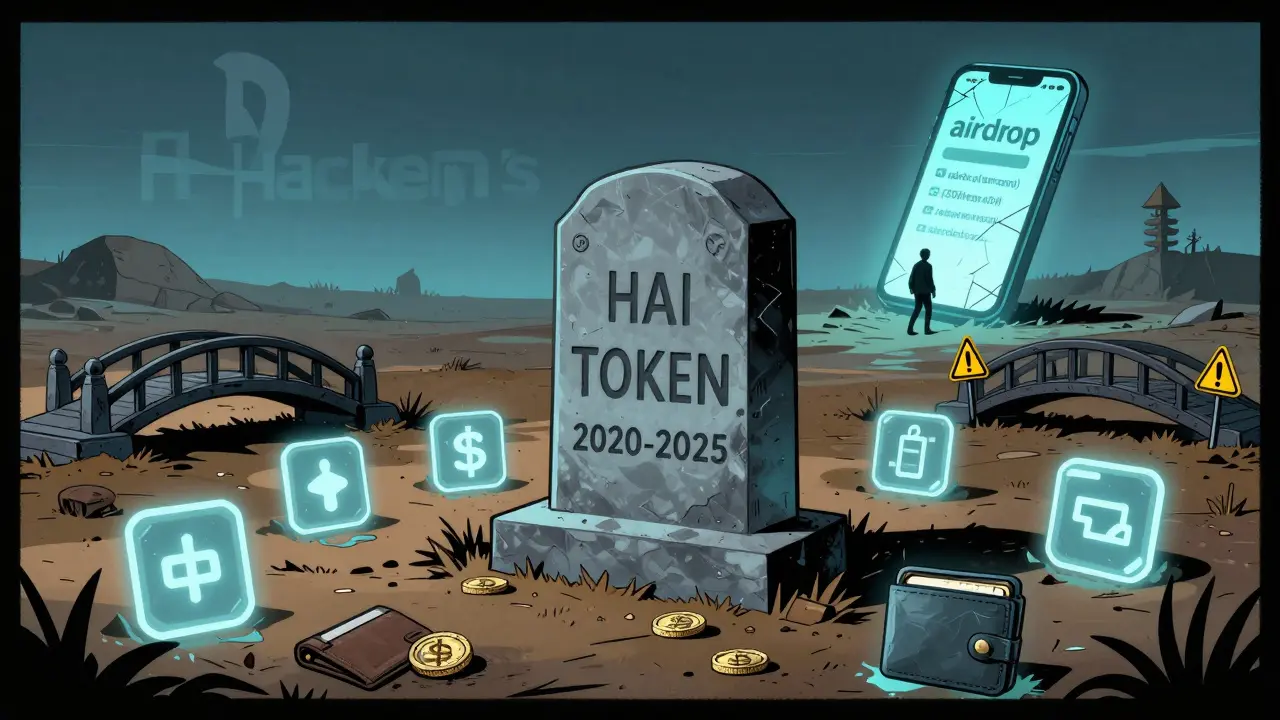
If you’re thinking of buying HAI: don’t. It’s not a recovery play. It’s a tombstone.
If someone messages you about an HAI airdrop: block them. Report them. Delete the message.
If you’re wondering whether Hacken will recover: maybe. But not with HAI. The token is functionally dead. Any future product will likely use a new token - if they rebuild at all.
Final Reality Check
Airdrops aren’t magic. They’re marketing tools. Companies use them to grow adoption. But when a company’s own infrastructure is compromised - when their token is flooded with fake supply - there’s no recovery through giveaways. There’s only damage control.
Hacken didn’t fail because of market conditions. They failed because of a preventable mistake. A single private key. One line of bad code. And now, millions of users are paying the price.
The lesson? Don’t trust the name. Don’t trust the logo. Don’t trust the promise. Always check the source. And if someone says "free HAI tokens," they’re not giving you a gift. They’re taking your keys.
Is there an official HAI token airdrop happening right now?
No. There is no official HAI token airdrop. Hacken has publicly stated multiple times that no airdrops are planned or will ever be launched. Any website, Telegram group, or social media post claiming otherwise is a scam designed to steal your crypto. Always verify claims through Hacken’s official channels - their website and verified Twitter account.
Why did the HAI token price crash so hard?
The HAI token crashed because a malicious actor gained access to a private key that allowed them to mint 900 million new tokens - more than the entire original supply. They dumped these tokens on decentralized exchanges, flooding the market. This caused the price to plummet from $0.015 to under $0.0001 within hours. The hack exploited a flaw in Hacken’s own cross-chain bridge during an upgrade.
Can I still stake HAI tokens or use hDAO?
Technically, yes - the staking and governance contracts still exist. But with HAI trading at $0.00026 and no liquidity, there’s no value in staking. Voting power in hDAO is meaningless when the token has no market demand. Hacken has not updated or maintained these systems since the breach, so they’re essentially frozen.
Is Hacken still operating after the breach?
Yes, Hacken’s core cybersecurity services - like smart contract audits and threat monitoring - are still running. But their token infrastructure is offline. The company has revoked the compromised minter key and paused the bridge, but they’ve not announced any plans to restore HAI functionality or launch a new token. Their focus now is on rebuilding trust, not reviving the token.
Should I try to sell my HAI tokens?
It’s unlikely you’ll find a buyer. The market for HAI is virtually dead. Exchanges show almost no trading volume. Trying to sell could expose your wallet to a scam contract if you interact with a fake DEX. The safest move is to leave the tokens where they are - don’t interact with them. They have no value and no future.
What should I do if I already clicked a fake HAI airdrop link?
Immediately disconnect your wallet from all websites using a tool like WalletGuard or Etherscan’s wallet revocation feature. Move any remaining funds to a new wallet - never reuse the compromised one. Report the scam to the platform where you found it (Twitter, Telegram, etc.). Never connect your wallet again to unsolicited links, even if they look official.
Michelle Mitchell
March 1, 2026 AT 14:23Kaitlyn Clark
March 1, 2026 AT 20:47christopher luke
March 3, 2026 AT 17:32Mary Scott
March 5, 2026 AT 07:30Shannon Holliday
March 6, 2026 AT 06:19Jeremy buttoncollector
March 7, 2026 AT 20:22Michelle Xu
March 9, 2026 AT 06:28Ryan Burk
March 9, 2026 AT 22:30Elizabeth Smith
March 10, 2026 AT 12:18George Suggs
March 11, 2026 AT 10:10Dianna Bethea
March 12, 2026 AT 05:11Phillip Marson
March 13, 2026 AT 23:18Jeff French
March 14, 2026 AT 18:59Michael Rozputniy
March 14, 2026 AT 19:16Tanvi Atal
March 15, 2026 AT 04:20Sony Sebastian
March 15, 2026 AT 05:58Brian Lemke
March 16, 2026 AT 04:48Megan Lavery
March 17, 2026 AT 06:44Amanda Markwick
March 17, 2026 AT 16:28Leslie Cox
March 17, 2026 AT 20:02Andrew Hadder
March 19, 2026 AT 11:58Derek Sasser
March 21, 2026 AT 02:06Neeti Sharma
March 22, 2026 AT 01:20Nadia Shalaby
March 22, 2026 AT 06:00Fiona Monroe
March 22, 2026 AT 16:45Molley Spencer
March 23, 2026 AT 21:19John Fuller
March 24, 2026 AT 18:07Lucy Simmonds
March 25, 2026 AT 19:46