
Have you ever tried to trade a coin from the Cosmos network and felt like you were jumping through hoops? You connect your wallet, wait for the bridge, pray the transaction doesn’t fail, and then wonder if the fees just ate your profit. That is the old way of doing things. Enter Osmosis, a decentralized exchange (DEX) that changed the game for anyone holding assets on the Cosmos blockchain.
If you are looking for a quick verdict, here it is: Osmosis is currently the best place to swap tokens within the Cosmos ecosystem. It offers a user experience that rivals centralized exchanges, lower fees than Ethereum-based competitors, and deep liquidity for popular assets like ATOM and OSMO. However, if you are trying to trade Bitcoin or Ethereum directly, this isn't the platform for you. It is a specialized tool, not a generalist one.
What Is Osmosis?
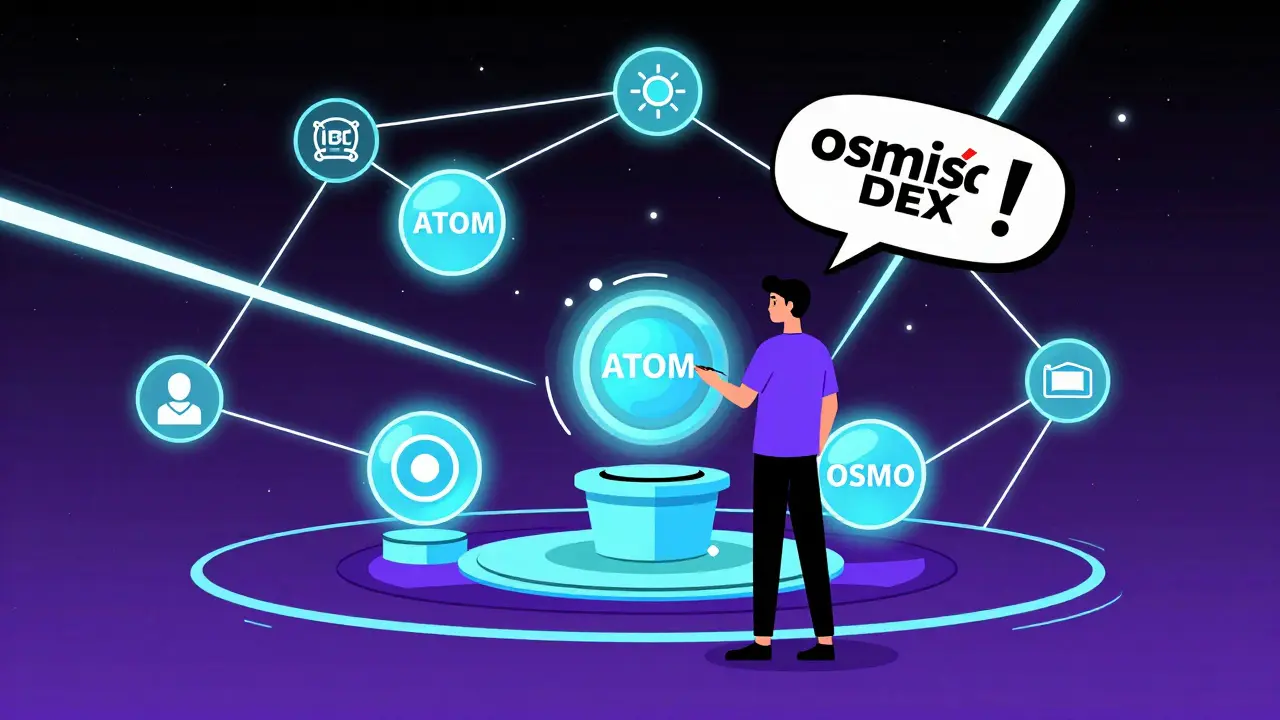
To understand why Osmosis matters, you first need to understand the problem it solves. The cryptocurrency world is fragmented. You have Ethereum, Solana, Binance Smart Chain, and dozens of others. Moving money between them used to require risky bridges or complex workarounds. The Cosmos network was built to fix this with a protocol called Inter-Blockchain Communication (IBC). Think of IBC as a universal translator that lets different blockchains talk to each other safely.
Osmosis sits right in the middle of this conversation. Launched in October 2021, it acts as the primary liquidity hub for the entire Cosmos ecosystem. Unlike older decentralized exchanges that relied on simple order books, Osmosis uses an Automated Market Maker (AMM) model. This means there are no buyers and sellers waiting for each other. Instead, you trade against pools of liquidity provided by other users. This makes trades instant and available 24/7, regardless of market hours.
The platform operates on its own blockchain, which is part of the Cosmos SDK family. This gives it high speed and low costs compared to congested networks like Ethereum. Its native token, OSMO, serves as the governance and utility token for the platform, allowing users to vote on proposals and earn rewards for providing liquidity.
User Experience: Does It Actually Feel Easy?
Let’s be honest: most DeFi interfaces look like they were designed by engineers who hate buttons. They are cluttered, confusing, and intimidating for newcomers. Osmosis is different. When you visit app.osmosis.zone, you are greeted with a clean, modern dashboard that feels more like a traditional trading app than a Web3 experiment.
The interface is intuitive. You select the token you want to sell, pick the token you want to buy, enter the amount, and hit swap. That’s it. There are no hidden menus or cryptic settings required for basic trades. Industry observers, including Jae Kwon, the founder of Cosmos, have praised the launch as a "best moment" because it proved that cross-chain trading could have great user experience (UX).
But how does it perform under the hood? Data shows that the site receives over 220,000 organic visits per month. Users spend an average of 2 minutes and 30 seconds on the site, visiting nearly 5 pages per session. These metrics suggest that people aren’t just bouncing off; they are engaging with the platform. The bounce rate sits at 38%, which is relatively healthy for a financial tool where precision matters.
For those who prefer mobile, Osmosis offers a responsive web interface that works well on smartphones, though dedicated apps are still evolving in the DeFi space. You will need a compatible wallet, such as Keplr or Leap, to interact with the site. Connecting these wallets is seamless, often requiring just a single click after installation.
Liquidity and Trading Volume
In the world of decentralized exchanges, liquidity is king. Without enough funds in the pools, you face high slippage-meaning you get less of the token you’re buying than expected. So, how does Osmosis stack up?
As of 2025, Osmosis maintains a Total Value Locked (TVL) of approximately $150 million. While this number might seem small compared to giants like Uniswap or Curve, which boast billions in TVL, context is crucial. Osmosis holds the largest market share within the Cosmos ecosystem. For traders focused on ATOM, OSMO, TIA, and other IBC-enabled tokens, Osmosis often provides deeper liquidity than any alternative.
| Exchange | Primary Ecosystem | Estimated TVL (2025) | Best For |
|---|---|---|---|
| Osmosis | Cosmos / IBC | $150 Million | Cosmos-native tokens, low fees |
| Uniswap | Ethereum | $4 Billion+ | Broadest token selection, stability |
| PancakeSwap | Binance Smart Chain | $2 Billion+ | Low-cost BSC trading |
| Curve | Ethereum / Multi-chain | $4 Billion+ | Stablecoin swaps |
The key advantage here is specialization. If you are trying to swap ATOM for USDC on Ethereum, you might face higher gas fees and slower confirmation times. On Osmosis, the transaction is fast, cheap, and native to the asset class. However, if you are looking to trade obscure memecoins or new launches outside the Cosmos sphere, you will likely find better options elsewhere.
Fees and Costs
Costs can make or break your trading strategy. On Ethereum-based DEXs, gas fees can sometimes exceed the value of the trade itself during peak congestion. Osmosis avoids this pitfall by operating on its own efficient blockchain.
Typical transaction fees on Osmosis are fractions of a cent. You will pay a small network fee in OSMO or ATOM to process the transaction, plus a tiny percentage (usually around 0.20% to 0.30%) that goes to liquidity providers. This structure is predictable and transparent. There are no surprise spikes in costs unless the network is experiencing extreme load, which is rare given the current capacity.
Additionally, Osmosis has implemented features similar to EIP-1559, burning a portion of transaction fees. This deflationary mechanism can potentially increase the value of the OSMO token over time, benefiting holders and active traders alike.
Security and Regulation
When you move away from centralized exchanges like Coinbase or Binance, you take on more responsibility. Osmosis is non-custodial, meaning you always control your private keys. Your funds never leave your wallet until the moment of swap. This eliminates the risk of exchange hacks stealing your balance, but it introduces smart contract risks.
The core code of Osmosis has been audited by leading security firms, and the team has a strong track record of shipping secure updates. The development activity is among the highest in the Cosmos ecosystem, with monthly feature releases and governance proposals. This continuous improvement suggests a mature and vigilant team.
However, regulatory clarity remains a gray area. FxVerify notes that Osmosis does not appear to be regulated by any specific government authority. This is standard for decentralized protocols but means there is no customer support hotline to call if you make a mistake. If you send funds to the wrong address, they are gone forever. Always double-check addresses and use the built-in safeguards provided by your wallet.
Who Should Use Osmosis?
Osmosis is not for everyone. If you are a beginner who wants to buy Bitcoin with a credit card, stick to a centralized exchange. But if you fit into one of these profiles, Osmosis is likely your best option:
- Cosmos Ecosystem Investors: If you hold ATOM, OSMO, TIA, or other IBC tokens, Osmosis offers the deepest liquidity and best prices.
- DeFi Yield Farmers: The platform allows you to provide liquidity and earn trading fees and OSMO incentives. Customizable pool configurations let you tailor risk and reward.
- Developers: Building on Osmosis is easier thanks to comprehensive documentation and active community support. Recent updates have simplified node operation and integration.
Conversely, avoid Osmosis if you primarily trade Ethereum ERC-20 tokens or seek broad exposure to thousands of altcoins across multiple chains without using bridges.
Final Verdict
Osmosis has successfully carved out a niche as the premier decentralized exchange for the Cosmos network. It combines technical sophistication with a surprisingly polished user interface. While it may not rival the sheer scale of Ethereum-based DEXs in total volume, it dominates its specific vertical. For anyone serious about the Cosmos ecosystem, Osmosis is not just an option; it is essential infrastructure.
As the IBC protocol continues to gain adoption, Osmosis is well-positioned to grow alongside it. With regular updates, active governance, and a focus on user experience, it sets a high bar for what decentralized finance should feel like. Just remember: do your own research, manage your keys securely, and start with small amounts until you are comfortable with the workflow.
Is Osmosis safe to use?
Yes, Osmosis is considered safe due to its non-custodial nature and rigorous smart contract audits. However, as with all DeFi platforms, you are responsible for securing your own private keys. Never share your seed phrase, and verify URLs to avoid phishing sites.
What wallet do I need for Osmosis?
You need a Cosmos-compatible wallet. Keplr is the most widely used and recommended option. Leap is another popular alternative. Both integrate seamlessly with the Osmosis interface.
Can I trade Bitcoin on Osmosis?
Not directly. Osmosis supports tokens within the Cosmos ecosystem and those bridged via IBC. While wrapped versions of Bitcoin (like tBTC) might be available depending on current pool listings, native BTC trading is not supported. Stick to centralized exchanges for direct BTC pairs.
How much does it cost to swap on Osmosis?
Fees are very low, typically fractions of a cent for network gas plus a small trading fee (around 0.20-0.30%) paid to liquidity providers. This is significantly cheaper than trading on Ethereum during peak times.
What is the OSMO token used for?
OSMO is the native utility and governance token of the Osmosis network. Holders can vote on protocol upgrades, propose changes, and earn rewards by providing liquidity to trading pools. A portion of transaction fees is also burned, creating deflationary pressure.