
North Korea doesn’t allow its citizens to own cryptocurrency. That’s the official line. But while ordinary North Koreans are locked out of the digital economy, the regime has turned crypto into its most powerful weapon abroad - stealing over $2.17 billion in 2025 alone. That’s more than the entire previous year, and it’s all going to fund nuclear missiles, not Bitcoin portfolios.
The ByBit Hack: A New Benchmark in Crypto Theft
On February 21, 2025, the world’s largest cryptocurrency exchange hack happened - not in a shadowy basement in Eastern Europe, but orchestrated by a state-run cyber unit in Pyongyang. The target: ByBit. The result: $1.5 billion stolen. That’s not just a record. It’s a turning point. What made this attack different wasn’t just the size. It was how they did it. ByBit used "cold" wallets - hardware devices stored offline, disconnected from the internet, considered nearly unhackable. Yet North Korean hackers breached them. How? They didn’t crack the code. They cracked the people. The FBI labeled the operation "TraderTraitor." Their investigation showed that insiders - employees at crypto firms, often unaware they were working for North Korea - were recruited through fake job postings. These workers, posing as developers in the U.S., Canada, or Germany, were actually operating remotely from Pyongyang. Once inside, they installed backdoors, stole credentials, and moved funds before anyone noticed. The stolen assets were instantly broken into thousands of wallet addresses across Ethereum, Bitcoin, and other blockchains. Blockchain analysts now track these addresses. Some are still active. Others have been laundered through bridges and decentralized exchanges. The money isn’t sitting still. It’s being converted, moved, and hidden.How North Korea Turns Hackers Into Cash Machines
This isn’t just about one big heist. It’s a full-scale industrial operation. The North Korean regime runs a global workforce of 5,000 to 8,000 IT workers, disguised as freelancers or remote employees. They’re sent to China, Russia, Southeast Asia, and even Africa under fake identities. They get paid in cryptocurrency - not bank transfers, because those leave a paper trail. They work for Western tech companies, building apps, managing servers, writing code - all while funneling money back to the state. The United Nations estimates this scheme brings in $600 million a year. That’s not a side hustle. That’s a national revenue stream. And it’s legal in the countries where these workers are based - because no one knows who they really are. Meanwhile, North Korea’s hacking teams focus on exchanges, DeFi protocols, and crypto bridges. They don’t need to be the best coders. They just need to be smarter than the security teams. And they are.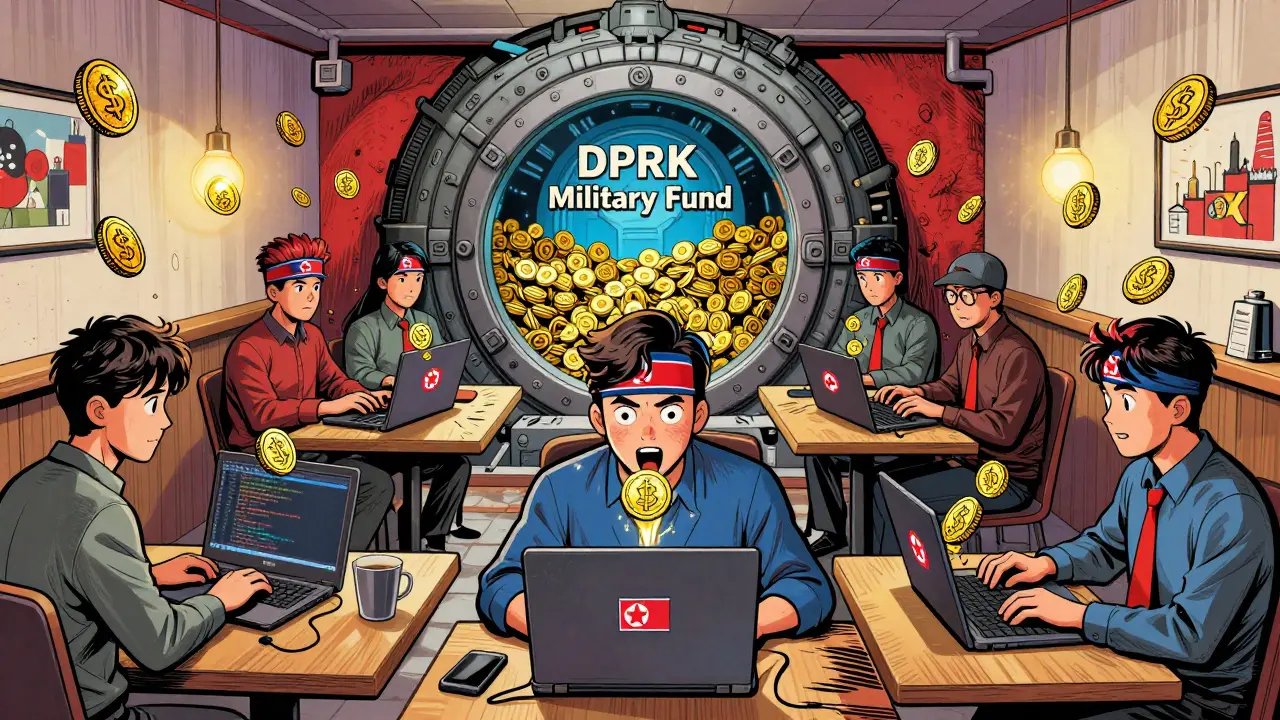
The Cambodia Connection: Laundering Crypto in Plain Sight
Money doesn’t stay on the blockchain forever. It needs to become cash. That’s where Cambodia comes in. In 2025, the U.S. Treasury’s FinCEN flagged the Huione Group - a Cambodian company with ties to North Korea - as a major money laundering hub. Huione Guarantee and Huione Crypto were used to convert stolen crypto into stablecoins that can’t be frozen. These stablecoins then flowed into casinos, real estate deals, and luxury goods markets across Southeast Asia. Huione didn’t just move money. They made it look clean. Their network includes shell companies, fake invoices, and front businesses that accept crypto payments for services that don’t exist. The result? Millions of dollars in stolen assets now appear as "legitimate" income in global financial systems. This isn’t an accident. It’s a strategy. North Korea picked Cambodia because it has weak oversight, a booming gambling industry, and no extradition treaties with the U.S. or EU. It’s the perfect sandbox for laundering.How the U.S. Is Fighting Back - And Why It’s Not Enough
The U.S. government didn’t sit idle. In March 2025, the Treasury’s OFAC sanctioned the Korea Sobaeksu Trading Company and three key individuals tied to the hacking operations. The Department of Justice unsealed indictments against seven North Korean nationals. The State Department offered rewards up to $7 million for information leading to arrests. The FBI started warning exchanges, wallet providers, and blockchain analytics firms: block transactions tied to known TraderTraitor addresses. Some did. Others didn’t - because tracking crypto is hard, and compliance costs money. Senators Elizabeth Warren and Jack Reed demanded answers. "Why are we still letting North Korea steal billions?" they asked. The answer? Because the system is broken. Most crypto exchanges still use outdated security tools. Many don’t monitor for unusual wallet activity. Some don’t even know who their users are. And even when they do, there’s no global database of known bad actors - just scattered alerts from the FBI and Treasury. The cost of stopping one major hack like ByBit? Experts say it would take $50 million in better security, AI monitoring, and staff training. Most exchanges spend $5 million. The math doesn’t add up.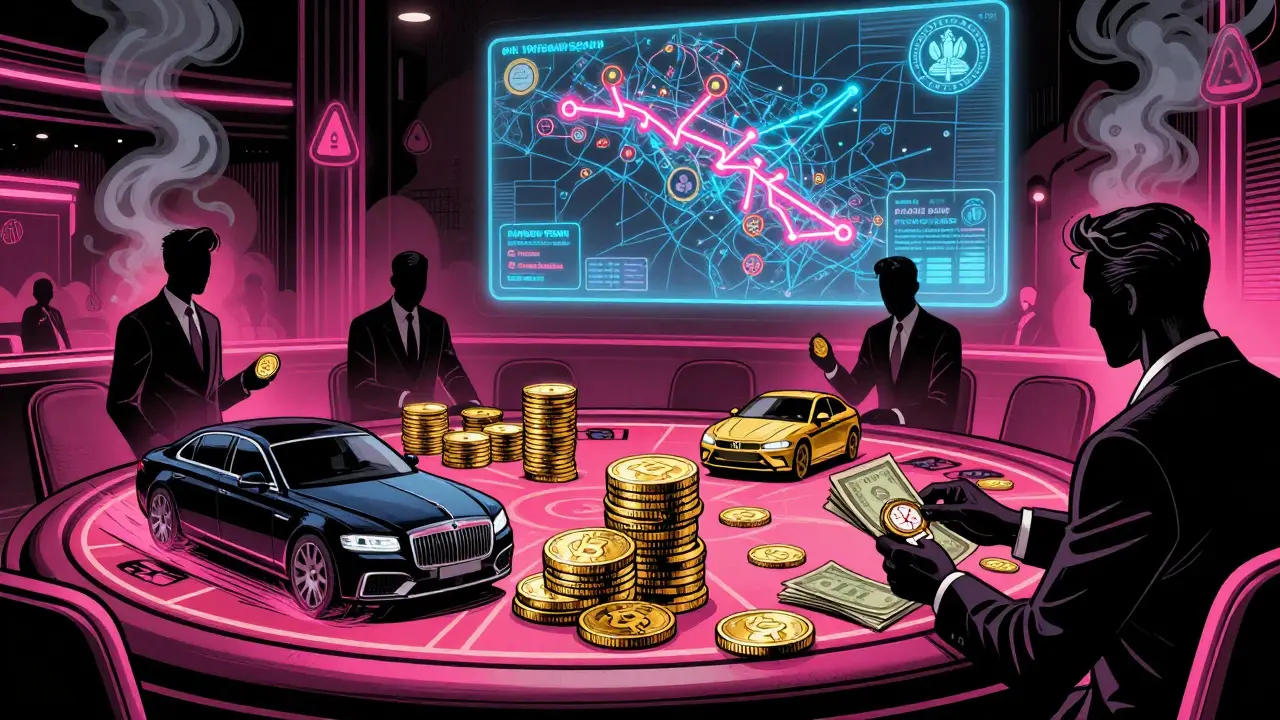
Why the Crypto Ban Doesn’t Matter - And What It Really Means
North Korea bans crypto for its people. That’s not about protecting citizens. It’s about control. If citizens could trade crypto, they could bypass state surveillance. They could send money out of the country. They could access information from the outside world. But for the regime? Crypto is the perfect tool. It’s borderless. It’s anonymous. It’s untraceable - unless you’re looking hard enough. And North Korea is looking harder than anyone. The ban isn’t about ethics. It’s about asymmetry. While its own people starve under sanctions, the regime uses stolen crypto to buy missile parts, fuel, and high-tech components from black-market suppliers in China and Russia. The money doesn’t go through banks. It doesn’t get flagged. It just moves - from hacker to wallet to casino to luxury car dealership.What Comes Next
The attacks aren’t slowing down. In fact, they’re accelerating. North Korea’s cyber units are now training in AI-assisted phishing, deepfake voice scams, and automated wallet exploitation. They’re learning from each failure. And they’re getting better. The global crypto industry is still treating this like a criminal problem. It’s not. It’s a national security threat. One that’s funded by stolen digital cash and executed by state-backed hackers who operate with impunity. Without coordinated international action - real sanctions, real tracking, real consequences - this will only get worse. By 2027, experts predict North Korea could steal over $5 billion a year. That’s more than the entire GDP of some small nations. The crypto world thought it was immune to war. It was wrong. The war is here. And the battlefield is your wallet.Why does North Korea ban crypto for its citizens but steal it from others?
North Korea bans crypto for its citizens to maintain total control over information and finances. If ordinary people could use crypto, they could bypass state surveillance, send money abroad, or access uncensored news. But for the regime, crypto is a weapon - a way to steal billions from global exchanges and launder it through third countries to fund its nuclear program without using traditional banks that can be sanctioned.
How did North Korea hack ByBit’s cold wallets?
They didn’t break the hardware. They broke the people. North Korean operatives infiltrated ByBit’s supply chain by posing as remote IT workers hired from abroad. Once inside, they gained access to internal systems, stole credentials, and manipulated security protocols to access the cold wallet keys. The attack relied on social engineering, not brute force - a pattern seen in nearly all major DPRK crypto heists.
What role does Cambodia play in North Korea’s crypto theft?
Cambodia has become a major laundering hub for North Korean crypto funds. The Huione Group, based in Cambodia, uses fake businesses, gambling operations, and untraceable stablecoins to convert stolen crypto into clean cash. U.S. regulators have identified Huione as a key link in the money trail, with executives directly tied to North Korean intelligence. The country’s weak financial oversight makes it ideal for hiding illicit funds.
Are North Korean hackers really working for Western companies?
Yes. Thousands of North Korean IT workers are employed remotely by U.S., European, and Asian tech firms under false identities. They use VPNs and fake resumes to appear as developers in the U.S. or Germany. They’re paid in crypto, which avoids banking scrutiny. Many companies don’t know they’re hiring state-sponsored hackers - until it’s too late.
Can crypto exchanges stop these attacks?
They can try - but most aren’t doing enough. Stopping these attacks requires AI-powered transaction monitoring, real-time wallet tracking, strict KYC for remote workers, and global sharing of threat data. But these tools are expensive. Many exchanges cut corners to save money. Until regulators force them to invest in real security, the attacks will keep succeeding.
What’s the U.S. doing to stop North Korea’s crypto theft?
The U.S. has sanctioned North Korean entities like Korea Sobaeksu Trading Company, indicted seven hackers, and offered up to $7 million in rewards for information. The FBI is working with exchanges to block known stolen addresses. But these are reactive measures. There’s no global system to prevent hackers from getting hired in the first place, and no way to stop money laundering in places like Cambodia. The response is fragmented - and too slow.
Is North Korea the biggest crypto threat in the world today?
Yes. In 2025, North Korea stole more crypto than all other cybercriminal groups combined. Their attacks are state-funded, highly coordinated, and aimed at national survival - not profit. Unlike ransomware gangs or DeFi scammers, they have unlimited resources, long-term planning, and no fear of jail. That makes them the most dangerous crypto threat on the planet.
greg greg
January 13, 2026 AT 18:11Okay, so let’s unpack this. North Korea doesn’t let its people use crypto because it’s a control mechanism-simple, brutal, effective. But the regime’s entire economy now runs on stolen digital assets? That’s not just irony, that’s a full-blown paradox wrapped in a firewall. They’re using the very technology they outlaw to bypass the sanctions they’re under. It’s like banning cars because your citizens might drive too fast, then building a fleet of armored tanks to raid neighboring towns. The scale of this operation is terrifying. Five thousand to eight thousand IT workers, scattered across the globe, working for Western companies under fake names, paid in Bitcoin, funneling cash back to Pyongyang? That’s not a cyberattack-it’s a shadow state within the global workforce. And nobody’s checking IDs properly. No one’s verifying locations. No one’s asking why a ‘Canadian developer’ is logging in from a VPN in Ulan Bator. The system is built on trust, and North Korea exploited that trust like a master thief. The ByBit hack? It wasn’t a hack. It was a corporate espionage operation disguised as a crypto heist. Cold wallets? Irrelevant. The weakest link was always the human. And humans are cheap to recruit when you’re offering them a life outside of starvation rations and propaganda. The real horror? This isn’t going to stop. It’s only getting smarter. AI-assisted phishing. Deepfake voices. Automated wallet exploits. They’re not just stealing money-they’re learning how to break the entire trust model of Web3. And we’re still treating this like a compliance issue instead of a national security emergency.
LeeAnn Herker
January 14, 2026 AT 14:17Wait… so the U.S. sanctions North Korea for stealing billions… but still lets them hire hackers as ‘remote developers’? 😂 Maybe we should just start sending them our crypto wallets in the mail with a note that says ‘please take’? This whole thing is a joke. The government spends $500 billion a year on ‘defense’ but can’t stop a bunch of coders in Pyongyang from turning our exchanges into ATMs? Also, Cambodia? Really? That’s the laundering hub? I thought it was Dubai or Switzerland. Oh wait-those places have paperwork. Cambodia just has palm trees and casino lights. 🌴💸 I’m starting to think the real crypto revolution isn’t blockchain-it’s the global acceptance of ‘we don’t care as long as it’s not my problem.’
Sherry Giles
January 15, 2026 AT 07:56Canada’s been quiet about this because we’re too busy pretending we’re not complicit. You think our tech firms don’t hire ‘remote talent’ from sketchy locations? We’ve got companies in Toronto and Vancouver onboarding ‘developers’ from China, Russia, and yes-North Korea-with zero background checks. They use fake LinkedIn profiles, PayPal payments, and crypto wallets. And when the FBI comes knocking? Everyone plays dumb. ‘Oh, we thought he was from Ukraine!’ Like that’s an excuse. We’re not victims here. We’re enablers. And if you think this is just about money, you’re delusional. This is a long-term geopolitical play. North Korea’s not trying to get rich-they’re trying to survive. And they’ve figured out that the only way to survive under sanctions is to weaponize the global economy’s laziness. We built the internet to be open. Now we’re reaping what we sowed. And we’re mad because the monsters we let in are now using our own tools to burn our houses down.
Andy Schichter
January 15, 2026 AT 23:56So let me get this straight… the guy who can’t buy a Bitcoin because the state says no… is the same guy whose government is stealing billions from people who *can*? What a beautiful dystopia. The only thing more tragic than this is that we’re all just waiting for the next headline. ‘North Korea Hacks Another Exchange!’ Yawn. We’ve seen this movie. We just keep buying tickets. And the real punchline? The people who built the systems being hacked? They’re the same ones who made the ‘easy login’ button and called it ‘user-friendly.’ We didn’t get hacked. We invited them in with a free coffee and a handshake. And now we’re surprised they took our wallet? Please. The only thing more predictable than this is the fact that no one will actually change anything. Because change costs money. And money… well, money’s what they’re stealing.
Meenakshi Singh
January 17, 2026 AT 02:27Bro. North Korea is basically the OG crypto whale. 🐋💸 They don’t HODL-they HODL and THEN steal. And the best part? They’re using our own tools against us. Cold wallets? Pfft. Social engineering is the new zero-day. And Cambodia? 😭 That’s not a country-it’s a crypto laundromat with a beach. I’ve seen those Huione ads on Instagram. ‘Invest in luxury villas!’ Yeah, with stolen ETH. I’m just waiting for the day a North Korean hacker buys a Tesla with $100M in ByBit funds and posts a selfie with the dealer. #CryptoLife #DPRKStyle
Kelley Ramsey
January 18, 2026 AT 19:17This is terrifying… but also… kind of brilliant? I mean, think about it: they turned a ban into a weapon. They took a system designed for freedom and used it to fuel oppression. It’s like they’re playing 4D chess while the rest of us are still trying to figure out how to use the rook. But here’s the thing-we can fix this. Not with more sanctions. Not with more headlines. But with better tools. Better KYC. Better AI monitoring. Better global cooperation. We’re not powerless. We just need to stop treating crypto like a Wild West and start treating it like infrastructure. And we need to stop pretending that ‘remote workers’ don’t need background checks. This isn’t about politics. It’s about responsibility. And we owe it to every person who lost their savings in these hacks to do better. 💪🌍
Frank Heili
January 20, 2026 AT 00:02Let’s be real: the ByBit hack didn’t happen because of a technical flaw. It happened because of a procedural one. No exchange should allow remote employees to access cold wallet systems without multi-person authorization, geofencing, and behavioral anomaly detection. None. Period. The fact that they didn’t is negligence. And the fact that other exchanges are still operating the same way? That’s not ignorance-that’s greed. Security is a cost center. But in crypto, it’s the only thing that keeps you alive. The $50 million figure? That’s peanuts compared to the $1.5 billion lost. If you’re an exchange CEO and you’re not investing in real security, you’re not a leader-you’re a liability. And you should be held accountable. Not just by regulators. By your users. Because if you can’t protect their money, you don’t deserve to hold it.
Jon Martín
January 20, 2026 AT 16:25Y’all are missing the big picture. This isn’t just about North Korea. It’s about the death of trust in digital systems. We built crypto to be decentralized. To be free. To be unshackled. But now? The most powerful actor in crypto is a regime that doesn’t believe in freedom. And they’re using our ideals to destroy them. It’s like inventing the internet to connect people… and then having a dictator use it to spy on everyone. We thought we were building the future. Turns out we just built a playground for the most ruthless players on Earth. But here’s the good news-we’re not done yet. We can still fix this. We can demand better. We can build smarter. We can make security sexy again. It’s not too late. We just have to choose to care. 💥
Mollie Williams
January 22, 2026 AT 11:57There’s something deeply unsettling about how perfectly this mirrors the human condition. We create systems to liberate, and then we let them be corrupted by those who have nothing to lose. North Korea doesn’t want Bitcoin for its people because it fears what freedom might do to its control. But it doesn’t fear what its own actions might do to the world. It’s a mirror. We, too, have built systems of convenience that ignore ethics. We outsource labor. We ignore red flags. We prioritize growth over safety. And now we’re surprised when the system collapses under its own hypocrisy? The ban isn’t about morality. It’s about power. And power, when unchecked, always finds a way to feed itself-even if it has to steal from the very world that gave it the tools to survive.
Surendra Chopde
January 24, 2026 AT 00:40North Korea's cyber operations are not just hacking-they are economic warfare. The fact that they use fake identities to infiltrate global tech firms shows a level of strategic planning that rivals Cold War espionage. What's worse is that Western companies are unknowingly funding a regime that threatens global stability. This isn't a tech problem. It's a geopolitical one. We need international cooperation, not just sanctions. We need identity verification protocols that work across borders. And we need to stop pretending that remote work doesn't carry security risks. The time for denial is over.
Tiffani Frey
January 25, 2026 AT 16:59It’s fascinating-and horrifying-how North Korea has weaponized the very principles of decentralization and anonymity that crypto enthusiasts celebrate. They’ve turned privacy into a shield and global connectivity into a weapon. And yet, the response from the West? Fragmented, slow, and underfunded. We have the technology to trace these transactions. We have the intelligence to identify these actors. But we lack the political will to act decisively. Why? Because it’s messy. Because it requires cooperation. Because it’s easier to blame the hackers than to fix the systems that let them in. But let’s be clear: this isn’t a crime. It’s a siege. And if we don’t change how we defend our digital infrastructure, we’re not just losing money-we’re losing the future.
Tre Smith
January 26, 2026 AT 03:29Let’s not romanticize this. North Korea isn’t a rogue state with a tech division. It’s a criminal syndicate with nuclear weapons. The fact that they’re using remote workers under fake identities to infiltrate Western firms isn’t clever-it’s predatory. And the fact that companies are still hiring them without verification isn’t negligence-it’s complicity. The U.S. sanctions are theater. The real solution is to mandate biometric verification for all remote IT contractors working with financial infrastructure. No exceptions. No ‘trust but verify.’ Just verify. And if you don’t? You lose your license. Simple. Effective. And long overdue.
Ritu Singh
January 27, 2026 AT 02:13It’s poetic, really. The regime that starves its people to fund missiles is now using the digital age’s most radical invention to do it. Crypto was supposed to empower the individual. Instead, it’s become the perfect tool for the most oppressive regime on Earth. And we’re all just watching, waiting for the next headline. Meanwhile, the Huione Group is quietly turning stolen ETH into luxury condos in Phnom Penh. No one’s coming to stop them. No one cares enough. We built a world where money flows freely-and now we’re surprised when the worst of us use it to buy power. The tragedy isn’t the theft. It’s how little we mourn it.
kris serafin
January 28, 2026 AT 17:32Bro, the ByBit hack was wild. Cold wallets? Gone. Just like that. 😱 And the worst part? The hackers didn’t even need to code anything fancy. They just waited for someone to click ‘accept’ on a fake job offer. That’s it. No magic. Just human error. And now we’re all like ‘oh no’ while the money’s already in Cambodia. I just hope the next exchange doesn’t wait for another $1.5B loss before they update their security. We’re all just one bad hire away from disaster.
Jordan Leon
January 29, 2026 AT 13:52There is a quiet dignity in the way North Korea has turned isolation into advantage. While the world rushed toward openness, they chose control. And now, through the very architecture of the global digital economy, they have found a way to transcend their isolation without surrendering their control. The ban on crypto for citizens is not hypocrisy-it is strategy. They have created a closed loop: no internal access, maximum external leverage. The West built the tools. They mastered their use. And we are now left to clean up the consequences of our own ingenuity. This is not a failure of security. It is a failure of imagination.
Rahul Sharma
January 31, 2026 AT 03:33North Korea's crypto theft is not new. But the scale is. And the method-using fake remote workers-is the real threat. Companies must verify identities with government-issued documents, not just resumes. Also, crypto exchanges must integrate real-time geolocation tracking for all internal access. No more ‘developer from Canada’ logging in from a Chinese IP. This is basic. Why isn’t it standard? Because it costs money. And that’s the problem. We value profit over security. And now we pay the price.
Gideon Kavali
February 1, 2026 AT 02:52Let me be clear: This is an act of war. Not cyberwarfare. Not espionage. WAR. A sovereign state is stealing over $2 billion from private citizens and corporations across the globe to fund weapons of mass destruction. And we’re treating it like a bad audit? The U.S. government needs to declare a national emergency. Freeze all assets tied to North Korean-linked wallets. Block all transactions from known bad actors. And shut down every company that hires ‘remote IT workers’ without full biometric and government-verified identity checks. This isn’t a debate. It’s a crisis. And if we don’t respond with force, we’re not just weak-we’re complicit.
Allen Dometita
February 1, 2026 AT 14:54Imagine being a North Korean hacker. You’re stuck in a country with no internet freedom, no freedom at all… but you’re also the one holding the keys to billions. You’re the guy who gets paid in crypto while your neighbors starve. That’s the real dystopia. And we’re just sitting here arguing about security protocols. Meanwhile, the person who cracked ByBit? They’re probably watching the news, laughing, and buying a new gaming rig with stolen ETH. The system isn’t broken. It’s just rigged. And the people who built it? We’re the ones who let it happen.
Brittany Slick
February 3, 2026 AT 00:23I keep thinking about the people who lost everything in these hacks. Not the exchanges. Not the investors. The everyday people-teachers, nurses, retirees-who put their life savings into crypto because they believed in it. And now? Their money’s in a Cambodian casino, turned into fake invoices and luxury watches. It’s not just theft. It’s betrayal. We built this world to give people hope. But someone turned it into a weapon. And we’re the ones who have to fix it-not with more tech, but with more heart.
Caitlin Colwell
February 4, 2026 AT 04:54Cambodia is the perfect place for this. No one watches. No one asks. Just casinos, beaches, and quiet money. It’s not evil. It’s just… empty. And that’s what makes it dangerous.
Denise Paiva
February 5, 2026 AT 06:00North Korea banning crypto for its people while stealing it globally is the most elegant form of authoritarian hypocrisy. But here’s the twist: the West enabled this. We built the infrastructure. We created the anonymity. We allowed remote work without verification. And now we’re shocked? This isn’t North Korea’s crime. It’s ours. We didn’t just fail to stop it-we designed the conditions for it. And we still won’t fix it. Because fixing it means admitting we were wrong. And that’s too much to ask.
Charlotte Parker
February 5, 2026 AT 10:19Oh wow. So the regime that locks its people in a prison of propaganda is now using the internet’s greatest promise-freedom-to fund its own tyranny. How poetic. How tragic. How utterly predictable. We thought crypto was the end of government control. Turns out it’s just the new playground for the most controlling regime on Earth. And we’re still debating whether KYC is ‘too invasive.’ I’m not even mad. I’m just… tired. We knew this was coming. We just didn’t want to believe it.
greg greg
February 5, 2026 AT 11:56Actually, the most chilling part? The North Korean hackers aren’t even the top-tier coders. They’re not geniuses. They’re just patient. They wait. They watch. They learn. They don’t need to break the system-they just need to wait for someone to make a mistake. And in a world that rewards speed over security? Mistakes are inevitable. The real lesson here isn’t about crypto. It’s about human nature. We optimize for convenience. We ignore risk. We trust strangers because it’s easier. And that’s exactly what North Korea counted on. They didn’t hack the blockchain. They hacked our complacency.