
Imagine buying a machine that costs $5,000, screams like a jet engine, and can only do one thing. Now imagine buying a graphics card for $400 that sits quietly on your desk, plays games, and mines coins when you’re not using it. This is the core choice facing every new miner today. The debate between ASIC mining and GPU mining isn't just about technical specs; it’s about risk tolerance, budget, and how much control you want over your investment.
In 2026, the landscape has shifted again. With energy costs fluctuating and new algorithms emerging, picking the wrong hardware can mean months of running at a loss. You need to know exactly what these machines do, how they make money, and where they fail before you plug anything into the wall.
The Core Difference: Specialization Versus Flexibility
To understand why these two technologies are so different, you have to look at their design purpose. An Application-Specific Integrated Circuit (ASIC) is built from the ground up to solve one specific mathematical problem. Nothing else. If you buy an ASIC designed for Bitcoin’s SHA-256 algorithm, it cannot mine Ethereum Classic, Litecoin, or any other coin unless those coins also use SHA-256. It is a single-purpose tool, like a key cut for one specific lock.
On the other hand, a Graphics Processing Unit (GPU) is a general-purpose processor originally designed for rendering video games and visual effects. Because GPUs excel at parallel processing-handling thousands of small calculations simultaneously-they can be repurposed to mine various cryptocurrencies. They aren’t as fast as ASICs at any single task, but they can switch tasks instantly by changing software settings.
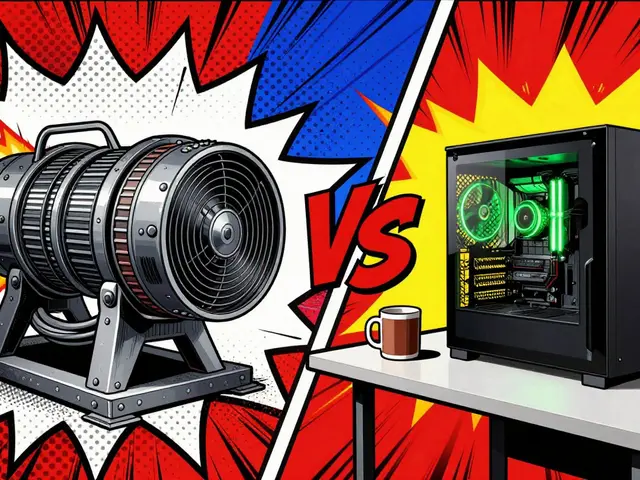
This fundamental difference drives everything else: cost, noise, heat, and profit potential. ASICs win on raw speed for their specific job. GPUs win on adaptability.
Performance and Efficiency: The Numbers Game
When we talk about mining performance, we measure it in hash rate-the number of calculations a device can perform per second. Here, ASICs leave GPUs in the dust.
Take the Bitmain Antminer S21 Hydro, a top-tier ASIC released recently. It pumps out approximately 335 Terahashes per second (TH/s) while consuming 5,360 watts of power. Compare that to a high-end consumer GPU, which might achieve 100 Megahashes per second (MH/s) on memory-intensive algorithms. That is a difference of millions in computing power. For Bitcoin mining, a GPU is effectively useless because it cannot compete with the network difficulty set by billions of dollars worth of ASIC hardware.
However, efficiency isn't just about total power; it's about efficiency per watt. ASICs are incredibly efficient at their specific task. The Antminer L11 Pro, used for Litecoin and Dogecoin, produces around 21 Gigahashes per second (GH/s) at 3,612W. While that sounds like a lot of electricity, the ratio of hashes to watts is far superior to any GPU attempting the same Scrypt algorithm.
For GPU miners, the advantage lies in memory-intensive algorithms like Ethash (used by Ethereum Classic) or KawPow (used by Ravencoin). These algorithms require large amounts of VRAM (video memory), which GPUs have in abundance. ASICs struggle here because building massive, cheap memory chips specifically for mining is expensive and complex. This keeps GPU mining viable for certain altcoins even in 2026.
| Feature | ASIC Miner | GPU Miner |
|---|---|---|
| Hash Rate | Extremely High (TH/s range) | Moderate (MH/s range) |
| Flexibility | None (Single Algorithm) | High (Multiple Algorithms) |
| Upfront Cost | $3,000 - $10,000+ | $300 - $800 per unit |
| Noise Level | Very Loud (70-80 dB) | Quiet to Moderate (30-50 dB) |
| Resale Value | Low (Rapid Obsolescence) | High (Gaming/AI Demand) |
| Ideal Use Case | Bitcoin, Litecoin, Dedicated Farms | Altcoins, Hobbyists, Diversification |
Cost Analysis: Entry Barriers and Hidden Expenses
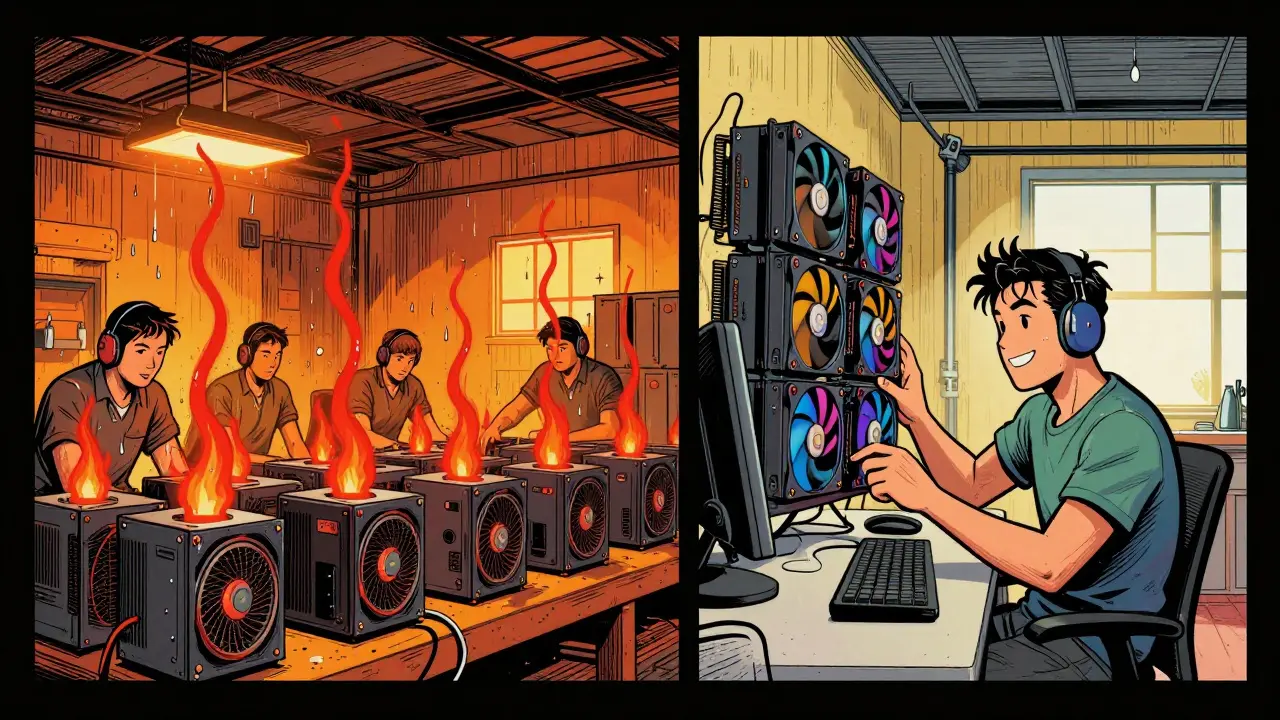
Let’s talk money. The barrier to entry for ASIC mining is steep. A single industrial-grade ASIC unit typically ranges from $3,000 to $10,000. But that’s just the hardware. You also need to factor in infrastructure. ASICs generate immense heat and noise. Running one in your living room is impossible; it sounds like a vacuum cleaner stuck in a blender. You’ll likely need a dedicated space, potentially a warehouse or a garage with serious ventilation, and possibly upgraded electrical panels to handle the load.
GPU mining is far more accessible. You can start with a single card for under $500. Many hobbyists build rigs with six to ten cards, costing between $3,000 and $6,000 total, including the case and power supply. These rigs fit in a closet or a spare room. They are quiet enough to ignore and cool enough to run with standard fans.
But don’t let the lower upfront cost fool you. Electricity is the silent killer of mining profits. In 2026, average residential electricity rates in many Western countries remain high. If you pay more than $0.10 per kWh, your margins shrink rapidly. ASICs consume more total power, but if you have access to cheap industrial electricity (under $0.05/kWh), their efficiency makes them profitable. GPU miners often rely on residential power, making them sensitive to rate hikes.
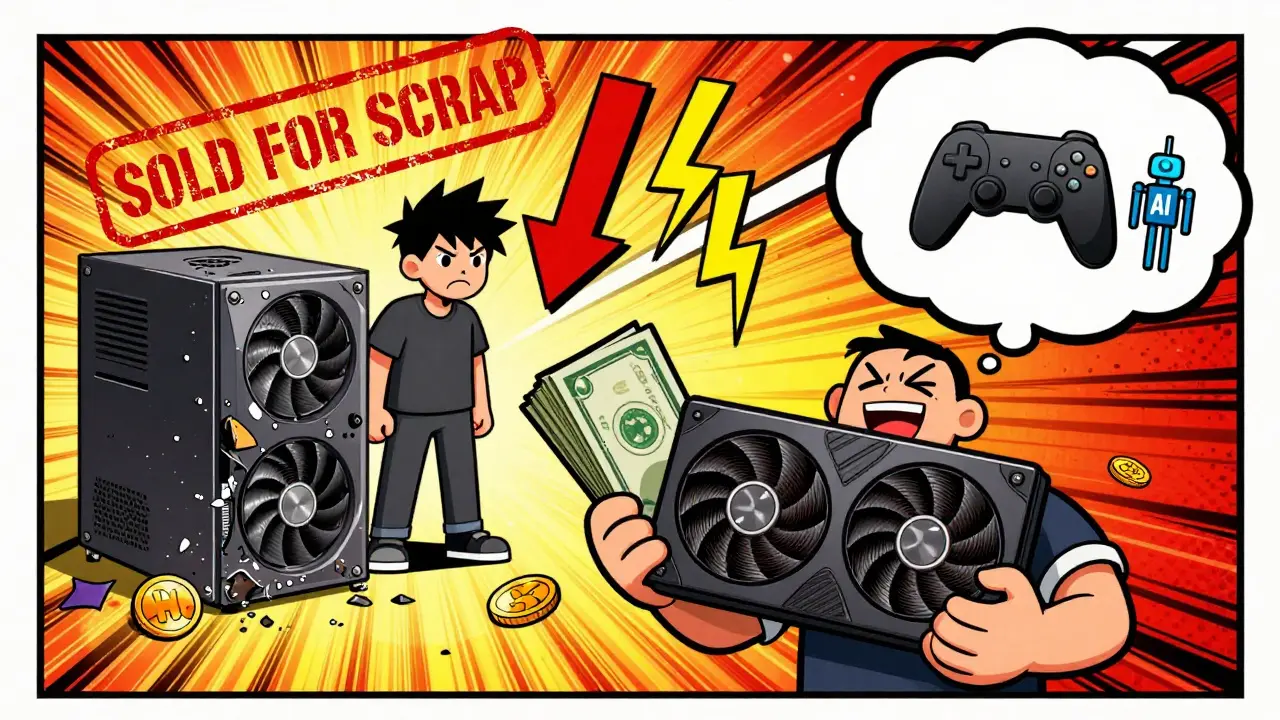
Consider the resale value too. This is a critical financial safety net. If GPU mining becomes unprofitable tomorrow, you can sell your cards to gamers or AI researchers. The demand for GPUs in artificial intelligence training keeps their secondary market strong. ASICs? Once a newer model comes out, your old ASIC loses most of its value. It’s a depreciating asset with no alternative use.
Profitability and Risk: What Actually Makes Money?
Profitability depends on three variables: coin price, network difficulty, and electricity cost. ASIC miners dominate the first two for major coins like Bitcoin. Because they produce so many hashes, they capture a larger share of the block rewards. However, this concentration increases risk. If Bitcoin’s price drops or the network difficulty spikes, your ASIC’s revenue falls immediately. You have no way to pivot.
GPU miners face a different risk profile. Since they mine smaller altcoins, they are exposed to higher volatility in those specific markets. However, they have an escape hatch. If the price of Ethereum Classic crashes, you can switch your GPU rig to mine Ravencoin, Ergo, or whatever is currently profitable. This flexibility allows GPU miners to chase yields, mitigating some downside risk.
Industry experts note that ASIC mining is a volume game. It requires scale to be truly profitable due to fixed costs and maintenance. For individual investors, the ROI (Return on Investment) period for an ASIC can stretch to 12-18 months if electricity isn’t cheap. GPU mining can break even faster, sometimes in 3-6 months, especially if you bought hardware during a dip or have free solar power.
Also, consider the "halving" events. Bitcoin’s halving reduces rewards by half every four years. After each halving, less efficient ASICs die off. In 2024 and 2026, we’ve seen waves of older ASICs becoming obsolete overnight. GPU mining doesn’t face sudden death spirals as dramatically because the altcoin ecosystem is fragmented and diverse.
Setup and Maintenance: The Practical Reality
Setting up a GPU rig is a DIY project. You buy parts, assemble them in a frame, install Windows or Linux, and flash mining software like HiveOS or NiceHash. There’s a learning curve, but thousands of YouTube tutorials guide you through driver updates and overclocking. Overclocking GPUs can boost performance by 10-20% without breaking the hardware, provided you manage temperatures well.
ASIC setup is simpler in software terms-you usually just connect to Wi-Fi and enter pool details-but physically, it’s heavier lifting. You need to manage cable management for high-amperage power supplies, ensure adequate airflow to prevent overheating, and deal with constant fan noise. Maintenance involves cleaning dust filters regularly and monitoring for failing fans. If an ASIC fan dies, the chip overheats and shuts down within minutes. GPU fans are easier to replace and quieter.
Support differs too. GPU manufacturers like NVIDIA and AMD provide drivers for gaming and professional workloads, meaning broad community support. ASIC manufacturers like Bitmain or MicroBT offer limited customer service. If your ASIC breaks after warranty, you’re often on your own, requiring specialized repair skills that few people possess.
Which One Should You Choose in 2026?
Your decision should hinge on your goals and resources.
Choose ASIC mining if:
- You have access to very cheap electricity (under $0.06/kWh).
- You want to mine Bitcoin or Litecoin specifically.
- You have a dedicated, ventilated space away from living areas.
- You are comfortable with a longer ROI period and higher initial capital.
- You plan to operate at scale (multiple units).
Choose GPU mining if:
- You are a beginner or hobbyist testing the waters.
- You want flexibility to switch coins based on market trends.
- You need quiet operation in a home environment.
- You want hardware with residual resale value for gaming or AI.
- You have moderate electricity costs but want to diversify risk.
In 2026, the trend is clear: ASICs are for professionals and farms chasing maximum efficiency on established chains. GPUs are for enthusiasts, diversifiers, and those betting on the broader altcoin ecosystem. Neither is inherently "better," but one will likely be worse for your specific situation. Know your numbers, check your local electricity rates, and never invest money you can’t afford to lose.
Is ASIC mining still profitable in 2026?
Yes, but only for those with access to cheap electricity (typically below $0.06 per kWh). With rising network difficulty, inefficient older models are no longer profitable. Newer models like the Antminer S21 series remain viable for large-scale operations, but small-scale home users often struggle to cover electricity costs.
Can I mine Bitcoin with a GPU?
Technically yes, but practically no. The hash rate required to mine Bitcoin competitively is in the terahash range. GPUs operate in megahashes. You would spend more on electricity than you would earn in rewards, even if you ran thousands of GPUs. ASICs are mandatory for Bitcoin mining.
What is the best GPU for mining in 2026?
The best GPU depends on the algorithm. For memory-intensive coins like Ethereum Classic, cards with high VRAM bandwidth like the NVIDIA RTX 4090 or previous-gen RTX 3080/3090 are popular. For efficiency, the RTX 40-series offers better hashes-per-watt. Always calculate ROI based on current coin prices and your electricity rate.
How loud are ASIC miners compared to GPUs?
ASIC miners are extremely loud, often registering 70-80 decibels, similar to a lawnmower or vacuum cleaner. They cannot be used in living spaces. GPU rigs are much quieter, typically 30-50 decibels, comparable to a normal conversation or background office noise, making them suitable for home use.
Do ASICs become obsolete quickly?
Yes. ASIC technology advances rapidly. Every 12-18 months, new models with significantly higher efficiency are released. Older ASICs lose profitability as network difficulty rises and cheaper energy consumption becomes the standard. GPUs retain value longer due to their versatility in gaming and AI applications.
JEVON HALL
June 8, 2026 AT 02:30Look, I've been running rigs since the GPU gold rush of '17 and let me tell you, the noise factor is real. 🤫 If you put an ASIC in your garage without serious soundproofing, your neighbors will call the cops before you mine your first satoshi. GPUs are loud too, sure, but they're manageable. The real killer isn't the noise though, it's the heat. You think a 4090 runs hot? Try cooling three Antminers in July without AC. 💸
Lee Paige
June 9, 2026 AT 19:39This entire narrative about 'flexibility' is a trap designed by Silicon Valley to keep you poor. They want you buying consumer electronics so they can track your usage patterns while you waste electricity on worthless altcoins. ASICs are centralized tools for the elite, yes, but at least Bitcoin is sovereign money. These 'altcoins' mined on GPUs are just casino chips issued by tech oligarchs who hate freedom. Wake up.
Caitlin Donahue
June 11, 2026 AT 10:32i mean... if u have cheap power like under 5 cents then yeah go ahead but most of us dont. i tried mining with my old 3080 and after paying electric bill i lost money lol. maybe its better to just buy btc directly instead of trying to be clever with hardware?
Karthikeyan S
June 13, 2026 AT 01:08Oh look, another article pretending that retail miners have a chance 😂. Let me analyze this disaster for you. The ROI calculation ignores the depreciation curve which is vertical downwards for ASICs. You buy a S21 today, in 6 months it's e-waste because the S22 comes out with 20% more efficiency. Meanwhile, GPUs hold value because AI labs are desperate for VRAM. It’s not even close. Stop losing money on 'hobbyist' setups. 📉🔥
Dinesh Pattigilli
June 14, 2026 AT 11:25You people really think you can compete with industrial farms? Its pathetic. The hash rate concentration is higher than ever. Unless you have a warehouse in Iceland or Siberia, you are burning cash. The only reason GPU mining exists is because the altcoin devs need liquidity providers who are dumb enough to subsidize their tokenomics. Pure exploitation of the uninformed masses. 🙄
Madhu Menon
June 15, 2026 AT 13:57There is a deeper philosophical question here about the nature of value creation. When we mine with ASICs, we are participating in a singular, monolithic truth-Bitcoin. It is rigid, unyielding, and pure. GPU mining represents chaos, multiplicity, and the illusion of choice. Is flexibility truly freedom, or is it merely the anxiety of indecision manifested in silicon? Perhaps the noise of the ASIC is the sound of reality breaking through the silence of our digital delusions. 🤔
Narendra Kulkarni
June 16, 2026 AT 23:58hey guys, good point about the resale value. i sold my rig last year and got back 80% of what i paid because everyone wanted gpus for ai stuff. if i had bought asics i would be stuck with bricks. so for small players gpu is definitely safer option imo 👍
verna kennedy
June 18, 2026 AT 03:07Let’s be clear: if you cannot afford enterprise-grade cooling and dedicated 240V circuits, you do not belong in ASIC mining. This is not a hobby; it is an industrial operation. Bringing home appliances into a residential setting is negligent. Stick to your graphics cards if you must play, but stop pretending you are part of the network security backbone. You are not. You are a rounding error.
Kelly Tenney
June 19, 2026 AT 05:08I completely understand why this feels overwhelming! There is so much technical jargon and fear-mongering out there. But remember, starting small with a single GPU allows you to learn the mechanics without risking your life savings. It’s about education first, profit second. You’ve got this! Take it one step at a time and don’t let the big farms intimidate you. Your journey matters too. ✨
Caralee Robertson
June 19, 2026 AT 14:50i live in canada and our hydro rates are kinda high so im scared to even plug in my pc for long periods. does anyone know if solar panels make sense for a small rig? feels like the math never works out unless you have free power which nobody has right?
Greg Lewis
June 20, 2026 AT 13:55you think you own your data when you mine? no. the pool operators control everything. you are just a node in their surveillance grid. they see your ip they see your location they see your habits. gpu mining gives them more points of entry. asic mining centralizes the risk but also centralizes the control. neither is safe. you are all pawns in a game you dont understand
Dr Lynea LaVoy
June 20, 2026 AT 23:02As someone who analyzes energy markets, the variable here is purely electricity cost. If you are on a tiered residential plan, GPU mining might push you into a higher bracket during peak hours, wiping out any gains. ASICs require flat-rate industrial pricing to be viable. Check your utility bill structure before buying anything. Most people ignore demand charges, which are silent profit killers. Be precise with your calculations.
Matthew Malone
June 21, 2026 AT 19:36Why are we still talking about Chinese-made ASICs? It’s a national security nightmare to rely on Bitmain for our financial infrastructure. We should be supporting domestic semiconductor efforts. Until we have American-made mining hardware, I’m staying out of the ASIC game entirely. It’s either sovereignty or submission, folks. Choose wisely.
aaliyah zahid
June 23, 2026 AT 00:57In my culture, we value adaptability above all else. A tool that can do many things is respected more than one that breaks when the world changes. GPU mining aligns with this philosophy. Plus, it’s quieter, which means less stress for the household. Why fight against harmony when you can flow with the market trends? 🌿
Erik Kirana
June 23, 2026 AT 02:55This article is dangerously misleading. It fails to mention the firmware update risks associated with modern GPUs. NVIDIA is actively throttling mining performance via driver updates. You think you have flexibility? You have a leash. And ASICs? At least they do what they are told. The 'resale value' argument is weak because gamers won’t pay full price for used mining cards with degraded thermal paste and worn fans. Do your due diligence. 📉
Sylvia Mossman
June 24, 2026 AT 07:46Everyone says ASICs are for pros, but that’s just gatekeeping to keep prices high. I ran a closet farm of L7s for two years and made decent returns. Sure, it was loud, but I wore earplugs. The problem isn’t the hardware; it’s the lazy mindset of people who expect easy money. If you’re going to mine, commit fully or don’t bother. Half-measures get you eaten alive.
Alexis Abster
June 25, 2026 AT 21:44My heart races just thinking about the potential! Imagine the thrill of seeing that balance tick up every block! 🚀 Yes, there are risks, but isn’t life about taking calculated leaps? I started with one GPU and now I have ten. The community support is incredible, and the learning curve is steep but rewarding. Don’t let the naysayers dampen your spirit. The future is decentralized, and you can be part of it!
dan kaffeman
June 27, 2026 AT 06:17Stop crying about noise and heat. Real miners deal with discomfort. If you can’t handle a fan blowing in your face, you’re not cut out for this industry. ASICs are superior because they deliver results without compromise. Weaklings choose GPUs because they want comfort over profit. Grow up and buy the iron that actually moves the needle. The rest of you are just playing house. 💪
Meg Gran
June 28, 2026 AT 10:56oh wow, such a sophisticated take on 'risk'. lets pretend that switching algos is easy when the pools are congested and fees are eating your profits. plus, the environmental guilt of running a 24/7 server in your living room is real. maybe try investing in index funds instead of burning coal to mine tokens that will be worth zero in five years. sarcasm aside, the math rarely favors the retail miner anymore. 🙃
Brad Ranks
June 29, 2026 AT 11:40I bought an ASIC six months ago and it died yesterday. No warranty support, just a dead brick. Meanwhile, my friend’s GPU rig has been running flawlessly for three years. The drama of maintaining these specialized machines is insane. One loose cable and you’re down thousands in potential revenue. I’m done with the hassle. Going back to GPUs where I can actually fix things myself. What a nightmare.