
Imagine owning a piece of a skyscraper in New York, a share of a wind farm in Texas, or a fraction of a $500 million bond issued by a government - all with a single click. No paperwork. No brokers. No delays. That’s not science fiction. It’s already happening, and it’s called security token markets.
Back in 2017, security tokens were a niche experiment. Today, they’re the fastest-growing corner of blockchain finance. The market for tokenized real-world assets - like stocks, bonds, real estate, and commodities - is projected to hit $30 trillion by 2030. That’s not a typo. It’s more than the entire global stock market today. And the shift isn’t coming. It’s already here.
What Exactly Are Security Tokens?
Security tokens are digital versions of traditional financial assets. Think of them as stocks or bonds, but built on blockchain. Instead of paper certificates or backend databases controlled by banks, these assets exist as programmable tokens on public ledgers. Each token represents ownership, dividends, voting rights, or interest payments - just like traditional securities - but with far more flexibility.
Unlike cryptocurrencies like Bitcoin or Ethereum, which are designed as currencies or platforms, security tokens are regulated. They’re legally recognized as securities. That means they must comply with rules set by agencies like the U.S. Securities and Exchange Commission (SEC). This isn’t a loophole. It’s a feature. Regulation brings legitimacy, which brings institutions - and institutional money is what’s driving this boom.
Why Now? The Perfect Storm
Three things are pushing security tokens from fringe to mainstream: regulation, technology, and institutional adoption.
First, regulation. The SEC’s clear stance - that many digital assets are securities - created a legal pathway. No more guessing. No more ICO chaos. Companies now know exactly what they need to do: register, disclose, and comply. That’s turned tokenization from a risky gamble into a structured investment.
Second, blockchain tech got smarter. Interoperability protocols now let tokens move between networks. Smart contracts automatically pay dividends, enforce lock-up periods, or restrict transfers to verified investors. You don’t need a lawyer to transfer a share anymore - a code snippet does it in seconds.
Third, Wall Street showed up. BlackRock launched on-chain liquidity funds. Franklin Templeton tokenized its bond funds. These aren’t side projects. They’re core strategic moves. In 2024, 69.8% of all capital in security token markets came from institutions - hedge funds, asset managers, pension funds. Retail investors? They’re still on the sidelines. This isn’t a crypto craze. It’s finance 2.0.
Real Estate Leads, Commodities Explode
Right now, real estate dominates the tokenized asset space. In 2024, it made up over 30% of all tokenized holdings. Why? Because property is illiquid. Selling a building takes months. Tokenizing it turns one asset into 10,000 tradable pieces. A small investor in Tokyo can now own 0.01% of a London office tower. That’s impossible in the old system.
But the fastest-growing segment? Commodities. Oil, gold, copper - they’re booming. With a 50.10% CAGR, commodity tokens are outpacing everything else. Why? Because global supply chains are messy. Tokenization brings transparency. A farmer in Brazil can sell next season’s coffee harvest as a token. A manufacturer in Germany can lock in copper prices months in advance. No middlemen. No delays. No fraud.
And it’s not just big assets. Even fine art, rare wines, and private equity stakes are being tokenized. The barrier to entry is collapsing. You don’t need $1 million to invest in a private fund anymore. You need $50.

North America Leads, Asia Pacific Rises
North America holds 36.45% of the market today - mostly because of the U.S. regulatory framework. The SEC’s clarity has made it the safest jurisdiction for STOs (Security Token Offerings). Companies know they can raise capital without fear of being shut down.
But the real story is Asia Pacific. It’s projected to grow faster than any other region. India’s Reserve Bank allows tokenization of RuPay cards. Singapore and Hong Kong are building regulatory sandboxes. China is quietly testing tokenized bonds. This isn’t about crypto hype. It’s about modernizing financial infrastructure.
The Middle East and Africa? They’re the dark horse. With a projected 27.52% CAGR, they’re leapfrogging legacy systems. Countries like Saudi Arabia and the UAE are using tokenization to attract global capital without relying on Western banks.
Permissionless Blockchains Win
You might think institutions would prefer private, permissioned blockchains - controlled, secure, and closed. But the data says otherwise. Over 53% of growth is happening on permissionless networks like Ethereum, Polygon, and Solana. Why?
Because liquidity matters more than control. A token on a private chain can only be traded among a few approved investors. A token on Ethereum can be bought by anyone, anywhere, 24/7. That global access means higher prices, faster trades, and deeper markets.
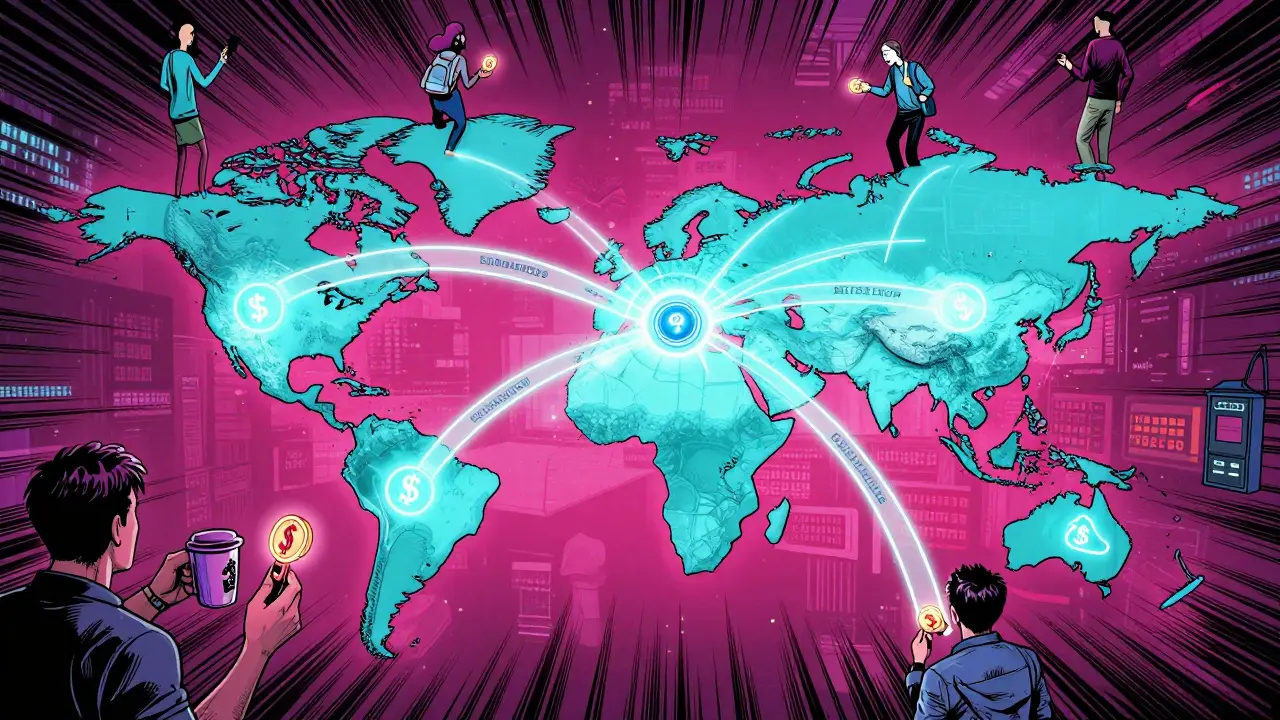
Plus, interoperability tools like LayerZero and Chainlink CCIP let tokens move between chains. You can issue a token on Ethereum and trade it on Solana without moving it. That’s the future: open, connected, and borderless.
The Retail and E-Commerce Angle
Most people think security tokens are for billionaires. But the biggest surprise? Retail and e-commerce.
Imagine buying a pair of sneakers from Nike. Instead of just owning the shoes, you own a token that gives you 1% of future resale profits. Or buying a coffee from Starbucks - and getting a token that earns you dividends from their global expansion. This isn’t theory. Companies are already testing it.
Tokenization turns customers into stakeholders. A loyal buyer isn’t just a user - they’re a partial owner. That changes loyalty forever. And with e-commerce projected to grow at 22.73% CAGR through 2030, this could be the next big wave.
Challenges? Yes. But They’re Solvable
It’s not all smooth sailing. Regulatory complexity varies wildly. A token issued in the U.S. can’t be sold to someone in Brazil without compliance checks. Cross-border tax rules are a mess. Smart contracts can have bugs. And not every asset class is ready for tokenization.
But these aren’t dead ends - they’re engineering problems. Legal tech firms are building automated compliance tools. Auditing platforms now verify ownership in real time. Custodians like Anchorage and BitGo offer institutional-grade storage. The tools are here. The question is: who will build on them?
What Does 2030 Look Like?
By 2030, the $30 trillion market won’t be a curiosity. It’ll be the norm.
Private equity funds? Tokenized. Venture capital deals? Tokenized. Sovereign debt? Tokenized. Even your pension fund might hold tokenized infrastructure bonds.
Traditional exchanges will become relics. Trading won’t happen on NYSE or NASDAQ - it’ll happen on decentralized platforms with 24/7 liquidity. Settlements won’t take two days. They’ll happen in seconds.
The winners? Not the biggest banks. The ones who build bridges - between blockchains, between regulators, between investors and assets. The ones who make ownership simple, global, and programmable.
This isn’t about replacing finance. It’s about upgrading it. Faster. Fairer. More open.


Charrie VanVleet
February 18, 2026 AT 07:20Scott McCrossan
February 18, 2026 AT 16:22Nikki Howard
February 20, 2026 AT 10:00Sasha Wynnters
February 21, 2026 AT 18:00Ruby Ababio-Fernandez
February 22, 2026 AT 08:25Jenn Estes
February 23, 2026 AT 03:52Angela Henderson
February 24, 2026 AT 17:18Geet Kulkarni
February 25, 2026 AT 11:11Paul David Rillorta
February 25, 2026 AT 20:16andy donnachie
February 26, 2026 AT 06:06Lauren Brookes
February 27, 2026 AT 10:38Chris Thomas
February 28, 2026 AT 09:32James Breithaupt
March 1, 2026 AT 11:16Sarah Shergold
March 1, 2026 AT 17:15Andrew Edmark
March 1, 2026 AT 20:40Dominica Anderson
March 2, 2026 AT 10:08sruthi magesh
March 2, 2026 AT 10:50Lisa Parker
March 4, 2026 AT 03:36Nova Meristiana
March 5, 2026 AT 03:22Aileen Rothstein
March 6, 2026 AT 13:18JJ White
March 6, 2026 AT 15:45Nicole Stewart
March 8, 2026 AT 13:09Alan Enfield
March 8, 2026 AT 13:49Jennifer Riddalls
March 10, 2026 AT 10:18Kyle Tully
March 10, 2026 AT 23:41kieron reid
March 11, 2026 AT 21:27Charrie VanVleet
March 13, 2026 AT 14:18Chris Thomas
March 15, 2026 AT 00:14