
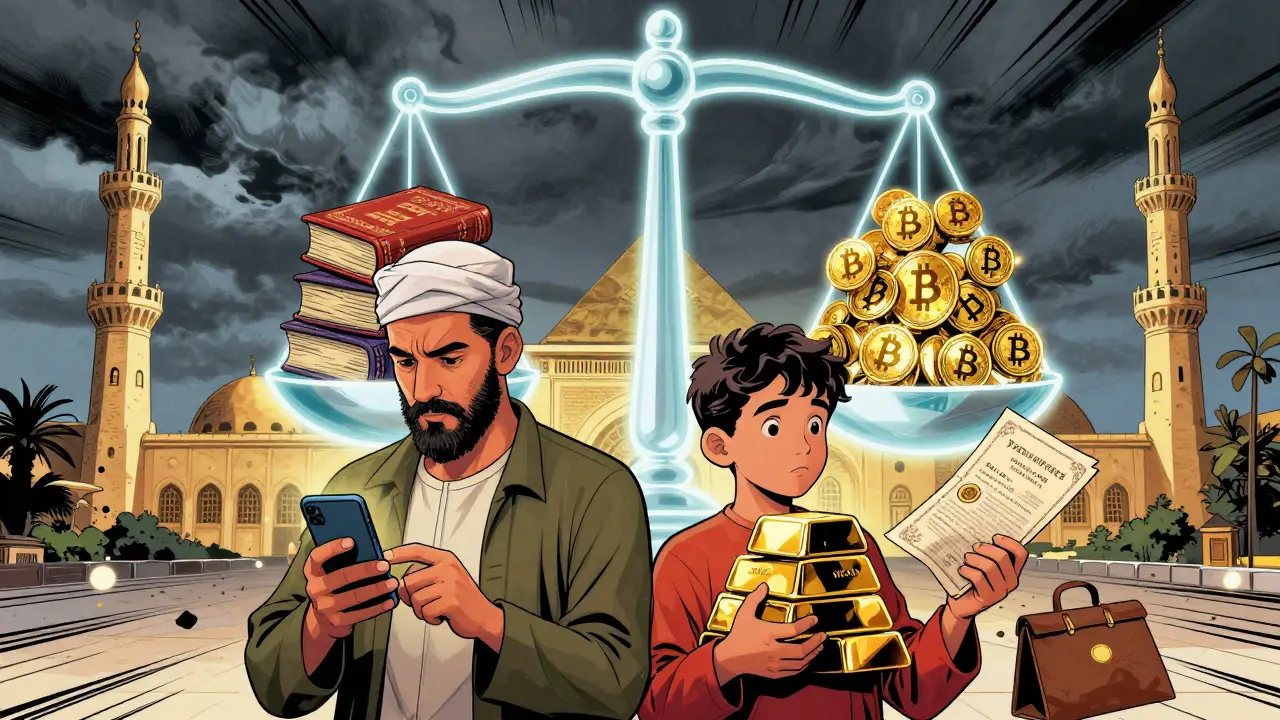
When Egypt’s Grand Mufti, Dr. Shawky Ibrahim Allam, issued a fatwa in December 2017, he didn’t just make a religious statement-he shut the door on cryptocurrency for millions of Muslims. The ruling was simple, direct, and absolute: Bitcoin and all forms of digital currency are haram, or religiously forbidden, under Islamic law. No exceptions. No gray areas. No future loopholes. Just a firm "no." This wasn’t some fringe opinion. It came from Dar al-Ifta, the official Islamic legal body tied to al-Azhar University-one of the most respected institutions in Sunni Islam. For over 130 years, Dar al-Ifta has advised Egypt’s courts and government on religious matters. When it speaks, people listen. And in 2017, it spoke loudly against crypto. So why? What made Bitcoin so dangerous in the eyes of Islamic scholars? The fatwa didn’t just say "crypto is bad." It laid out clear, technical reasons rooted in Sharia principles. First, Bitcoin has no physical form. It’s not backed by gold, not issued by a government, and not controlled by any central authority. In Islamic finance, money must have clear ownership, value, and regulation. Bitcoin, the ruling said, is "an entire electronic currency that is exchanged via Internet only," with no tangible presence or legal recognition. That alone made it invalid as money. Then came the bigger issue: uncertainty. Sharia law demands transparency in contracts. Every transaction must be clear, known, and free from deception. But Bitcoin’s price swings wildly. One day it’s $15,000. The next, $8,000. No one can predict it. No one can guarantee it. That’s called gharar-excessive risk or ambiguity-and it’s strictly forbidden in Islamic contracts. Buying Bitcoin, according to the fatwa, is like gambling without knowing the rules. But the most shocking part of the ruling wasn’t about finance-it was about crime. The fatwa explicitly linked Bitcoin to terrorist financing. It named ISIS, drug cartels, and money launderers as users of the technology. "Bitcoin is used to evade security authorities," the document stated. "It enables illegal purposes and weakens central financial systems." This wasn’t just theology. It was security policy dressed in religious language. In 2017, global media was full of headlines about Bitcoin being used on the dark web. The Egyptian government, already wary of extremist threats, saw crypto as a threat to national stability. And since Dar al-Ifta advises Egypt’s judiciary, this fatwa wasn’t just spiritual-it had legal weight. Compare this to other Islamic scholars. In Malaysia, Mufti Faraz Adam argues that crypto can be halal if it’s used as a real digital asset. He says, "Classical scholars would look at the after-effect of a thing and base its ruling on that." In other words, if Bitcoin works as money-people accept it, it transfers value, it’s scarce-then it should be treated like money. He even says Muslims should pay zakat on their crypto holdings, treating them like cash. But Egypt? No. The fatwa says you can’t buy it, sell it, mine it, or even sign up for a crypto exchange. Period. The practical impact? Huge. In Egypt, banks and financial institutions avoid crypto entirely. Apps like Binance and Coinbase aren’t banned by law-but they’re culturally blocked. Muslim investors who follow Dar al-Ifta’s guidance avoid crypto completely. Some even leave Egypt to trade, using offshore accounts. Others stick to gold or real estate, the traditional "halal" stores of value. But here’s the twist: the world moved on. In 2026, Bitcoin is no longer just a wild digital experiment. Major banks now offer crypto custody. Countries like El Salvador have made it legal tender. The U.S., EU, and even Saudi Arabia have built regulatory frameworks. Central bank digital currencies (CBDCs) are being tested everywhere. But Egypt’s fatwa hasn’t changed. Why? Because the ruling wasn’t about technology. It was about control. The Grand Mufti didn’t say, "Bitcoin is unstable." He said, "There is no authority behind it." That’s the core. Islamic finance requires oversight. A central body that can verify ownership, settle disputes, and enforce contracts. Bitcoin’s entire design removes that. And in Egypt’s view, that’s not innovation-it’s chaos. Some scholars criticize the fatwa for ignoring maslahah (public interest) and urf (custom). They argue that if millions of people use Bitcoin as money, shouldn’t Islamic law adapt? But Dar al-Ifta’s answer is clear: adaptation without regulation is dangerous. For Muslims in Nigeria, Indonesia, or Pakistan, this fatwa is a reference point. Many follow it because al-Azhar’s authority is trusted. Others ignore it because they follow different scholars. The result? A deep split in the Muslim world. One group says: "Crypto is haram-full stop." The other says: "Wait. Let’s study it. Maybe it can be made halal." And right now, the Egyptian position holds more weight because it’s official, centralized, and backed by state power. So what does this mean for you? If you’re a Muslim investor in Egypt or a country that follows its religious leadership, you’re legally and spiritually barred from crypto. Even if you believe in blockchain, you can’t touch Bitcoin, Ethereum, or any altcoin. You can’t use it to pay for goods. You can’t mine it. You can’t even hold it as an investment. But if you live in Turkey, Malaysia, or the UAE-where scholars take a more flexible view-you might be able to use crypto, as long as you avoid coins tied to gambling, interest, or unethical businesses. There’s no middle ground in Egypt. And that’s the real story. This isn’t about Bitcoin’s technology. It’s about who gets to decide what’s valuable. Is it the market? The users? Or a religious authority with centuries of tradition? In Egypt, the answer is clear: the authority. And for now, that means no crypto.
What exactly does the fatwa forbid?
The Egyptian fatwa doesn’t leave room for interpretation. It bans:
- Buying or selling Bitcoin and any other cryptocurrency
- Using crypto to pay for goods or services
- Mining Bitcoin or other digital coins
- Investing in crypto exchanges or funds
- Participating in Initial Coin Offerings (ICOs)
- Leasing or lending crypto assets
- Subscribing to any platform that facilitates crypto transactions
Even holding Bitcoin as a "store of value" is considered impermissible. The fatwa treats it as a speculative instrument, not a valid asset.
How does this compare to other Islamic rulings?
| Authority | Position | Key Reasoning | Can Crypto Be Halal? |
|---|---|---|---|
| Egypt (Dar al-Ifta) | Haram | No central authority, high uncertainty (gharar), linked to illegal activity | No |
| Malaysia (Mufti Faraz Adam) | Potentially Halal | Functions as digital money; use and utility matter more than form | Yes, if screened for Sharia compliance |
| Syria (Islamic Council) | Haram | Similar to Egypt-lack of regulation and excessive risk | No |
| Indonesia (MUI) | Haram | Too volatile, resembles gambling (qimar) | No |
| Saudi Arabia (General Authority) | Unclear, under review | Monitoring CBDCs and regulated exchanges | Possibly, with oversight |
Why hasn’t Egypt updated its stance?
Even though Bitcoin has evolved since 2017-regulated exchanges exist, institutional investors are involved, and governments are creating digital currencies-Egypt hasn’t revisited the fatwa. Why? Because the core issue hasn’t changed: control. Islamic finance isn’t just about ethics-it’s about structure. Sharia law requires clear ownership, accountability, and dispute resolution. Bitcoin’s decentralized nature removes all of that. Even if a coin is stable, if no one can be held responsible for its value, it’s still problematic. Also, Egypt’s political environment hasn’t shifted. The government still sees unregulated digital money as a threat to financial sovereignty. And since Dar al-Ifta works closely with the state, its rulings reflect national priorities.

What should Muslims do today?
If you follow Egypt’s fatwa: avoid all crypto. Don’t trade. Don’t hold. Don’t even research it. It’s not worth the religious risk. If you follow other scholars: look for coins that meet Sharia standards. Avoid coins tied to gambling, alcohol, or interest-based systems. Pay zakat on your holdings. And never invest more than you can afford to lose. But here’s the truth: there’s no universal answer. The Muslim world is divided. And that division isn’t going away.
Is Bitcoin haram in all Muslim countries?
No. While Egypt, Syria, and Indonesia have declared Bitcoin haram, countries like Malaysia, Turkey, and the UAE allow it under certain conditions. Some scholars say crypto can be halal if it’s used as a legitimate digital asset and not for speculation or illegal purposes. The ruling depends on which Islamic authority you follow.
Can I still use crypto if I don’t live in Egypt?
Yes, if your local Islamic scholars permit it. Many Muslims outside Egypt trade crypto while paying zakat and avoiding high-risk coins. But if you follow the Egyptian fatwa, you’re expected to avoid it regardless of where you live. Religious rulings often travel with the believer, not the border.
Does the fatwa apply to Ethereum and other cryptocurrencies too?
Yes. The Egyptian fatwa doesn’t mention Bitcoin by name alone-it bans "any and all uses of cryptocurrency." That includes Ethereum, Solana, Dogecoin, and any other digital asset. The ruling is broad because it targets the system, not just one coin.
Can I mine Bitcoin if I’m a Muslim?
No. Mining is considered an active form of participation in cryptocurrency, which the fatwa explicitly prohibits. Even if you’re not selling the coins, the act of mining is seen as supporting an impermissible system. This applies to all forms of crypto mining.
Why did Egypt focus on ISIS and crime in the fatwa?
In 2017, Bitcoin was frequently linked to dark web markets and terrorist financing in global media. Egypt, facing real security threats, used this context to justify the ban. The fatwa wasn’t just about theology-it was a security statement. By tying crypto to extremism, the ruling gained political and public support.
What’s next for crypto and Islamic law?
The debate isn’t over. More scholars are asking: "What if crypto becomes regulated? What if a central bank issues a digital currency that meets Sharia standards?" Some believe that’s the future. Others say the damage is done. The Egyptian fatwa set a precedent that’s hard to undo. For now, if you’re a Muslim and you care about following religious law, you have to choose: do you follow the strict, official ruling? Or do you follow the scholars who say, "Let’s wait and see?" There’s no right answer. But there is one fact: in Egypt, crypto is still haram. And until that changes, it stays banned.
Bruce Doucette
March 16, 2026 AT 22:33Marie Vernon
March 18, 2026 AT 17:07rajan gupta
March 20, 2026 AT 00:03Billy Karna
March 21, 2026 AT 10:48Arlene Miles
March 23, 2026 AT 00:38Jessica Beadle
March 23, 2026 AT 09:46Brenda White
March 24, 2026 AT 19:42Elizabeth Kurtz
March 25, 2026 AT 16:22john peter
March 26, 2026 AT 06:31Marc Morgan
March 27, 2026 AT 15:59Anastasia Thyroff
March 28, 2026 AT 16:16Kira Dreamland
March 30, 2026 AT 04:38shreya gupta
March 31, 2026 AT 22:05Christopher Hoar
April 2, 2026 AT 16:07Robert Kunze
April 3, 2026 AT 22:53Sarah Zakareckis
April 5, 2026 AT 07:56Heather James
April 5, 2026 AT 10:54Ann Liu
April 6, 2026 AT 14:26Dionne van Diepenbeek
April 8, 2026 AT 05:06Graham Smith
April 9, 2026 AT 23:52Gene Inoue
April 10, 2026 AT 15:39Ricky Fairlamb
April 10, 2026 AT 23:43Lauren J. Walter
April 11, 2026 AT 08:14