
Back in October 2021, the blockchain gaming world was buzzing. Binance Smart Chain (BSC) hosted its third GameFi Expo - a seven-day event that brought together three major blockchain games: Dragonary, Mobox, and DSG Metaverse. Among them, Dragonary, developed by Coinary, offered a $20,000 worth of CYT tokens to participants. This wasn’t just another airdrop. It was part of a larger push to bring casual gamers into the blockchain space without forcing them to understand wallets or gas fees. But what did it actually take to get those tokens? And what happened after the event ended?
What Was the Dragonary Airdrop?
The Dragonary airdrop was tied directly to the BSC GameFi Expo III, which ran from October 23 to October 30, 2021. Coinary Token (CYT) was the native BEP-20 token of Dragonary, a free-to-play RPG where players collect, breed, and battle dragons. The game was designed to be playable by anyone - whether they knew what a blockchain was or not. But for those who did, the CYT token unlocked deeper gameplay: staking, trading items, and earning rewards from in-game actions.The airdrop promised up to 500,000 CYT tokens per user, depending on how much they engaged. To qualify, you had to:
- Follow Dragonary’s official Twitter account
- Like and retweet the airdrop announcement post
- Tag three friends in the comments
- Watch the 15-minute Dragonary showcase livestream on October 25 at 12:00 UTC
- Complete a short quiz about Dragonary’s gameplay and tokenomics
- Connect a Binance Smart Chain-compatible wallet (like MetaMask)
It wasn’t hard, but it was busy. You had to do all of this within a single week. If you missed one step, you got nothing. And unlike some projects that let you claim tokens over months, this window closed fast.
How the CYT Token Was Built
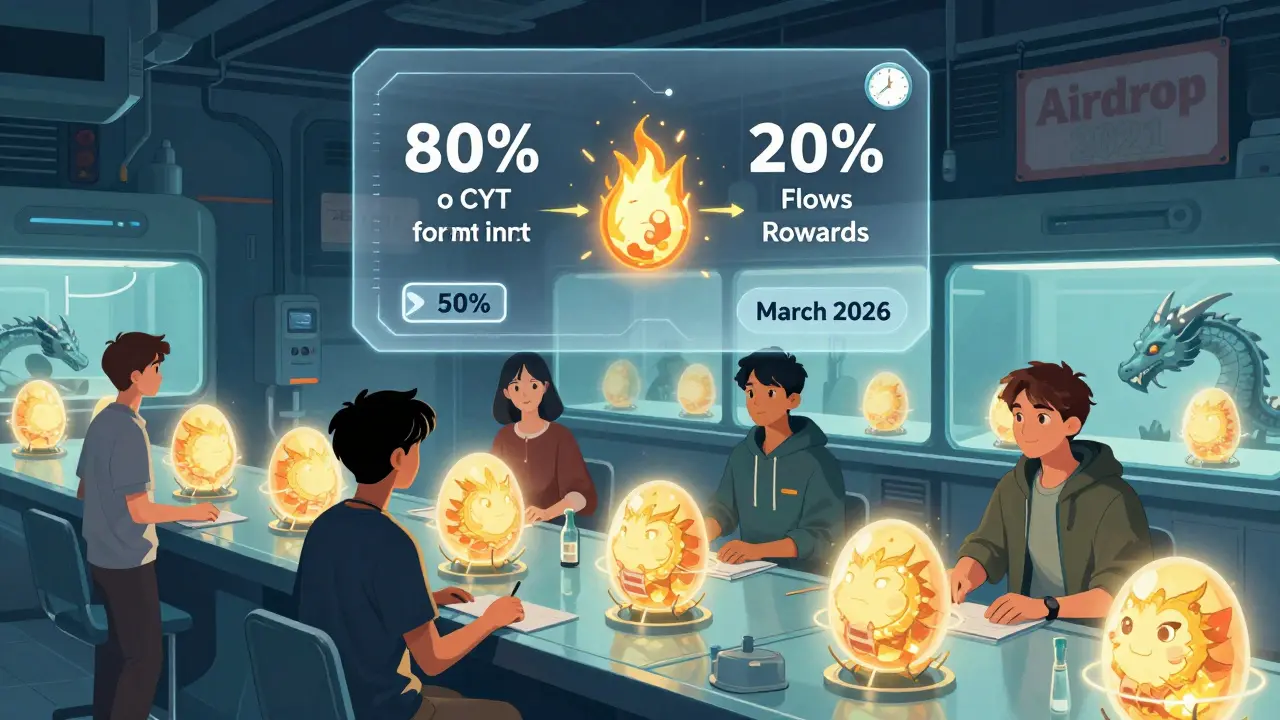
The CYT token wasn’t just thrown out as a marketing gimmick. Its design was intentional. With a total supply of 1 billion tokens, 74.9% was reserved for in-game mining - meaning players earned it by playing, not just by signing up. Another 16% went to investors, 5% to the development team (locked for 10 years), and 4.1% - about 41 million tokens - was set aside for community airdrops like this one.What made CYT different was its deflationary model. Up to 80% of every in-game purchase, breeding fee, or item fusion cost was burned. That meant the total supply of CYT slowly shrank over time. The remaining 20% was distributed back to players as rewards. This wasn’t just theory - it was built into the smart contract. Most GameFi tokens at the time had no burn mechanism, making CYT’s approach unusually thoughtful.
Why This Airdrop Mattered
In late 2021, GameFi was exploding. DappRadar reported a 2,000% year-over-year increase in users. BSC had over 100 million unique addresses and was the second-largest blockchain ecosystem after Ethereum. But most blockchain games were still too complicated for regular gamers. Dragonary’s big move was offering a full RPG experience - with PVE battles, dragon breeding, and PVP arenas - without requiring users to touch crypto at all. Crypto users could connect their wallets to earn CYT. Non-crypto users could just play.This hybrid model was rare. Projects like Axie Infinity forced players into wallets from day one. Dragonary didn’t. That’s why it stood out. It didn’t try to convert everyone. It let people discover blockchain on their own terms.
What Went Wrong?
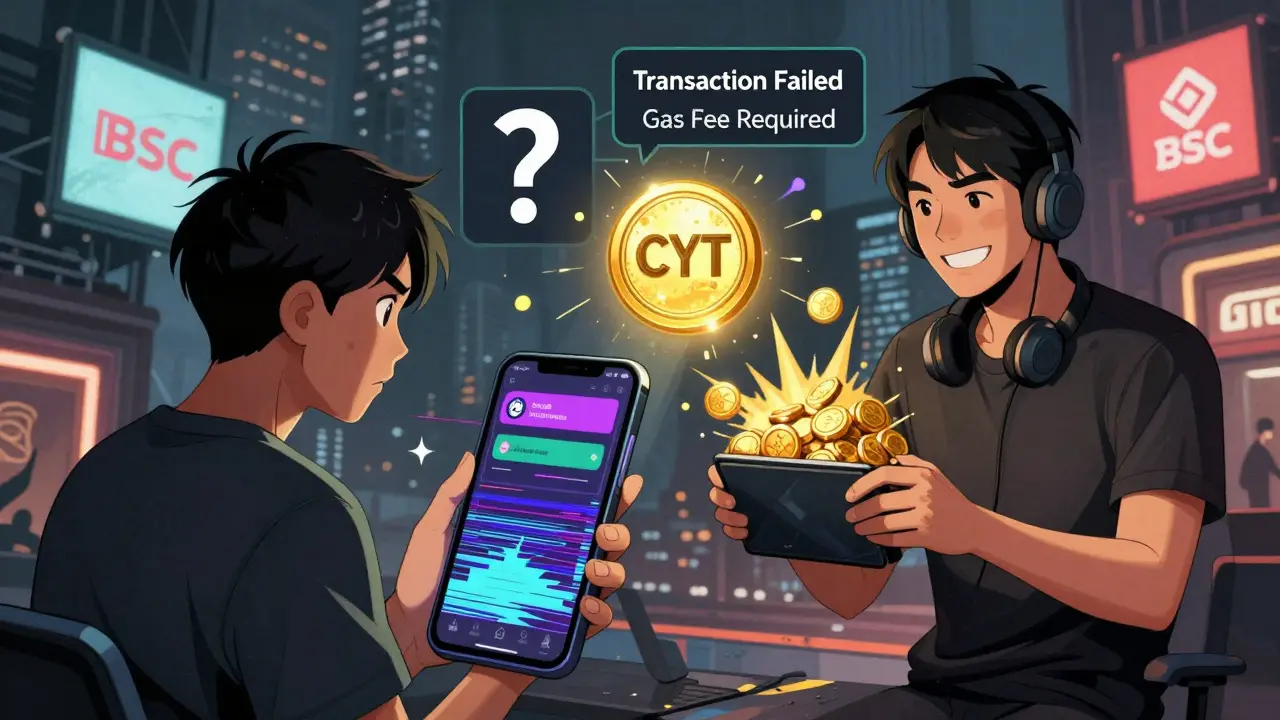
Despite the smart design, the airdrop had serious issues.First, the wallet connection process was buggy. Many users reported “transaction failed” errors when trying to claim their tokens. MetaMask often wouldn’t connect to the BSC network unless manually configured. Gas fees were supposed to be free, but sometimes users still needed $1-2 in BNB to complete the transaction. If they didn’t have it, they got locked out.
Second, the quiz was too vague. Some questions asked about token distribution percentages - things most players wouldn’t know unless they’d read the whitepaper. That turned the airdrop into a test of research skills, not gameplay interest.
Third, liquidity was non-existent. When tokens were distributed, there was nowhere to trade them. The 24-hour trading volume on CoinGecko hovered around $461. That meant even if you got 250,000 CYT, you couldn’t sell it. The price crashed 32% in the 48 hours after the airdrop ended. Many early claimers dumped their tokens immediately, dragging the price down further.
What Did Users Say?
Reddit user u/BlockchainGamer89 wrote: “Claimed 250k CYT after watching the livestream and finishing the quiz. Took 15 minutes. Easy.”But on Twitter, @CryptoNewbie2021 complained: “Tried 5 times to connect wallet. Kept getting ‘transaction failed.’ Felt like a scam.”
Trustpilot reviews for Coinary’s platform showed 3.7/5 stars. Positive reviews praised the simple mobile gameplay. Negative ones almost all mentioned wallet issues. 82% of unhappy users cited connection failures.
YouTube tutorials, like CryptoWithChris’s video, became essential guides. They showed exactly how to set up MetaMask for BSC, where to find the airdrop page on CoinMarketCap, and how to bypass the quiz errors. Without those videos, many users would’ve given up.
How It Compared to Other Airdrops
The Dragonary airdrop was mid-tier in value. Axie Infinity’s September 2021 scholarship program gave out $100,000. Gala Games dropped $1 million. But most indie GameFi projects gave under $5,000. So $20,000 was decent.But time mattered more than money. Dragonary’s window was seven days. Splinterlands ran airdrops for six months. That gave people time to learn, test, and fix mistakes. Dragonary didn’t. It was a sprint, not a marathon.
And the expo format itself was smart. BSC used these events to educate users. Daily livestreams featured BSC’s own team explaining blockchain gaming. That built trust. Most airdrops just drop tokens and vanish. Dragonary gave context.
What Happened After?
The hype faded fast. By November 2021, CYT’s price peaked at $0.0021. By December, it was down to $0.0008. As of March 2026, it trades around $0.00093 - still far below its peak.But Dragonary didn’t disappear. The team kept building. They added new dragon types, expanded the PVP arena, and integrated with other Coinary multiverse games. They held smaller airdrops too - like a 5 million CYT giveaway in Q1 2023. They never stopped.
And the tokenomics? Still working. The burn mechanism continues. Every time someone breeds a dragon or fuses gear, 80% of the CYT used disappears. That slow, steady reduction keeps supply tight.
Today, Dragonary still has players. Not millions, but thousands. And those who stuck around? They’re the ones who learned the game first, not the airdrop.
Lessons Learned
The Dragonary airdrop taught us a few things:- Airdrops can’t replace real gameplay. If the game isn’t fun, tokens won’t matter.
- Wallet complexity kills adoption. If users can’t claim their tokens, they’ll walk away.
- Tokenomics matter more than marketing. A burn mechanism with long-term vesting builds trust.
- Expos like BSC GameFi Expo III were ahead of their time. They combined education, community, and rewards - not just a drop-and-run strategy.
Most GameFi projects from 2021 are gone. Dragonary isn’t. Not because of the airdrop. But because it focused on the game first - and the token second.
anshika garg
March 15, 2026 AT 03:15Okay, but let’s be real-Dragonary didn’t need to force anyone into wallets. That was the whole beauty of it. I remember watching that livestream on my phone during lunch, no wallet, no gas fees, just dragons breathing fire on a 3G connection. It felt like playing a game, not doing homework. The burn mechanism? Genius. Not because it was flashy, but because it whispered, ‘We’re in this for the long game.’ Most projects scream. Dragonary just… existed. And somehow, that made it last.
Bruce Doucette
March 16, 2026 AT 21:04LMAO so you’re telling me this ‘revolutionary’ game just… didn’t work? 😂 Bro, they gave away free tokens and people still couldn’t connect a wallet? That’s like handing someone a Ferrari and yelling ‘GO!’ while the keys are in the ignition… and they forgot how to turn the key. This wasn’t blockchain innovation-it was a stress test for human incompetence.
Marie Vernon
March 18, 2026 AT 18:52I love how Dragonary let people just… play. No pressure. No ‘you must understand DeFi to enjoy this.’ I’ve seen so many projects try to onboard gamers with 17-step tutorials and mandatory wallet setups. Dragonary? They said, ‘Here’s a dragon. Go fight.’ And people did. That’s the quiet magic of good design. You don’t need to explain blockchain-you just need to make the game so fun, they don’t care. The token? Just a bonus. Not the point.
Ross McLeod
March 18, 2026 AT 19:50It’s interesting how the structural flaws in the airdrop-particularly the wallet connection issues and the quiz’s reliance on whitepaper knowledge-exposed a fundamental misalignment between the project’s goals and its execution. The intention was accessibility, yet the mechanics required technical literacy that most casual users simply didn’t possess. This isn’t a failure of user education-it’s a failure of system design. If the onboarding process is more complex than the game itself, you’ve inverted the entire value proposition. The burn mechanism was elegant, yes, but it couldn’t compensate for a user experience that felt like a maze with no exit.
Tony Weaver
March 20, 2026 AT 04:06Let’s not pretend this was anything but a marketing stunt with a thin veneer of ‘tokenomics.’ 80% burn? Cute. But when the entire ecosystem’s liquidity is $461, and the team locked their 5% for 10 years? That’s not deflationary-it’s a Ponzi in slow motion. They didn’t build a game. They built a token pump disguised as a dragon simulator. And the fact that people still talk about it? That’s not a win. That’s a cautionary tale wrapped in pixel art.
Patty Atima
March 21, 2026 AT 18:27Still play Dragonary. Still get my daily dragon fix. Tokens? Don’t care. The game’s chill. That’s all that matters.
Lucy de Gruchy
March 22, 2026 AT 17:22Of course the airdrop failed. BSC was a honeypot for rug pulls. Everyone knew it. The ‘hybrid model’? A trap. They wanted you to think you were playing a game while quietly funneling your data into their surveillance network. MetaMask errors? Coinary was probably harvesting private keys. Don’t be fooled by the dragons. Behind every pixel is a ledger.
S F
March 22, 2026 AT 19:23USA made the best blockchain games. This? This was a joke. If you’re from India or wherever and you think this was ‘accessible,’ you’re delusional. Real gamers don’t need quizzes or wallets-they just play. Dragonary was made for people who think ‘gas fee’ is a type of coffee. America didn’t need this. We had Axie. We had Gala. We had real innovation. This was just crypto cosplay.
Taylor Holloman.
March 23, 2026 AT 06:15There’s something quietly beautiful about how Dragonary just… kept going. No fanfare. No hype cycles. No ‘next big thing’ announcements. Just updates. New dragons. A better arena. A few more people showing up. It didn’t need to be big. It just needed to be there. And now? It is. That’s rare. Most projects vanish the second the airdrop ends. Dragonary? It’s still breathing. Slowly. Steadily. Like a dragon sleeping under a mountain.
Steph Andrews
March 23, 2026 AT 09:27I loved that you could play without crypto. That was the secret sauce. I didn’t even know what BSC was until I started breeding dragons. Now I’ve got a wallet. Not because I had to. Because I wanted to. That’s how you onboard people. Not with lectures. With dragons.
Prakash Patel
March 25, 2026 AT 02:32Everyone’s acting like this was some genius move. Nah. It was just another airdrop. Same script. Different dragons. The burn mechanism? Everyone’s doing that now. The wallet issues? Standard. The price crash? Predictable. This didn’t change anything. It just made people think they did.
Zachary N
March 26, 2026 AT 01:36If you’re trying to onboard casual gamers, you need to treat them like humans-not data points. Dragonary’s real win wasn’t the tokenomics. It was the fact that you could open the app, tap a button, and get a dragon without reading a whitepaper. That’s the gold standard. The wallet issues? That was a technical hiccup. The quiz? Poorly designed. But the core idea? Perfect. Most projects still don’t get this. They think you need to explain blockchain to get people to play. You don’t. You just need to give them something fun. And Dragonary did. That’s why it survived.
Elizabeth Kurtz
March 27, 2026 AT 21:56The fact that Dragonary kept building after the airdrop is what makes it special. So many projects treat tokens like fireworks-bright, loud, then gone. But Dragonary? They treated the game like a house. They kept fixing the roof, repainting the walls, adding new rooms. The token? Just the address. The house? That’s what people stayed for.
john peter
March 29, 2026 AT 17:20One must question the epistemological foundations of GameFi’s purported democratization. If the user is unable to navigate a wallet interface, is the system truly inclusive-or merely performative? The burn mechanism, while mathematically elegant, is ontologically inert without user agency. Dragonary’s longevity, therefore, is not a triumph of design, but a testament to the inertia of residual community-however diminished. One cannot build a civilization on the ashes of a poorly executed airdrop.
Marc Morgan
March 31, 2026 AT 05:17Look, I’m Australian. We don’t do hype. We do ‘eh, it’s fine.’ Dragonary? Fine. Not amazing. Not terrible. Just… there. And now? Still there. That’s more than I can say for half the GameFi projects from 2021. They didn’t revolutionize anything. But they didn’t vanish either. And in crypto? That’s basically a Nobel Prize.
Anastasia Thyroff
April 1, 2026 AT 10:42I cried when I couldn’t claim my tokens. Five times. I reinstalled MetaMask. I switched networks. I called my brother. I even tried on my tablet. I was SO CLOSE. Then… nothing. Just a spinning wheel. And then… silence. I still have the dragon I bred. I named him ‘Regret.’ He’s my favorite.
Kira Dreamland
April 2, 2026 AT 07:06Love that this didn’t feel like crypto. It felt like a game. And that’s rare. I’ve played so many blockchain games that feel like tax forms with dragons. Dragonary? Just felt like… fun. Even if I never cashed out, I still played. And I still do. That’s the win.
Anastasia Danavath
April 2, 2026 AT 11:30the airdrop was a scam 💀
rajan gupta
April 4, 2026 AT 09:12They said it was for gamers. But the quiz? It was a filter. Only the ones who read the whitepaper got tokens. Everyone else? Just window dressing. This wasn’t about accessibility. It was about filtering out the masses. The dragons? Just bait. The token? The real prize. And the people who didn’t study? They were never meant to win.
Billy Karna
April 4, 2026 AT 19:26For anyone struggling with the wallet setup back then-here’s the real fix: Manually add BSC network with RPC https://bsc-dataseed.binance.org/, chain ID 56, symbol BNB, and block explorer https://bscscan.com. No one told you that. The official page just said ‘connect wallet’ like it was magic. It wasn’t. It was a glitch. And once you fixed that? The quiz was easy. The token? Worthless. But the game? Still fun. That’s what matters.
Cheri Farnsworth
April 6, 2026 AT 12:07The tokenomics were meticulously structured. The burn mechanism, with its 80% deflationary retention, demonstrated a sophisticated understanding of economic equilibrium within a closed-loop ecosystem. Furthermore, the vesting schedule for the development team-ten years-indicates an unprecedented commitment to long-term value creation. In contrast, the majority of competing GameFi projects exhibited reckless token distribution models, thereby undermining their own sustainability. Dragonary, therefore, emerges not as a mere game, but as a model of economic foresight.
Ernestine La Baronne Orange
April 6, 2026 AT 20:59They promised accessibility. But the moment you had to connect a wallet? That’s when they started exploiting you. They knew people would panic. They knew gas fees would be a barrier. And they didn’t fix it. They didn’t care. They just wanted you to feel like you were part of something… until you weren’t. Then they vanished. This wasn’t innovation. It was emotional manipulation. And now? The token’s dead. Just like their promises.
Manali Sovani
April 7, 2026 AT 13:47It is a fact of economic reality that any token with no liquidity is a liability. The fact that the market cap of CYT hovered below $500 after distribution indicates not a failure of user adoption, but a failure of financial engineering. The game may have been playable, but the token was not viable. One cannot sustain a digital economy on sentiment alone. This was not a revolution. It was an accounting error.
Konakuze Christopher
April 8, 2026 AT 01:14It was a trap. The livestream? A distraction. The quiz? A trap. The wallet? A backdoor. They didn’t want gamers. They wanted your data. And your private keys. And your IP. And your phone number. And your soul. You think you got tokens? You got tracked. Always.