
Imagine you’re running a bank. You need to track every deposit, withdrawal, and transfer - quickly, accurately, and without errors. You’d use a traditional database. Now imagine you’re sending Bitcoin across the world to someone you’ve never met, with no bank in between. You’d use blockchain technology. Both store data. Both handle transactions. But they’re built on completely different rules - and knowing the difference isn’t just technical, it’s practical.
How Data Is Stored: Tables vs. Chains
Traditional databases organize data in tables. Think of Excel sheets with rows and columns. One row is one customer. One column is their balance. Another is their last transaction. You can edit any cell. Delete a row. Add a new one. It’s flexible. Fast. And controlled by one person or team - the database admin. Blockchain works differently. Data goes into blocks. Each block holds a batch of transactions - like 1,000 Bitcoin transfers. Once a block is full, it’s sealed with a cryptographic hash - a unique digital fingerprint. Then it’s chained to the previous block. That chain can’t be broken. If someone tries to change a transaction in block 50, the hash of block 50 changes. That breaks the link to block 51. And every node on the network notices. The system rejects it. This is why blockchain is called immutable. You can’t delete or alter data. You can only add new blocks. That’s not a bug - it’s the whole point. It means no single person can tamper with records. But it also means you can’t fix a mistake. If you send 10 BTC to the wrong address? Too bad. The network won’t undo it.Centralized vs. Decentralized: Who’s in Charge?
In a traditional database, there’s a boss. Maybe it’s a company like Oracle or Microsoft. Maybe it’s your internal IT team. They control who can read, write, or delete data. If their server goes down, the whole system stops. If they get hacked, your data’s exposed. There’s one point of failure - and it’s a big one. Blockchain has no boss. It runs on a network of computers - called nodes - spread across the world. Each node has a full copy of the ledger. When a new transaction happens, it’s broadcast to all nodes. They check it. Validate it. Agree on it. Only then is it added to the chain. This is called consensus. It’s slower. But it’s trustless. You don’t need to trust the person you’re transacting with. You don’t even need to trust the network operator. The math does the work. This makes blockchain ideal for situations where multiple parties don’t trust each other - like a supply chain with 10 different companies. Each one adds data to the chain. No one can cheat. Everyone sees the same version of truth.Speed and Performance: Why Your Bank Still Uses SQL
A traditional database can handle tens of thousands of transactions per second. Visa’s network processes around 1,700 transactions per second on average. Some modern databases like PostgreSQL or Redis can do much more - especially with caching and indexing. Bitcoin? Around 7 transactions per second. Ethereum? About 15 to 30, depending on network load. Even newer blockchains like Solana or Polygon top out at a few thousand - still far behind a single cloud server running a simple database. Why? Because every transaction on a blockchain has to be verified by dozens, sometimes hundreds, of computers. Each one runs complex cryptographic checks. That takes time. And energy. A single Bitcoin transaction uses as much power as a UK household does in two days. That’s not sustainable for high-volume applications like online shopping or stock trading. Traditional databases don’t need all that. They run on one machine. Or a small cluster. Updates happen in milliseconds. Queries return results instantly. That’s why your online banking app, your Spotify playlist, and your Netflix recommendations all use traditional databases - not blockchain.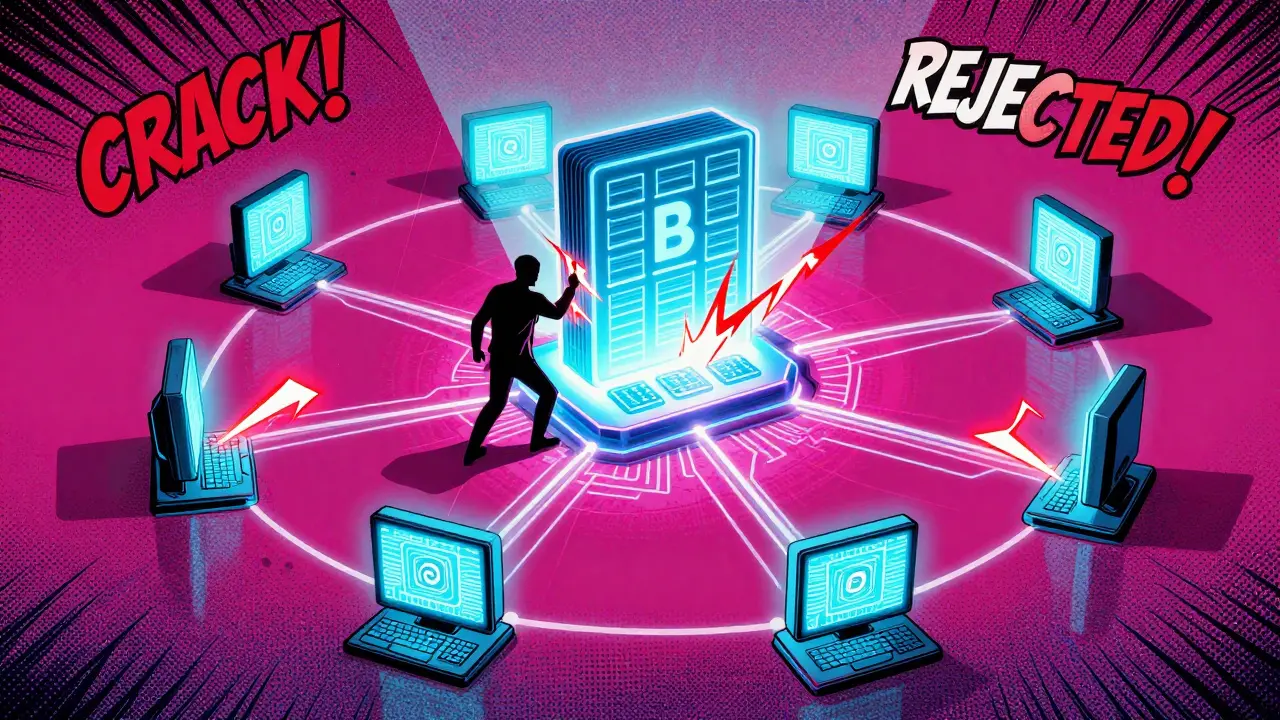
Security: Encryption vs. Distributed Trust
Traditional databases use encryption. They lock data behind passwords, firewalls, and access controls. But if someone breaks in - say, through a weak employee password - they can steal everything. In 2024, a major UK healthcare provider lost 2.3 million patient records because an unencrypted backup file was left online. That’s the risk of centralization. Blockchain doesn’t rely on firewalls. It relies on math. Every block is cryptographically linked. Every node holds a copy. To alter data, you’d need to control over 51% of the entire network - and change every copy at once. That’s nearly impossible for large blockchains like Bitcoin or Ethereum. It would cost billions. But blockchain isn’t unhackable. Exchanges get hacked. Smart contracts have bugs. Wallets get phished. The ledger stays intact - but the people using it don’t always. Your private key is your password. Lose it, and your crypto is gone. No customer service can help you. So security isn’t about the system being perfect. It’s about what you’re protecting. If you need to safeguard against insider fraud or tampering by a central authority, blockchain wins. If you need to protect against phishing and human error, traditional systems with good training and multi-factor auth still hold up.Cost: Who Pays for the Power?
Running a traditional database? You pay for a server. Maybe $50 a month on AWS. Or you license software from Microsoft or Oracle. The cost is predictable. Low. Efficient. Running a blockchain? You pay for electricity. For hardware. For miners or validators. Bitcoin’s network consumes more electricity than entire countries like Argentina or the Netherlands. Even proof-of-stake blockchains like Ethereum 2.0 still need dozens of high-end servers running 24/7 to keep the network alive. That’s why most businesses don’t run full blockchains for internal use. They use them for specific, high-value tasks - like verifying the origin of luxury goods or tracking pharmaceutical shipments. For payroll, inventory, or CRM? Still a traditional database. Cheaper. Faster. Simpler.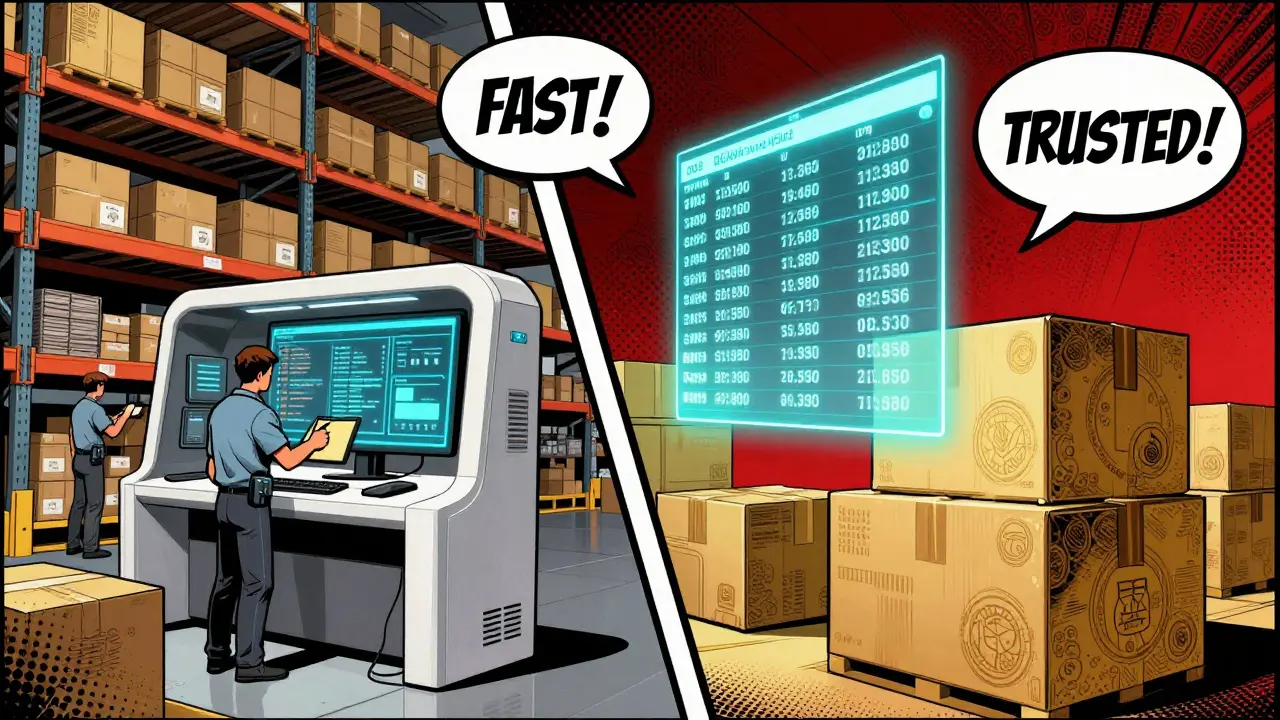
When to Use Which?
Use a traditional database when:- You need to update or delete data regularly
- You run complex queries - like "show me all customers who bought X in Q3 and spent over £500"
- Speed matters - real-time apps, gaming, financial trading
- You have a single trusted authority managing the system
- Your budget is tight
- No single party can be trusted to manage the data
- History must be permanent and tamper-proof
- Multiple organizations need to share data without central control
- You’re tracking physical assets across borders - like diamonds, food, or medicines
- You need transparent, auditable records - like voting or public contracts
The Future: Hybrid Systems Are Already Here
The idea that blockchain will replace databases is dead. It won’t. But the opposite is also true: databases won’t replace blockchain. Instead, companies are mixing them. Think of blockchain as a secure, tamper-proof log. And the database as the fast, flexible engine that powers your app. For example: A logistics company uses a traditional database to track shipments in real time. But every time a package crosses a border, it writes a hash of the record to a blockchain. That way, customs, carriers, and clients all have a shared, unchangeable proof of when and where the item moved. Or a hospital stores patient records in a secure SQL database. But every time a record is accessed or updated, it logs the event - timestamp, user ID, action - on a private blockchain. If someone tries to falsify access logs, the blockchain catches it. These hybrid systems are the future. They keep the speed and flexibility of databases. And add the trust and transparency of blockchain - only where it matters.Final Thought: It’s Not Either/Or - It’s And
Blockchain isn’t the next database. It’s a different tool for a different job. Like a hammer and a screwdriver. One doesn’t replace the other. They just do different things better. If you’re building an app that needs to change data often - use a database. If you’re building a system where no one should be able to lie about what happened - use blockchain. And if you’re smart? You’ll use both.Can blockchain replace traditional databases?
No. Blockchain isn’t designed to replace traditional databases. It sacrifices speed, flexibility, and low cost for immutability and decentralization. Traditional databases are far better for everyday applications like banking apps, CRM systems, or inventory management where data needs to be edited, searched, and updated quickly. Blockchain is best for scenarios requiring trustless, tamper-proof records - like cryptocurrency, supply chain verification, or digital identity. Most real-world systems now use both: databases for performance, blockchain for audit trails.
Is blockchain more secure than a traditional database?
It depends on what you’re protecting. Blockchain is more secure against tampering by a central authority or insider fraud because data can’t be altered once recorded. But it doesn’t protect against user errors - like losing your private key or falling for a phishing scam. Traditional databases can be secured with encryption, access controls, and multi-factor authentication, but they’re vulnerable to single-point breaches. So blockchain wins on data integrity; traditional systems win on operational security when properly managed.
Why is blockchain so slow?
Every transaction on a blockchain must be verified by multiple computers across the network. This process - called consensus - ensures no one can cheat. But it takes time. Bitcoin, for example, confirms a transaction every 10 minutes. Ethereum takes 12-15 seconds. Compare that to a traditional database, which can process thousands of transactions per second on a single server. The trade-off is speed for trust. Blockchain prioritizes security and decentralization over performance.
Can you delete data from a blockchain?
No. Once data is added to a blockchain, it cannot be deleted or altered. This is by design - it’s what makes the ledger immutable. If you need to correct a mistake, you add a new transaction that reverses or overrides the previous one. But the original record stays in the chain forever. This is great for audit trails but problematic for privacy laws like GDPR, which require the right to be forgotten. Some blockchains solve this by storing only hashes on-chain and keeping actual data off-chain in encrypted databases.
Are blockchain systems more expensive to run?
Yes, significantly. Running a blockchain requires hundreds or thousands of computers (nodes) to validate every transaction. This uses massive amounts of electricity and hardware. Bitcoin’s network consumes more energy than most countries. Even energy-efficient blockchains like Ethereum 2.0 require dedicated servers and ongoing maintenance. Traditional databases can run on a single cloud server for under $100/month. The cost difference makes blockchain impractical for most routine business applications.
What industries use blockchain instead of databases?
Industries that need transparency and trust between untrusted parties use blockchain. Examples include: cryptocurrency (Bitcoin, Ethereum), supply chain tracking (Walmart uses it to trace food sources), pharmaceuticals (verifying drug authenticity), digital identity (government-issued IDs on blockchain), and voting systems (some pilot programs in Estonia and West Virginia). These use cases benefit from immutable, shared records - not speed or flexibility.
Do banks use blockchain?
Most banks still use traditional databases for core operations like account management and payments. But many are experimenting with blockchain for cross-border settlements, trade finance, and KYC (Know Your Customer) verification. JPMorgan’s Onyx network and HSBC’s blockchain-based trade platform are examples. They use private, permissioned blockchains - not public ones like Bitcoin - to speed up processes and reduce fraud, while keeping control within their own systems.
What’s the difference between a blockchain and a distributed database?
A distributed database copies data across multiple servers but still relies on a central authority to manage updates and resolve conflicts. A blockchain has no central authority. All nodes must agree on changes using consensus algorithms. In a distributed database, data can be edited; in a blockchain, it can only be appended. Blockchain adds cryptographic linking and immutability - features most distributed databases don’t have.

Shruti Sinha
December 18, 2025 AT 06:53Blockchain isn't magic. It's just a fancy ledger. Databases are still king for everything that needs to be fast and editable. I use PostgreSQL daily and never once thought, 'Man, I wish this was on a blockchain.' It's like using a rocket ship to go to the grocery store.
Craig Nikonov
December 18, 2025 AT 19:24They don't want you to know this but the whole blockchain thing is a central bank plot to keep control under the guise of decentralization. Every 'node' is secretly owned by the Fed. They're just using proof-of-work to drain your electricity bill and make you think you're free. Wake up, sheeple.
Jesse Messiah
December 19, 2025 AT 21:03Really enjoyed this breakdown. I work in logistics and we started using blockchain just for cross-border customs docs. It's not faster, but now everyone-shipping co, customs, client-sees the same timestamp. No more 'who sent what when?' arguments. Super handy for audits. Still use our old SQL DB for tracking inventory in real time. Hybrid is the way to go.
Emma Sherwood
December 20, 2025 AT 17:57As someone from a country where identity fraud is rampant, I’ve seen blockchain used to issue digital IDs. No more fake birth certificates or stolen passports. The tech isn’t perfect, but the principle? Game changer. We don’t need to replace databases-we need to layer trust where it’s missing. This post nails it.
Elvis Lam
December 22, 2025 AT 09:17Blockchains are slow because they’re designed to be secure, not efficient. That’s not a flaw-it’s a feature. If you need speed, use a database. If you need to prove something happened 3 years ago and no one can deny it, use blockchain. Stop trying to force one into the other’s job. It’s like using a chainsaw to butter toast.
Sue Bumgarner
December 22, 2025 AT 15:30Let’s be real-blockchain is just a buzzword for ‘I don’t trust my coworkers.’ If you’re running a business where everyone’s honest, you don’t need it. And if they’re not? No blockchain will fix a toxic culture. Also, the energy use? Criminal. We’re powering crypto with coal while kids in Texas lose power during heatwaves. Wake up.
Bradley Cassidy
December 23, 2025 AT 00:17Y’all are overthinking this. Blockchain is like a digital notary. You don’t use it to write your novel-you use it to notarize the first page. That’s it. My company uses a DB for everything, then drops a hash of critical events (invoice approvals, contract changes) onto a private chain. Simple. Cheap. Works. No drama.
Cheyenne Cotter
December 23, 2025 AT 06:10Okay but have you thought about how blockchain’s immutability clashes with GDPR? Like, if someone requests their data be deleted because they changed their mind, and the blockchain says NOPE, that’s a legal nightmare. I work in compliance and we’ve had clients get fined because they stored PII on-chain thinking it was ‘secure.’ It’s not secure if you’re breaking the law. Also, why do people think decentralization means no one’s in charge? There’s always a dev team. Always.
Jonny Cena
December 23, 2025 AT 13:54Love how this post shows both sides. I used to think blockchain was the future of everything. Then I worked on a project where we tried to replace an internal HR database with a blockchain. Took 3 minutes to update a vacation request. Employees quit. We went back to SQL in 2 weeks. Blockchain is amazing for trustless environments-but if you’re already in a trusted team? Just use the tool that works.
Donna Goines
December 23, 2025 AT 23:35They say blockchain is decentralized but every major chain has 5 big miners who control 80% of the hash power. It’s not decentralization-it’s oligarchy with a fancy name. And the whole ‘no one can alter data’ thing? What about the 2016 DAO hack? They just rolled back the chain like it was a video game save. So much for immutability.
Jack Daniels
December 25, 2025 AT 22:42I read this at 3am. My brain is mush. But I think I get it. Databases = fast. Blockchain = unchangeable. Like a diary you can’t erase. But if you write ‘I hate my boss’ and then regret it… you’re stuck. That’s kinda beautiful. And kinda terrifying.
Sean Kerr
December 26, 2025 AT 18:26YES!! This is exactly what I’ve been trying to tell my boss!! 😊 We don’t need blockchain for payroll! We need it for the audit trail!! I told him: ‘Imagine if someone edits the payroll log and says ‘I paid Bob $10k’-but the blockchain says ‘NOPE, you paid him $1k’-that’s power!!’ He still thinks I’m crazy but… I’m not!! 😎🙌
Sally Valdez
December 27, 2025 AT 17:58Blockchain? More like blockchain BS. America built the internet. We don’t need some crypto bro’s distributed ledger to track shipping containers. We have trucks, GPS, and common sense. This is just Europe trying to be ‘green’ while we actually get stuff done. Stop overengineering. Just fix the damn database.
Samantha West
December 29, 2025 AT 03:29One must interrogate the ontological implications of immutability within epistemic frameworks of trust. The blockchain, as a syntactic monument to the post-human condition, reifies the illusion of objectivity through cryptographic formalism-yet, in doing so, it obscures the very human fallibility embedded in its consensus mechanisms. The database, by contrast, remains a palimpsest of administrative intentionality, mutable, human, and thus, profoundly honest. To conflate the two is to mistake the mirror for the face.
Greg Knapp
December 30, 2025 AT 23:37My cousin lost 20k in crypto because he sent it to the wrong address. No one helped him. No one can help him. That’s the ‘security’ you guys love? That’s not security-that’s abandonment. Meanwhile, my bank reversed a fraudulent charge in 2 hours. Guess which system I trust more? 🤷♂️