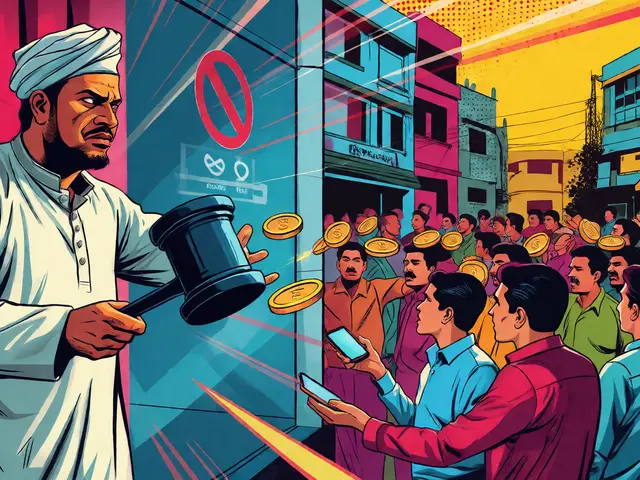
Imagine trying to send money home from abroad without paying hefty fees or waiting days for the transfer to clear. For millions of Bangladeshis, this isn't a hypothetical scenario-it's their daily reality. Here is the paradox that confuses regulators and fascinates analysts: Bangladesh maintains a complete legal ban on cryptocurrency, yet it ranks surprisingly high in global adoption metrics. With approximately 3.1 million verified users as of 2025, the country defies the logic that prohibition equals non-existence. Why does a nation where digital assets are technically illegal boast such robust engagement? The answer lies not in speculative trading, but in raw economic necessity.
The Paradox of Prohibition and Participation
You might assume that a strict government ban would wipe out cryptocurrency usage entirely. In Bangladesh, however, the opposite has happened. While the central bank and financial authorities maintain a hardline stance against cryptocurrency transactions, treating them as illegal activities, the grassroots demand remains undeterred. Data from CoinLedger places Bangladesh at rank 35 globally in terms of adoption intensity, while historical data from Chainalysis has previously positioned it even higher, around ranks 13-15. This discrepancy highlights a crucial truth: regulatory frameworks often lag behind technological utility.
The 3.1 million users aren't necessarily day-trading Bitcoin for profit. Instead, they are leveraging digital assets to solve specific financial pain points. When traditional banking channels fail to provide fast, cheap cross-border transfers, people find workarounds. The ban creates a shadow market, but it doesn't eliminate the need for efficient value transfer. This resilience suggests that for many Bangladeshis, cryptocurrency is less about investment hype and more about survival and efficiency in an unstable economic landscape.
Stablecoins Drive the Underground Economy
If you look closely at what these 3.1 million users are actually doing, you'll notice a distinct pattern. They aren't primarily buying volatile assets like Dogecoin or Ethereum for speculation. The dominant use case is stablecoins, particularly USDT (Tether) and USDC. These tokens offer a hedge against local currency devaluation and inflation, which have been persistent concerns in Bangladesh's economy. More importantly, they serve as a critical tool for remittances.
Bangladesh is one of the world's top recipients of worker remittances. Millions of overseas workers send money home to support their families. Traditional methods involve high fees and slow processing times. By using stablecoins, workers can send value digitally, which recipients then convert to local Taka through peer-to-peer (P2P) networks. This method is faster, cheaper, and often more accessible than formal banking channels. The focus on utility over speculation marks a mature adoption curve, similar to what we see in other emerging markets where financial inclusion is a priority rather than a luxury.

Regional Context: South Asia's Crypto Landscape
To understand Bangladesh's position, you must look at its neighbors. South Asia is currently one of the fastest-growing regions for cryptocurrency adoption. India leads the pack with an adoption index of 1.000, driven by a massive tech-savvy population and a thriving startup ecosystem. Pakistan follows closely with an index of 0.619, adding 5.4 million new users in 2025 alone. Against this backdrop, Bangladesh's ranking of 35 might seem modest, but it represents significant penetration given the legal hurdles.
The regional trend is clear: lower- and middle-income countries dominate adoption rankings because cryptocurrency solves real problems. Whether it's protecting savings from inflation or facilitating freelance payments, the utility is undeniable. Bangladesh shares these economic pressures with its neighbors. The difference lies in enforcement. While India has introduced taxation and regulatory clarity, and Pakistan has moved toward legalization, Bangladesh maintains a prohibitionist stance. Yet, the flow of capital continues, proving that economic gravity outweighs regulatory friction.
| Country | Adoption Rank/Index | User Base Estimate | Primary Driver | Regulatory Status |
|---|---|---|---|---|
| India | Rank #1 / Index 1.000 | >100 Million | Speculation & Web3 | Taxed & Regulated |
| Pakistan | Rank #3 / Index 0.619 | 18.2 Million | Freelance Payments | Legalizing |
| Bangladesh | Rank #35 | 3.1 Million | Remittances & Stablecoins | Banned |
| Vietnam | Top 10 Globally | >20 Million | Trading Volume | Unregulated Grey Zone |
How Users Navigate the Legal Minefield
So, how do 3.1 million people trade crypto in a country where it's illegal? They rely on alternative infrastructure. Most access happens through international exchanges that don't require local bank integration, or via P2P platforms where users trade directly with each other. VPNs play a crucial role here, allowing users to bypass geo-restrictions and access global liquidity pools. This decentralized approach makes enforcement incredibly difficult for authorities who lack the technical resources to monitor every digital wallet interaction.
Risk is inherent in this model. Users face potential legal ambiguity if caught exchanging large sums. However, for small-scale remittance transfers, enforcement is rare. The community operates on trust and established networks. If you're sending $200 home via USDT, you're unlikely to attract the same scrutiny as someone moving millions. This practical, low-profile usage allows the ecosystem to thrive under the radar, creating a parallel financial system that coexists with the formal one.

The Future of Crypto in Bangladesh
Will the ban hold forever? History suggests that when technology offers superior utility, regulation eventually adapts or becomes obsolete. We've seen this in other sectors. As neighboring countries integrate blockchain into their financial systems, pressure will mount on Bangladesh to modernize its approach. The current model works, but it's inefficient for the state, which misses out on tax revenue and loses visibility into capital flows.
For now, the trajectory is upward. The Asia-Pacific region saw 69% growth in crypto ownership recently, and Bangladesh is part of this wave. If traditional banks continue to struggle with cross-border payment costs, the shift toward stablecoins will only accelerate. Policymakers face a choice: continue fighting a losing battle against market forces, or create a regulated sandbox that captures the benefits of this adoption. Given the sheer number of users already engaged, the latter seems increasingly likely.
Key Takeaways
- Resilience Over Regulation: Bangladesh proves that bans do not stop adoption when economic necessity drives demand.
- Utility Focus: Unlike speculative hubs, Bangladesh's users prioritize stablecoins for remittances and inflation hedging.
- Significant User Base: With 3.1 million verified users, the underground market is too large to ignore.
- Regional Momentum: Neighboring countries' legalizations may force Bangladesh to reconsider its stance to remain competitive.
Is cryptocurrency completely illegal in Bangladesh?
Yes, the Bangladesh Bank and the Financial Intelligence Unit have declared cryptocurrency transactions illegal. Engaging in crypto trading can lead to fines or imprisonment under existing foreign exchange regulations. However, enforcement varies, and the activity persists largely through peer-to-peer channels and international platforms.
Why do Bangladeshis use cryptocurrency despite the ban?
The primary driver is remittance efficiency. Millions of overseas workers use stablecoins like USDT to send money home faster and cheaper than through traditional banking channels. Additionally, stablecoins serve as a hedge against local currency inflation, preserving value for ordinary citizens.
How many crypto users are there in Bangladesh?
As of 2025, estimates suggest there are approximately 3.1 million verified cryptocurrency users in Bangladesh. This figure comes from organizations like CoinLaw and reflects active engagement, though the actual number of participants in the informal market may be higher.
What is Bangladesh's global crypto adoption ranking?
Bangladesh currently ranks 35th globally according to CoinLedger's 2025 data. Previous reports from Chainalysis have placed it higher, between ranks 13 and 15, indicating consistent relevance in global adoption indices despite regulatory restrictions.
Which cryptocurrencies are most popular in Bangladesh?
Stablecoins, particularly Tether (USDT), are the most widely used due to their stability and utility in remittances. Bitcoin and Ethereum also have followings, but they are less dominant than stablecoins in the Bangladeshi context, where risk aversion and practicality drive choices.