
Taiwan’s Financial Supervisory Commission (FSC) has built one of the most structured crypto regulatory systems in Asia-not by banning crypto, but by forcing exchanges to play by clear rules. If you're running or using a crypto exchange in Taiwan, you can't afford to ignore these regulations. They're not suggestions. They're enforceable requirements backed by criminal penalties. And as of 2026, the system is fully live, with real consequences for non-compliance.
Virtual Commodities, Not Legal Tender
The FSC doesn't treat Bitcoin or Ethereum as money. They're classified as virtual commodities digital assets that can be traded or transferred but are not issued or guaranteed by a central bank. This distinction matters. It means exchanges can't offer crypto as payment for goods or services like a bank would with dollars. But it also means they can legally operate as trading platforms-if they follow the rules.
That’s why every exchange operating in Taiwan, whether based locally or overseas, must register as a Virtual Asset Service Provider (VASP) a business that facilitates trading, custody, or transfer of digital assets. No exceptions. Not even if you’re a foreign exchange with just one Taiwanese user. The FSC made this clear in July 2024: registration is mandatory before you open your doors.
Anti-Money Laundering Is Non-Negotiable
AML compliance isn’t a checkbox. It’s the foundation. Every VASP must implement a full anti-money laundering and counter-financing of terrorism (AML/CFT) program. That includes:
- Know Your Customer (KYC) checks for every user-no anonymous accounts
- Real-time transaction monitoring for suspicious activity
- Reporting all unusual transactions to Taiwan’s Financial Intelligence Unit
- Keeping records of all trades and user data for at least five years
Failure to comply isn’t just a fine. It’s jail time. New laws passed in late 2024 introduced custodial sentences for executives who knowingly allow crypto platforms to be used for money laundering. The Ministry of Justice is actively prosecuting cases. In 2025, two exchange operators were sentenced to 18 months in prison for failing to report large, repeated transfers from unverified accounts.
How Exchanges Must Handle Customer Assets
One of the biggest lessons from the FTX collapse was how easily customer funds can vanish when mixed with company money. Taiwan’s FSC banned that practice. All exchanges must now strictly separate customer assets from their own operational funds. This is called asset segregation the legal requirement that customer digital assets be held separately from the exchange’s own holdings.
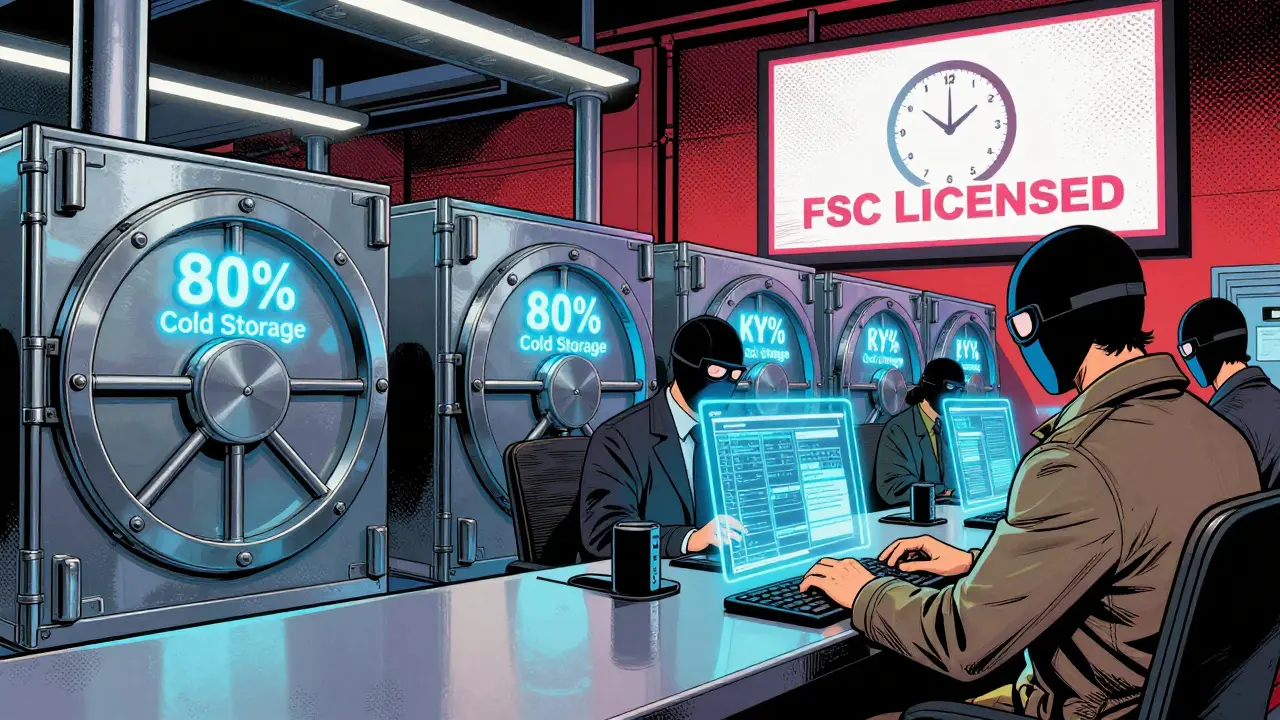
Exchanges must use cold storage for at least 80% of user funds. Hot wallets (online wallets used for daily trading) are allowed-but only if they’re capped at 20% of total holdings. The FSC requires independent audits every quarter to verify this separation. If an exchange can’t prove it, they lose their license.
Security and Transparency Requirements
Security isn’t optional. The FSC demands that exchanges meet specific cybersecurity standards. That means:
- Multi-signature wallet systems
- Regular penetration testing by licensed third parties
- Two-factor authentication for all user logins
- Encryption of all user data, both at rest and in transit
Transparency is equally critical. Every exchange must publish a public whitepaper detailing:
- Which tokens they list and why
- How they select new assets
- Who their auditors are
- How customer funds are stored
- Clear risk disclosures for each cryptocurrency
These aren’t marketing materials. They’re legal documents. If a token gets delisted without explanation, or if the whitepaper is outdated, the FSC can suspend operations.
Security Tokens Are a Different Ballgame
Not all crypto is treated the same. If a digital asset qualifies as a security token a digital asset representing ownership or financial interest in an underlying asset, subject to securities law-like a tokenized share of a company or real estate-it falls under the Securities and Exchange Act Taiwan’s primary law governing stock and bond trading. That means:
- Only licensed securities dealers can trade them
- They must be listed on the Taipei Exchange (TPEx)
- Full financial disclosures and prospectus filings are required
As of 2026, only one security token has been approved in Taiwan. The bar is high. Most startups avoid this path because the legal and reporting costs are too steep. But for institutional investors, it’s the only legal way to gain exposure to tokenized assets in Taiwan.
Crypto ETFs Are Open-But Only for Pros
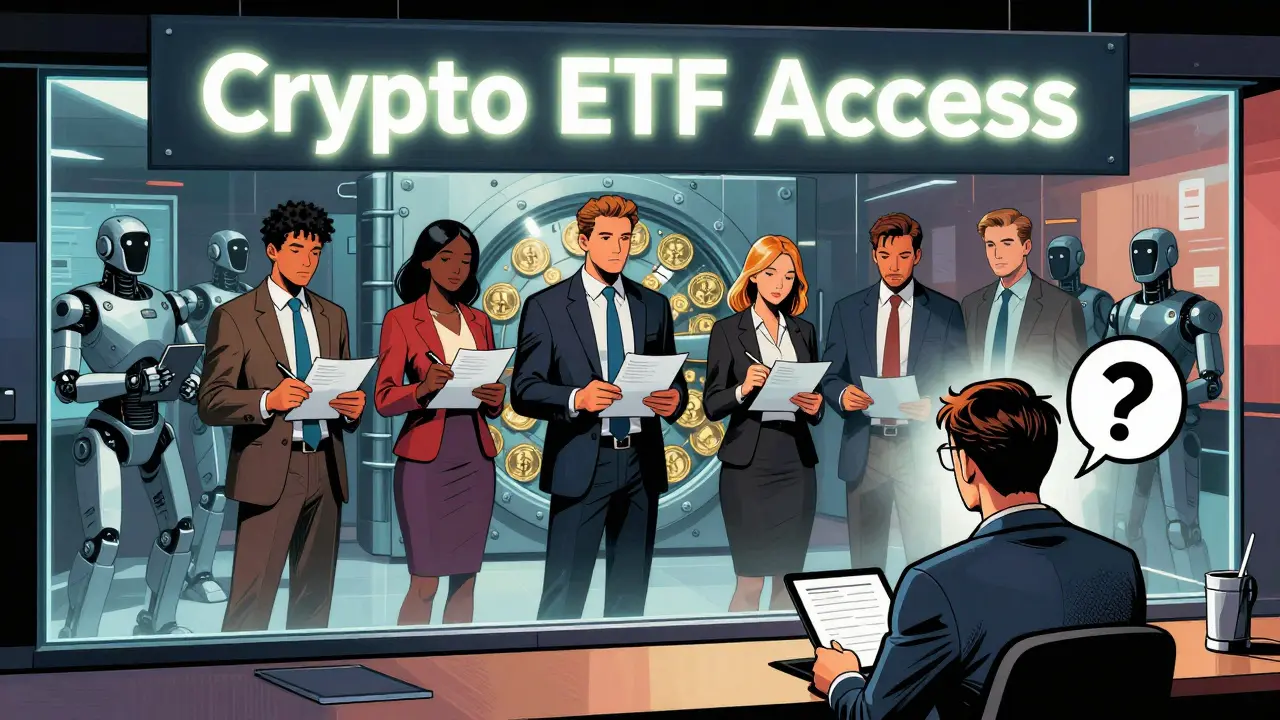
Taiwan doesn’t let average users buy Bitcoin ETFs. But it does allow professional investors to access foreign crypto ETFs. In early 2025, the FSC and the Securities Business Association of the Republic of China agreed on five criteria for this access:
- Investors must have over NT$10 million in liquid assets
- They must pass a knowledge test on crypto risks
- ETFs must be listed on regulated foreign exchanges (like the U.S. or EU)
- Underlying assets must be fully audited and transparent
- Only ETFs with at least $100 million in assets under management are allowed
This isn’t a free-for-all. It’s a controlled experiment. The FSC is watching how these ETFs perform before deciding whether to open access to regular retail investors.
The Industry Is Self-Regulating
Surprisingly, the industry isn’t fighting back. In 2024, 24 major exchanges formed the Taiwan Virtual Asset Service Provider Association a self-regulatory organization formed by licensed crypto exchanges in Taiwan to promote compliance and industry standards. They meet monthly with FSC officials to discuss implementation challenges. They’ve even created a shared compliance toolkit for smaller exchanges.
This cooperation isn’t altruistic. It’s survival. The FSC has made it clear: if you don’t comply, you’re out. And with the new laws, there’s no second chance.
What’s Next? A Full Crypto Law by 2025
The FSC isn’t done. A draft comprehensive cryptocurrency law is expected by July 2025. It will likely:
- Formally define all crypto-related terms in legislation
- Set minimum capital requirements for exchanges
- Introduce a licensing tier system (basic, advanced, institutional)
- Clarify how taxes apply to crypto transactions
- Align more closely with international standards like FATF’s Travel Rule
Exchanges are already preparing. Those who waited until 2025 to get compliant are already behind. The smart ones started in 2023.
Why This Matters
Taiwan’s approach is a middle path. Not as strict as China. Not as loose as some U.S. states. It’s designed to protect users while letting innovation continue. The result? More institutional money is flowing in. Major global exchanges like Kraken and Bybit now have Taiwan-licensed subsidiaries. Local exchanges like Bitrue and MEXC have gone fully compliant.
For users, it means safer platforms. For businesses, it means clearer rules. And for regulators, it means Taiwan is no longer seen as a crypto haven-but as a responsible financial center.
Do foreign crypto exchanges need to register with Taiwan’s FSC?
Yes. Any exchange that allows Taiwanese residents to trade, deposit, or withdraw crypto must register as a VASP with the FSC-even if it’s based in Singapore, the U.S., or Hong Kong. The FSC has no jurisdiction over offshore platforms that completely block Taiwanese IP addresses, but if even one Taiwanese user accesses the platform, registration is required.
What happens if an exchange doesn’t register?
The FSC can issue a public warning, freeze assets, block domain access in Taiwan, and refer the case to prosecutors. Operators may face criminal charges under the new anti-fraud laws, including prison time. Banks will also cut off payment processing, making it impossible to operate.
Can I trade crypto on an unregistered exchange in Taiwan?
Technically, you can-but you’re taking huge risks. Unregistered exchanges aren’t subject to asset segregation, audits, or AML checks. Your funds could vanish without warning, and you have no legal recourse. The FSC advises all users to only use registered platforms. There’s a public list of licensed VASPs on the FSC website.
Are stablecoins regulated the same way as Bitcoin?
Yes. All stablecoins-whether pegged to the U.S. dollar or another asset-are treated as virtual commodities under the VASP rules. Exchanges listing them must comply with full AML, KYC, and asset segregation requirements. The FSC has explicitly warned that stablecoins tied to unregulated reserves are high-risk and subject to immediate delisting if transparency is lacking.
Is staking or yield farming allowed in Taiwan?
Staking is allowed-but only if offered by a registered VASP. Yield farming through decentralized protocols (like Uniswap or Aave) is in a gray zone. The FSC hasn’t banned it outright, but it considers such activities high-risk. If you earn rewards from an unregistered DeFi platform, you may be subject to tax scrutiny, and there’s no legal protection if the protocol fails.
One thing is clear: Taiwan’s crypto rules aren’t going away. They’re getting tighter. If you’re involved in crypto here, compliance isn’t a cost-it’s the price of staying in the game.
KingDesigners &Co
February 23, 2026 AT 18:57Felicia Eriksson
February 25, 2026 AT 01:46aaron marp
February 25, 2026 AT 12:08Patrick Streeb
February 27, 2026 AT 01:27Alyssa Herndon
February 28, 2026 AT 04:51Lucy Simmonds
March 2, 2026 AT 02:39maya keta
March 3, 2026 AT 04:51Curtis Dunnett-Jones
March 4, 2026 AT 22:56Robert Conmy
March 5, 2026 AT 10:30Lilly Markou
March 6, 2026 AT 21:07McKenna Becker
March 7, 2026 AT 10:33precious Ncube
March 8, 2026 AT 11:30Amita Pandey
March 9, 2026 AT 20:37Jan Czuchaj
March 11, 2026 AT 14:59Tracy Peterson
March 13, 2026 AT 04:04George Suggs
March 15, 2026 AT 02:13Dianna Bethea
March 15, 2026 AT 02:41Trenton White
March 15, 2026 AT 16:15Cheryl Fenner Brown
March 17, 2026 AT 08:46Michael Teague
March 18, 2026 AT 09:52KingDesigners &Co
March 20, 2026 AT 09:50