
Trading on a decentralized exchange (DEX) feels different every time you click 'swap.' Sometimes it’s instant. Other times, you lose money to slippage or watch your transaction fail because the pool was too thin. If you are looking at ArbSwap, a decentralized exchange built specifically for the Arbitrum network, you probably want to know one thing: is it worth using right now?
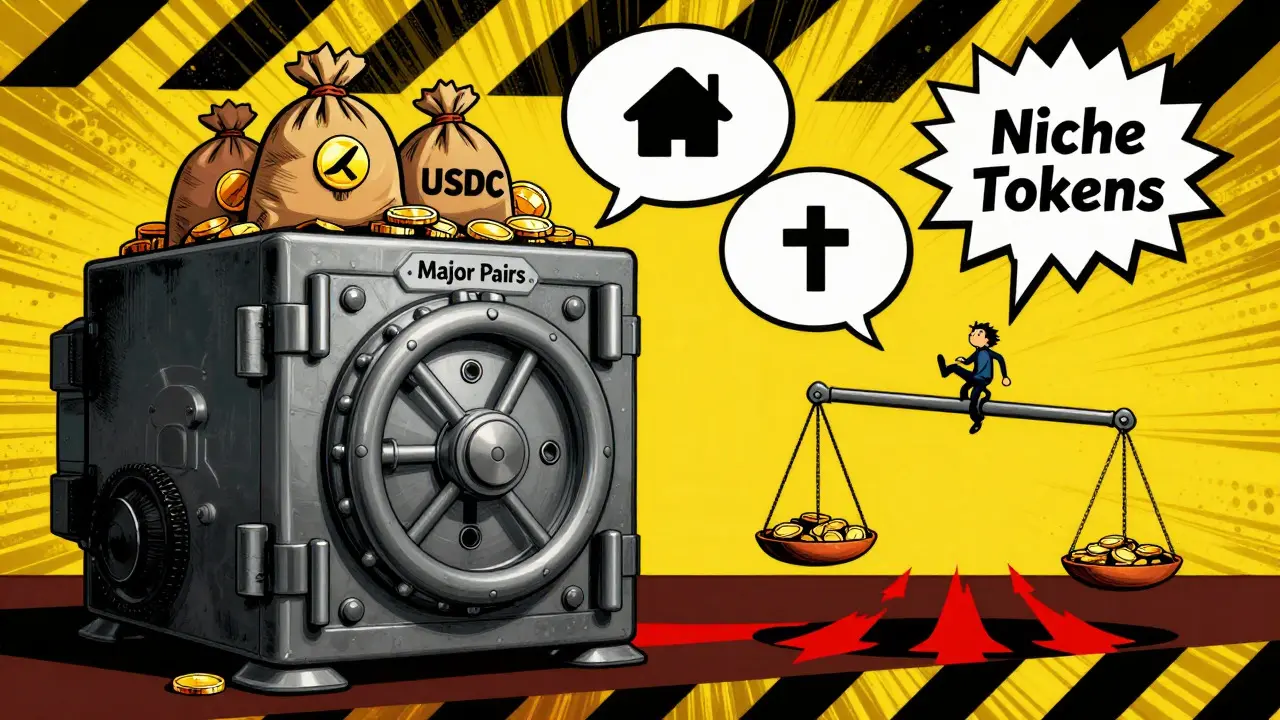
The short answer is complicated. ArbSwap has a sleek interface and incredibly low fees, but it suffers from a major problem that plagues many niche exchanges: lack of deep liquidity outside its top pairs. While it offers a great experience for trading major tokens like ETH or USDC on Arbitrum, stepping into smaller, native tokens can be risky due to high price impact.
What Is ArbSwap and Why Does It Exist?
ArbSwap launched as one of the first native decentralized exchanges on the Arbitrum One Ethereum Layer 2 scaling solution network. After pausing operations throughout 2024 to rebuild its infrastructure, the platform relaunched in January 2025 with a clear mission: to provide deep liquidity specifically for Arbitrum-native assets.
Unlike massive aggregators like Uniswap multi-chain decentralized exchange protocol that spread their resources across dozens of blockchains, ArbSwap focuses exclusively on Arbitrum. The idea is simple. By concentrating all its efforts on one chain, ArbSwap aims to offer better pricing and lower fees for tokens that live only on Arbitrum.
This specialization makes sense in theory. Many new projects launch on Arbitrum and struggle to find good liquidity on generalist platforms. ArbSwap tries to fill that gap. However, this narrow focus also creates a vulnerability. If traders don’t flock to the platform, the pools remain shallow, leading to poor execution prices for users.
How ArbSwap Works: Fees, Speed, and Interface
When you actually use the platform, the user experience is surprisingly polished. The team updated the interface in version 2.1, integrating real-time charting from TradingView directly into the swap page. You can see price action without leaving the site, which saves time and reduces errors.
Speed is another strong point. Because Arbitrum is a Layer 2 network, transactions are fast and cheap. ArbSwap optimizes further by reducing average swap execution time to about 1.2 seconds. Compare that to older versions or congested mainnet Ethereum swaps, and the difference is night and day.
Here is how the fee structure breaks down:
- Standard Swap Fee: 0.3% for most trades.
- Governance Token Holders: Reduced to 0.25% (expected rollout in late 2025).
- Concentrated Liquidity Pools: As low as 0.15%.
- Gas Fees: Typically under $0.02 per transaction, even during busy periods.
For liquidity providers, the rewards include 0.05% of all swap fees plus additional incentives from staking contracts. Annual percentage rates (APRs) vary wildly, ranging from a modest 4.2% for stablecoin pairs to over 18% for exotic token pairs. Keep in mind that higher APRs usually mean higher risk due to impermanent loss or smart contract vulnerabilities.
The Liquidity Problem: Where ArbSwap Struggles
If there is one criticism that dominates reviews of ArbSwap, it is liquidity depth. According to data from early 2025, ArbSwap holds about $47.8 million in total value locked (TVL). That sounds like a lot until you compare it to Uniswap V3 leading automated market maker on Arbitrum, which sits at over $1.2 billion on the same network.
More concerning is how that liquidity is distributed. Reports indicate that nearly 97% of ArbSwap’s liquidity is concentrated in just five trading pairs: ETH/USDC, ETH/USDT, WBTC/USDC, ARB/USDC, and GMX/USDC. If you trade these major pairs, you will likely get decent prices. But if you try to swap an obscure Arbitrum-native token, you might face slippage of 2.8% or more on trades over $5,000.
User experiences back this up. On Reddit and Trustpilot, traders frequently mention getting "rekt" by high slippage when trying to move large amounts into smaller tokens. One user reported a 4.7% slippage loss on a $1,000 swap for a lesser-known asset. For serious traders, this kind of price impact eats into profits quickly.
| Feature | ArbSwap | Uniswap V3 | Camelot DEX |
|---|---|---|---|
| Total Value Locked (TVL) | $47.8 Million | $1.24 Billion | $150+ Million |
| Token Selection | 147 Verified Tokens | 1,200+ Tokens | 500+ Tokens |
| Primary Focus | Arbitrum-Native Assets | Multi-Chain Aggregation | Order Book + AMM Hybrid |
| Average Slippage (Major Pairs) | < 0.1% | < 0.05% | < 0.1% |
| Liquidity Depth (Niche Tokens) | Low / High Risk | Moderate | Moderate |
| User Interface Rating | High (Modern UI) | Moderate (Complex) | High (Gaming-inspired) |
Is ArbSwap Safe? Security and Smart Contract Risks
Security is paramount in DeFi. ArbSwap operates as an automated market maker (AMM) using the standard constant product formula ($x \times y = k$). This model is battle-tested and widely used across the industry. The platform underwent a strategic pause in 2024 to enhance its security protocols before relaunching in 2025.
However, the anonymous nature of the development team raises some eyebrows. In an industry where reputation matters, not knowing who is behind the code can be a deterrent for institutional investors. That said, the smart contracts have been audited, and the platform follows permissionless finance principles, meaning no single entity controls user funds once deposited.
The biggest risk isn’t necessarily a hack-it’s the economic risk of interacting with shallow pools. When liquidity is thin, market manipulators can easily push prices up or down. Always check the price impact warning before confirming any swap on ArbSwap. If the estimated output is significantly lower than the current market price, consider splitting your trade or using a different exchange.
Who Should Use ArbSwap (and Who Should Avoid It)?
ArbSwap is not for everyone. Its specialized nature means it serves specific types of users better than others.
You should use ArbSwap if:
- You primarily trade major pairs like ETH/USDC or ARB/USDC on Arbitrum and want a clean, fast interface.
- You hold governance tokens for upcoming fee discounts.
- You are providing liquidity to stablecoin pairs and want steady, albeit modest, yields.
- You believe in the long-term potential of Arbitrum-native ecosystems and want to support early-stage infrastructure.
You should avoid ArbSwap if:
- You need to trade large volumes of obscure or low-cap tokens.
- You require deep liquidity for algorithmic trading strategies.
- You prefer the social proof and community size of larger platforms like Uniswap or Camelot.
- You are uncomfortable with the risks associated with anonymous development teams.

The Future of ArbSwap: Roadmap and Outlook
The team knows its weaknesses. In March 2025, they proposed a three-phase liquidity bootstrapping plan. Phase one involves incentivizing stablecoin pairs to build a base layer of trust and volume. Phase two focuses on partnerships with emerging Arbitrum projects. Phase three includes the launch of a full governance token in Q4 2025.
Additionally, ArbSwap plans to integrate with Arbitrum’s Stylus upgrade, which supports WebAssembly. This could improve contract execution speed by up to 40%, making the platform even more competitive technically. Analysts suggest that for ArbSwap to survive, it needs to reach at least $200 million in TVL within 18 months. Without significant growth, it risks becoming irrelevant in an increasingly consolidated DeFi landscape.
Frequently Asked Questions
Is ArbSwap safe to use in 2026?
ArbSwap uses standard, audited smart contracts and operates on the secure Arbitrum network. However, the primary risk is not technical failure but economic loss due to low liquidity in niche token pairs. Always verify price impact before swapping.
What is the minimum amount to swap on ArbSwap?
There is no official minimum deposit threshold. However, you need enough ETH in your wallet to cover gas fees, which typically cost less than $0.02 on Arbitrum. The platform recommends keeping at least 0.005 ETH for buffer during network congestion.
How does ArbSwap compare to Uniswap?
Uniswap has vastly more liquidity and token selection, making it safer for large trades and obscure assets. ArbSwap offers a simpler interface and potentially lower fees for specific Arbitrum-native pairs, but suffers from thin liquidity outside its top five trading pairs.
Why is slippage so high on ArbSwap for small tokens?
Slippage occurs when there isn't enough liquidity in the pool to fill your order at the current price. Since 97% of ArbSwap's liquidity is concentrated in just five major pairs, trading anything else often results in significant price impact, especially for trades over $5,000.
Will ArbSwap launch a governance token?
Yes, the roadmap outlines a governance token launch planned for Q4 2025. Holding this token will grant users reduced swap fees (down to 0.25%) and voting rights on future protocol decisions.