
You can own Bitcoin in Saudi Arabia. You can even trade it. But if you try to move that money through a local bank account, you will hit a wall. This is the reality of the Saudi Arabia banking ban on crypto transactions. It is not a total prohibition on digital assets for individuals, but it is a strict firewall between traditional banks and cryptocurrency exchanges.
As of 2026, this policy creates a unique paradox. The Kingdom has one of the fastest-growing crypto markets in the Middle East, with millions of users and billions in transaction volume. Yet, the financial infrastructure refuses to touch it. For traders, businesses, and investors, understanding this separation is critical. One wrong move could mean frozen accounts or legal trouble.
The Core Rule: Banks Cannot Touch Crypto
The foundation of this restriction goes back to 2018. Back then, government regulators issued a clear directive: Saudi banks are prohibited from engaging in cryptocurrency trades. This was not a suggestion; it was an explicit ban enforced by the Saudi Arabian Monetary Authority (SAMA), now known as the Saudi Central Bank.
In practical terms, this means you cannot walk into Al Rajhi Bank, Alinma, or any other local institution and ask them to process a wire transfer to Binance, Coinbase, or Kraken. They will refuse. If they detect crypto-related activity in your account, they may freeze funds or close the account entirely under anti-money laundering (AML) protocols.
This ban applies to all financial institutions in the Kingdom. It creates a comprehensive barrier that forces the entire crypto ecosystem to operate outside the conventional banking system. Unlike neighboring countries like the UAE, which have established clear regulatory frameworks for virtual asset service providers, Saudi Arabia maintains a stance of "no recognition, no regulation, no banking support."
Why Does This Ban Exist?
To understand the ban, you need to look at the risks SAMA identifies. The central bank views cryptocurrencies as highly volatile and unregulated instruments. In 2018, the Standing Committee for Awareness on Dealing in Securities Activities issued warnings highlighting the lack of government supervision over virtual currencies. They argued that without oversight, traders face significant risks of fraud, loss, and market manipulation.
The Ministry of Finance reinforced this in 2019, stating that cryptocurrencies are neither legally recognized nor regulated by any official entities in Saudi Arabia. From a regulatory perspective, allowing banks to facilitate these transactions would imply state endorsement. By keeping banks out, the government distances itself from the risks associated with speculative digital assets.
There is also a monetary policy angle. The Saudi Riyal is pegged to the US Dollar. Allowing widespread crypto adoption could potentially undermine confidence in the national currency or complicate capital controls. By restricting banking access, SAMA retains tighter control over the flow of money within the economy.
The Gray Area: Individual Ownership vs. Institutional Access
Here is where it gets tricky for everyday users. While banks are banned from processing crypto transactions, owning crypto is not explicitly illegal for individuals. This creates a regulatory gray area. You can buy Bitcoin using cash, peer-to-peer (P2P) networks, or international platforms that do not require a Saudi bank account.
However, this freedom comes with heavy caveats. Because there is no specific legislation governing cryptocurrencies as of late 2024 and into 2026, your rights as a trader are not protected by law. If an exchange hacks your wallet or disappears with your funds, you have no recourse in Saudi courts. The government has repeatedly warned citizens against investing in virtual currencies, emphasizing that losses are borne solely by the investor.
This distinction matters. It means the ban is primarily about protecting the banking system’s integrity rather than criminalizing individual behavior. But for businesses, the lines blur. Operating a crypto business without banking access is nearly impossible, leading many firms to incorporate offshore or use complex workarounds.
| Country | Banking Access for Crypto | Regulatory Status | Legal Tender |
|---|---|---|---|
| Saudi Arabia | Banned (No direct transfers) | Unregulated / Warning-based | No |
| UAE | Allowed (with license) | Comprehensive Framework (VARA) | No |
| Bahrain | Allowed (with license) | Regulated by CBB | No |

How Traders Navigate the Ban
If banks won’t help, how does anyone trade? The answer lies in alternative ecosystems. Despite the banking ban, Saudi Arabia’s crypto-asset market grew to $23.1 billion in 2024. Transaction values surged 153% from mid-2023 to mid-2024, topping $31 billion. How? Through ingenuity and risk.
Many traders rely on Peer-to-Peer (P2P) platforms. These allow users to buy and sell crypto directly with each other, often settling payments via cash deposits, mobile wallets, or gift cards. While convenient, P2P trading carries high counterparty risk. There is no guarantee the other party will release the crypto after payment.
Others use international brokerage accounts or offshore banking relationships. High-net-worth individuals often hold accounts in jurisdictions with more favorable crypto regulations, such as Switzerland or Singapore, and route their investments through those channels. For smaller traders, this option is largely inaccessible due to high fees and minimum balance requirements.
Crypto businesses face even steeper hurdles. Without access to traditional banking for liquidity management, they must navigate complex compliance structures. Many opt for corporate income tax registration while paying zakat (a religious tax) separately, creating a dual reporting burden. The inability to easily convert Saudi Riyals to USD or EUR for trading purposes adds friction and cost to every operation.
The Blockchain Paradox: Banning Crypto, Embracing Tech
It seems contradictory, but while Saudi Arabia bans banks from touching Bitcoin, the government is heavily invested in blockchain technology. This is not hypocrisy; it is a strategic distinction. The state wants the efficiency and transparency of distributed ledger technology without the volatility and decentralization of cryptocurrencies.
A prime example is the mBridge project. In 2024, Saudi Arabia joined this pilot program alongside the UAE, China, Thailand, and Hong Kong. mBridge explores the use of Central Bank Digital Currencies (CBDCs) for cross-border payments. This initiative shows that SAMA sees value in digital currencies when they are controlled, regulated, and issued by central authorities.
SAMA is actively testing CBDC capabilities for integration into the domestic financial system. The goal is to modernize payment infrastructure while maintaining monetary sovereignty. This selective approach allows the government to benefit from blockchain innovation-such as smart contracts for supply chain management or land registry-while keeping speculative crypto assets at arm's length.
Taxation and Legal Risks
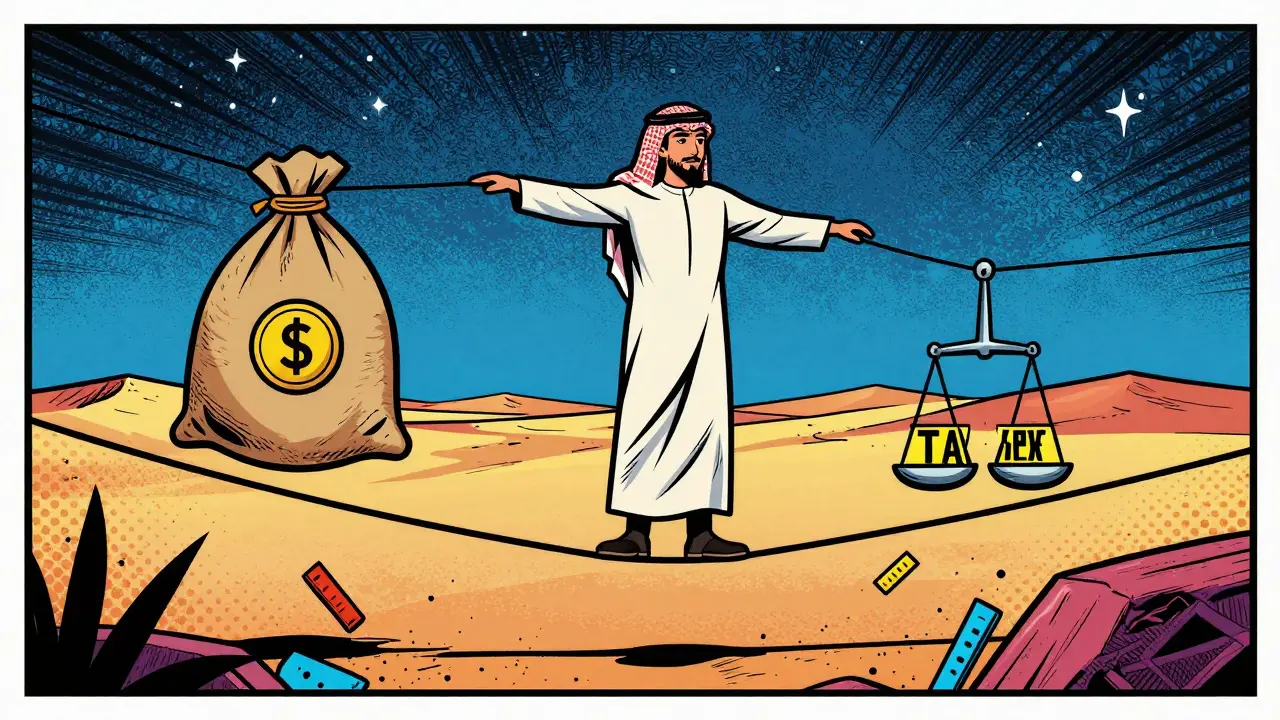
Even if you manage to trade successfully, the tax implications are complex. Crypto assets are treated as intangible assets, not legal tender. For individuals, there is currently no capital gains tax on personal crypto profits. However, this does not mean the activity is invisible.
For businesses, the picture is different. Corporate income tax stands at 20%, and capital gains may be taxed at 15%. Additionally, Zakat (typically 2.5% for Muslim-owned businesses) applies to crypto holdings. The challenge lies in reporting. Without clear guidelines from the General Authority of Zakat and Tax (GAZT), businesses must interpret existing laws broadly. Misclassification can lead to audits, fines, or penalties.
Furthermore, the Anti-Money Laundering Law (Royal Decree No. M/20) and the Law on Combating Terrorist Financing (Royal Decree No. M/21) define "funds" broadly to include assets obtained through electronic systems. This means crypto activities fall under AML/CFT oversight. Even though there is no specific crypto regulation, engaging in suspicious transactions can trigger investigations under these general laws.
Religious Acceptance vs. Regulatory Caution
A surprising development occurred recently when a high-ranking Saudi religious leader issued a fatwa confirming that Bitcoin and other cryptocurrencies align with Sharia law principles. This endorsement contrasts sharply with the banking restrictions. It suggests that within Islamic jurisprudence, crypto is permissible if used responsibly.
This religious validation may influence future policy. With 63% of Saudi’s population under 30 years old, demand for digital finance is growing. Young Saudis show higher interest in altcoins and decentralized finance (DeFi) compared to global averages. The demographic pressure, combined with religious acceptance, could push regulators toward a more nuanced framework in the coming years.
However, until comprehensive legislation is enacted-which is not expected before the late 2020s-the current stance remains cautious. Authorities prefer controlled experimentation over broad liberalization. The tension between market demand and regulatory caution defines the landscape.
What Should You Do?
If you are considering trading crypto in Saudi Arabia, proceed with extreme care. First, never use your primary Saudi bank account for direct transfers to exchanges. Second, consider using reputable P2P platforms with escrow services to mitigate counterparty risk. Third, keep detailed records of all transactions for potential tax reporting, even if current enforcement is lax.
For businesses, consult with legal experts specializing in Gulf financial regulations. Structuring your entity offshore may provide necessary banking access, but ensure compliance with both local and international laws. Monitor updates from SAMA and the Capital Market Authority (CMA), as policies may evolve as the mBridge project progresses.
The Saudi crypto market is vibrant but fragile. The banking ban protects the traditional financial system but isolates digital innovators. Until a clear regulatory bridge is built, traders must navigate this gap with caution, creativity, and respect for the law.
Is cryptocurrency illegal in Saudi Arabia?
Owning and trading cryptocurrency is not explicitly illegal for individuals in Saudi Arabia. However, it is unregulated and unrecognized as legal tender. Banks are prohibited from facilitating crypto transactions, and the government issues regular warnings about the risks involved.
Can I withdraw crypto to my Saudi bank account?
No. Saudi banks are banned from processing cryptocurrency transactions. Attempting to withdraw funds from a crypto exchange to a local Saudi bank account will likely result in the transaction being blocked or the account being flagged for review.
Do I pay tax on crypto profits in Saudi Arabia?
Individuals generally do not pay capital gains tax on personal crypto profits. However, businesses must pay corporate income tax (20%) and Zakat (2.5%). Crypto assets are treated as intangible assets, and proper reporting is required to avoid penalties.
Why is Saudi Arabia banning crypto banks but joining mBridge?
The government distinguishes between speculative cryptocurrencies (like Bitcoin) and regulated Central Bank Digital Currencies (CBDCs). mBridge focuses on secure, state-controlled digital payments for cross-border transactions, which aligns with monetary policy goals, unlike decentralized crypto.
When will new crypto laws be introduced?
As of 2026, no comprehensive crypto legislation is expected before the late 2020s. The government prefers a cautious approach, focusing on controlled experiments like CBDCs while monitoring market growth and international standards.