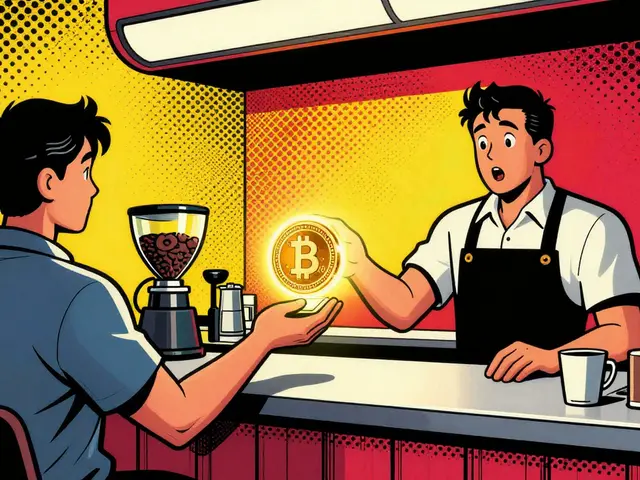
Have you ever wondered if Bitcoin’s price volatility makes it useless for buying your morning coffee? That is the exact problem Hacash (HAC) tries to solve. It bills itself as a "PoW Flatcoin"-a peer-to-peer digital currency that aims for stable purchasing power rather than just holding value like gold or swinging wildly like a tech stock.
Launched with its first block on February 4, 2019, Hacash is a programmable Proof-of-Work Layer 1 blockchain designed to stabilize purchasing power through the interaction of three assets: HAC, HACD, and BTC. While it sounds similar to Bitcoin, the mechanics under the hood are quite different. Instead of a fixed supply cap that leads to hyper-deflation, Hacash uses a dynamic monetary policy intended to keep the cost of goods relatively steady over time. If you are looking for a cryptocurrency that acts more like everyday money and less like a speculative asset, here is what you need to know about how it works, its economics, and whether it is worth your attention in 2026.
The Core Concept: What is a "Flatcoin"?
To understand Hacash, you have to look past the standard "store of value" narrative. Most people know Bitcoin as digital gold-it is scarce, so the theory goes, its price should go up forever. But if the price doubles every year, can you really use it to pay rent or buy groceries without worrying about inflation or deflation eating your wallet?
Hacash introduces the concept of a "flatcoin," which targets stable purchasing power by dynamically adjusting its supply based on economic metrics rather than pegging to a fiat currency like the US Dollar. This is distinct from stablecoins like USDT or USDC, which are centralized and backed by bank reserves. Hacash is decentralized and secured by Proof-of-Work (PoW). It attempts to track a basket of real-world value. If the global economy grows, the supply of HAC might adjust to ensure that one HAC still buys roughly the same amount of goods today as it did last year.
This approach positions HAC between two worlds:
- Bitcoin (BTC): Fixed supply, high volatility, primarily a store of value.
- Fiat Stablecoins: Pegged to USD, low volatility, but centralized and reliant on traditional banking systems.
Hacash argues that true decentralization requires a monetary policy that doesn't rely on a central bank or a corporate treasury. By using code and mining power to regulate supply, it aims to create "crypto sound money" for daily transactions.
The Three-Asset Ecosystem: HAC, HACD, and BTC
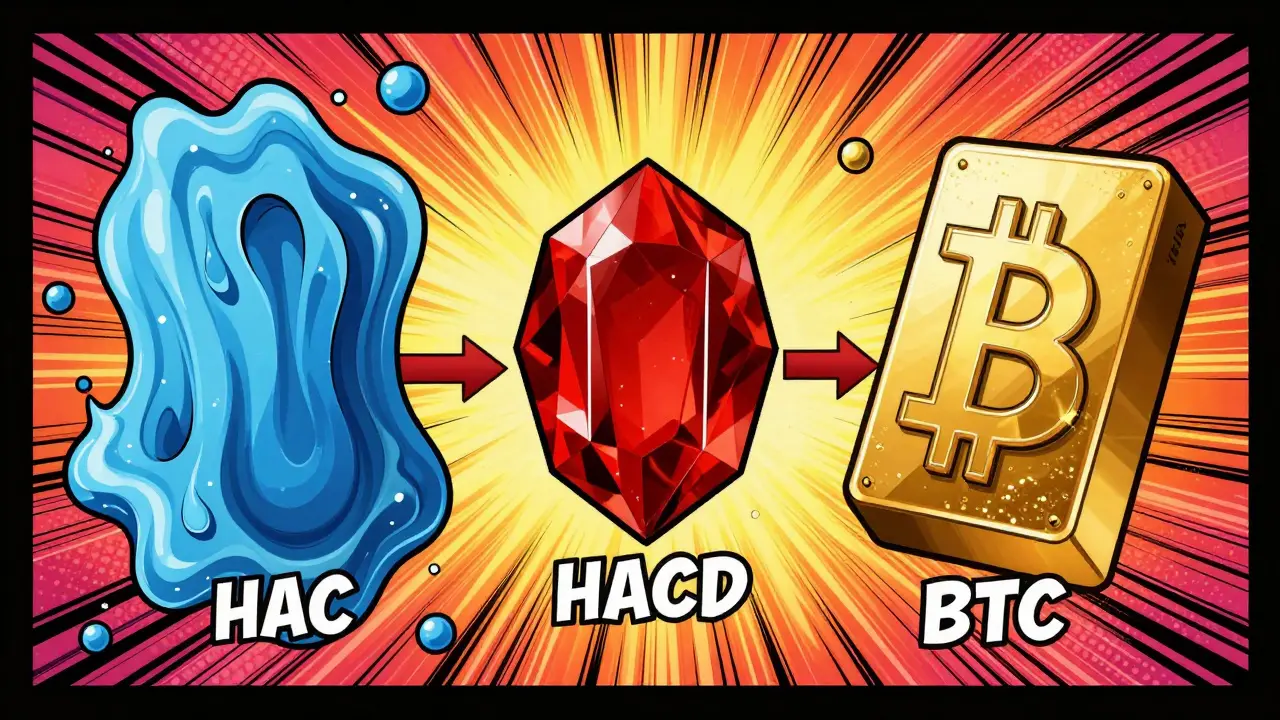
The uniqueness of the Hacash network lies in its multi-asset design. It is not just one coin; it is an ecosystem of three interconnected Proof-of-Work assets. Understanding their roles is crucial to grasping how Hacash stabilizes purchasing power.
| Asset | Symbol | Primary Function | Scarcity Model |
|---|---|---|---|
| Hacash Main Coin | HAC | Everyday payment settlement currency | Dynamic supply adjustment |
| Hacash Diamond | HACD | Scarce store of value, mined via auction | Indivisible, heterogeneous, extremely limited |
| Bitcoin | BTC | One-way collateral input to anchor value | Fixed 21 million supply (external) |
HAC is the liquid fuel of the system. You use it to pay for things. Its supply is elastic, meaning it can expand or contract slightly to match demand and maintain stability.
HACD (Hacash Diamond) is the rare gem. It is mined through a unique on-chain auction process where miners bid using HAC. HACD units are indivisible and heterogeneous, much like physical diamonds. They serve as a long-term store of value within the ecosystem, absorbing excess liquidity when the market is hot.
BTC plays a specific role too. Users can transfer Bitcoin into the Hacash system one-way. This injected value helps anchor the purchasing power of HAC, providing a bridge to the broader crypto market without compromising Hacash’s internal monetary rules.
Monetary Policy: The 66-Year Roadmap
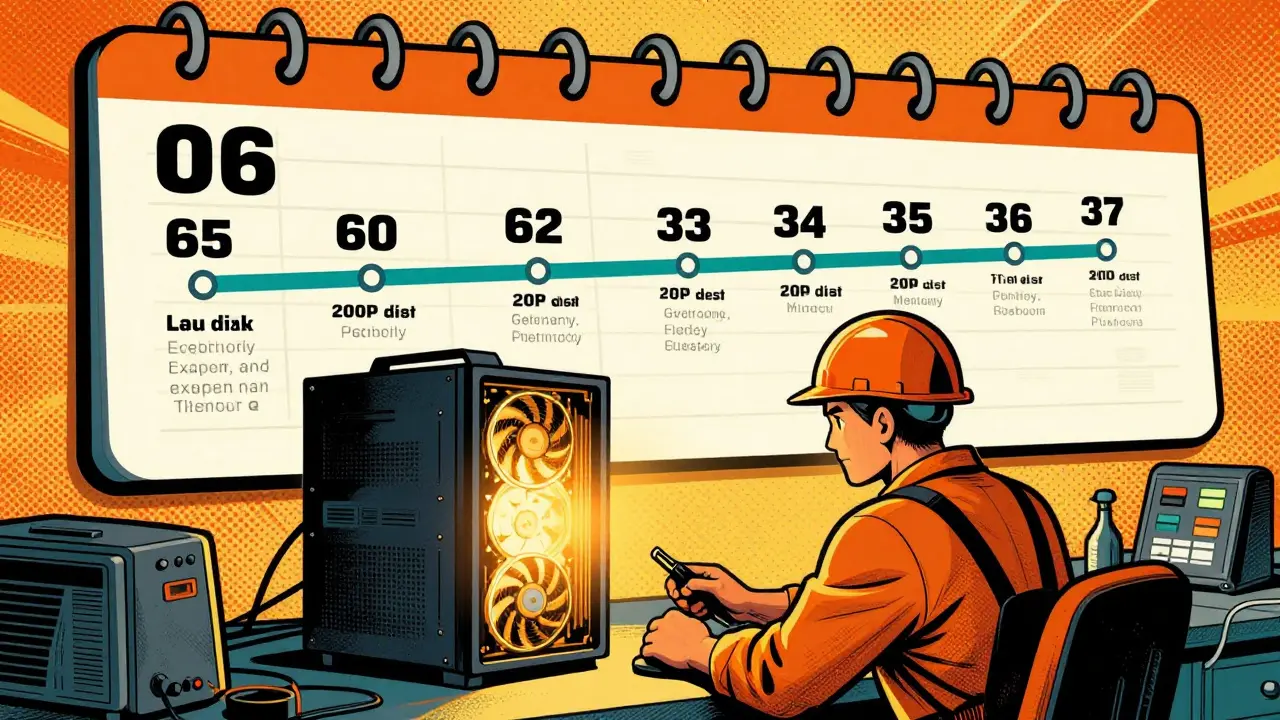
If you are used to Bitcoin’s predictable halving events every four years, Hacash’s schedule will feel complex. The project outlines a 66-year distribution plan divided into three stages. This long-term view is designed to bootstrap the network early and then transition to a stable, low-inflation environment.
- Stage 1: Growth (2020-2025 approx.) Block rewards increased rapidly to encourage adoption and liquidity. Rewards went from 1 HAC per block in 2020 up to 8 HAC per block by 2024. Adjustments happened roughly every 100,000 blocks (about once a year).
- Stage 2: Stabilization (2025-2075 approx.) Starting around 2025, the reward rate slows down significantly. The 8 HAC per block reward lasts for about a decade before dropping to 5 HAC, then 3 HAC, 2 HAC, and finally settling at 1 HAC per block. Adjustments occur every 1,000,000 blocks (roughly every 9.5 years).
- Stage 3: Permanence (2075 onwards) The network enters a permanent state with a constant block reward of 1 HAC. This provides a predictable, low level of inflation to secure the network and incentivize miners indefinitely.
The total block rewards for the first 66 years are capped at approximately 22 million HAC. Note that some data aggregators list the maximum supply as 21 million, creating a slight discrepancy. However, the official documentation emphasizes the 22 million figure derived from the block reward schedule. This structured emission prevents the "pre-mine" issues seen in many newer chains, ensuring a fair distribution to miners from day one.
Technical Architecture and Mining
Hacash runs on a programmable Proof-of-Work Layer 1 chain. Unlike Ethereum, which moved to Proof-of-Stake, Hacash insists that PoW is essential for true decentralization and security against state bloat. It supports smart contracts but aims to avoid the complexity and centralization risks associated with large validator sets.
Mining Algorithm: Hacash uses the X16RS algorithm (sometimes referred to as X16RT in older docs). This algorithm was chosen to resist ASIC dominance in the early days, allowing GPUs and CPUs to mine fairly. As of mid-2026, the network hash rate sits around 27.59 TH/s, indicating a healthy but niche mining community.
Block Time: The target block time is 5 minutes. This is faster than Bitcoin’s 10 minutes, facilitating quicker transaction confirmations for payments, while still being slow enough to prevent excessive orphan blocks.
HACD Mining: Mining HACD is different. You cannot mine it directly with hash power alone. You must run a full node, synchronize the entire blockchain, and participate in on-chain auctions using your mined HAC. This ties the utility of HAC directly to the creation of HACD, creating a closed-loop economic engine.
Market Performance and Liquidity in 2026
Let’s talk numbers. As of July 2026, Hacash is a small-cap asset. It is not trading on major exchanges like Coinbase or Binance for direct retail purchase, which limits its mainstream visibility.
- Price: Trading in the range of $0.20 to $0.35 USD.
- Market Cap: Approximately $300,000 to $600,000 USD, depending on the aggregator (CoinGecko vs. CoinPaprika).
- Circulating Supply: Around 1.3 to 1.8 million HAC.
- All-Time High: Reports vary widely, with some sources citing peaks near $62 in March 2024, while others suggest lower highs around $5. The current price represents a significant drawdown from those peaks.
Liquidity is concentrated on mid-tier exchanges like CoinEx and NonKyc.io. Daily trading volumes often hover between $10,000 and $16,000 USD. For context, Bitcoin trades billions daily. This means that buying or selling large amounts of HAC can impact the price significantly (slippage). If you are an investor, this lack of deep liquidity is a key risk factor.
The absence from top-tier regulated exchanges suggests that Hacash has not yet met the compliance or volume thresholds required for institutional listing. However, its presence on major data trackers like CoinGecko and Crypto.com indicates it is recognized as a legitimate, albeit experimental, project.
Pros and Cons of Using Hacash
Is Hacash right for you? Here is a balanced look at its strengths and weaknesses compared to other cryptocurrencies.
| Aspect | Strengths | Weaknesses |
|---|---|---|
| Decentralization | No pre-mine, fair PoW launch, no VC allocation. | Smaller hash rate than Bitcoin/Ethereum. |
| Stability | Designed for purchasing power stability, not speculation. | Still volatile due to low market cap and liquidity. |
| Adoption | Unique "flatcoin" model attracts ideological supporters. | Limited merchant acceptance; not on major exchanges. |
| Technology | Programmable PoW, integrated HACD auction system. | Complex monetary policy may confuse average users. |
The biggest advantage is the ideology. If you believe that money should be neutral and stable, and you distrust centralized stablecoins, Hacash offers a pure, code-based alternative. The integration of HACD adds a layer of depth that most simple PoW coins lack.
The biggest drawback is usability. Running a full node to mine HACD is technically demanding. Buying HAC requires navigating smaller exchanges. And because the market cap is so small, the price can swing dramatically on thin order books. It is currently more of a developer/miner project than a consumer payment solution.
How to Get Started with Hacash
If you want to explore Hacash, here is the practical path forward.
- Acquire HAC: Create an account on CoinEx or NonKyc.io. Deposit USDT or BTC and trade for HAC. Be aware of fees and slippage due to low volume.
- Storage: Use the official Hacash wallet or a compatible hardware wallet that supports HAC addresses. Never leave significant funds on an exchange.
- Mining (Optional): If you have GPU resources, configure mining software for the X16RS algorithm. Join a pool or solo mine. Remember, solo mining yields are low given the 27 TH/s network difficulty.
- HACD Auctions (Advanced): To participate in HACD mining, you must run a full node. Download the node software from hacash.org, sync the blockchain (this takes time), and use your HAC balance to bid in on-chain auctions.
For most users, simply holding HAC as a speculative bet on its monetary theory is the easiest entry point. For enthusiasts, running a node supports the network’s decentralization and gives you access to the HACD ecosystem.
Future Outlook
Hacash is entering Stage 2 of its monetary policy in 2026. The block rewards are set to remain at 8 HAC for a few more years before beginning the gradual decline toward 1 HAC. This predictability is good for miners planning long-term operations.
The project’s survival depends on building utility. Without merchants accepting HAC or developers building dApps on its Layer 1, it remains a theoretical experiment. The team continues to update documentation and maintain the network, as evidenced by recent site updates in July 2026. However, achieving mass adoption will require bridging the gap between its complex technical design and simple user experience. If it can attract more liquidity and perhaps list on a larger exchange, its potential as a "stable" PoW currency could become more tangible. Until then, it remains a fascinating niche project for those interested in the future of decentralized monetary engineering.
Is Hacash (HAC) a stablecoin?
Not in the traditional sense. HAC is called a "flatcoin." It does not peg to the US Dollar like USDT. Instead, it aims to stabilize its purchasing power over time by adjusting its supply dynamically. This means its price in USD can still fluctuate, but the goal is that one HAC buys the same amount of goods year after year.
What is the difference between HAC and HACD?
HAC is the liquid payment currency used for transactions and bidding. HACD (Hacash Diamond) is a scarce, indivisible store of value. You mine HACD by bidding with HAC in on-chain auctions. Think of HAC as cash and HACD as a rare collectible or gold bar within the ecosystem.
Can I buy Hacash on Coinbase or Binance?
As of mid-2026, Hacash is not listed on major tier-1 exchanges like Coinbase or Binance. You can typically find it on mid-tier exchanges such as CoinEx and NonKyc.io. Always check current listings as they change frequently.
Is Hacash mining profitable?
Profitability depends on your electricity costs and hardware. With a network hash rate of ~27 TH/s and a block reward of 8 HAC, it is accessible for GPU miners. However, due to HAC's low market price, profits are modest compared to mining larger coins. Use a mining calculator with the X16RS algorithm to estimate returns.
What is the maximum supply of HAC?
Official documentation states that 22 million HAC will be emitted through block rewards over the first 66 years. Some data sites list 21 million, likely due to rounding or interpretation differences. The supply is not strictly capped like Bitcoin's 21 million; instead, it transitions to a permanent 1 HAC per block reward after 2075.