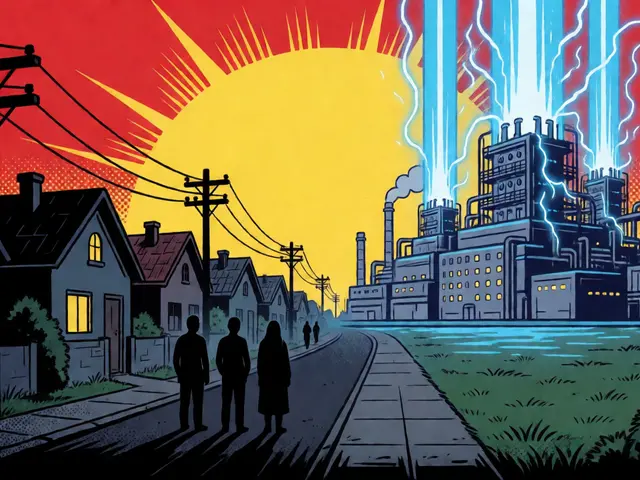
Imagine turning on your air conditioner during a scorching 45°C summer day in Tehran, only to have the power cut out for fourteen hours. Now imagine that while your home sits in darkness, a massive industrial complex nearby is humming with enough electricity to keep thousands of specialized computers running at full tilt. This isn't a hypothetical scenario; it’s the daily reality for many Iranians. The culprit? State-controlled crypto mining is not just an economic activity in Iran; it is a strategic lifeline for the regime, deeply entangled with the Islamic Revolutionary Guard Corps (IRGC) and designed to bypass crippling international sanctions.
You might think cryptocurrency is all about decentralization and freedom from government control. But in Iran, the story flips on its head. Here, the state doesn’t just regulate mining; it owns it, protects it, and profits from it. Since officially recognizing mining as a legal industry in July 2018 under President Hassan Rouhani, Iran has transformed into one of the world’s top three Bitcoin miners, accounting for roughly 4.5% of the global hash rate by 2022. But this dominance comes at a steep price: chronic energy shortages, political corruption, and a constant cat-and-mouse game with global financial watchdogs like Tether.
The Sanctions Workaround: Why the State Wants In
Why would a government obsessed with controlling its economy embrace volatile digital assets? The answer lies in isolation. U.S. sanctions have effectively locked Iranian banks out of the SWIFT system, making traditional cross-border transactions nearly impossible. For the Iranian government, particularly entities linked to Supreme Leader Ali Khamenei and the IRGC, cryptocurrency offers a backdoor. By mining Bitcoin using domestically produced, heavily subsidized electricity, the state can generate foreign currency without ever touching a Western bank account.
This strategy turned into a gold rush between 2019 and 2020. Powerful political factions partnered with Chinese investors to build massive mining farms. These weren’t small garage operations; we’re talking about facilities like the 175-megawatt farm in Rafsanjan, Kerman province. The economics are staggering when you look at the inputs. While commercial electricity rates globally hover around $0.10 per kWh, Iranian mining operations often pay as little as $0.004 per kWh. That’s fifty times cheaper than the global average. It creates a profit margin so wide that even if Bitcoin prices dip, the operation remains profitable. This cheap energy advantage allows Iran to compete with miners in Texas or Kazakhstan, despite having older infrastructure and less reliable hardware.
The Energy Crisis: Who Pays the Price?
If the state makes money, who loses? You guessed it: the regular citizens and local industries. The core conflict in Iran’s crypto sector is the diversion of national resources. The grid wasn’t built to handle the sudden spike in demand from hundreds of megawatts of ASIC miners. When the IRGC and other state-affiliated entities run their farms at full capacity, they draw power directly from the national grid, often leaving factories and homes scrambling for supply.
| Factor | State-Affiliated Miners | Regular Citizens/Industry |
|---|---|---|
| Electricity Cost | ~$0.004 - $0.07 per kWh (Subsidized/Licensed) | Standard residential/commercial rates (Higher relative cost) |
| Power Reliability | Prioritized access, dedicated feeds on military bases | Frequent blackouts, especially in summer/winter peaks |
| Regulatory Oversight | Minimal scrutiny, protected by security apparatus | Strict enforcement, fines for illegal usage |
| Economic Benefit | Foreign currency generation for elite networks | Inflationary pressure, reduced industrial output |
Investigative reports describe this dynamic as a "crypto cartel." Facilities operate on IRGC-controlled military bases or within special economic zones, enjoying dedicated power feeds that bypass normal load-balancing restrictions. Meanwhile, documented cases show power outages lasting days across multiple provinces. During the heatwaves of May 2024, social media erupted with complaints under hashtags like #IranEnergyCrisis. One verified report noted a 14-hour blackout in District 3 of Tehran while nearby IRGC-linked mines continued operating uninterrupted. It’s a tangible example of how political connections trump public utility needs.
Hiding in Plain Sight: The Ahvaz Stadium Case
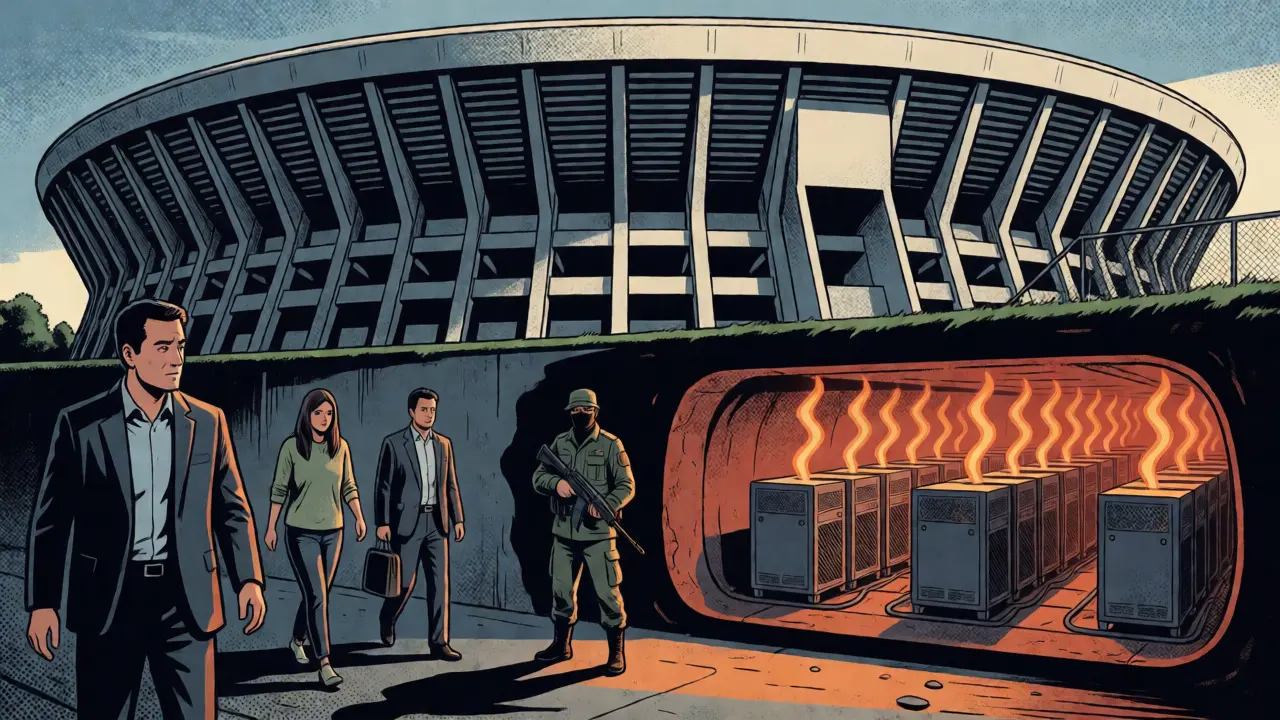
Not all state-protected mining is openly advertised. Some operations hide in plain sight, exploiting regulatory gaps and physical concealment. A striking example occurred in Ahvaz, where authorities discovered a large-scale mining operation hidden inside the Shahid Ghorbani Sports Complex. For over two years, miners ran rigs in tunnels beneath the cycling track and in service rooms housing electrical systems. The facility covered 16 hectares, yet it went undetected because it was shielded by the prestige of the sports complex and likely the protection of powerful patrons.
This case highlights the inconsistency of enforcement. The Ministry of Industry, Mine and Trade requires licenses, specific tariffs, and approved hardware. However, enforcement is patchy. If you’re a small entrepreneur trying to go legal, you face a six-to-eight-week licensing process and mandatory use of government-approved hardware, which can reduce efficiency by 15-20%. If you’re connected to the right faction, you might not need a license at all. This dual system breeds resentment. Ordinary Iranians see their factories shutting down due to power rationing while knowing that well-connected elites are minting Bitcoin underground.
The Tether Freeze and Financial Whack-a-Mole
As Iran’s mining output grew, so did international scrutiny. Cryptocurrencies were meant to be censorship-resistant, but stablecoins like USDT (Tether) are centralized. On July 2, 2025, Tether executed its largest-ever freeze of Iranian-linked funds, blocking 42 addresses associated with Nobitex, Iran’s largest domestic exchange, and various IRGC wallets. This move, flagged by the Israeli National Bureau for Counter Terrorist Financing, disrupted established transaction patterns overnight.
How does the state respond to such freezes? Adaptation. Following the freeze, there was a government-coordinated push urging users to offload USDT holdings in favor of DAI via the Polygon network. This shift demonstrates a surprising sophistication in navigating financial restrictions. Instead of abandoning crypto, Iranian actors pivot to different chains and stablecoins that might be less immediately targeted. It’s a high-stakes game of whack-a-mole with global compliance firms. Every time a major player like Tether blocks addresses, the Iranian ecosystem migrates, often leading to increased fragmentation and higher transaction costs for ordinary users.

Regulatory Chaos: From Ban to Tax
The legal landscape for crypto in Iran is anything but stable. In early 2025, the Central Bank of Iran (CBI) ordered the closure of rial payment gateways for cryptocurrency exchanges, citing transparency issues. The CBI argued that billions of dollars were flowing through these platforms without tax payments or visible financial statements. This created a liquidity crunch for traders who couldn’t easily convert crypto to rials.
Then came the partial reversal in January 2025, which allowed gateways to reopen but required government API access for "full user data." Essentially, every legal trade became a surveilled event. By August 2025, the government enacted the "Law on Taxation of Speculation and Profiteering," imposing capital gains tax on cryptocurrency trading for the first time. This formally positioned digital assets alongside gold and real estate as speculative assets subject to state taxation. The goal is clear: capture revenue from a sector that previously operated in the shadows. But for the miner, this adds another layer of complexity. You now need to navigate licensing, hardware restrictions, surveillance APIs, and new tax codes, all while competing against unregulated state-backed giants.
Future Outlook: Sustainability vs. Survival
Where does this leave Iran’s crypto future? The regime faces a trilemma. First, it needs crypto to evade sanctions and generate foreign reserves. Second, it must prevent capital flight by keeping citizens’ wealth within the national economy. Third, it has to manage an energy crisis that threatens social stability. Currently, the balance tilts toward survival through extraction. The state continues to prioritize mining revenues over equitable energy distribution.
Experts warn that this model is unsustainable. The tension between regulatory ambitions and economic necessity is widening. As international pressure mounts-evidenced by actions from Tether and potential future sanctions on mining hardware imports-the cost of maintaining this parallel economy will rise. If the government cannot modernize its grid or enforce fairer energy allocation, the social unrest sparked by blackouts could outweigh the benefits of mined Bitcoin. For now, however, the lights stay on for the miners, while the rest of the country waits in the dark.
Is cryptocurrency mining legal in Iran?
Yes, but it is strictly regulated. Legal operations require a license from the Ministry of Industry, Mine and Trade, must use government-approved hardware, and pay specific electricity tariffs. However, many state-affiliated operations operate with minimal oversight.
Why is electricity so cheap for Iranian miners?
The Iranian government subsidizes energy heavily. Licensed miners pay significantly lower rates than the global average (sometimes as low as $0.004 per kWh), which provides a competitive edge in profitability despite less efficient infrastructure.
How does state-controlled mining affect the Iranian people?
It contributes to frequent power outages, especially during peak seasons. Resources diverted to mining farms often lead to blackouts for homes and businesses, causing frustration and economic disruption for ordinary citizens.
What happened with Tether freezing Iranian funds?
In July 2025, Tether froze 42 addresses linked to Iranian exchanges and the IRGC. This forced Iranian users to migrate to other stablecoins like DAI and alternative networks like Polygon to maintain liquidity and avoid further sanctions exposure.
Can ordinary Iranians mine Bitcoin legally?
Yes, but it is difficult. They must obtain a license, buy approved hardware, and pay higher electricity rates than state entities. Many find the process bureaucratic and expensive, leading some to mine illegally or simply trade rather than mine.