Remember when you could trade perpetual futures on Solana with up to 10x leverage and keep full custody of your assets? That was Mango Markets. But if you are looking to sign up today, you have bad news. Mango Markets is a decentralized cryptocurrency exchange (DEX) built on the Solana blockchain that launched in 2021 and permanently shut down in January 2025. The platform announced its complete cessation of operations, advising all remaining users to close their positions immediately. For anyone reading this in 2026, Mango Markets is no longer a viable option for trading. It serves as a critical case study in DeFi security, oracle vulnerabilities, and the rapid lifecycle of crypto projects.
This review isn't about how to use Mango Markets-it's about understanding why it failed, what happened to the funds, and what lessons remain for traders who still want exposure to Solana-based derivatives. We will look at the features that made it popular, the catastrophic exploit that broke it, the legal aftermath involving trader Avraham Eisenberg, and where you should go instead in 2026.
What Was Mango Markets?
Mango Markets positioned itself as a bridge between centralized finance (CeFi) liquidity and decentralized finance (DeFi) self-custody. Launched in 2021 by co-founders Maximilian Schneider and Daffy Durairaj, it aimed to solve a specific pain point: the lack of advanced trading tools on blockchains other than Ethereum. At the time, Ethereum dominated DeFi but suffered from high gas fees and slow transaction speeds. Solana offered speed and low costs, but lacked sophisticated order books and margin trading infrastructure.
The platform provided several core features that attracted professional and retail traders alike:
- Spot Trading: Direct exchange of tokens using an automated market maker (AMM) model combined with limit orders.
- Margin Trading: Users could borrow against their collateral to increase position size, with leverage options ranging from 5x to 10x.
- Perpetual Futures: Contracts that track the price of underlying assets without an expiration date, allowing traders to bet on price movements without owning the asset.
- Lending & Borrowing: A permissionless lending market where users could earn interest on deposits or take out fully collateralized loans.
Unlike centralized exchanges like Binance or FTX, Mango never held user keys. Your assets remained in your wallet until you explicitly approved a smart contract interaction. This "non-custodial" approach was its biggest selling point. You had control, but you also bore the risk. If the smart contract failed, there was no customer support team to refund you.
The Core Vulnerability: Oracle Manipulation
To understand why Mango Markets collapsed, you need to understand how it priced assets. In DeFi, protocols need a reliable source of price data. This is called an oracle-a system that feeds real-world data, such as asset prices, into a blockchain. Mango Markets relied on price oracles fed by external exchanges like FTX, AscendEX, and Serum.
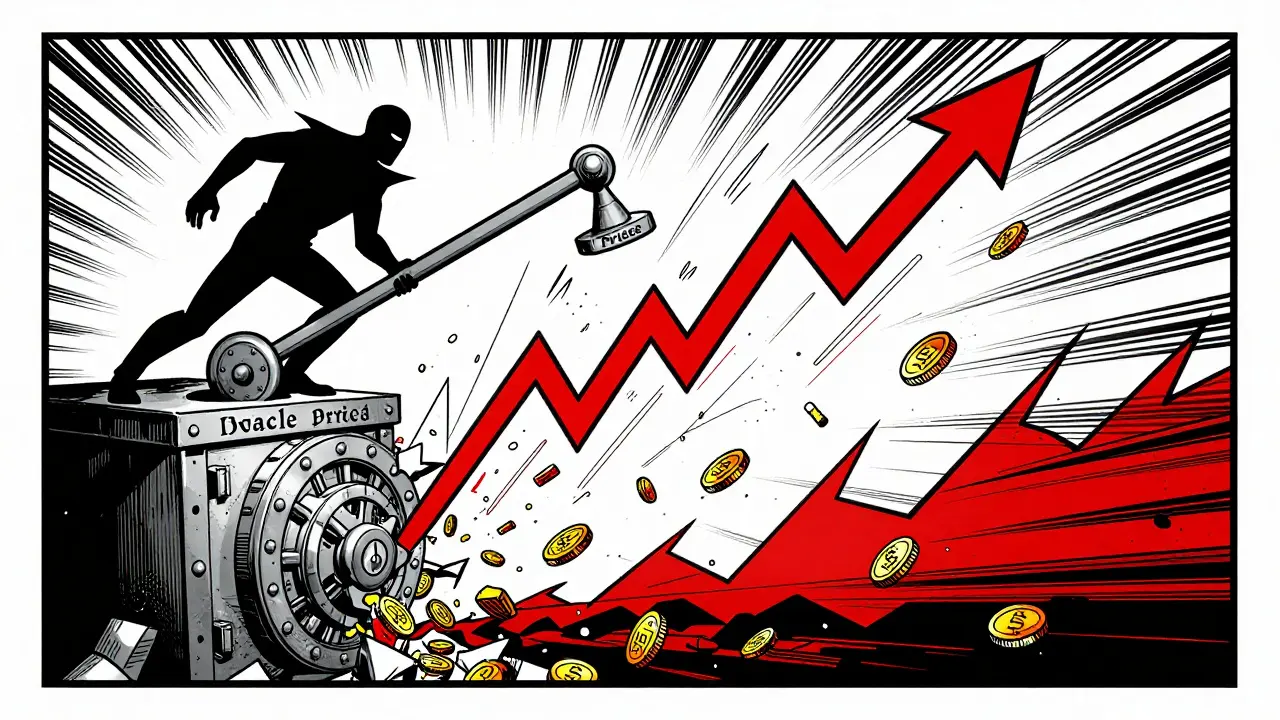
The problem? These oracles were not robust enough to handle coordinated manipulation. They took the last traded price from these exchanges as truth. If someone bought a large amount of MNGO (Mango's native token) on one of those exchanges, the price would spike instantly. Mango's smart contract would see this spike and assume the value of all MNGO collateral on its platform had increased.
This design flaw created a fatal weakness. A malicious actor could artificially inflate the price of MNGO, use that inflated value as collateral to borrow massive amounts of stablecoins (like USDC), and then dump the MNGO, crashing the price back down. The borrowed funds were now theirs to keep, while the protocol was left with worthless collateral.
The $116 Million Exploit: October 2022
On October 11, 2022, crypto trader Avraham 'Avi' Eisenberg executed exactly this attack. Here is how it unfolded, step by step:
- Setup: Eisenberg deposited $5 million worth of USDC into two separate Mango Markets accounts.
- Offsetting Positions: He opened long and short positions in MNGO Perpetual contracts to hedge his initial risk.
- Price Manipulation: He used capital to buy large amounts of MNGO on exchanges connected to Mango’s oracles (FTX, AscendEX, Serum). This caused the MNGO price to skyrocket.
- Collateral Inflation: Mango’s smart contracts saw the higher price and allowed Eisenberg to borrow significantly more funds, treating his MNGO holdings as highly valuable collateral.
- Extraction: He borrowed over $100 million in USDC and other assets from the protocol.
- The Dump: He sold off the MNGO tokens he had bought, crashing the price back to reality. His short positions profited immensely, and he withdrew the borrowed funds.
The total loss exceeded $116 million in crypto assets. The exploit drained the liquidity pool, leaving legitimate lenders and traders with empty vaults. While Eisenberg later returned $67 million through a DAO-mediated settlement, approximately $40 million vanished forever. This event fundamentally undermined user confidence and proved that the platform’s risk management systems were insufficient for its scale.
Legal Aftermath and Regulatory Scrutiny
The fallout from the exploit extended far beyond the code. Eisenberg was arrested in December 2022 on charges of fraud and market manipulation. The case became a landmark test for how traditional courts interpret crimes in decentralized environments.
In April 2024, a jury convicted Eisenberg of commodities fraud, commodities manipulation, and wire fraud after a nine-day trial. He faced up to 20 years in prison. However, the legal landscape shifted dramatically in May 2025. U.S. District Judge Arun Subramanian issued a 35-page ruling vacating all criminal convictions against Eisenberg, granting his motion for acquittal. The judge’s opinion detailed significant issues with the prosecution’s evidence and interpretation of market manipulation laws in the context of DeFi.
Simultaneously, the Securities and Exchange Commission (SEC) pursued civil enforcement actions. As part of the broader regulatory pressure and the inability to recover all losses, Mango Markets’ team decided to wind down operations entirely. By January 2025, borrowing was no longer economically viable, and the platform ceased all services. This shutdown highlights the increasing regulatory scrutiny on DeFi platforms, especially those offering leveraged products that resemble securities.
Mango Markets vs. Alternatives in 2026
If you were a Mango Markets user, you likely valued low fees, fast transactions, and leverage. Today, the Solana ecosystem has evolved. Several alternatives offer similar features with improved security models, particularly regarding oracle design.
| Feature | Mango Markets (Defunct) | Raydium | Jupiter Aggregator | Drift Protocol |
|---|---|---|---|---|
| Status | Shut Down (Jan 2025) | Active | Active | Active |
| Type | DEX / Perps | AMM / Spot | Aggregator | DEX / Perps |
| Max Leverage | Up to 10x | N/A (Spot only) | Varies by route | Up to 20x+ |
| Oracle Security | Vulnerable (Single Source) | Pyth / Chainlink | Multi-Source | Pyth / Switchboard |
| User Custody | Non-Custodial | Non-Custodial | Non-Custodial | Non-Custodial |
Raydium remains a top choice for spot trading on Solana due to its deep liquidity and integration with Serum’s central limit order book (now migrated). It uses multiple oracle sources like Pyth and Chainlink, reducing the risk of single-point manipulation.
Jupiter is not a standalone exchange but an aggregator. It finds the best prices across dozens of Solana DEXes, including Raydium and Orca. For most users, Jupiter provides the easiest interface and best execution rates for spot trades.
Drift Protocol emerged as a direct competitor to Mango in the perpetual futures space. It offers higher leverage and employs more robust oracle mechanisms, including time-weighted average prices (TWAP) to prevent flash-crash exploits. If you miss Mango’s perps, Drift is the closest functional alternative.

Lessons Learned for DeFi Traders
The rise and fall of Mango Markets teaches us three critical lessons for navigating DeFi in 2026:
- Oracle Design Matters: Never trust a single price feed. Protocols must use multiple independent oracles and implement time delays or circuit breakers to detect anomalous price spikes. The Mango exploit showed that even small pools on peripheral exchanges can manipulate mainnet prices if the oracle logic is flawed.
- Leverage Is Double-Edged: While 10x leverage sounds attractive, it amplifies both gains and losses. In a volatile market, liquidation cascades can wipe out accounts in seconds. Always monitor your collateral ratio closely.
- Regulatory Risk Is Real: DeFi is not outside the law. The SEC’s involvement in Mango’s shutdown signals that regulators are watching leveraged products closely. Platforms that offer features resembling securities may face forced closures or restrictions.
For developers, the open-source nature of Mango allowed the community to audit its code, but audits alone cannot fix fundamental design flaws in economic incentives. Future protocols must prioritize resilience over complexity.
Final Verdict
Mango Markets was an innovative project that brought advanced trading tools to Solana. Its non-custodial model and low fees appealed to many users. However, its reliance on vulnerable oracles led to a devastating $116 million exploit in 2022. Combined with legal battles and regulatory pressure, the platform could not recover. As of January 2025, Mango Markets is completely shut down.
If you are looking for Solana-based trading, do not attempt to interact with old Mango contracts-they are inactive and potentially unsafe. Instead, consider established alternatives like Raydium for spot trading or Drift Protocol for perpetuals. Always verify the current status of any DeFi platform before depositing funds, and remember that in decentralized finance, you are your own bank-and your own security team.
Is Mango Markets still operational in 2026?
No. Mango Markets permanently shut down all operations in January 2025. Users were advised to close positions and withdraw funds before the shutdown. The platform is no longer accessible for trading.
What happened to the funds lost in the Mango Markets exploit?
The October 2022 exploit resulted in a loss of over $116 million. Trader Avraham Eisenberg returned $67 million through a settlement mediated by the Mango DAO. Approximately $40 million was never recovered and is considered lost to the protocol and its users.
Was Avraham Eisenberg convicted for the Mango Markets hack?
Eisenberg was initially convicted in April 2024 for fraud and market manipulation. However, in May 2025, a U.S. District Judge vacated all criminal convictions, granting him an acquittal. Civil enforcement actions by the SEC continued alongside the criminal proceedings.
Why did Mango Markets fail despite being on Solana?
Mango Markets failed primarily due to a critical vulnerability in its price oracle system, which allowed for manipulation. The resulting $116 million exploit destroyed user trust. Additionally, regulatory pressure from the SEC and the complexity of recovering funds contributed to its decision to shut down in 2025.
What are the best alternatives to Mango Markets on Solana?
For spot trading, Raydium and Jupiter Aggregator are top choices. For perpetual futures and margin trading, Drift Protocol is a leading alternative. These platforms employ more robust oracle systems and have active development teams ensuring ongoing security updates.
Can I still hold MNGO tokens?
While you may still hold MNGO tokens in your wallet, they have no utility since the platform has shut down. The token was used for governance and fee discounts on Mango Markets. With the platform closed, these functions are obsolete. Check current market listings for any residual speculative value, but expect limited functionality.