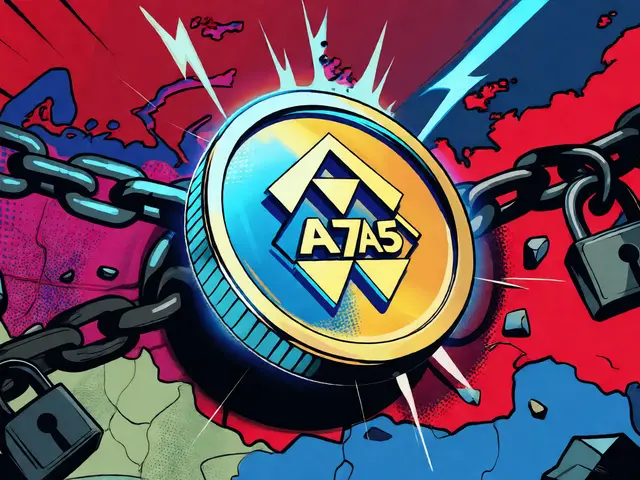
Imagine moving $9.3 billion in just four months without touching a traditional bank account that might freeze your funds. That is not a hypothetical scenario; it is the reality of the A7A5 token, a ruble-backed cryptocurrency designed specifically to circumvent Western financial restrictions. Since its launch, this digital asset has become a critical lifeline for Russian entities trying to keep money flowing despite unprecedented economic pressure. But how exactly does a custom token on a blockchain manage to slip through the net of over 2,700 UK sanctions and similar US measures? The answer lies in a sophisticated web of shell companies, rebranded exchanges, and strategic jurisdictional arbitrage.
The Rise of the A7A5 Token and Ruble-Backed Crypto
At the heart of Russia’s latest evasion strategy is the A7A5 token. Unlike Bitcoin or Ethereum, which are decentralized and often volatile, A7A5 is pegged to the Russian ruble. This design choice is deliberate. It allows users to convert sanctioned fiat currency into a digital format that can move across borders with relative ease. Issued by a firm based in Kyrgyzstan, the token operates on both the TRON and Ethereum blockchains. Why two chains? Redundancy. If regulators crack down on one network, the other remains operational. In its first four months, A7A5 processed billions in transactions, acting as a bridge between the isolated Russian financial system and global crypto markets. This isn't just about convenience; it's about survival for businesses cut off from SWIFT and correspondent banking relationships.
Kyrgyzstan: The New Financial Gateway
You might wonder why Kyrgyzstan, a small Central Asian nation, plays such a pivotal role. Historically, countries like Cyprus or the UAE served as financial hubs for Russian capital. Now, attention has shifted. Kyrgyzstan offers a combination of laxer regulatory oversight and geographic proximity to Russia. The centerpiece of this shift is Capital Bank, led by director Kantemir Chalbayev. This institution acts as the on-ramp and off-ramp for crypto flows. It connects traditional banking systems with the opaque world of digital assets, allowing military goods procurement and general trade settlements to proceed. By routing money through Kyrgyz banks, Russian entities create a layer of separation that makes tracing the ultimate beneficiary significantly harder for Western intelligence agencies.
From Garantex to Grinex: The Rebranding Game
Sanctions enforcement often feels like playing whack-a-mole. When authorities sanction an exchange, the operators simply rename it and continue business. This happened with Garantex, a major crypto platform previously designated by the US Treasury. After law enforcement actions in early 2025 effectively froze Garantex’s operations, its infrastructure didn’t vanish. Instead, officers transferred customer deposits to a new entity called Grinex. Promotional materials for Grinex explicitly admitted it was formed in response to sanctions against Garantex. This seamless transition allowed billions of dollars in crypto to continue flowing. Recently, the US Office of Foreign Assets Control (OFAC) caught up, designating Grinex itself for sanctions, but the pattern suggests more replacements will emerge. The speed of these transitions highlights the agility of these networks compared to the slower pace of bureaucratic regulation.
| Entity Name | Type | Status | Primary Function |
|---|---|---|---|
| A7A5 Token | Cryptocurrency | Active | Ruble-backed bridge for cross-border payments |
| Garantex | Exchange | Sanctioned/Replaced | Original liquidity provider before legal action |
| Grinex | Exchange | Sanctioned (Oct 2025) | Successor to Garantex, handling migrated deposits |
| Capital Bank | Banking Institution | Active | Fiat-to-crypto conversion gateway in Kyrgyzstan |
| Ilan Shor | Political Figure | Sanctioned | Alleged conduit for political influence funding via crypto |

Political Influence and Ilan Shor’s Wallets
Crypto isn't just used for buying microchips; it’s also fueling geopolitical influence. Leaked data from September 2025 revealed the extent of activities linked to Ilan Shor, a Moldovan politician sanctioned for undermining democratic elections. Analysis by blockchain intelligence firm Elliptic showed that wallets associated with Shor and related businesses received $8 billion in stablecoin transactions over 18 months. These funds weren't just sitting idle. They were used to pay networks of political activists and manage apps designed to sway public opinion in Moldova. This demonstrates how cryptocurrency enables rapid, borderless disbursement of funds for soft power projects, bypassing the need for formal aid packages that might be scrutinized by international observers.
Regulatory Crackdowns: The EU and UK Response
Western governments are no longer watching passively. The European Union’s 19th package of sanctions marked a turning point by directly targeting "dirty" Russian crypto schemes. For the first time, the EU banned transactions on specific platforms known to facilitate evasion. Similarly, the UK government announced in October 2025 that it was targeting the Grinex and Meer exchanges alongside the A7A5 infrastructure. These moves signal a shift from broad economic sanctions to surgical strikes on the digital plumbing that keeps the Russian economy afloat. Organizations like Transparency International have been instrumental here, publishing reports like "Crypto Laundromat" that exposed how Moscow City towers host conveyor-belt cash-out operations using shell individuals to bypass Know Your Customer (KYC) checks.

The Technical Obfuscation Layer
Why is it so hard to stop these flows? The technical architecture involves multiple layers of obfuscation. Money doesn't just go from Bank A to Exchange B. It might start as rubles, convert to A7A5 tokens on TRON, swap for USDT on Ethereum, pass through a Kyrgyz bank, and finally exit as euros in a different jurisdiction. Each step adds complexity. Furthermore, the use of custom tokens like A7A5 means there is no established market price or liquidity depth that traditional monitoring tools easily track. Compliance firms like Elliptic have had to update their screening protocols to recognize these niche assets, adding support for A7A5 on both major blockchains. This cat-and-mouse game drives innovation on both sides: evaders find new loopholes, and regulators develop better tracking algorithms.
Implications for the Global Crypto Industry
This situation raises uncomfortable questions for the broader cryptocurrency community. Is crypto inherently a tool for sanctions evasion, or is it being misused by specific actors? The sophistication of Russia’s approach-using purpose-built tokens and integrated banking partners-shows that generic compliance measures aren't enough. Exchanges must now perform deeper due diligence on the origins of their user bases. The rapid replacement of Garantex with Grinex proves that shutting down one platform doesn't kill the network effect if the underlying technology and relationships remain intact. As Oxford Analytica noted in late 2025, while these methods provide short-term relief for Russia, they invite increasing regulatory scrutiny that could stifle legitimate crypto growth in the region.
What is the A7A5 token?
The A7A5 token is a ruble-backed cryptocurrency issued by a Kyrgyzstani firm. It is designed to help Russian entities bypass Western sanctions by converting sanctioned rubles into a digital asset that can be traded on international blockchains like TRON and Ethereum.
Why did Garantex become Grinex?
Garantex was sanctioned by the US, leading to frozen assets and halted operations. Its operators created Grinex to transfer customer deposits and continue providing exchange services, effectively rebranding to evade the direct impact of the sanctions until Grinex itself was designated.
How does Kyrgyzstan fit into Russia's crypto strategy?
Kyrgyzstan serves as a financial gateway where traditional banks, like Capital Bank, interface with crypto exchanges. This location allows Russian entities to convert fiat to crypto and vice versa outside of jurisdictions with strict Western-aligned regulations, facilitating easier movement of funds.
What role does Ilan Shor play in crypto sanctions evasion?
Leaked data indicates that wallets linked to Ilan Shor received billions in stablecoins. These funds were reportedly used to finance political activists and influence campaigns in Moldova, demonstrating how crypto facilitates rapid, untraceable payments for geopolitical goals.
Are Western sanctions effective against crypto?
They are becoming more effective but face challenges. While traditional banking sanctions work well, crypto allows for quick rebranding and jurisdiction hopping. Recent EU and UK actions show a shift toward targeting specific crypto platforms and tokens, improving the precision of enforcement.