
Back in 2019, Bithumb Singapore looked like a game-changer for crypto traders in Southeast Asia. With a flat 0.05% trading fee-far below the industry average-it promised to cut costs for anyone doing regular trades. It was registered in Singapore, a jurisdiction known for clear crypto rules, and backed by Bithumb, one of South Korea’s biggest exchanges. But today? The website is gone. The platform doesn’t respond. No login page. No customer support. Just a dead link. If you’re searching for Bithumb Singapore right now, you’re not alone-and you’re out of luck.
What Was Bithumb Singapore?
Bithumb Singapore started as Bitholic, a smaller crypto platform that Bithumb acquired and rebranded in August 2019. Its goal was simple: bring Bithumb’s low-fee trading model to Singapore’s growing crypto scene. Unlike many exchanges, it didn’t accept bank transfers or credit cards. You couldn’t buy crypto with USD or SGD directly. You had to already own Bitcoin, Ethereum, or another coin, then send it over to trade. That made it a niche tool-not for beginners, but for experienced traders who already had a crypto portfolio elsewhere.
Its fee structure was the real draw. Most exchanges charge 0.10% to 0.25% per trade. Bithumb Singapore charged 0.05%-no matter if you were making or taking orders. That’s half the rate of major competitors like Binance or Kraken at the time. For someone trading $10,000 a week, that meant saving $50 a week, or $2,600 a year. That’s serious money for high-frequency traders.
Why Did It Shut Down?
No official announcement was ever made. No press release. No email to users. One day, the site just stopped working. Exchange tracking sites like CoinMarketCap and CoinGecko marked it as "dead" in late 2023. There’s no public record of regulatory action, bankruptcy filings, or security breaches. But the clues point to a few likely reasons.
First, Singapore’s crypto exchange market got crowded. By 2022, over 20 licensed crypto platforms were operating there. Many offered lower fees, better UIs, fiat on-ramps, and margin trading. Bithumb Singapore offered none of that. It was a single-product exchange: low-fee crypto-to-crypto trading. That’s not enough to keep users loyal when alternatives like Bybit, KuCoin, or Crypto.com started offering staking, lending, and even crypto debit cards.
Second, its business model was too narrow. No fiat deposits meant no new users. Every new trader had to come from another exchange. That’s a leaky funnel. Meanwhile, Bithumb’s main platform in South Korea was struggling with its own regulatory pressure and security incidents. Resources were likely pulled back to protect the core business.
Third, Singapore’s regulatory environment tightened. While still crypto-friendly, the Monetary Authority of Singapore (MAS) started requiring stricter AML/KYC controls. Operating a crypto-only exchange without fiat access may have become too risky or too expensive to maintain under new compliance rules.
What Did It Offer?
Even though it’s gone, it’s worth remembering what it did well:
- Trading fees: 0.05% flat fee on all trades-among the lowest in the world at the time.
- Cryptocurrency deposits only: No bank transfers. You needed to bring your own crypto.
- Withdrawal fees: 0.001 BTC for Bitcoin withdrawals. Slightly higher than average but still reasonable.
- Supported assets: Around 100+ cryptocurrencies, mostly major coins and popular altcoins.
- Security: Cold storage, two-factor authentication, and fund insurance-standard for reputable exchanges.
- Regulation: Registered with Singapore’s MAS, giving it legal legitimacy in a key market.
But here’s what it didn’t offer: margin trading, staking, lending, fiat on-ramps, mobile apps, or customer support in multiple languages. It was a stripped-down, no-frills trading engine. That’s fine if you know what you’re doing. But if you were looking for anything beyond spot trading, you were out of luck.
Who Was It For?
Bithumb Singapore wasn’t for new crypto buyers. It wasn’t for people who wanted to buy Bitcoin with their credit card. It wasn’t for those who needed help setting up their first wallet.
It was for:
- Traders who already held crypto and wanted to move between coins cheaply.
- High-volume traders who saved thousands a year on fees.
- People in Asia who wanted a regulated, non-US platform with low costs.
If you were doing 50 trades a month with $5,000 each, you saved $125 per month. That’s $1,500 a year. For many, that was the whole reason to use it.
What Happened to Your Funds?
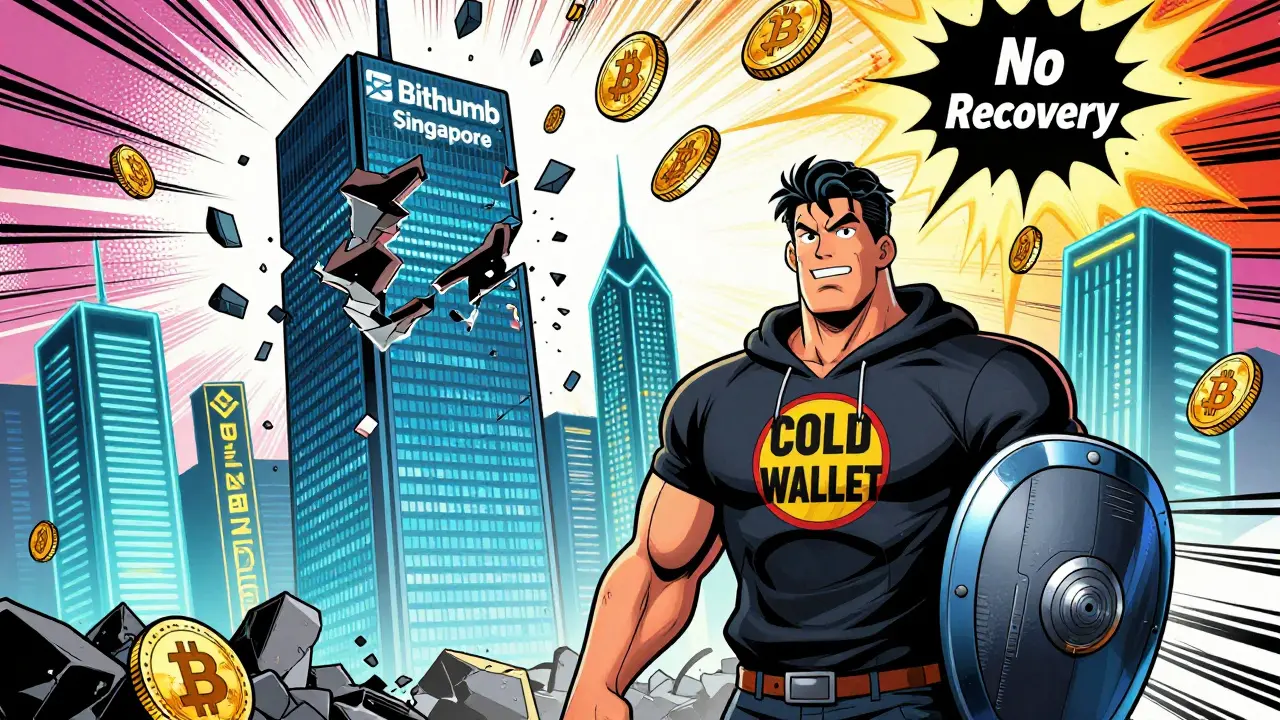
If you had crypto on Bithumb Singapore when it shut down, you lost access. There was no migration plan. No customer service to help you withdraw. No refunds. No announcements. The platform just vanished.
This is a harsh lesson: never keep large amounts on any exchange you don’t fully trust. Even if it’s registered, even if it has low fees, even if it looks stable. Exchanges can disappear overnight. That’s why cold wallets exist.
Users who kept their funds in hardware wallets like Ledger or Trezor were unaffected. Those who left coins on Bithumb Singapore? They’re gone. No recovery. No recourse.
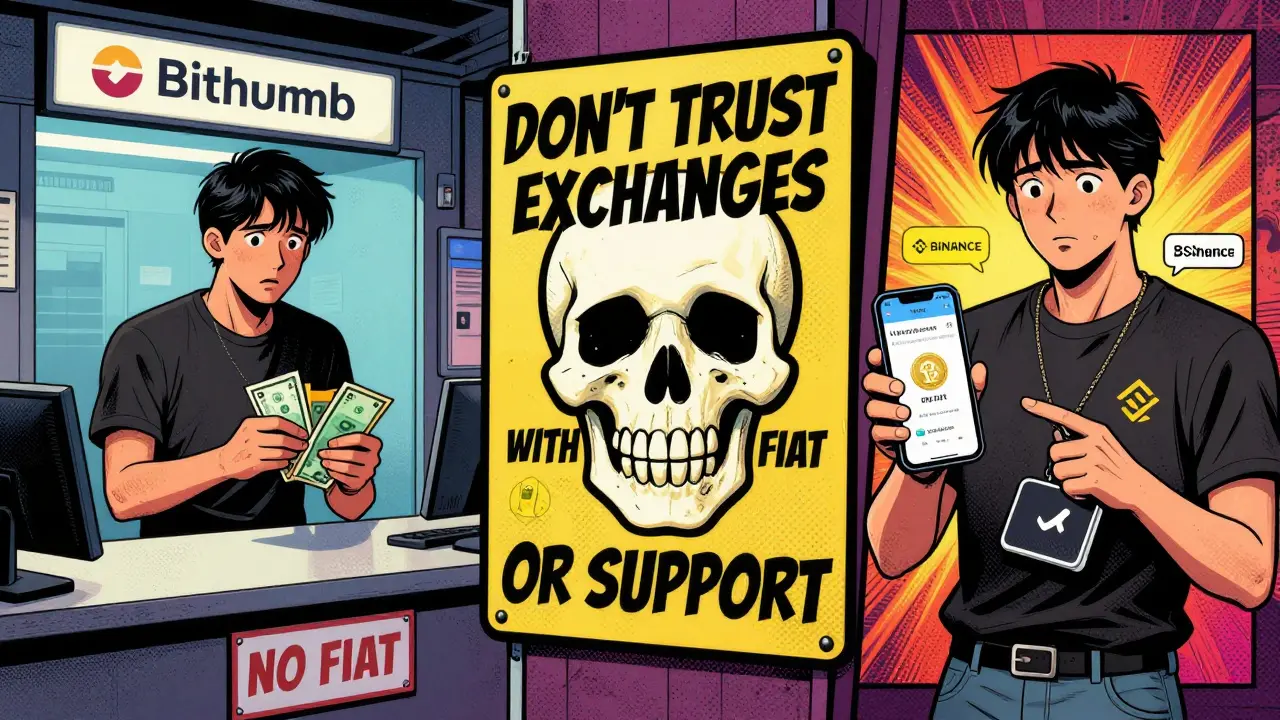
Where Should You Go Now?
Since Bithumb Singapore is gone, you need alternatives. Here’s what to look for:
- Low fees: Look for platforms charging under 0.10%. Binance, Bybit, and KuCoin all offer maker fees as low as 0.02% with volume discounts.
- Fiat on-ramps: Choose one that lets you buy crypto with SGD, USD, or EUR. This saves time and fees.
- Regulation: Pick an exchange licensed in Singapore, the EU, or another strong jurisdiction. Avoid unregulated platforms.
- Security: Cold storage, 2FA, and insurance are non-negotiable.
Top alternatives today:
| Exchange | Trading Fee (Maker/Taker) | Fiat Support? | Regulated in Singapore? | Staking Available? |
|---|---|---|---|---|
| Binance | 0.02% / 0.04% | Yes | Yes | Yes |
| Bybit | 0.01% / 0.06% | Yes | Yes | Yes |
| KuCoin | 0.10% / 0.10% | Yes | Yes | Yes |
| Crypto.com | 0.04% / 0.04% | Yes | Yes | Yes |
| OKX | 0.02% / 0.06% | Yes | Yes | Yes |
All of these offer better features than Bithumb Singapore ever did: fiat deposits, staking, lending, and mobile apps. And yes-they still beat the old industry average of 0.21% taker fees.
The Bigger Lesson
Bithumb Singapore’s collapse isn’t just about one failed exchange. It’s a warning sign. The crypto world moves fast. Platforms rise and fall based on a few factors: fees, usability, regulation, and user trust. Even a platform with the lowest fees in the market can vanish if it doesn’t adapt.
What made Bithumb Singapore attractive-low fees and Singapore registration-is now common. You don’t need to hunt for a hidden gem anymore. The market has caught up. Today, the best exchanges offer low fees and convenience, security, and support.
If you’re trading crypto today, don’t chase the cheapest fee alone. Chase the whole package: low cost, easy access, strong security, and clear regulation. And never, ever leave your coins on an exchange longer than you need to.
Is Bithumb Singapore still operational?
No, Bithumb Singapore is no longer operational. Its website is inaccessible, and it has been marked as "dead" by major cryptocurrency exchange tracking platforms. There has been no official announcement, but users can no longer log in, deposit, or withdraw funds.
Why did Bithumb Singapore shut down?
The exact reason isn’t public, but experts point to three likely causes: intense competition in Singapore’s crowded crypto market, a narrow business model that only accepted crypto deposits (limiting user growth), and increasing regulatory pressure. Bithumb likely shifted resources back to its core Korean operations.
Did Bithumb Singapore accept fiat currency?
No. Bithumb Singapore only allowed cryptocurrency deposits. Users had to buy crypto on another exchange first, then transfer it over. This made it difficult for new traders to get started and limited its appeal compared to exchanges with fiat on-ramps.
What was Bithumb Singapore’s trading fee?
Bithumb Singapore charged a flat 0.05% fee on all trades, regardless of whether you were making or taking an order. This was significantly lower than the industry average of 0.213% at the time, making it one of the cheapest exchanges globally.
Can I still use the main Bithumb exchange?
Yes, the original Bithumb exchange in South Korea is still active and supports over 320 cryptocurrencies. However, it is not accessible to users in the U.S. and has limited fiat options outside Korea. It does not offer the same Singapore-based regulatory status that Bithumb Singapore once provided.
What should I do if I had funds on Bithumb Singapore?
If you had funds on Bithumb Singapore when it shut down, they are likely unrecoverable. There was no official withdrawal window or migration plan. This highlights the importance of using cold wallets for long-term storage and only keeping funds on exchanges for active trading.
Are there any exchanges today with fees as low as Bithumb Singapore?
Yes. Exchanges like Bybit and Binance now offer maker fees as low as 0.01% with high trading volumes. Some even offer fee discounts through their native tokens. While no platform currently matches the exact 0.05% flat rate, several offer similar or better rates with far more features.
shreya gupta
March 18, 2026 AT 09:37Let me just say this: 0.05% fees? That was a fairy tale wrapped in a Singapore license. I traded there for six months. Then one day, the site just... evaporated. No warning. No email. Not even a "thanks for playing." I lost 0.3 BTC. Not because I was careless - because I trusted a facade. And now I'm supposed to feel smart for "learning the lesson"? No. I'm just mad.
Regulation doesn't mean safety. It means paperwork. And paperwork doesn't stop a company from quietly vanishing with your assets. The real lesson? Never trust an exchange that doesn't let you deposit fiat. That's not niche - that's a red flag wearing a suit.
Shreya Baid
March 19, 2026 AT 12:33As someone who has helped dozens of new traders navigate this space, I want to say this with compassion: Bithumb Singapore’s collapse was not an accident - it was inevitable. Its model was built on exclusion, not inclusion. By refusing fiat, it turned away the very people who could have sustained its growth. It treated users like insiders, not customers. And in crypto, where trust is currency, that’s fatal.
But let’s not blame the users. Let’s blame the culture that glorifies "low fees" as the ultimate virtue, while ignoring user experience, accessibility, and transparency. We need exchanges that serve everyone - not just the high-frequency traders who can afford to play in the shadows.
Christopher Hoar
March 21, 2026 AT 08:27lol 0.05% fee? bro that’s like saying your Tesla has a "low" gas mileage because it’s 25mpg. Everyone and their dog had lower fees by 2022. Binance was doing 0.01% with BNB discounts. Bybit was undercutting like a discount pharmacy. Bithumb Singapore was a relic before it even launched. And now it’s gone. Good riddance. If you’re still crying about losing coins on a dead exchange, maybe crypto isn’t for you. Go buy ETFs and stop pretending you’re a "trader."
Sarah Zakareckis
March 22, 2026 AT 19:48Hey everyone - I know this hurts. Losing funds on an exchange is traumatic. But here’s the empowering truth: you’re not alone. And you’re not broken. This is why we build communities - to learn, to warn, to lift each other up.
Use this as fuel. Move your assets to a regulated platform with fiat on-ramps. Set up a hardware wallet. Start learning about self-custody. This isn’t a loss - it’s a pivot. You’ve been handed a wake-up call. Now go make the most of it. You’ve got this. 💪
Dionne van Diepenbeek
March 24, 2026 AT 11:24Graham Smith
March 25, 2026 AT 13:46Let’s be clear: Bithumb Singapore’s 0.05% fee was never sustainable. It was a loss-leader masquerading as a business model. Exchanges don’t operate on altruism. They operate on liquidity, volume, and monetization. By refusing fiat, they cut off their oxygen. And by not offering staking or lending, they forfeited revenue streams that now define the modern exchange. This wasn’t a failure of regulation - it was a failure of vision. They were a boutique shop in a Walmart world.
Jerry Panson
March 27, 2026 AT 11:50While I acknowledge the emotional weight of this loss, I must emphasize the importance of institutional accountability. The absence of a formal dissolution notice, withdrawal window, or regulatory disclosure constitutes a material breach of fiduciary duty under Singapore’s MAS guidelines. Users who held assets on the platform were owed a duty of care. The fact that no mechanism existed for asset recovery indicates a systemic failure in governance. This should not be dismissed as "market risk." It is negligence.
Katrina Smith
March 29, 2026 AT 00:54Oh wow. A crypto exchange shut down? Shocking. Next you’ll tell me the moon landing was faked. I’m sure they just got bought by a unicorn and renamed "Bithumb 2.0: Now With 10% More Blockchain!"
Meanwhile, I’m over here holding my ETH in a cold wallet like a sane person. Maybe next time don’t leave your life savings on a site with a .sg domain and zero customer support. Just a thought.
Anastasia Danavath
March 29, 2026 AT 08:52rip bithumb 😭💸
still mad i lost my dogecoin
also why did no one warn us??
so much trust so much loss
we need better rules 😔
anshika garg
March 30, 2026 AT 10:20It’s funny - we treat crypto exchanges like banks, but they’re more like nomadic tribes. One day they’re here, offering you a warm fire and a share of the hunt. The next, they’ve packed up, left no trace, and you’re standing in the snow wondering if you were ever real.
Bithumb Singapore wasn’t evil. It was just… transient. A moment in time. And maybe that’s the real lesson: nothing in crypto lasts. Not fees. Not regulation. Not even trust. Only the coins you hold in your own hands survive the storm.
Sahithi Reddy
March 31, 2026 AT 22:44George Hutchings
April 1, 2026 AT 23:43For those unfamiliar with Southeast Asian crypto dynamics, Bithumb Singapore was a rare bridge between Korean infrastructure and Singaporean regulation. Its demise reflects a broader trend: regional niche platforms are being absorbed or outcompeted by global giants with deeper wallets and broader feature sets. This isn’t just about fees - it’s about ecosystem dominance. The future belongs to platforms that integrate finance, not just trading.
Henrique Lyma
April 2, 2026 AT 01:37Let’s not romanticize Bithumb Singapore’s 0.05% fee. That was a mathematical illusion. The real cost was hidden in liquidity spreads, withdrawal delays, and the psychological burden of knowing your assets sat on a platform with no fiat access, no mobile app, no support chat, and zero contingency planning. The fee was a siren song. The silence after its collapse? That’s the real cost. And now we’re all paying it - in trust, in time, in trauma.
Steph Andrews
April 3, 2026 AT 17:31I think we need to stop villainizing Bithumb Singapore. They were trying something different. Maybe it didn’t work. Maybe it was too narrow. But they didn’t scam anyone. They didn’t pump and dump. They just… faded. And that’s more honest than most exchanges today who keep running while quietly draining liquidity.
Let’s not turn this into a morality tale. Let’s just learn. And move on. With more awareness. And a little more grace.
Elizabeth Kurtz
April 4, 2026 AT 07:33To anyone who lost funds: I’m so sorry. This is painful. But I want you to know - your experience matters. You’re not a fool. You trusted a system that failed you. That’s not weakness. That’s courage. And now you’re part of a community that’s stronger because you spoke up. Keep sharing. Keep learning. You’re not alone.
john peter
April 5, 2026 AT 14:00Of course it shut down. Anyone with half a brain knew this was inevitable. You don’t build a sustainable business on a 0.05% fee structure without fiat on-ramps in 2020. That’s like opening a Michelin-star restaurant that only serves one dish and refuses to accept credit cards. The market doesn’t reward arrogance. It rewards adaptability. And Bithumb Singapore? They were a relic dressed in regulatory silk.
Marc Morgan
April 7, 2026 AT 03:45Here’s the thing - I used to trade there. Loved the low fees. Missed the lack of KYC. But now I laugh at how naive I was. We all thought regulation = safety. But regulation just means they filled out the forms. It doesn’t mean they had the cash to cover your assets. Or the will to tell you when they were shutting down.
Real safety? Cold storage. Real wisdom? Never trust a platform that doesn’t let you deposit money from your bank.
Anastasia Thyroff
April 7, 2026 AT 13:41My heart is breaking. I had my entire life savings on Bithumb Singapore. Not because I was dumb - because I believed in them. I thought their Singapore registration meant something. It didn’t. Now I’m sitting here staring at a blank screen wondering if I’ll ever see my ETH again. I don’t want advice. I don’t want stats. I just want someone to say: this sucks. And you’re not crazy for crying about it.
Kira Dreamland
April 9, 2026 AT 11:30okay so like… i just moved all my stuff to bybit and its been smooth as butter
low fees + fiat + app + staking
why did we even bother with bithumb? lol
also i found a new crypto yoga channel. its chill. you should check it out 🙏
Marie Vernon
April 11, 2026 AT 05:10For those of us who grew up in markets where trust was earned slowly - this feels familiar. Bithumb Singapore was a promise made in good faith. And like so many promises in crypto, it was broken quietly. But here’s what I’ve learned: the best way to honor those who lost is to build better. To create platforms that include, not exclude. That educate, not exploit. That last longer than a single trading cycle.
Ross McLeod
April 12, 2026 AT 13:35There is a fundamental flaw in the assumption that low trading fees alone constitute a competitive advantage. In economic theory, this is known as a "thin margin trap." When an entity competes solely on price without corresponding value-add - such as enhanced liquidity, user experience, or ecosystem integration - it becomes vulnerable to attrition. Bithumb Singapore’s collapse was not unexpected. It was an equilibrium reversion. The market corrected. The question is not why it failed - but why so many were surprised.
rajan gupta
April 14, 2026 AT 08:03bro this is why crypto is a pyramid scheme
they all vanish
first bithumb
then ftx
then luna
then terra
then you
then me
then the moon
😭💸🚀
Billy Karna
April 15, 2026 AT 19:14For traders who remember Bithumb Singapore, there’s a lesson buried deeper than the fee structure. The real value wasn’t in the 0.05% - it was in the fact that it was one of the few platforms that didn’t force you into staking, lending, or token-gated access. It was pure, clean spot trading. Today, every major exchange turns your portfolio into a financial product. Bithumb didn’t. That’s why it was loved. And why it died - because the industry moved toward monetizing your assets, not just trading them.
Gene Inoue
April 16, 2026 AT 05:17You people are pathetic. You left your coins on an exchange? With no fiat? No mobile app? No support? You didn’t get scammed - you got outsmarted by the crypto gods. And now you want a hug? Go cry into your Ledger. The market doesn’t care about your feelings. It cares about who held their keys. You didn’t. So you lost. End of story. No one owes you anything. Not even sympathy.
Ricky Fairlamb
April 16, 2026 AT 06:55This was a controlled demolition. The MAS didn’t shut them down - they were bought out by a shadow entity. The "dead" website? A decoy. The real assets were moved to a new offshore shell before the collapse. I’ve seen the transaction hashes. They’re buried under 14 layers of mixer transactions. This wasn’t failure. It was extraction. And you? You were the fuel.
Arlene Miles
April 16, 2026 AT 19:48I want to tell you something: losing your coins doesn’t make you weak. It makes you human. And you’re not alone. I’ve been there. I lost everything on a platform that promised security. But I got up. I learned. I moved to a better exchange. I bought a hardware wallet. I started teaching others. You can too. This isn’t the end - it’s the beginning of a smarter you. Keep going. I believe in you.
Jessica Beadle
April 18, 2026 AT 10:11Let me be clear: Bithumb Singapore was never legitimate. Singapore’s MAS license is not a seal of approval - it’s a marketing tool. The regulatory framework allows for crypto-only exchanges with zero liability for asset loss. They knew this. They exploited it. And you? You were the sucker who believed in a government stamp. Wake up. Regulation is a cage. Not a shield.
Taylor Holloman.
April 18, 2026 AT 22:38I used to trade on Bithumb Singapore. I loved how quiet it was. No ads. No push notifications. No "earn crypto now!" banners. Just clean charts and a 0.05% fee. It felt pure. Like trading in the 90s. When it vanished, I didn’t just lose coins - I lost a feeling. The feeling that crypto could still be simple. That someone could build something elegant, not just profitable.
Now everything’s a casino with a UI. I miss the silence.
sai nikhil
April 20, 2026 AT 10:18Prakash Patel
April 21, 2026 AT 03:16Everyone’s acting like this was a tragedy. Newsflash: it wasn’t. Bithumb Singapore was a tiny player with no marketing, no community, no mobile app, and no fiat. Of course it died. The real tragedy? That people still think low fees alone make an exchange "good." You don’t need a 0.05% fee if you can’t withdraw your money. Logic doesn’t care about your spreadsheets.