
If you're looking for a place to trade digital assets and you live in Thailand, you've probably come across Bitazza is a Thailand-based cryptocurrency exchange and digital asset management platform launched in 2018. It's built specifically to give Southeast Asian traders a regulated environment to buy and sell coins without the legal headaches that often come with using offshore platforms.
But here is the catch: while it's a powerhouse for Thai residents, it's a completely different story for anyone else. The platform is heavily optimized for the Thai Baht (THB) and local regulations, which makes it a dream for some and a nightmare for others. If you're wondering whether this is the right home for your portfolio, let's look at the actual numbers and user experiences.
Quick Summary: The Good and The Bad
Before we get into the weeds, here is the reality of using Bitazza crypto exchange review in 2026. It's a specialized tool, not a general-purpose global exchange.
- Best for: Thai citizens who want a Thai SEC regulated platform and easy THB liquidity.
- Worst for: Retail investors outside Thailand or those who want to deposit small amounts of fiat currency.
- Standout Feature: The Bitazza Visa card that lets you spend your crypto in the real world.
- Biggest Red Flag: A massive $30,000 minimum for fiat deposits and withdrawals.
Trading Experience and Asset Variety
When you log in, you'll find a clean interface that doesn't scream "professional trader," which is actually great for beginners. The platform supports over 90 cryptocurrencies. You'll find the heavy hitters like Bitcoin and Ethereum, but they also list things like Solana, Polkadot, and Chainlink.
For most people, 90 coins are plenty. However, if you're a "gem hunter" looking for the latest micro-cap tokens, you'll feel the limitation. Compare this to a giant like Bybit, which offers over 500 assets. Bitazza isn't trying to be everything to everyone; they are focusing on a curated list of assets with stable liquidity, especially in the USDT market where they offer around 190 trading pairs.
The charting tools are basic. If you're used to the deep technical analysis tools in TradingView, you'll find Bitazza's graphs a bit simplistic. It's enough to see the trend, but not enough to run a complex scalp-trading strategy.
The Cost of Trading: Fees and Tokens
Bitazza uses a standard maker-taker model. If you're providing liquidity (making the market), you pay 0.15%. If you're taking liquidity (hitting the buy/sell button immediately), you pay 0.25%. These are competitive, though not the absolute cheapest in the industry.
If you want to slash those costs, you can look into the FDM token, which is the platform's native utility asset. Holding FDM can give you fee discounts of up to 70%. This is a common tactic in the crypto world, and it effectively rewards loyal users for keeping their assets on the platform.
| Feature | Value / Cost | Note |
|---|---|---|
| Maker Fee | 0.15% | Standard rate |
| Taker Fee | 0.25% | Standard rate |
| FDM Token Discount | Up to 70% | Based on holdings |
| Min. Crypto Deposit | 0.001 BTC / $10 | Very accessible |
| Min. Fiat Transaction | $30,000 | Major barrier for retail |

Security and the Regulatory Maze
The biggest selling point for Bitazza is its legitimacy within Thailand. Being regulated by the Securities and Exchange Commission of Thailand gives users a level of comfort that unregulated offshore exchanges can't match. They use a tiered KYC (Know Your Customer) system to keep things secure. Depending on how much documentation you provide, your daily withdrawal limits range from $90,000 (Level 1) all the way to unlimited (Level 3).
Technically, they do the right things: cold storage for the majority of funds, mandatory two-factor authentication (2FA), and third-party custodians. However, if you're in the UK or Singapore, keep in mind that they don't have Tier-1 oversight from the FCA or MAS. They are a local champion, not a global titan.
There's a bit of a conflict in the data here. While most sources confirm their Thai SEC status, some international reviewers have claimed they aren't regulated. This usually happens because these reviewers are looking for global licenses rather than regional ones. In Thailand, they are a top-three player; globally, they are a niche provider.
Real-World User Experience: The Good and the Glitchy
Reading user reviews is where the picture gets blurry. On the Google Play Store, they hold a decent 3.9-star rating, but Trustpilot is much harsher at around 2.9 stars. Why the gap? Usually, it comes down to technical friction.
Thai users rave about the fast bank transfers. Since the platform is built for the Thai ecosystem, moving THB in and out is seamless-provided you aren't hitting that $30,000 limit for certain fiat services. The local customer support is also a huge plus, as they can actually speak your language and understand local banking quirks.
On the flip side, the mobile app has a reputation for crashing during the KYC process. Imagine trying to take a photo of your ID, only for the app to close right as you click the shutter. It's a frustrating experience that has led to some very angry reviews. Additionally, during periods of extreme market volatility, some users on Reddit reported that withdrawals took over 72 hours, which is an eternity when the market is crashing.
Is the Bitazza Visa Card Worth It?
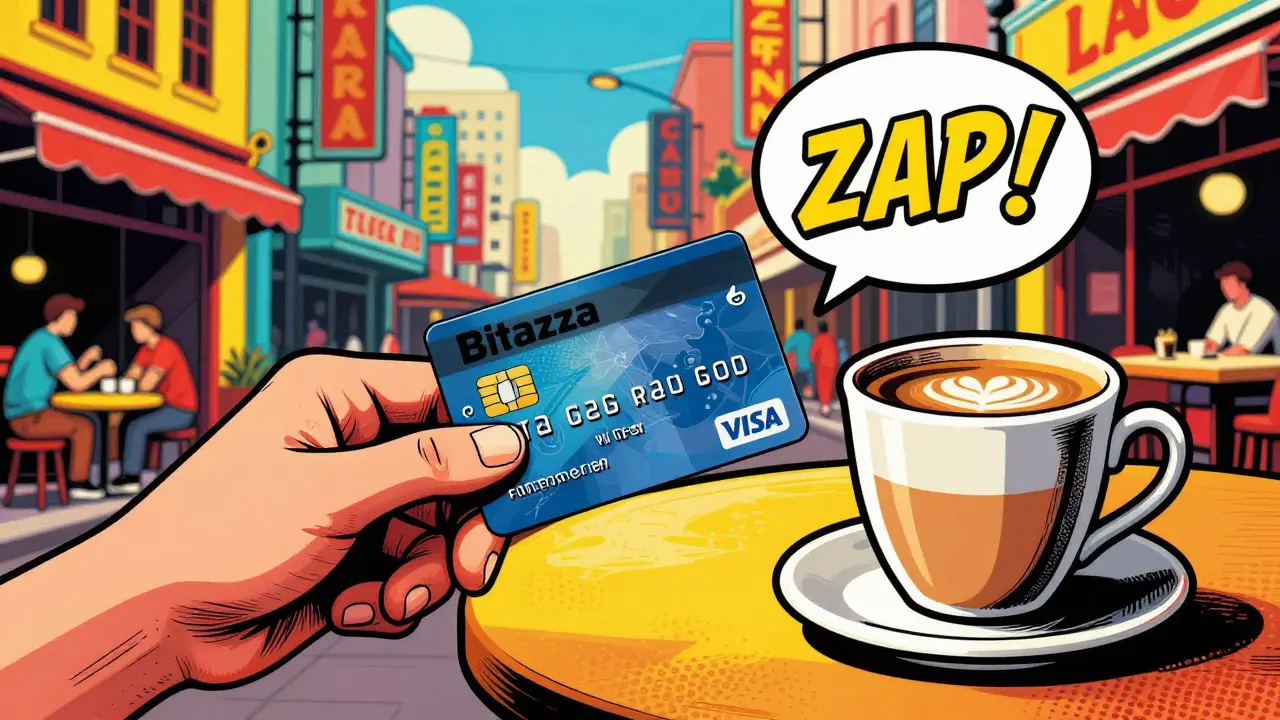
One of the most exciting additions is the Bitazza Visa card launched in late 2024. This bridges the gap between your digital wallet and your morning coffee. Instead of selling your crypto for fiat, transferring it to a bank, and then spending it, you can spend your crypto directly. This is a massive win for those who believe in the long-term value of their assets but still need to pay for real-world expenses.
It effectively turns Bitazza from just a trading desk into a financial hub. If you live in a region where the card is supported, it's the most practical way to actually "use" your cryptocurrency rather than just staring at a chart all day.
Who Should Actually Use Bitazza?
Let's be honest: if you are a retail trader in the US or Europe with $500 to invest, Bitazza is not for you. The $30,000 fiat minimum is a wall that most regular people can't climb. You'd be much better off with a global exchange like Binance or Coinbase.
However, if you are a Thai resident or a business operating in Southeast Asia, the trade-offs are worth it. You get:
- Legal peace of mind via the Thai SEC.
- Deep liquidity for THB pairs.
- A way to spend crypto via the Visa card.
The platform is moving toward tokenizing real-world assets and improving its OTC (Over-the-Counter) services for big players. This means they are doubling down on the institutional and high-net-worth market rather than trying to fight for every single retail user on the planet.
Is Bitazza safe to use?
Within Thailand, it is considered very safe because it is regulated by the Thai SEC. They use cold storage and 2FA to protect funds. However, it lacks global Tier-1 licenses (like the UK's FCA), so international users should be aware that they don't have the same level of protection as they would on a globally licensed exchange.
What are the Bitazza trading fees?
The standard fees are 0.15% for makers and 0.25% for takers. If you hold the native FDM token, you can get a discount on these fees of up to 70%, making it significantly cheaper for active traders.
Can I deposit small amounts of fiat money?
This is one of the platform's main drawbacks. While crypto deposits start as low as $10, fiat deposits and withdrawals are generally restricted to transactions of $30,000 or higher, making it difficult for small retail investors to move traditional money onto the platform.
How many cryptocurrencies does Bitazza support?
Bitazza supports over 90 cryptocurrencies, including major assets like Bitcoin, Ethereum, Solana, and Polkadot, with roughly 190 trading pairs available in the USDT market.
How does the KYC process work on Bitazza?
Bitazza uses a tiered KYC system. You provide personal identification and documents; once verified (usually within 24-48 hours), you are assigned a level. Level 1 allows $90,000 daily withdrawals, Level 2 allows $900,000, and Level 3 offers unlimited withdrawals.
vijendra pal
April 8, 2026 AT 08:44Wow $30k min deposit is just insane lol 😱 how is any normal person gonna use this?? Totally a whale playground 🐳
Emma Pease-Byron
April 9, 2026 AT 01:00The sheer audacity of a platform to brag about a "curated list" when they simply lack the infrastructure to support a broader asset range is truly quaint.
Sonya Bowen
April 9, 2026 AT 19:13Regional regulation is a double-edged sword. Local safety is great, but global liquidity often wins.
Susan Wright
April 10, 2026 AT 19:58If you're actually in Thailand, the THB pairs are a lifesaver. Way better than dealing with P2P nonsense on other apps.
Earnest Mudzengi
April 11, 2026 AT 06:17Cold storage? Yeah right. Every single one of these centralized hubs is just a honeypot for the globalists to track your every move. Once you hit that KYC level 3 you've basically handed over your soul to the system. The $30k limit isn't a "barrier," it's a filter to ensure they only get the high-value targets for their data harvesting algorithms. Don't trust the SEC of any country, they're all puppets for the same shadow cabal running the fiat collapse.
Matthew Wright
April 12, 2026 AT 14:38The Visa card sounds like a great bridge... but I wonder about the spread on those instant conversions???
Krystal Moore
April 13, 2026 AT 18:20Imagine the drama of the app crashing during KYC! I can already feel the stress and the rage. Absolute nightmare fuel!
Deepak Prusty
April 14, 2026 AT 07:46The maker-taker model is basic industry standard. Nothing revolutionary here.
Carmelita Gonzales
April 15, 2026 AT 02:14sounds like a good choice for local people just keep your boundaries in mind with the kyc
shubhu patel
April 16, 2026 AT 14:29I think it is quite interesting how they focus so heavily on the institutional side of things these days and while I agree it might be alienating for the average person who just wants to invest a few dollars it actually makes a lot of sense for the stability of the platform in the long run since high net worth individuals bring more consistent volume to the order books.
Siddharth Bhandari
April 17, 2026 AT 05:09For those wondering about FDM tokens, they basically act as a loyalty rebate. Standard utility tokenomics.
June Coleman
April 18, 2026 AT 18:39Oh honey, $30k minimum for retail? That is just so incredibly "inclusive" of them. I'm sure the average Joe is thrilled to be excluded!
Arwyn Keast
April 20, 2026 AT 13:18Typical provincial rubbish. Why would anyone use a regional boutique when the global giants offer actual depth and professional-grade tooling? This is just an inefficient relic of local regulatory capture.
Manisha Sharma
April 22, 2026 AT 03:18Such a tiny platform’s tryin to act big 🙄 India’s exchanges would eat this for breakfast lol. Absolute joke of a limit.
Nicholas Whooley
April 23, 2026 AT 03:22It is heartening to see platforms focusing on legal compliance within their own borders. This creates a very sustainable path for new investors.
alex rodea
April 23, 2026 AT 23:56Keep it simple. Just use it if you live there.
Sharhonda Walker
April 24, 2026 AT 02:50I tried signin up and the app totaly glitched on the ID upload part... such a pain in the butt!!
Erica Mahmood
April 24, 2026 AT 07:47low latency thb pairs are the only reason to stay if you're in bkk. otherwise just use a global ddex and avoid the kyc friction
Adriana Gurau
April 24, 2026 AT 22:10The UI looks like it was designed by someone who's never actually traded in their life 🙄. So basic. 💅
Evan Borisoff
April 26, 2026 AT 18:25The systemic failure of these regional exchanges to integrate high-frequency trading (HFT) APIs while simultaneously implementing draconian fiat thresholds demonstrates a complete lack of understanding of modern market microstructure and liquidity provision which only serves to stifle the growth of the sovereign digital asset ecosystem in the face of global hegemony.
akash temgire
April 28, 2026 AT 03:50The fiat limit is unacceptable.
Carol Prates
April 28, 2026 AT 21:05Omg I love how they just randomly decide who can deposit money lol! It's like an exclusive club but for people who are actually rich and not just pretending to be 💖