Finding a reliable place to trade digital assets when you're based in Russia feels like navigating a minefield. Between shifting sanctions and a regulatory landscape that seems to change every other week, the options for Russian citizens have shrunk significantly. If you're tired of seeing "Service unavailable in your region" messages, you're not alone. While the door isn't completely shut, the path to getting your money into the market is now much narrower.
The reality is that most major global platforms have tightened their KYC (Know Your Customer) rules. However, a handful of exchanges still provide a lifeline for those looking to trade with Russian Rubles. Whether you are a retail trader looking for the next memecoin or a business owner trying to settle cross-border payments, knowing which platforms still play ball is essential for your financial survival.
Quick Summary: Top Choices for 2026
If you need a fast answer, here are the most reliable platforms currently accepting Russian users and RUB deposits:
- Bybit: The gold standard for RU users with full language support and low fees.
- Gate.io: Best for those who want the widest variety of small-cap tokens.
- KuCoin: A strong choice for altcoin and memecoin enthusiasts.
- MEXC: Known for aggressive staking rewards that can sometimes hit triple digits.
- Bitget: The go-to for copy trading.
- Phemex: Specialized for those focused on derivatives and futures.
Deep Dive into the Best RUB-Friendly Exchanges
Not all "accessible" exchanges are created equal. Some just let you open an account, while others actually let you move money in and out using local tools. Bybit is currently the most comprehensive platform for Russian investors. Why? Because they've integrated the tools people actually use. You can deposit RUB via Sberbank, Tinkoff, and standard card transfers without jumping through a dozen hoops. Their spot trading fees sit at a lean 0.1%, and they offer a massive library of over 2,000 cryptocurrencies.
If you're more of a "treasure hunter" looking for the next 100x gem, Gate.io is your best bet. They boast a catalog of over 3,600 cryptocurrencies, which is nearly double what most other RU-friendly platforms offer. On the other end of the spectrum, if you're into high-yield passive income, MEXC has been spotted offering staking rewards exceeding 600% APY on specific assets, though you should always remember that higher yields usually come with higher risks.
| Exchange | Key Strength | RUB Deposit Methods | Asset Variety |
|---|---|---|---|
| Bybit | User Experience & Fees | Sberbank, Tinkoff, Cards | High (2,000+) |
| Gate.io | Asset Selection | P2P / Third-party | Very High (3,600+) |
| KuCoin | Altcoin Focus | P2P | High |
| MEXC | Staking Rewards | P2P | High |
The "Qualified Investor" Barrier: Understanding the ELR
You might have heard about the Experimental Legal Regime (ELR) launched by the Central Bank of Russia. In plain English: the government wants to control who plays the game. If you want to trade on state-authorized markets, you can't just be a guy with a laptop; you have to be a "highly qualified investor."
To get this status, you currently need to prove you have over 100 million rubles (roughly $1.2 million) in securities or a previous year's income exceeding 50 million rubles. For 99% of people, this is an impossible bar. The good news? The Ministry of Finance (Minfin) has hinted that these thresholds are too high and are likely to be lowered to encourage more people to adopt crypto. Until then, most retail traders continue to use international exchanges that operate outside this specific state-authorized regime.

The Rise of the A7A5 Stablecoin
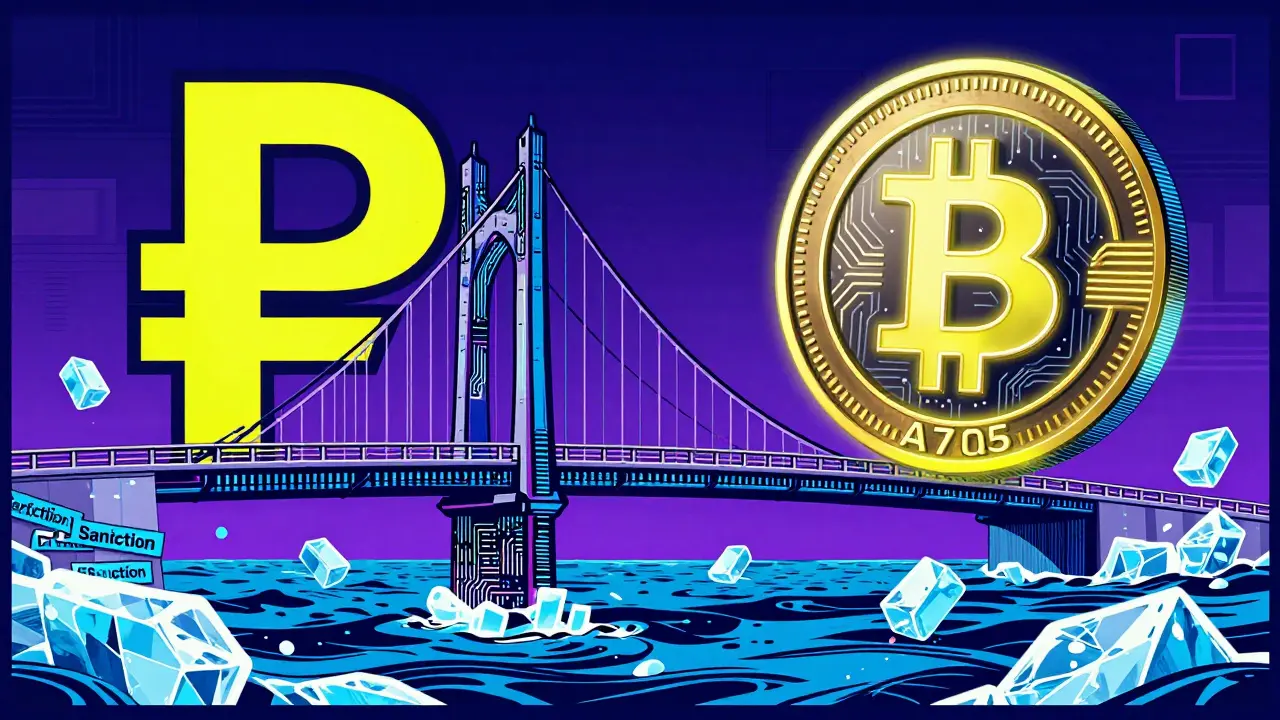
One of the biggest headaches for Russian traders is the risk of USDT (Tether) being frozen by Western authorities. To solve this, a new player emerged: A7A5. This is a ruble-backed stablecoin developed by A7 that acts as a digital bridge for RUB transactions.
A7A5 is backed 1:1 by ruble deposits held in Promsvyazbank (PSB) accounts via a Kyrgyz company called Old Vector LLC. Because it isn't tied to the US dollar, it doesn't carry the same freezing risks from OFAC. Interestingly, data shows that A7A5 is primarily used by businesses during the work week (Monday to Friday), meaning it's becoming a tool for corporate cross-border payments rather than just retail gambling. With over $496 million in circulation, it's a serious alternative for those who can't trust dollar-pegged assets.
The Shadow Market: Sanctioned Successors
When a big exchange gets hit by sanctions, it doesn't usually disappear; it just changes its name or moves its headquarters. Take Garantex, for example. After the US Secret Service forced it offline in early 2025, it was essentially succeeded by Grinex, which operates out of Kyrgyzstan. This pattern of shifting to Central Asian jurisdictions is a common survival tactic.
Then there is Bitpapa, a P2P platform that has faced OFAC sanctions but continues to facilitate millions in payments. While these platforms offer a way around restrictions, they are high-risk. Trading on a sanctioned exchange is like walking on thin ice-you might get across, but you could also find your funds locked or your account flagged by international compliance tools like Elliptic.
Common Pitfalls and How to Avoid Them
Trading in a restricted environment requires a different strategy than trading in the US or EU. Here are a few rules of thumb to keep your assets safe:
- Avoid direct bank transfers to sanctioned entities: Your bank may block the transaction or, worse, freeze your entire account for "suspicious activity."
- Use P2P markets carefully: Peer-to-peer trading is the backbone of the Russian crypto economy, but it's rife with scammers. Always use the exchange's built-in escrow service.
- Diversify your stablecoins: Don't keep all your reserves in USDT. Consider A7A5 or other assets that are less susceptible to Western freezes.
- Keep records: Even though the rules are murky, you are still required to declare crypto holdings. Keep a clean ledger of your transactions to avoid issues with tax authorities.
Are Russian citizens banned from owning cryptocurrency?
No, there is no explicit ban on owning or trading cryptocurrency for Russian citizens. However, using cryptocurrency as a means of payment for goods and services is prohibited. You can hold and trade it, but you cannot use it to buy a coffee or pay for a service legally within the country.
What is the safest way to deposit rubles into an exchange?
Currently, platforms like Bybit offer the most streamlined experience by allowing deposits through Sberbank and Tinkoff. For other exchanges, the P2P (Peer-to-Peer) market is the most common method, where you send rubles directly to another user who then releases the crypto to you through the exchange's escrow system.
How does A7A5 differ from USDT?
While USDT is pegged to the US Dollar, A7A5 is pegged to the Russian Ruble. The primary advantage of A7A5 is that it is not subject to freezing by Western authorities (like OFAC), making it a safer harbor for those worried about geopolitical sanctions affecting their digital dollars.
What is a "highly qualified investor" in the context of the ELR?
This is a legal status required to trade on state-authorized crypto markets under the Experimental Legal Regime. To qualify, you need either 100 million rubles in investments or an annual income of at least 50 million rubles. The government is currently considering lowering these limits to increase adoption.
Which exchanges should I avoid?
Avoid platforms that have been fully liquidated or permanently banned by global regulators without a clear successor. Be extremely cautious with exchanges like Suex or Garantex unless you are using their legal successors (like Grinex) and fully understand the risks associated with OFAC sanctions.
Next Steps for Traders
If you're just starting out, your first move should be to open an account on Bybit or KuCoin, as they have the most established infrastructure for RU users. Once you've moved your initial capital into a stablecoin, explore the A7A5 ecosystem if you plan on doing frequent business-related transfers.
For those with higher capital, keep a close eye on the Ministry of Finance's announcements regarding the ELR. If the investment thresholds are lowered, it may become legally safer to move your trading activity into the state-authorized framework, providing a layer of domestic legal protection that international exchanges simply cannot offer.
Alex Long
April 18, 2026 AT 21:01This is just a list of apps that haven't banned them yet. Total waste of time.
Ian Chait
April 20, 2026 AT 12:06Typical globallist propoganda pushing "safe" exchanges. Wake up folks, the whole system is rigged by the WEF to track every single satoshi you move. The A7A5 stablecoin is probably just a honeypot for the central bank to see who's actually trading before they flip the switch and freeze everything. Just use cold wallets and P2P if you aren't a complete sheep. The move to Kyrgyzstan is just a shell game to keep the liquidity flowing while the suits in DC pretend to enforce sanctions. Absolute joke.
Prachi Bhadarge
April 21, 2026 AT 12:34Oh sure, because trusting a company based in Kyrgyzstan is the peak of financial security. Truly a masterclass in risk management.
Robert Preston
April 21, 2026 AT 16:11For anyone actually trying to do this, please realize that the risk isn't just the exchange, but the on-ramp. Banks are getting way more aggressive with their internal flags. If you're using P2P, never use keywords like "crypto" or "BTC" in the transfer comments. Just keep it simple and neutral. It's the fastest way to get your account flagged for a manual review. Stay safe and be careful with your documentation.
Andrew Southgate
April 22, 2026 AT 08:44I've seen a lot of people struggle with this over the years, and I think the most important thing to remember is that the landscape is always shifting. If you're looking at Bybit or KuCoin, you're starting in the right place because they've historically been more lenient with the RU region, but you absolutely must keep your funds in a hardware wallet. Never leave your life savings on any exchange, regardless of whether they allow RUB deposits or not, because a single regulatory change in an overnight update can lock you out of your account instantly. I always tell my friends to only keep what they are actively trading on the platform and move the rest to a seed phrase they control. It takes a bit more time to manage, but the peace of mind is worth every second of the extra effort. Just a little bit of caution goes a long way in this volatile market!
Tracy Sperandio
April 23, 2026 AT 05:15The sheer audacity of these platforms to keep the doors open while the rest of the world is locking them down is just dazzling! It's a wild ride, but if you're going to dive into the crypto abyss, you might as well do it with some flair and precision. Let's get those gains!
Trudy Morse
April 24, 2026 AT 13:13The ELR is basically a club for the rich. Classic.
Evan Iacoboni
April 24, 2026 AT 17:09The A7A5 thing is the only part of this that actually interests me. If it's really being used by corporations for cross-border payments, the volume must be insane. Why would a company risk a ruble-backed coin over just using USDT if the risk is truly the freezing part?
Sean Douglas
April 25, 2026 AT 09:12I am absolutely reeling from the horror of having to prove I have 100 million rubles just to be a "qualified investor." It's a visceral insult to every retail trader out there! My soul is practically weeping for the common man who just wants to trade a few memecoins without being treated like a peasant by the Ministry of Finance. The drama of this regulatory circus is just too much to bear!
Adam Mann
April 25, 2026 AT 09:15It's really heartening to see that there are still ways for people to manage their finances and find opportunities despite the tough situation. I think if we just stay positive and help each other navigate these tools, everyone can find a way to protect their wealth. Bybit seems like a great starting point for anyone who is feeling overwhelmed by the technical side of things because the user interface is pretty friendly. Just take it slow, learn as you go, and don't be afraid to ask the community for help when things get confusing. We're all in this together!
Gaurav Undirwade
April 27, 2026 AT 06:45It is profoundly disappointing that individuals seek to bypass international sanctions through such clandestine means. One must consider the ethical implications of supporting platforms that operate in the shadows of Kyrgyzstan. True financial stability cannot be built upon a foundation of regulatory evasion and moral ambiguity.
Shantal Sanjur
April 27, 2026 AT 14:40Oh, look at the "ethical" guy over here. Please, tell us more about your moral superiority while you probably hold a bunch of coins that were minted by the same people. It's all a scam anyway. They'll just wait until you put enough money in and then "technical issues" will happen. Trust me, the only winners here are the ones who know how to exit before the rug pull.
Vicky Duffala
April 28, 2026 AT 19:49Crypto is such a mirror for our current global struggle, isn't it? 🌀 It's a fascinating intersection of technology and geopolitical will. Just keep pushing forward! ✨
nathan jones
April 30, 2026 AT 05:07Bybit is fine. Works for me.
Nishant Goyal
May 1, 2026 AT 11:05Keep it simple, just use P2P.
Kevin Lư
May 3, 2026 AT 07:09I don't know why people make this so hard. Just find a guy who sells it. Who cares about the "regulations" when you can just swap coins with someone in a chat group?
Chintu Parikh
May 3, 2026 AT 08:19I believe that providing this information is a wonderful service to the community. It is my sincere hope that everyone can transition their assets safely and without undue stress. Let us support one another in these challenging times and strive for a collaborative financial future!
Mike Kempenich
May 3, 2026 AT 12:24I'm optimistic that the thresholds for qualified investors will drop soon. It makes a lot of sense for the government to want more people in the system if they want it to actually grow.
Ankit Sindhu
May 4, 2026 AT 23:40I totally agree with the point about diversifying stablecoins. It's a great way to manage risk for everyone involved. Let's keep sharing these tips!