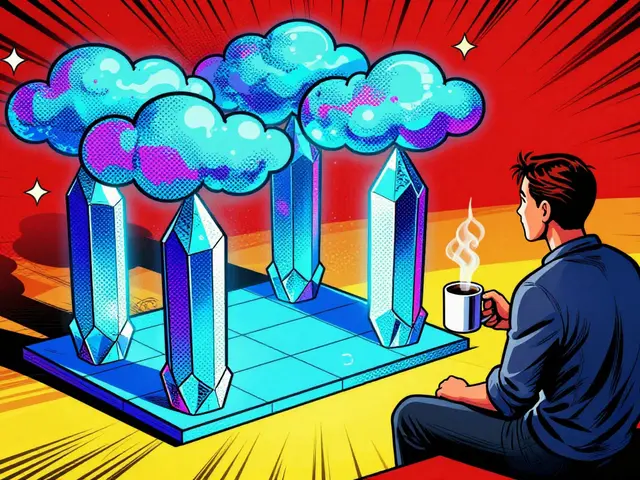
Imagine building your own blockchain in the time it takes to brew a morning coffee. For most developers, this dream requires months of coding and security audits. But UNIT0 is a cryptocurrency designed to simplify this process through a decentralized autonomous organization (DAO). Launched by the Units Network in November 2024, this token isn't just another digital asset; it serves as the key to a specific type of infrastructure known as Layer 0 technology. If you are wondering what actually makes this coin tick beyond the price charts, here is a clear breakdown of its mechanics, utility, and where it stands in the broader crypto landscape.
Understanding the Core Function of UNIT0
At its simplest, UNIT0 acts as a governance token for the Units ecosystem. When you hold these tokens, you aren't just betting on a price pump; you gain membership rights within the DAO. This means holders can vote on how treasury funds are spent. For example, in July 2025, the community successfully voted to allocate rewards via GPT360, an AI platform with over 150,000 users. This direct influence distinguishes UNIT0 from many passive investment tokens where holders have no say in the project's direction.
The token functions as the foundational element of the network's economy. According to technical documentation from CoinCarp, UNIT0 allows participants to secure the network and participate in decision-making regarding treasury allocation. This dual purpose-financial asset plus voting power-is typical of governance models seen in mature DeFi protocols, but applied here specifically to the construction and maintenance of blockchain infrastructure.
How Layer 0 Architecture Differs From Standard Blockchains
To understand why UNIT0 matters, you need to grasp the concept of a Layer 0 protocol. Most people know Layer 1s like Ethereum or Layer 2s like Arbitrum. A Layer 0 solution sits underneath both. Think of it as the internet protocol for blockchains, providing the scalability and connectivity that upper layers need to function efficiently.
The Units Network leverages this architecture to optimize performance for Layer 2 networks. Instead of building everything from scratch, UNIT0 provides the "plumbing" that handles cross-chain interactions and security. One of the most distinctive features documented by Gate.com is the DAO-based blockchain constructor. Unlike traditional solutions that require deep coding knowledge, this platform lets users deploy customized blockchains through a visual interface managed by the DAO. Essentially, it democratizes blockchain creation, allowing non-technical founders to spin up their own chains quickly.
Restaking Mechanics and Security
A critical component of the Units Network infrastructure is its use of restaking mechanisms. In simple terms, restaking allows validators to reuse their staked assets to secure additional networks. With UNIT0, nodes and delegates can stake their tokens not just to secure the original Units Network, but to support other compatible systems. This creates a shared security model that is more cost-effective than launching a new proof-of-stake chain from zero.
This approach aligns with the broader industry trend seen with protocols like EigenLayer, but adapted specifically for the Units ecosystem. The goal is to enhance throughput and reduce the capital needed for security. By locking up tokens, users contribute to the consensus mechanism while earning yield, creating a loop of liquidity and security that supports the network's long-term stability.

Tokenomics and Market Performance
For investors, understanding the supply dynamics is crucial. UNIT0 has a fixed maximum supply capped at 100 million tokens. As of the latest comprehensive data from late 2025, approximately 4.02 million tokens were in circulation. This scarcity plays into the hands of long-term holders if demand increases, but it also means that initial distribution is relatively controlled compared to coins with inflationary models.
Market performance has shown moderate volatility, typical for emerging infrastructure tokens. Reports from October 2025 listed the token trading around $0.32 on various exchanges. While prices fluctuate between platforms due to liquidity depth, the core value proposition remains tied to network usage rather than speculation. Trading volumes have varied significantly, with daily turnover ranging from roughly $48,000 to over $400,000 depending on the exchange. This variation suggests that liquidity is still concentrating on specific venues, which traders need to watch to avoid high slippage when executing large orders.
| Metric | Value |
|---|---|
| Total Supply | 100 Million Tokens |
| Circulating Supply (Late 2025) | ~4.02 Million |
| Market Cap | ~$1.4 Million |
| Volatility (30-Day) | ~15.6% |
Ecosystem Adoption and Real-World Usage
A cryptocurrency's true test is whether things get built on top of it. As of September 2025, the Units Network infrastructure supported 37 active projects. Of these, 12 were generating measurable transaction volume, indicating real economic activity rather than just experimental code. Enterprise adoption remains in early stages, with only a handful of small-to-medium businesses currently implementing the solution.
User feedback highlights the ease of deployment as a primary strength. On community forums like Reddit and Discord, users frequently mention deploying custom chains in under 15 minutes. Comments such as "no coding required" appear regularly, validating the platform's promise of accessibility. However, liquidity constraints remain a pain point, with some traders reporting significant slippage on larger orders. This friction is common for niche tokens until deeper liquidity pools are established across major decentralized exchanges.

Roadmap and Future Development
The development roadmap focuses heavily on integrations that expand the token's utility. Plans for late 2025 included integrating with Ethereum's Layer 2 solutions to bridge the gap between legacy smart contract platforms and the new Units infrastructure. These types of bridges are vital for bringing existing liquidity into the ecosystem.
Long-term viability depends on achieving a critical mass of active projects. Analyses suggest that for the network to thrive past 2028, it needs to grow its ecosystem significantly, potentially reaching 100+ active projects by mid-2026. The team continues to release updates, and strategic partnerships, such as those with AI platforms like GPT360, aim to inject real-world utility into the governance structure.
Potential Risks and Considerations
No investment is without risk, and UNIT0 presents specific challenges typical of early-stage infrastructure. The primary concern is competition from established players like Cosmos or Polkadot, which have vastly larger market caps and established ecosystems. Additionally, the relatively low liquidity means that moving large amounts of capital in or out can impact the market price significantly.
Regulatory scrutiny is another factor to monitor. While currently functioning as a utility token within a permissioned framework, the classification of governance tokens evolves with market regulations. Staying informed on guidance from bodies like the SEC is essential for any holder looking to navigate compliance requirements as they mature.
Conclusion
UNIT0 represents an interesting convergence of DAO governance and modular blockchain technology. By lowering the barrier to entry for blockchain creation, it targets a growing market of developers who want custom infrastructure without the heavy engineering overhead. While the project is still scaling its liquidity and adoption, its unique position as a Layer 0 constructor sets it apart from generic Layer 1 competitors. Whether it becomes a household name depends on the execution of its upcoming integrations and the ability to attract enterprise users who need faster, cheaper blockchains.
Is UNIT0 a Layer 1 or Layer 2 token?
UNIT0 operates as a Layer 0 infrastructure token. Unlike Layer 1 blockchains (like Ethereum) or Layer 2 rollups, Layer 0 protocols provide the foundational environment that enables multiple blockchains to connect and scale, often handling interoperability and security consensus for the layers above it.
How do I buy UNIT0 tokens?
You can acquire UNIT0 primarily through centralized exchanges like Gate.io or decentralized platforms such as Raydium on the Solana network. Be mindful of liquidity depth when trading to avoid excessive slippage costs.
What is the total supply of UNIT0?
The hard cap for UNIT0 is set at 100 million tokens. As of late 2025 data, roughly 4% of this total was circulating, suggesting a deflationary pressure if remaining tokens enter circulation slowly or are burned.
Can UNIT0 be used for governance?
Yes, holding UNIT0 grants you voting rights within the Units Ecosystem DAO. You can participate in decisions regarding treasury spending and protocol upgrades directly.
Does UNIT0 support staking?
UNIT0 utilizes a restaking mechanism. Validators can reuse their tokens to secure the Units Network and other compatible blockchains, earning yields based on the security provided across the ecosystem.
Alex Lo
April 1, 2026 AT 18:58So many people talk about this coin today. They say it is good for blockchain building quickly. I think the technology is actually pretty sound too honestly. You see how they integrate with layer two solutions right now? That part is really impressive to me. Most new projects dont get the basics correct at all times. But here we have something different going on definitely. The DAO structure lets holders vote on things directly. That changes the dynamic completely compared to old models. If you hold the tokens you get actual power. Not just hope the price goes up eventually either. Restaking is another huge feature nobody talks enough about. Validators reuse the capital which saves money for everyone. This creates better security for everyone involved overall. It seems like a sustainable model for the future years ahead. We should all consider holding some for ourselves now.
Callis MacEwan
April 3, 2026 AT 06:40The narrative surrounding this protocol ignores significant interoperability risks inherent in Layer 0 architectures. While the DAO governance model appears robust on paper, the reliance on cross-chain validators introduces unnecessary attack vectors for malicious actors.
Furthermore, the tokenomics described suggest a deflationary pressure that is rarely sustainable during bear markets without artificial intervention.
Ashley Stump
April 4, 2026 AT 04:24This feels like another rug pull waiting to happen.
Matt Bridger
April 5, 2026 AT 12:12The underlying architecture suggests a sophisticated approach yet liquidity remains problematic for institutional entry
Joy Crawford
April 6, 2026 AT 14:00hope it moons soon :-) i am buying more today ;)
Liam Robertson
April 7, 2026 AT 13:16It is fantastic to see infrastructure getting attention like this. We need more tools that simplify deployment for creators. This could change how small businesses utilise blockchain technology.
Jay Starr
April 8, 2026 AT 16:14There is always a hidden cost in these simplified platforms however. Security audits take time and rushing this process is dangerous.
Lisa Walton
April 8, 2026 AT 21:37Another day another new chain promising the moon while burning through treasury funds.
Disha Patil
April 10, 2026 AT 14:07I cant believe everyone is ignoring the potential here why are you guys so negative?
Michael Nadeau
April 11, 2026 AT 14:42The philosophical implication of restaking touches on the nature of trust in distributed systems. We are essentially creating a web of shared responsibility rather than isolated chains. This shift in consensus theory is profound when considered against traditional centralised ledgers. The economic incentives must align perfectly for this to survive long term volatility.
Elizabeth Akers
April 12, 2026 AT 05:30totally vibe with that view. its interesting how much power the dao holds. cool concept for sure
Sean Carr
April 14, 2026 AT 04:23If you plan to stake make sure to read the documentation on lock-up periods carefully. Slippage is high on current exchanges so watch your order size.
Katrina Tate
April 14, 2026 AT 17:42Volatility metrics indicate a high risk environment for retail investors entering at this price point.
Zackary Hogeboom
April 15, 2026 AT 20:02I joined the discord yesterday and the community is super active about upgrades. People are really excited about the GPT360 integration for rewards.
Alex Kuzmenko
April 17, 2026 AT 04:26I thoguht about joinning the network but the gas fees seem hight whitch is weird for a layer 0
Lisa Miller
April 17, 2026 AT 19:22Welcome everyone who is joining the ecosystem! We have so many opportunities coming up for growth. Keep learning about the mechanics and stay positive!
Beverly Menezes
April 18, 2026 AT 13:55We all want the best for the project so lets focus on constructive feedback instead of fear mongering. Unity is what builds strong networks.
Ronald Siggy
April 19, 2026 AT 01:54Stay disciplined with your strategy and do not chase pumps. Long term utility is the only thing that matters for survival.